

HCPCS Code E0272: Foam rubber mattress billing guide
HCPCS Code E0272: official descriptor and code overview HCPCS Code E0272 is the ...

Last Updated: Nov 6, 2026
64905 is the CPT code for nerve pedicle transfer; first stage. It reports the opening operation of a staged nerve reconstruction. A donor nerve segment is joined to the recipient nerve while it stays attached at its origin.
The second operation divides the pedicle and completes the transfer, and it is reported separately with 64907. Both codes carry a 90-day global period, so the second stage usually takes modifier 58.
Let Pabau's smart automation suggest the right codes, reduce claim denials, and keep your practice compliant—effortlessly.
Automate repetitive tasks and focus on what matters most—your patients.
Reduce coding errors and ensure compliance with the latest regulations.
Clean claims, fewer denials, and faster reimbursements.
Powerful insights and reporting to help your practice thrive.
HIPAA compliant SOC 2 certified GDPR-compliant Trusted by 4,000+ clinics worldwide

CPT code 64905 reports nerve pedicle transfer; first stage, the opening operation of a staged nerve reconstruction.
The second operation is a separate code, 64907, and no 64906 or per-strand add-on exists for pedicle transfers.
Both stages carry a 90-day global period, so append modifier 58 to 64907 when the same surgeon stages it inside the 64905 global.
Free nerve grafts belong to 64885-64902 and allografts to 64912, so the operative note decides the code family.
The 2026 total is 26.69 RVUs, about $891 before locality adjustment at the $33.4009 non-QP conversion factor.
CPT code 64905 is “Nerve pedicle transfer; first stage.” The American Medical Association (AMA) places it in the Nervous System surgery section, under neurorrhaphy with nerve graft, vein graft, or conduit (64885-64911).
The descriptor names a stage, not a strand count or a body site. It reports the first of two planned operations. The second operation, which completes the transfer, is reported with 64907, “Nerve pedicle transfer; second stage.”
A pedicle transfer moves a segment of donor nerve to a recipient nerve while one end stays attached. That attachment is the pedicle. It keeps the segment connected while axons regenerate into it.
In the first stage, the surgeon mobilizes the donor segment and joins it to the recipient nerve. Weeks or months later, the surgeon divides the pedicle at its donor origin and completes the transfer. Coding references tie that second operation to evidence of regeneration. Each stage then reports its own code and leaves its own trail in the note.
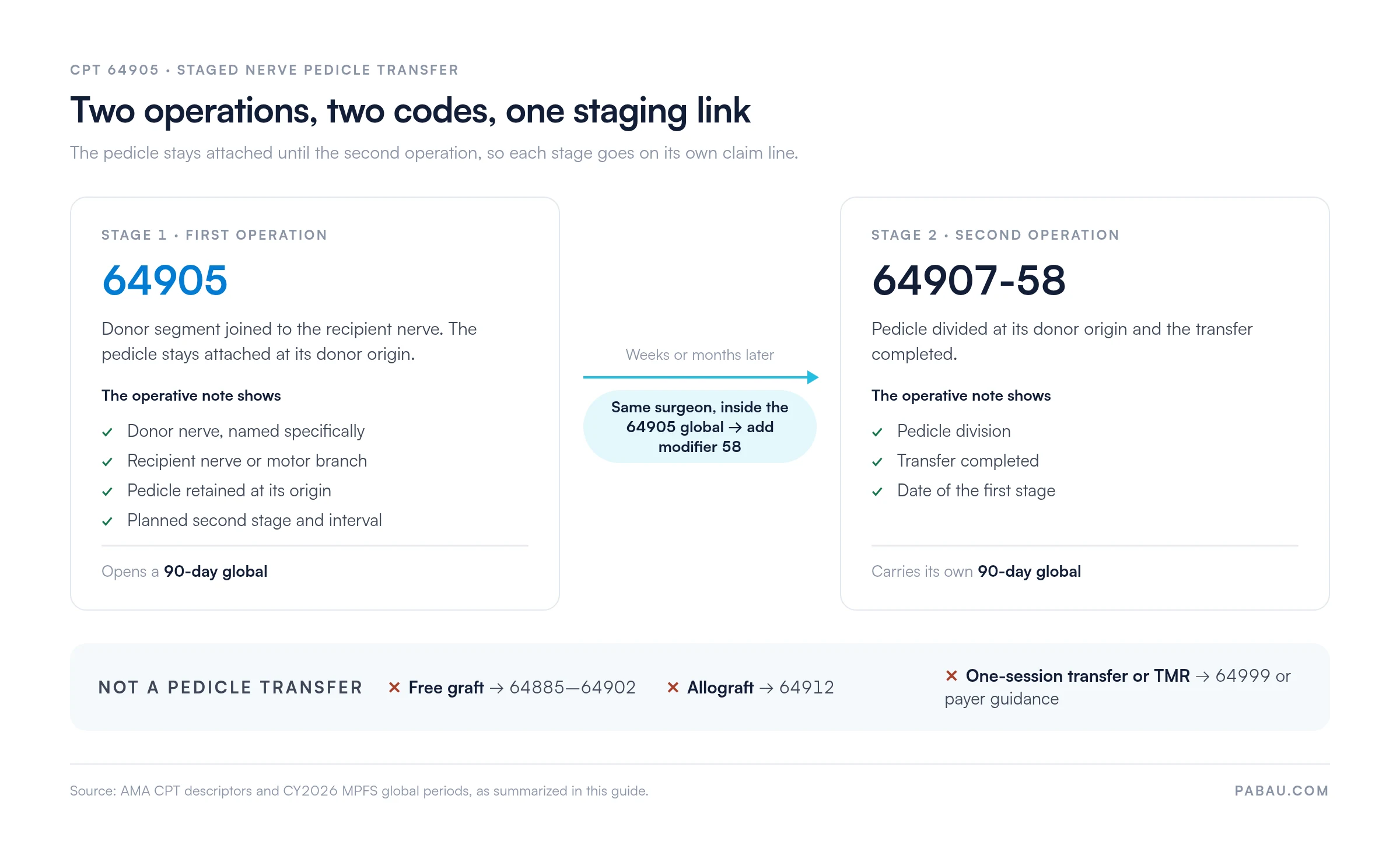
The technique dates back to the pedicled ulnar nerve graft, used to bridge long median nerve gaps. Free grafts, allografts, and single-stage nerve transfers have largely replaced it. That makes 64905 a rare code, and rare codes attract coding errors.
An AAPC Neurosurgery Coding Alert also pairs each stage with add-on +64727 when the surgeon performs microscope-assisted internal neurolysis. Report it only when the operative note describes that neurolysis.
The 64885-64911 range holds several codes that describe repairs on the same nerves. The table shows where 64905 sits against its neighbors. Confirm exact descriptor wording in the current AMA CPT code set. Guides for other surgery codes sit in our CPT procedure code library, in the same layout as this one.
No 64906 exists. If a charge sheet or claim template lists it, remove it. Strand counts belong to the graft codes and their add-ons, not to the pedicle transfer codes. See the CPT code 64912 guide for allograft repairs.
Single-stage nerve transfers are where coding gets contested. Coding forums show payers splitting on transfers such as anterior interosseous to ulnar motor branch. Some accept a listed nerve code, while others want the unlisted code 64999.
An AAPC Neurosurgery Coding Alert notes that not every nerve pedicle transfer is an Oberlin procedure. Its staged example reports 64905 for the first stage and 64907 for the second.
Targeted muscle reinnervation (TMR) follows the same pattern. Surgeons reroute residual nerve ends from an amputation to motor branches of nearby muscles. Practices commonly report TMR with 64999 or with nerve repair and transfer codes, and payer policy varies.
Because 64905 describes the first stage of a planned two-stage operation, it fits a single-session TMR poorly. Before billing TMR, take these steps.
Ask the payer which code it expects for TMR before the case, and keep the answer with the authorization. A pre-agreed code avoids arguing the unlisted-versus-listed choice after a denial.
The operative note has to show a staged pedicle transfer, not a free graft or a one-session transfer. Missing elements give the payer grounds to deny or to ask for a different code.
The 64907 note then records the pedicle division and completion of the transfer. It should cite the first-stage date, so the modifier 58 relationship is obvious to a reviewer.
Modifier choice on this code turns on staging. The table covers the scenarios billers meet most often.
Never report 64905 twice to mean two stages. Each stage has its own code, and the second stage carries modifier 58 when it falls inside the first global.
Medicare pays 64905 under the Medicare Physician Fee Schedule (MPFS) when the procedure is reasonable and necessary. No National Coverage Determination addresses it. Check your Medicare Administrative Contractor (MAC) for any local guidance.
The denial management workflow for 64905 starts before the claim leaves the practice. Eligibility, authorization, and diagnosis-to-procedure match all belong in the pre-submission check.
CY2026 MPFS relative value units (RVUs) for 64905 are shown below, as published by FastRVU from CMS data. Confirm current values in the CMS Physician Fee Schedule lookup tool before quoting them.
*CY2026 has two conversion factors. Qualifying APM participants (QPs) are paid at $33.5675, and everyone else at $33.4009. The indicative figure uses $33.4009, which gives about $891.47 before locality adjustment.
Geographic Practice Cost Indices (GPCIs) then move that figure up or down by locality. Use the CMS lookup tool or the FastRVU lookup tool for a locality rate. The 90-day global means postoperative visits in that window are not billed separately.
Most 64905 problems come from treating it like a graft code, or from losing track of the staged pair. These are the patterns to check for.
Build each item into your clean claim checklist for nerve surgery. A two-stage code pair also needs a tracking note, so the second claim goes out with the right modifier.
A staged procedure spreads one case across two operations, two claims, and a 90-day global. Practices often track that link on paper, so the second stage gets billed without its modifier.
Pabau, the practice management platform we build, keeps the patient record, the operative documentation, and the appointments in one place. Staff can book the second stage from the first-stage record and see both dates side by side.
Pabau’s claims management software works with our Claim.MD clearinghouse integration to submit claims and track their status. Your team still chooses the codes and modifiers, but every claim and its status sit with the patient.

Pabau keeps the patient record, both surgery dates, and every submitted claim in one place. Claims go out through the Claim.MD integration, and your team can track their status from the same record.

CPT code 64905 fits only when the surgeon plans a second operation to divide the pedicle. If the note shows no such plan, look at the graft, allograft, or unlisted codes first.
Treat both stages as one case from the day the first is booked. The second claim then goes out as 64907 with modifier 58, and the payer sees a planned stage instead of bundled aftercare.
Book a demo to see how Pabau keeps both stages of a nerve reconstruction, and their claims, on one patient record.

Choosing a clearinghouse for surgical claims? Claim.MD clearinghouse overview explains how claims move from your practice to the payer.
Want to understand how denial codes explain a rejected nerve surgery claim? Denial codes in medical billing covers CARC and RARC code interpretation for surgical claims.
Looking for a structured revenue cycle workflow for surgical practices? Revenue cycle management overview outlines the end-to-end process from eligibility check to payment posting.
CPT code 64905 reports nerve pedicle transfer; first stage. A donor nerve segment is joined to a recipient nerve while it stays attached at its origin. The second operation, which completes the transfer, is reported with 64907. Both codes carry a 90-day global period.
Append modifier 58 to 64907 when the same surgeon performs the second stage within the 64905 global period. It tells the payer the operation was planned, so it is not bundled into the first global. For bilateral work, check the MPFS bilateral indicator and the payer’s format first.
TMR is commonly reported with the unlisted code 64999 or with nerve repair and transfer codes, and payer policy varies. Because 64905 describes the first stage of a planned two-stage operation, it fits a single-session TMR poorly. Ask the payer which code it expects and get authorization first.
Common causes are billing 64905 for a free graft or one-session transfer, and listing the nonexistent code 64906. Others are billing 64907 inside the global without modifier 58, and a note that never shows the pedicle was retained. Diagnosis codes that do not support the indication also trigger denials.
It depends on the plan. Medicare Advantage and commercial plans often require authorization for nerve reconstruction, especially TMR-related work. Confirm the requirement with the specific plan before scheduling the first stage, and plan the second stage under the same review.
CPT 64905 is the first stage of a pedicle transfer, where the donor segment stays attached until a second operation. CPT 64890 and 64895 are free nerve grafts of the hand or foot, up to 4 cm. 64890 is a single strand and 64895 is multiple strands, and neither is an add-on.




