ICD-10 Code Y76.0: Diagnostic obstetric and gynecological devices
ICD-10 Code Y76.0: Definition and billable status ICD-10 Code Y76.0 is a valid, ...

Last Updated: Oct 23, 2026
Billable Code Specific Code
S70.10XA is the billable ICD-10-CM code for contusion of unspecified thigh, initial encounter. It covers a closed bruise of the thigh during active treatment. Use it only when the note doesn't say which leg was hurt.
The side is the detail that decides these claims. If the note names the right or left thigh, S70.11XA or S70.12XA replaces this code. Coding "unspecified" against a documented side invites a specificity denial or an audit flag. Below, we break down the code's structure, its 7th character, external cause pairing, and a checklist to run before you submit.
Let Pabau's smart automation suggest the right codes, reduce claim denials, and keep your practice compliant—effortlessly.
Automate repetitive tasks and focus on what matters most—your patients.
Reduce coding errors and ensure compliance with the latest regulations.
Clean claims, fewer denials, and faster reimbursements.
Powerful insights and reporting to help your practice thrive.
HIPAA compliant SOC 2 certified GDPR-compliant Trusted by 4,000+ clinics worldwide

ICD-10 code S70.10XA describes a contusion of the thigh when the clinical record does not identify the side.
A hip contusion belongs to a different subcategory, S70.0-, so a note that says “hip” never takes S70.10XA.
The 7th character A means the patient is in active treatment, not that it is the first calendar visit.
CMS does not mandate external cause codes, but some state Medicaid programs and commercial payers require them.
Physical therapy after active treatment ends usually carries S70.10XD instead of S70.10XA.
ICD-10 code S70.10XA is the billable code for a contusion of the unspecified thigh at the initial encounter. Read it left to right, and each of the seven characters narrows the injury down:
The placeholder X in position six is mandatory. Drop it, and the code is invalid, so payers reject it outright. The CDC ICD-10-CM web tool lists S70.10XA as valid in the current release, and it has been billable since FY2016.
When is “unspecified” the right call? Only when the clinical record never says which thigh was injured. If the note documents “right thigh” or “left thigh,” S70.10XA becomes a specificity error. Use S70.11XA for the right thigh or S70.12XA for the left instead.
S70.10XA belongs to S70.1-, the contusion-of-thigh subcategory. Its siblings split two ways. Some change the side, and others change the phase of care.
Category S70 covers superficial injuries of the hip and thigh. Hip contusions sit under S70.0-, and thigh contusions under S70.1-. Abrasions and blisters of the thigh fall under S70.3-, so they never share a code with a bruise. Every one of these neighbors has its own entry in our diagnosis code library.
In practice, three questions settle the code, and the path below runs through them in order.
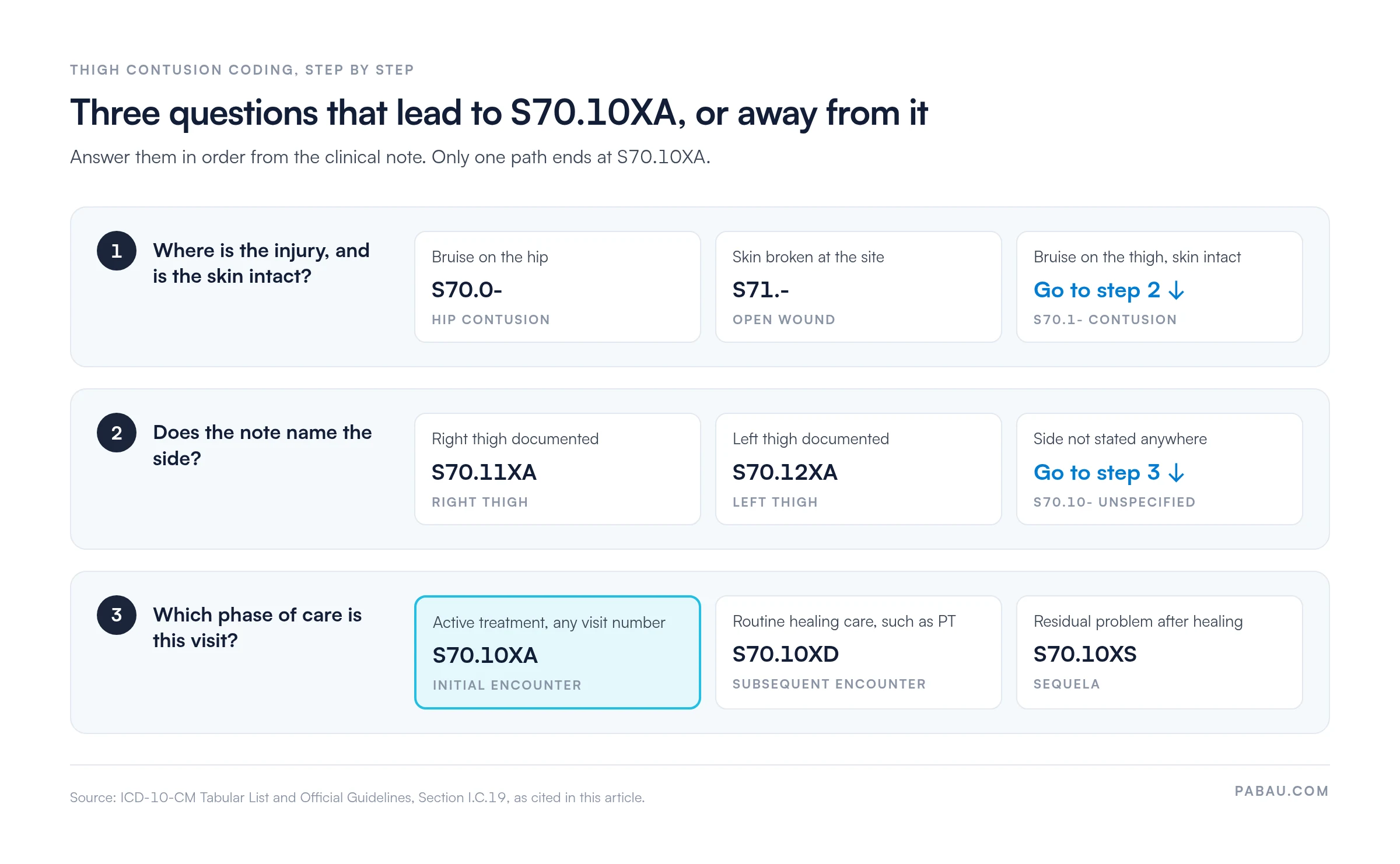
The 7th character in S70.10XA signals the phase of care. Under the ICD-10-CM Official Guidelines (Section I.C.19.a), A applies while the patient receives active treatment. That holds however many visits it takes.
Here’s how that plays out for one patient. She bumps her thigh on a desk corner, and the note never records which leg.
A contusion is a closed blunt-force injury to soft tissue, with the skin left intact. In the thigh, it shows up as localized pain, swelling, tenderness, and ecchymosis. Falls, a direct blow from an object, and sports contact cause most of them.
What limits S70.10XA: One Excludes2 note covers the hip and thigh injury block (S70-S79), and one guideline sets the rest of its scope.
Read the injury wording in the note before assigning S70.10XA. If the clinician writes “laceration” or “skin break” at the same site, code the open wound (S71.-) instead of the contusion. Check the anatomic site too, because a bruise documented on the hip belongs to S70.0-, not S70.1-.
The ICD-10-CM Official Guidelines encourage external cause reporting alongside S70.10XA. CMS does not require these codes on Medicare fee-for-service claims. Some state Medicaid programs and commercial payers do, though, so add them whenever the mechanism is known.
Watch the W18 wording closely. A patient who stumbles but never hits the ground takes a different code, W18.49XA.
The CPT codes billed with S70.10XA depend on the setting. Office and urgent care visits pair with E/M codes 99202-99215, by complexity. Physical therapy adds 97110, 97530, or 97140. If the provider orders imaging to rule out a fracture, femur X-rays bill as 73551 for one view or 73552 for two or more.
A thigh bruise claim is simple on paper. Still, it passes through several hands, and each one can stall it. A clean claim gets through every step on the first pass:
No CMS Local Coverage Determination (LCD) restricts thigh contusion as a standalone diagnosis. Medicare office visits don’t typically need prior authorization for it. Medicare Advantage plans can set their own rules, so check with the plan first.
Most rework on these claims starts in the note. Before the claim leaves, confirm each point below:
S70.10XA denials tend to repeat the same handful of errors. Catching them before submission beats appealing later, and that’s the point of solid denial management workflows.
Beyond the S70.1- siblings above, a few codes from nearby categories get mixed up with ICD-10 code S70.10XA. Here’s how to tell them apart.
The AAPC Codify ICD-10-CM lookup and the ICD List browser both show the S70 hierarchy in context. That makes hip, thigh, and abrasion siblings quicker to separate during high-volume coding.
Therapists ask the same few questions about this code, so here are quick answers.
Does a PT visit ever take S70.10XA? Rarely. PT usually starts after a physician or emergency provider has treated the injury. Rehab during recovery counts as a subsequent encounter, so it carries S70.10XD.
Which CPT codes fit a thigh contusion plan? These four come up most:
What does the note need? Functional outcomes. Tie each limitation, such as reduced knee flexion or an antalgic gait, to a goal in the treatment plan. That link is what carries medical necessity for every billed unit.
Many practices still retype diagnosis and procedure codes from the note into a separate billing system. Each retyped claim is a chance for a dropped character or an empty field.
Pabau, the practice management platform we build, includes claims software that pre-fills the claim form from the patient record. Its ICD-10-CM and CPT/HCPCS lookup libraries let coders find S70.10XA and its siblings without leaving the record.
Before submission, Pabau checks that the required claim fields are complete. Claims then go out through Claim.MD with US eligibility checks, and remittances come back as ERA postings. Code selection, including the 7th character, stays with your coder.

Pabau pre-fills claim forms from the patient record and checks required fields are complete. Claims go out through Claim.MD with US eligibility checks and ERA posting.

S70.10XA is a narrow code, and that’s its strength. It states four facts at once: thigh, intact skin, unknown side, active treatment. Each one has to be in the note.
If the side is missing only because nobody asked, ask before you code. A quick addendum turns an audit risk into S70.11XA or S70.12XA. If the side is unknown, S70.10XA is correct and easy to defend.
Good billing compliance comes from that habit plus a complete claim. To see how Pabau pre-fills and checks injury claims from the patient record, book a demo.

Submitting your first electronic claim? How the Claim.MD clearinghouse works explains the validation and routing process for ICD-10-coded claims to US payers.
Getting hit with claim rejections? Denial codes in medical billing breaks down the most common CARC reason codes and how to respond to each one.
Need to confirm coverage before treating? Insurance eligibility verification covers how eligibility checks at the front desk reduce claim rejections.
Coding a stumble with no fall? ICD-10 code W18.49XA covers slipping, tripping and stumbling without falling.
It depends on the side. A bruised right thigh is S70.11XA, and a bruised left thigh is S70.12XA. Use S70.10XA only when the record doesn’t name the side. On later healing visits, the A becomes a D.
Usually, yes. The ICD-10-CM index sends a traumatic hematoma with intact skin to Contusion, so it lands in S70.1-. A hematoma with no injury behind it is different. That one is coded M79.81, nontraumatic hematoma of soft tissue.
Treat it as a sequela. Code the residual condition first, from M61.05- (myositis ossificans traumatica, thigh). Then add the contusion code with the 7th character S, such as S70.10XS when the side is unknown.
No. Place of occurrence (Y92), activity (Y93), and external cause status (Y99) codes are reported once, at the initial encounter. Leave them off follow-up claims, even when the W-code itself repeats with a D.
Yes, when the bruise is the reason for the visit. It moves down the list when a more serious injury is the main focus of care. If that injury sits at the same thigh site, drop S70.10XA entirely.