ICD-10 Code S53.013D: Anterior subluxation of unspecified radial head
ICD-10 Code S53.013D: Quick reference summary Use the table below as your first ...

Last Updated: Nov 6, 2026
Billable Code Specific Code
S73.016D is the billable ICD-10-CM code for posterior dislocation of unspecified hip, subsequent encounter. It applies at a follow-up visit when the record states a posterior dislocation but does not name the side.
The 7th character D does not mean the patient's second visit. It means the patient is past active treatment and in routine care during healing or recovery. Mixing it up with the visit count can trigger denials or payer review.
Let Pabau's smart automation suggest the right codes, reduce claim denials, and keep your practice compliant—effortlessly.
Automate repetitive tasks and focus on what matters most—your patients.
Reduce coding errors and ensure compliance with the latest regulations.
Clean claims, fewer denials, and faster reimbursements.
Powerful insights and reporting to help your practice thrive.
HIPAA compliant SOC 2 certified GDPR-compliant Trusted by 4,000+ clinics worldwide

S73.016D is the billable ICD-10-CM code for posterior dislocation of an unspecified hip, subsequent encounter. Its siblings are S73.016A (initial) and S73.016S (sequela).
The 6th character 6 means the side is not documented. It is not a left hip code. The left hip is S73.015D and the right hip is S73.014D.
The 7th character D applies once active treatment has ended and the patient is healing, not simply at the second visit.
When the record names the side, use the side-specific code. When it says dislocation but not the direction, use S73.006D, S73.005D or S73.004D instead.
Pabau, the practice platform we build, can record diagnosis details such as side and direction in clinical notes for billers to check.
S73.016D sits in category S73, which covers dislocation and sprain of the joint and ligaments of the hip. Each character narrows the diagnosis, and the 6th character carries both the type of displacement and the side.
The word “unspecified” in this descriptor refers to the side, not the type of dislocation. The type is known: the femoral head was displaced posteriorly, which is the most common pattern in traumatic hip dislocation. What the record does not say is whether it was the right or the left hip. Per the CDC/NCHS ICD-10-CM web tool, S73.016D is a valid billable code in the current release.
The 7th character D does not mean “the second visit.” Under ICD-10-CM Official Guidelines Section I.C.19, the encounter character reflects the phase of care, not the visit count.
Active treatment ends when the provider is no longer managing the acute injury. Once the hip has been reduced and the patient is in monitored recovery, follow-up visits take the D character. That holds when the patient moves from orthopedics to physical therapy, and it holds months later.
The guidelines also rule out the aftercare Z codes for injuries. For injury aftercare, you assign the acute injury code with the 7th character D. A follow-up visit is coded S73.016D, not Z47.89.
Sequela coding applies to a different scenario. The patient presents with a late effect caused by the dislocation, such as osteonecrosis of the femoral head (M87.256 when the side is not documented). The late effect is sequenced first, and S73.016S follows it as the cause.
Two questions decide the code. Has active treatment ended? And does the record name the side? S73.016D is correct only when the answer to the first is yes and the answer to the second is no. The matrix below maps each combination of direction and side to its follow-up code.
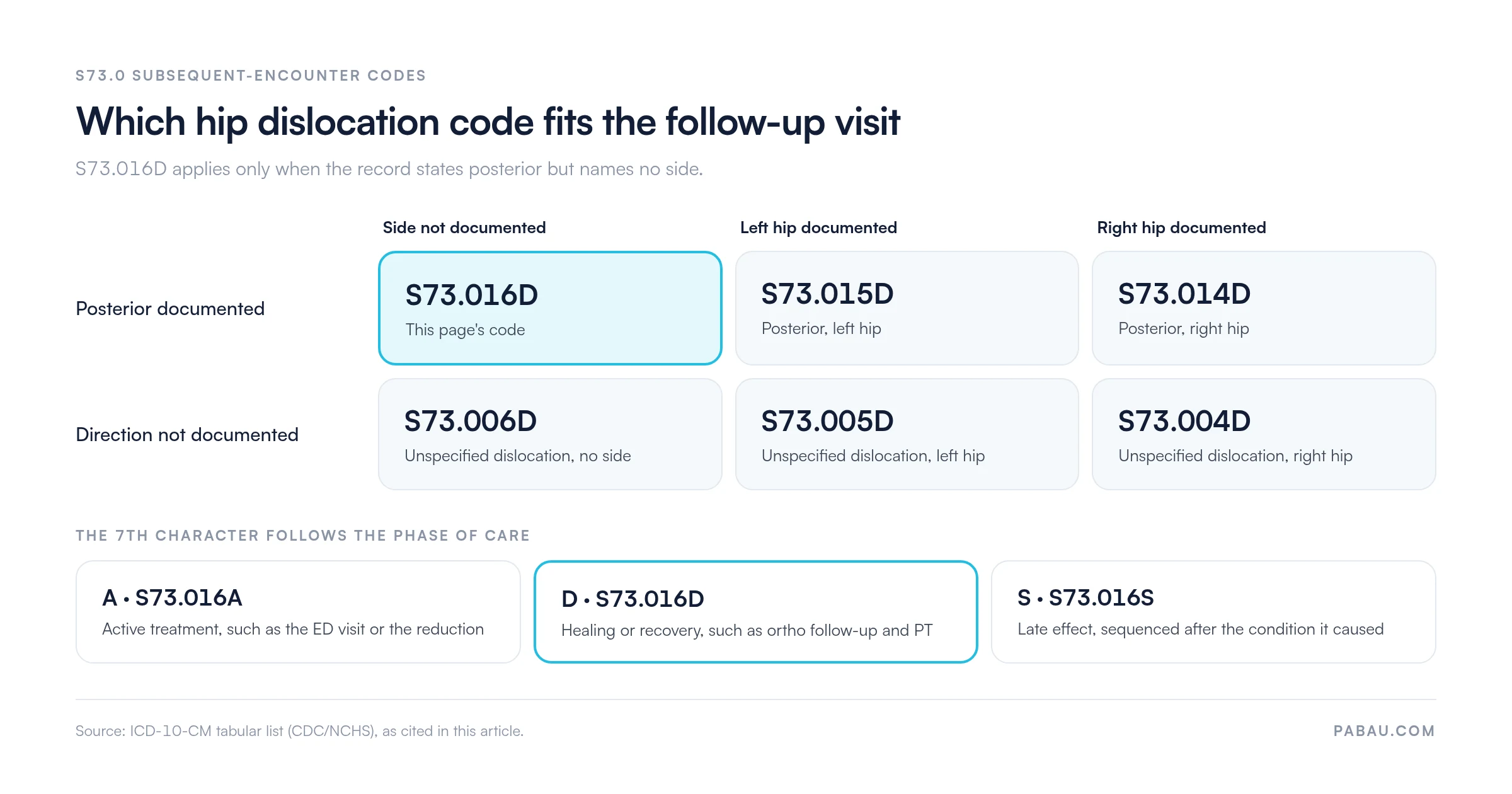
A patient is injured in a car crash and the ED reduces a posterior hip dislocation. Here is how the code changes as the record fills in:
The scenario shows what S73.016D is for. It is the right code for a follow-up visit only while the side is missing from the record. If the record does not identify the side, the guidelines direct you to the unspecified-side code. Once it does, the side-specific code takes over. The CMS ICD-10 coding resources page publishes the annual guidelines that set these rules.
S73.016D covers follow-up care for a traumatic posterior dislocation of the hip when the side is not documented. Knowing what it excludes prevents miscoding and medical necessity denials.
Category S73 also carries a “code also” note for any associated open wound. The AAPC ICD-10-CM lookup shows the full Excludes1 and Excludes2 notes for the category, which helps when you confirm exclusion logic during claim preparation.
The S73.0 subcategory is dense, and the 6th character alone separates side and severity. These are the codes most often mixed up with ICD-10 code S73.016D:
Payers reviewing a claim with ICD-10 code S73.016D look for specific record elements before they pay. Understanding medical billing fundamentals helps practices build documentation habits that hold up under payer scrutiny.
The CPT codes that pair with S73.016D depend on the encounter type. Because D marks a subsequent encounter, the reduction procedures from the initial visit pair with S73.016A, not S73.016D. Pabau’s claims software for practices validates claims for missing or invalid details before submission, and tracks insurer authorizations as cases.

The surgeon who performed the reduction may see the patient inside its global period. Those routine follow-ups are bundled and reported with 99024, not billed as E/M visits such as 99213. Physical therapy practices billing 97000-series codes such as 97110 should link each diagnosis to the procedure types it supports. That stops staff from carrying the reduction CPT from the initial claim into follow-up claims.
Before submitting a claim with S73.016D, search the chart for the words left and right. If either appears in any provider or therapist note, the unspecified-side code is the wrong choice. Also confirm that no reduction CPT code (27250, 27252, 27253 or 27254) sits on the same claim.
Medicare covers follow-up care for a traumatic hip dislocation under S73.016D when medical necessity is documented. Pabau’s integrated US clearinghouse, Claim.MD, adds eligibility checks and electronic remittance advice (ERA) feedback. That lets you spot a coverage problem before submission rather than after a denial.
Key coverage points to verify with each payer:
Submitting a clean claim for S73.016D means confirming eligibility before the visit, not just confirming the patient has coverage. Active coverage does not guarantee coverage for this diagnosis and procedure at this stage of care.
Most denials on ICD-10 code S73.016D follow a recognizable pattern. Structured denial management workflows built around these triggers reduce rework and shorten days in accounts receivable. The medical billing denial codes that show up most often on these claims break down as follows:
In most practices, side and direction travel through free text. The ED note says “posterior hip dislocation,” the referral says “hip,” and the biller picks a code days later. By then, the note that names the side may sit two entries back, and the claim still goes out as S73.016D.
In Pabau, clinicians can record diagnosis details in clinical notes, including the side and direction of the injury. Billers see those details in the same record when they choose the code. Claim validation then checks each claim for missing or invalid details before submission.
The result is a diagnosis code that agrees with the chart it came from. You spend less time on laterality queries and resubmissions, and every Pabau subscription includes the full feature set, from notes to claims.

Pabau keeps clinical notes and claims in one record for ortho and PT practices. It validates claims for missing or invalid details before submission, and tracks insurer authorizations as cases.

ICD-10 code S73.016D is narrower than its descriptor suggests. It means a posterior dislocation at a follow-up visit, with the side missing from the record. When a chart supports it, the better move is usually a provider query. Once the side is on record, S73.015D or S73.014D takes over.
Practices that capture side and direction in structured fields avoid the code almost entirely, along with the reviews it attracts. To see how Pabau handles clinical notes, claims validation and clearinghouse submission for orthopedic and PT practices, book a demo.

Need to understand how claims reach the payer? Medical claims clearinghouse guide explains how clearinghouses validate, route, and track claims before they reach CMS or commercial payers.
Seeing repeat denials with no clear pattern? Revenue cycle management overview covers the end-to-end process from eligibility check through payment posting.
Need to verify 837 electronic claim formatting? 837 file guide details the electronic claim format required for HIPAA-compliant submission to Medicare and commercial payers.
ICD-10 code S73.016D is the billable code for posterior dislocation of an unspecified hip, subsequent encounter. It is used when the patient is healing after a traumatic posterior hip dislocation and the record does not state which hip was injured.
No. The 6th character 6 means the side is unspecified. Posterior dislocation of the left hip at a subsequent encounter is S73.015D, and the right hip is S73.014D.
S73.016A is used while the patient receives active treatment, such as the ED visit or the reduction. S73.016D applies once active treatment has ended and the patient is in routine recovery care, such as physical therapy or orthopedic follow-up.
Subsequent encounter codes apply once active treatment ends, not at the second calendar visit. For a hip dislocation, that is usually the first follow-up after a successful reduction. PT visits, ortho checkups and monitoring appointments during healing take the D character.
Common triggers are an unspecified-side code when the record names the side, and a wrong encounter character. Pairing a reduction CPT code such as 27250 or 27252 with S73.016D also causes denials. So does a PT note that fails to establish medical necessity.
Follow-up E/M visits (99213, 99214) and physical therapy codes pair with S73.016D. Typical PT codes are 97161 to 97163 for evaluation, 97110, 97116 and 97530. Reduction codes 27250 to 27254 belong on the initial encounter claim.
The record needs imaging that confirms a traumatic posterior dislocation and a note showing the patient is in the recovery phase. It must also show that no note identifies the side. If any note says left or right, code S73.015D or S73.014D instead.