

ICD-10 Code S53.013D: Anterior subluxation of unspecified radial head
ICD-10 Code S53.013D: Quick reference summary Use the table below as your first ...

Last Updated: Nov 6, 2026
Billable Code Specific Code
S72.456F is the billable ICD-10-CM code for nondisplaced supracondylar fracture without intracondylar extension of lower end of unspecified femur. It applies at a subsequent encounter for open fracture type IIIA, IIIB, or IIIC with routine healing.
Coders reach for this code at follow-up visits once an open type III fracture has been treated. The 7th character carries the fracture type and the healing status together. D and G mean a closed fracture with routine or delayed healing. E and H cover open type I or II, and F and J cover open type IIIA-IIIC.
Let Pabau's smart automation suggest the right codes, reduce claim denials, and keep your practice compliant—effortlessly.
Automate repetitive tasks and focus on what matters most—your patients.
Reduce coding errors and ensure compliance with the latest regulations.
Clean claims, fewer denials, and faster reimbursements.
Powerful insights and reporting to help your practice thrive.
HIPAA compliant SOC 2 certified GDPR-compliant Trusted by 4,000+ clinics worldwide

S72.456F identifies a nondisplaced supracondylar fracture of an unspecified femur at a subsequent encounter. The fracture was open, Gustilo type IIIA, IIIB or IIIC, and healing is routine.
The 7th character carries the open-fracture grade and healing status together. D is closed, E is open type I or II, and F is open type IIIA-IIIC, all with routine healing.
Delayed healing moves the code to G (closed), H (open type I or II) or J (open type IIIA-IIIC). J, not G, is the delayed-healing pair for F.
S72.456F is the unspecified-side code. When the record names the side, query or code S72.454F (right) or S72.455F (left).
Pabau’s claims management software links with the Claim.MD clearinghouse to check eligibility, flag code-format errors and catch NCCI conflicts before a claim leaves the practice.
ICD-10 code S72.456F reports a follow-up visit for a nondisplaced supracondylar fracture of the lower femur, with the side not documented. The fracture was open, Gustilo type IIIA, IIIB or IIIC, and it is healing as expected. Each character carries part of that picture, so coders can read the code left to right before opening the chart.
The sixth character “6” encodes displacement status and laterality together. In S72.45, the digits 1, 2 and 3 mean displaced right, left and unspecified femur. The digits 4, 5 and 6 mean nondisplaced right, left and unspecified femur.
That makes S72.456 a nondisplaced fracture with no side documented. When the record names the side, S72.454 (right) or S72.455 (left) is the more specific code.
A supracondylar fracture occurs at the distal femur, in the flared metaphyseal region just above the femoral condyles. “Nondisplaced” means the bone fragments have not shifted from their anatomical alignment. The fracture line exists, but the two ends remain in acceptable position without reduction.
“Without intracondylar extension” means the fracture line stays above the condyles and doesn’t split the knee joint surface.
The 7th character F adds that the fracture was open, Gustilo type IIIA, IIIB or IIIC. Type III open fractures involve extensive soft-tissue damage, so they are typically treated with surgical debridement and fixation even when the bone is nondisplaced.
Displaced supracondylar fractures are coded separately under S72.451-S72.453. Coders must confirm displacement status in the operative or office note before selecting the code. “Minimally displaced” or “near-anatomical position” are ambiguous and require physician clarification.
Supracondylar femur fractures occur most commonly in two populations. The first is elderly patients with osteoporosis after low-energy falls. The second is younger patients after high-energy trauma such as motor vehicle accidents, which is where open type III fractures usually arise. Physical therapy practices often see these patients during rehabilitation, at the subsequent-encounter phase.
The CDC/NCHS ICD-10-CM tool confirms the official descriptor and billable status of S72.456F for the current code year.
The 7th character “F” states three facts at once. The patient is receiving care after active treatment has concluded, the fracture was open Gustilo type IIIA, IIIB or IIIC, and healing is progressing normally.
Per the ICD-10-CM Official Guidelines (Section I.C.19.a), a subsequent encounter applies when the patient is receiving routine care during healing or recovery. The physician’s documentation must support routine healing, such as good callus formation, alignment maintained and no evidence of delayed union.
The full S72 7th-character set covers every phase of the fracture encounter, and it builds the Gustilo grade into each open-fracture character. The most common coding error for this code family is picking a character from the type of visit. It must come from the documented fracture type and healing status.
Three neighbors cause most F errors. D is the closed-fracture code, E covers open type I or II fractures, and J is the delayed-healing pair for open type III. A physician who writes “healing is slower than expected” has documented delayed healing. So J applies, not F, and G is wrong here too, because G describes a closed fracture.
Coders can’t infer healing status or the Gustilo grade. Both must come from the physician’s documentation. Laid out as a grid, each of the three neighbors sits one step away from F.
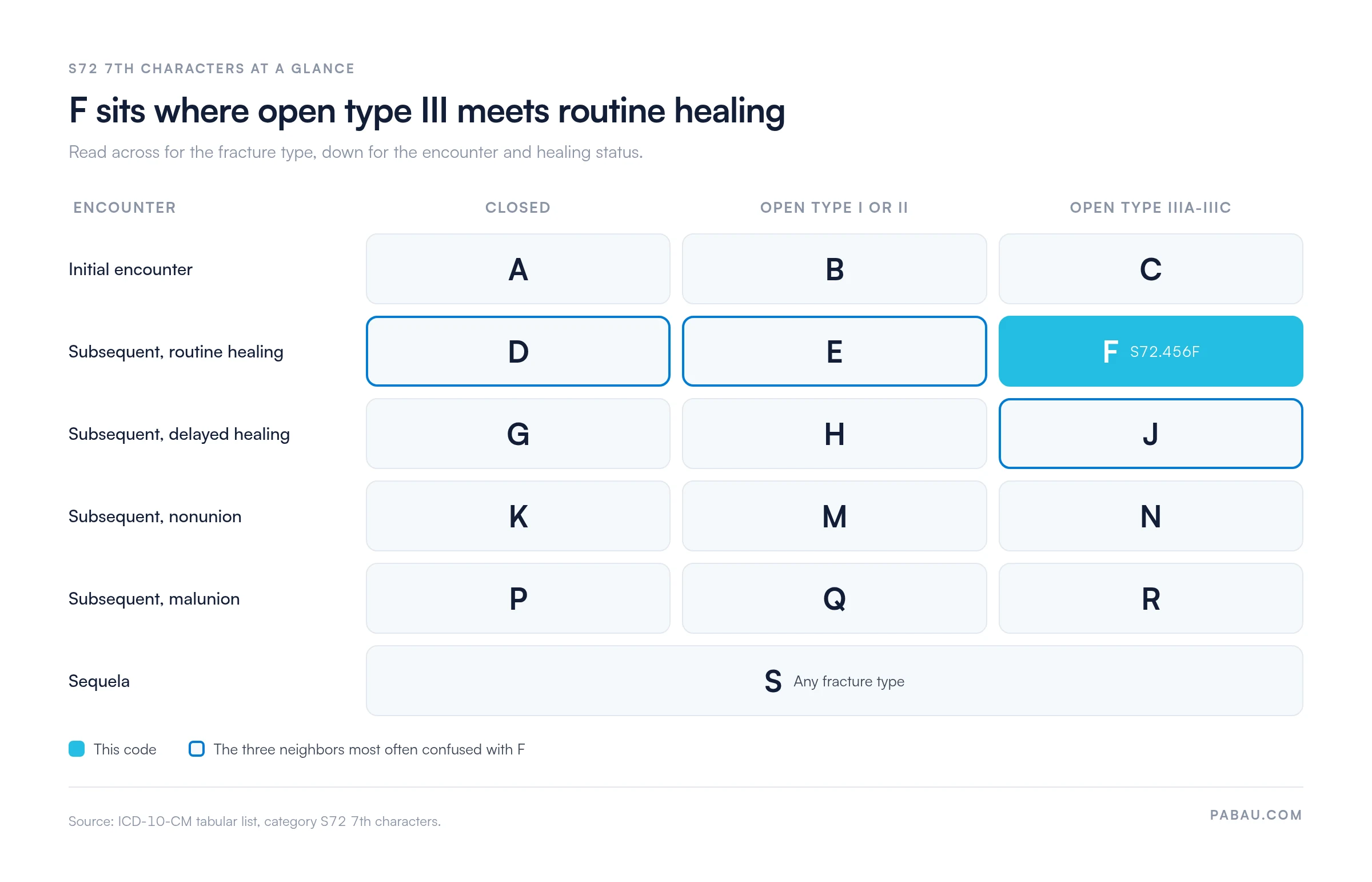
Four choices generate most of the selection errors for S72.456F: Healing status, open-fracture grade, laterality and displacement. Each row in the table below changes one of those four choices.
When an operative note describes a displaced fracture, the correct base code is S72.451 (right), S72.452 (left) or S72.453 (unspecified side), not S72.456. The displacement classification is set at the time of injury, not at the follow-up visit. A fracture not documented as displaced or nondisplaced is coded as displaced, so an unclear note points to S72.453F, not S72.456F.
The S72 category carries tabular instructions that affect code selection for any supracondylar femur fracture. Coders must review these notes before assigning S72.456F.
S72.4 covers fractures of the lower end of the femur, including the supracondylar region and the distal metaphysis. “Supracondylar fracture without intracondylar extension of lower end of femur” (S72.45) is the tabular heading directly above S72.456.
The S72 category notes add two defaults. A fracture not stated as displaced or nondisplaced is coded as displaced. A fracture not stated as open or closed is coded as closed. The open-fracture 7th characters follow the Gustilo open fracture classification.
S72.45 carries an Excludes1 note for supracondylar fracture with intracondylar extension (S72.46-). An Excludes1 note means the two codes can’t be reported together. If imaging shows the fracture line entering the joint between the condyles, code S72.46- instead of S72.456F. The S72 category also has an Excludes1 note for traumatic amputation of hip and thigh (S78.-).
Physeal fracture of the lower end of the femur (S79.1-) and fracture of the femoral shaft (S72.3-) sit under Excludes2 at S72.4. A growth-plate fracture in a skeletally immature patient is coded to S79.1-, not S72.456F. Excludes2 only means both codes may appear when the patient has both injuries.
S72 also lists fractures of the lower leg and ankle (S82.-), the foot (S92.-) and periprosthetic hip implant fractures (M97.0-) under Excludes2.
The Gustilo grade is not a separate code. It is built into the 7th character, so F already states an open fracture of type IIIA, IIIB or IIIC.
Chapter 19 tells coders to use a secondary code from Chapter 20 to identify the cause of injury. That external cause code takes the encounter’s 7th character too, which is D at a subsequent visit. Reporting external cause codes depends on state mandates and payer policy. Verify current-year CMS guidelines, as these instructions are updated annually.
When a patient presents for a subsequent visit and the chart references a fracture treated at an outside facility, request the initial operative report. Displacement status, the Gustilo grade and the open or closed classification must be confirmed from primary documentation. Don’t rely on referral summaries alone.
A clean S72.456F claim requires the medical record to document all five clinical elements that compose the code. Missing any one element gives a payer grounds to deny or downcode. The medical billing process depends on complete documentation before a claim is assembled.
Per CMS ICD-10-CM coding guidance, healing status is a physician-determined clinical finding, not a coder inference. When the note is ambiguous, a query to the treating physician is required before the claim is submitted.
S72.456F is the unspecified-side code, so a record that doesn’t name the side should prompt a provider query. A documented right or left femur moves the claim to S72.454F or S72.455F.
Medicare and most commercial payers process subsequent-encounter fracture claims under the global surgery period framework when a procedure was performed at the initial encounter. Practices should run insurance eligibility verification before each follow-up visit to confirm active coverage and identify any plan-level prior authorization requirements. These vary by payer and plan year.
When the initial fracture treatment involved a surgical procedure, Medicare assigns a global surgery period (typically 90 days for major procedures).
Type III open fractures are typically treated with debridement and fixation, so many S72.456F visits fall inside a global period. Follow-up visits within the global period are bundled with the surgical payment and cannot be separately billed with an E&M code. S72.456F still appears on the claim for tracking and data purposes.
A separate E&M needs modifier -24 when it is unrelated to the surgery, or modifier -57 when it leads to a decision for major surgery. Verify global period status using the CMS Physician Fee Schedule lookup for the specific CPT code billed at the initial encounter.
NCCI (National Correct Coding Initiative) edits are updated quarterly. They may restrict certain E&M codes from being billed alongside fracture care management codes at subsequent encounters. Verify current NCCI tables before submitting claims that pair S72.456F with E&M codes.
Pabau, the practice management platform we build, routes claims through the Claim.MD clearinghouse. Claim.MD applies payer edits before submission and flags potential NCCI conflicts.
Reviewing electronic remittance advice (ERA) after each claim cycle reveals payer-specific denial patterns. Each denied line carries a claim adjustment reason code, and our guide to medical billing denial codes explains each one. Repeated denials on S72.456F claims often trace to a single upstream documentation issue that can be corrected at source.
Most S72.456F denials fall into five categories. Each has a root cause in either documentation or coding workflow, and each is correctable before the claim re-bills. Denial management workflows that log the original reason code show which of the five keeps coming back.
Practices using claims management software with pre-submission validation catch most of these errors before the claim reaches the payer. Getting a clean claim out the first time cuts rework and speeds up payment for orthopedic and physical therapy practices. The AAPC ICD-10-CM code lookup provides additional crosswalk guidance when verifying adjacent codes during denial review.
At a subsequent encounter for a supracondylar femur fracture, the CPT codes billed depend on what the physician does during the visit. Procedure codes from the initial surgery are never repeated at follow-up visits. The table below lists codes typically paired with S72.456F at subsequent-encounter visits. Verify current-year AMA CPT descriptors and NCCI edits before submitting.
CPT codes 27501-27503, 27509, 27511 and 27513 (closed, percutaneous and open treatment of supracondylar femur fractures) are initial-treatment procedure codes. They must not appear on a claim that also carries S72.456F unless the visit involves a new surgical intervention. Check each payer’s bundling rules against the current NCCI tables when building claims for this diagnosis.
Many practices still check fracture follow-up claims by hand. A coder reads the note, picks the 7th character, then checks eligibility, the global period and NCCI edits in separate tools.
Pabau’s claims software runs pre-submission validation against current ICD-10-CM rules and routes each claim through the Claim.MD clearinghouse. It flags code-format errors and NCCI conflicts before the claim reaches the payer. Eligibility checks run from the same patient record before each follow-up visit.
The clinical calls stay with your coders. Software can’t read the physician’s note, so the Gustilo grade, displacement and healing status still come from the chart. Your team then spends its time on those calls instead of reworking rejected claims.

Pabau connects with Claim.MD to check patient eligibility, flag code-format errors and catch NCCI conflicts before your claim leaves the practice. Fewer claims come back denied.

S72.456F captures a specific clinical moment: A nondisplaced open type III supracondylar femur fracture, followed up after active treatment with healing on track. The side is undocumented, which is often the first sign the record needs a provider query. A missing Gustilo grade, an ambiguous healing note or a mixed-up 7th character causes most denials.
Before each S72.456F claim goes out, confirm the Gustilo grade, displacement and healing status in the physician’s note. When the side is missing, query the provider, because S72.454F or S72.455F is the more specific code. That check takes minutes, while a denied follow-up claim has to be reworked and resubmitted.
Software handles the format and bundling checks once the chart is right. To see how Pabau flags code-format errors and NCCI conflicts on orthopedic claims before they reach the payer, book a demo.

Need to understand how clearinghouse validation works? Medical claims clearinghouse guide explains how electronic claim routing and validation reduce denial rates for orthopedic and musculoskeletal billing.
Seeing repeated remittance denials? Denial codes in medical billing covers the most common CARC denial reason codes and the corrective steps for each.
Want to understand the full revenue cycle context for fracture billing? Revenue cycle management overview walks through each stage from eligibility check to payment posting.
Is the fracture on the left side with slower healing? ICD-10 code S72.455G covers a nondisplaced supracondylar fracture of the left femur with delayed healing.
Does imaging show the fracture entering the knee joint? ICD-10 code S72.461Q covers a displaced supracondylar fracture with intracondylar extension of the right femur.
ICD-10 code S72.456F is the diagnosis code for a nondisplaced supracondylar fracture without intracondylar extension of the lower end of an unspecified femur. It covers a subsequent encounter for an open fracture of Gustilo type IIIA, IIIB or IIIC with routine healing. It applies when active treatment has concluded and the physician documents normal healing.
All three describe a nondisplaced supracondylar fracture of an unspecified femur at a subsequent encounter. F is an open type IIIA, IIIB or IIIC fracture with routine healing. J is the same open type III fracture with delayed healing. G is a closed fracture with delayed healing, so it never pairs with an open type III fracture. The physician’s documented assessment, not the coder’s judgment, determines which character applies.
It depends on whether the fracture was closed or open and on its Gustilo grade. Use D for a closed fracture, E for open type I or II, and F for open type IIIA, IIIB or IIIC. D applies to every S72 code, not only some subcategories. If healing is delayed, the matching characters are G, H and J.
The medical record must explicitly state five elements. They are an open fracture graded Gustilo type IIIA, IIIB or IIIC, nondisplaced status, and a supracondylar or distal femoral location. The record must also show subsequent encounter context and routine healing progression. If any element is missing or ambiguous, a physician query is required before the claim is submitted. If the record doesn’t name the side, query the provider, because S72.454F (right) or S72.455F (left) is more specific.
Yes, S72.456F is a billable ICD-10-CM code accepted by Medicare. However, global surgery period rules may restrict separate E&M billing if a surgical procedure was performed at the initial encounter. Claims within the global period require the correct modifier to avoid bundling denials.
Five patterns cause most denials. The first is using F when the physician documented delayed healing, which calls for S72.456J instead. The second is an initial-encounter code (C) at a follow-up visit. The third is a Gustilo grade mismatch, such as F for a type I or II fracture. The fourth is a closed vs open mismatch between S72.456D and S72.456F. The last is a separate E&M billed within the global surgery period without the correct modifier.



