

ICD-10 Code S42.444P: Medial epicondyle fracture, right humerus
ICD-10 Code S42.444P: full descriptor and code validity ICD-10 Code S42.444P car...

Last Updated: Oct 13, 2026
Billable Code Specific Code
S72.455G is the billable ICD-10-CM code for nondisplaced supracondylar fracture without intracondylar extension of lower end of left femur. It applies at a subsequent encounter for closed fracture with delayed healing.
The 7th character G reports a closed fracture that is still uniting, more slowly than the expected timeline. Coders often reach for K, which belongs to a fracture that has stopped healing. P belongs to one that united in an abnormal position. Immature callus with a visible fracture line is what supports G.
Let Pabau's smart automation suggest the right codes, reduce claim denials, and keep your practice compliant—effortlessly.
Automate repetitive tasks and focus on what matters most—your patients.
Reduce coding errors and ensure compliance with the latest regulations.
Clean claims, fewer denials, and faster reimbursements.
Powerful insights and reporting to help your practice thrive.
HIPAA compliant SOC 2 certified GDPR-compliant Trusted by 4,000+ clinics worldwide

S72.455G is a billable ICD-10-CM code for a nondisplaced supracondylar fracture of the lower end of the left femur, valid for HIPAA-covered transactions in FY2026.
The 7th character G means subsequent encounter for a closed fracture with delayed healing. The bone is still uniting, just behind the expected timeline.
Delayed healing (G), nonunion (K), and malunion (P) are three separate 7th characters on a closed S72.455 fracture. Swapping one for another is the series’ most common denial trigger.
Pabau’s claims management software supports ICD-10-CM code lookup and electronic claim submission, reducing S72.455G coding errors before they reach the payer.
ICD-10 Code S72.455G is a billable, specific ICD-10-CM code valid for reimbursement under HIPAA-covered transactions.
It belongs to the FY2026 code set published in the CMS ICD-10-CM annual update, which runs from October 1, 2025 through September 30, 2026. The full official descriptor is: Nondisplaced supracondylar fracture without intracondylar extension of lower end of left femur, subsequent encounter for closed fracture with delayed healing.
Each component of that descriptor carries a distinct coding meaning. Coders need to verify every element in the physician note before assigning this code. The table below sets out what each element claims and what the note has to show for it.
The 7th character G in ICD-10-CM fracture codes means subsequent encounter for a closed fracture with delayed healing. It combines three clinical facts. The fracture is closed, the visit is a follow-up rather than initial treatment, and the bone is uniting more slowly than expected. Each character position in an ICD-10-CM code carries its own meaning, and the 7th is where the S72 series generates most of its denials.
The closed-fracture 7th characters in the S72.455 subcategory work as follows:
Open fractures in the same subcategory take their own characters. B and C cover initial encounters, E and F routine healing, H and J delayed healing, M and N nonunion, and Q and R malunion.
“Subsequent encounter” does not mean the patient’s second visit. It covers any visit after the initial treatment phase is complete. A patient seen for weeks of physical therapy following fracture reduction stays on a subsequent encounter code throughout that course of care.
Delayed healing, nonunion, and malunion are three separate outcomes on a closed fracture, and each one takes its own 7th character in the S72.455 subcategory. Choosing between G, K, and P is the single most frequent denial trigger in the series. Picking the right one requires the physician note to state which outcome the imaging supports.
A note recording “delayed union” or “slow to heal” supports G, because both describe union that is late rather than failed. Character K needs the physician to record that healing has stopped. Character P needs a completed union in an abnormal position. Where the note leaves the outcome ambiguous, query the physician before assigning the code.
A nondisplaced supracondylar fracture of the femur occurs at the distal femur, above the femoral condyles, with bone fragments remaining in anatomical alignment. These injuries are typically managed conservatively when nondisplaced, and patients often present at subsequent encounters for rehabilitative follow-up rather than surgical revision. That pattern puts much of the follow-up coding in the hands of a rehabilitation team rather than a surgical one.
Supracondylar femur fractures are more common in elderly patients with osteoporosis and in younger patients following high-energy trauma. For coding purposes, the mechanism is not relevant to code selection. What matters is displacement status, laterality, open versus closed status, and healing status.
ICD-10-CM Official Guidelines (FY2026) define “subsequent encounter” as any encounter after the patient has received active treatment for the injury. What the physician records about the visit decides the 7th character. The number of prior visits has no bearing on it. Coders who apply subsequent encounter codes correctly prevent a large share of fracture-claim rejections. That habit is where denial management in healthcare begins.
According to the CDC/NCHS ICD-10-CM lookup tool, initial encounter (A) applies even when a different provider takes over the case. What matters is that active treatment is still ongoing, not who delivers it. This trips coders up on referrals. A patient sent to an orthopedic specialist mid-treatment can pick up a subsequent encounter code while A is still the right one.
Audit your denied S72.455 claims from the past 90 days. Filter by 7th character and compare D, G, K, and P assignment rates. A spike in G denials usually means the notes describe nonunion or malunion while the claim carries delayed healing. Query those notes before resubmission.
The following clinical terms commonly appear in physician notes and map to ICD-10 Code S72.455G. Coders using natural-language search or reviewing clinical documentation should look for these phrasings when considering this code assignment:
The AAPC ICD-10-CM code lookup indexes many of these synonym terms against S72.455G in its alphabetic index. Coders can use the synonym list to cross-check the natural language in a physician note. It shows whether the wording maps to this code or to a related sibling.
S72.455 is the subcategory for nondisplaced supracondylar fractures without intracondylar extension of the lower end of the left femur. The 7th character completes the code. Every code below shares that fracture type and laterality. Only the encounter type, fracture type, and healing status change from one to the next.
Read as a grid, the series is simpler than sixteen separate codes suggest. Each healing status has one closed character and two open ones, and the open pair splits on Gustilo-Anderson type.
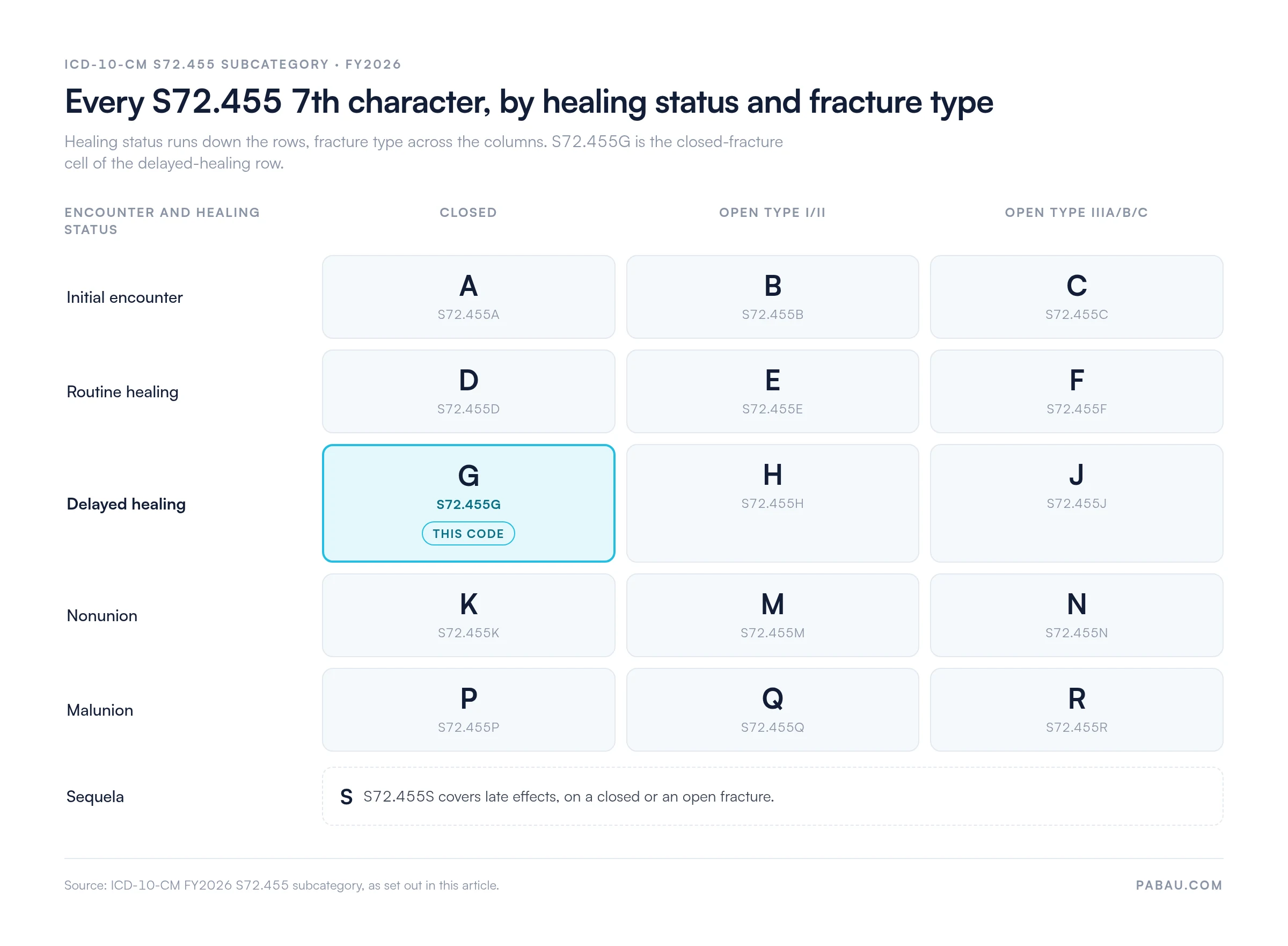
Understanding where S72.455G sits within the ICD-10-CM hierarchy helps coders verify they are at the correct specificity level and avoid truncated code submission. The hierarchy from broadest to most specific is:
Submitting S72.455 without the 7th character would result in a claim rejection. Only the fully specified 7th character codes are billable. S72.4 and S72.45 are parent codes used for classification but not for claim submission.
A physician note must explicitly support every coding element in S72.455G before a coder assigns it. Missing or vague documentation on any element creates audit exposure and frequently triggers medical billing denial codes at adjudication. Compliance on fracture codes therefore depends on note quality as much as on coder accuracy.
When documentation is incomplete, the correct workflow is a physician query rather than an assumption. Submitting S72.455G on imaging alone creates a compliance risk, unless the physician has recorded delayed healing in the encounter note. A clearinghouse cannot catch that before the claim reaches the payer. It validates code format and structure, and has no view on whether the note supports the code.
Four errors account for most rejected S72.455G claims, and each one has a simple check behind it:
Each of these is caught by the same habit. Read the healing status and the fracture type out of the note itself, then pick the 7th character. Do not reuse the character from the patient’s last claim.
Complex fracture codes like ICD-10 Code S72.455G carry multiple required coding elements, and manual verification across each element creates opportunities for error. Practice management software like Pabau, with integrated ICD-10 lookup and claims validation, catches these errors before claims reach the payer.

Pabau’s claims management software supports ICD-10-CM code assignment within the billing workflow. Claims then go out through Pabau’s integration with Claim.MD, our US clearinghouse partner. Claim.MD connects to thousands of US payers, handles 837P claim submission and real-time eligibility verification, and returns electronic remittance advice (835 ERAs). Practices can then reconcile payments and spot denial patterns by 7th character. Seeing which S72.455 characters draw rejections shortens the time between submission and a fix.

Pabau’s claims management software connects ICD-10-CM code lookup directly with your billing workflows, flagging incomplete documentation before claims reach the clearinghouse. See how practices using Pabau reduce denials on musculoskeletal and trauma codes.

ICD-10 Code S72.455G is one of the more documentation-sensitive codes in the S72 fracture category. Delayed healing has to be recorded by the physician, and the encounter has to be a genuine follow-up rather than an initial presentation. The fracture itself must be confirmed as closed, nondisplaced, supracondylar, without condylar extension, and left-sided. When every element is present in the note, the code is clean and billable. When any element is missing, a physician query is the right next step.
For practices managing musculoskeletal and trauma coding at volume, Pabau’s claims management tools support accurate ICD-10-CM code assignment and clean claim submission. Book a demo to see how Pabau handles fracture code workflows from documentation through payer adjudication.

Need a structured approach to denial prevention? Denial management in healthcare covers the workflows that catch coding errors before they become rejected claims.
Want to understand how clearinghouses fit into claims submission? Medical claims clearinghouse explained outlines how 837P files, eligibility checks, and ERA returns work together in a modern billing cycle.
Looking for the broader revenue cycle picture? What is revenue cycle management maps the end-to-end process from patient encounter to collected payment.
ICD-10 Code S72.455G is the billable diagnosis code for a nondisplaced supracondylar fracture of the lower end of the left femur, without intracondylar extension. It applies at a subsequent encounter for a closed fracture with delayed healing. Every element of the code has to appear in the physician note for clean claim submission.
Yes. S72.455G is a billable, specific ICD-10-CM code valid for HIPAA-covered transactions. It belongs to the FY2026 code set, which runs from October 1, 2025 through September 30, 2026. It can be submitted directly on claims without requiring a more specific code.
Delayed healing means the fracture is still uniting, only more slowly than expected. On a closed fracture, 7th character G reports it. Nonunion means healing has stopped and the fragments remain separated, which character K reports. Malunion means the fracture united in an abnormal position, which character P reports. The physician note must state which one applies, because coders cannot infer it.
The 7th character G means subsequent encounter for a closed fracture with delayed healing. It tells the payer three things. The patient is in follow-up care rather than initial treatment. The fracture was closed, with the skin intact. Union is running behind schedule without having failed.
A subsequent encounter in ICD-10-CM is any visit after the patient has received active treatment for the injury. It does not mean the second visit specifically. A patient attending weeks of follow-up orthopedic appointments or physical therapy after fracture reduction would receive subsequent encounter codes throughout that care course.
The closest related codes are S72.455D (subsequent, closed, routine healing), S72.455K (subsequent, closed, nonunion), S72.455P (subsequent, closed, malunion), and S72.455A (initial encounter, closed). The right femur equivalent of S72.455G is S72.454G. Displaced supracondylar fractures of the left femur fall under the S72.452 series instead.




