

ICD-10 code S61.201A: Open wound of left index finger without nail damage
ICD-10 code S61.201A covers a left index finger wound of unstated type ICD-10 co...

Last Updated: Oct 16, 2026
Billable Code Specific Code
S72.461Q is the billable ICD-10-CM code for a displaced supracondylar fracture of the lower end of the right femur with intracondylar extension. It applies at a subsequent encounter, where an open fracture of Gustilo type I or II has healed in malunion.
The fracture sits just above the knee and runs into the joint surface between the condyles. Coders most often confuse S72.461Q with S72.461P, which covers the same malunion after a closed fracture. A wound description with no Gustilo grade is the other usual reason these claims come back.
Let Pabau's smart automation suggest the right codes, reduce claim denials, and keep your practice compliant—effortlessly.
Automate repetitive tasks and focus on what matters most—your patients.
Reduce coding errors and ensure compliance with the latest regulations.
Clean claims, fewer denials, and faster reimbursements.
Powerful insights and reporting to help your practice thrive.
HIPAA compliant SOC 2 certified GDPR-compliant Trusted by 4,000+ clinics worldwide

S72.461Q is a billable FY2026 ICD-10-CM code, valid for HIPAA-covered transactions effective October 1, 2025.
The code describes a displaced supracondylar fracture of the right distal femur that extends into the joint between the condyles.
The 7th character Q means a subsequent encounter for an open fracture of Gustilo type I or II that has healed in malunion.
Documentation must confirm laterality, intracondylar extension, displacement, open fracture status, and a physician-stated malunion.
Practice management software like Pabau keeps these documentation details attached to the encounter, so coders are not chasing them later.
ICD-10 Code S72.461Q reports a displaced supracondylar fracture of the lower end of the right femur, extending between the condyles.
The 7th character Q marks a subsequent encounter for an open fracture of Gustilo type I or II. That fracture has healed in malunion.
The code is billable and specific, valid for the FY2026 edition effective October 1, 2025. It is accepted on HIPAA-covered transactions and needs no characters beyond the 7th already present.
Every phrase in the descriptor encodes a clinical fact the record has to support. The table below takes the descriptor apart term by term, so you can check your notes against each element before you assign the code.
Two components are never assumed. The record has to show that the fracture was open, and a physician has to state the malunion. Intracondylar extension is the third element worth double-checking. It separates S72.461 from the S72.451 series, which covers supracondylar fractures that stop short of the joint.
The 7th character on an S72.461 code carries three facts at once. It records the encounter type, the open or closed status of the original fracture, and the healing outcome. Sixteen values are valid across this family, and the open fracture characters split by Gustilo severity rather than by a simple open-or-closed choice.
Q and P are the two malunion characters for a right-sided S72.461 fracture. They differ on one point only: whether the original fracture was open. Assign Q when the record documents an open fracture of Gustilo type I or II, and P when the fracture was closed.
Two facts in the record decide the character: whether the wound was open and graded, and how the bone healed. The grid below crosses those two axes, so you can land on the letter without scanning all sixteen rows.
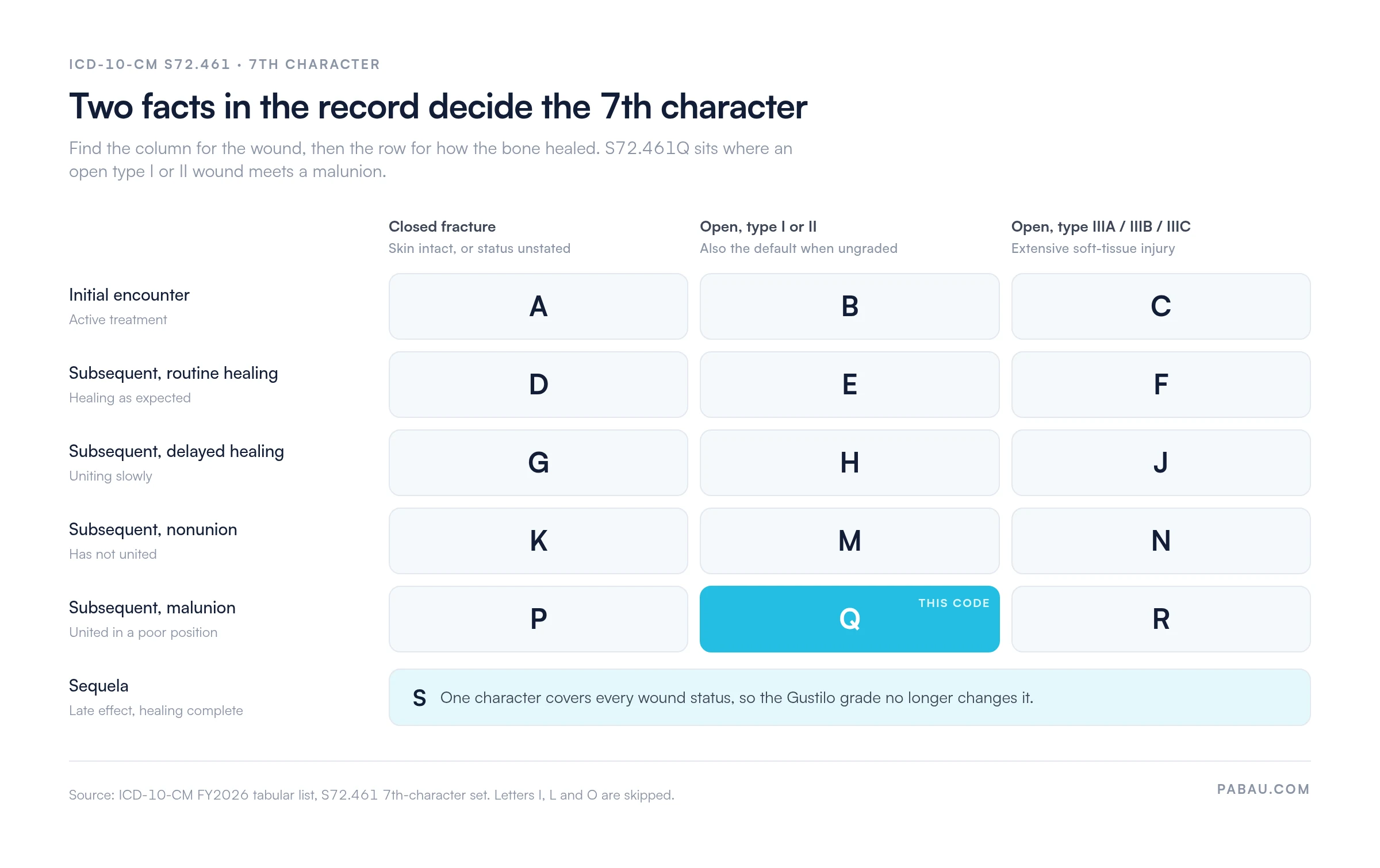
The set skips the letters I, L, and O on purpose, so a character can never be mistaken for a numeral.
S72.461Q sits at the most granular level of the femur fracture classification tree. Tracing its parents helps you confirm the subcategory before you add the 7th character. The full set of parents and siblings is indexed in the ICD-10-CM code library.
S72.4 covers the lower end of the femur only. A fracture of the femoral shaft belongs to a different subcategory, S72.3. A displaced comminuted shaft fracture on the right side is S72.351, not S72.461. Confirm the fracture site in the imaging or operative report before you settle on the subcategory.
Character Q depends on the Gustilo-Anderson grade recorded for the original wound, so that grade drives the code. Types I and II share one group of characters. Types IIIA, IIIB, and IIIC share another.
ICD-10-CM carries a default here that saves a lot of provider queries. Where the record documents an open fracture but names no Gustilo grade, the official guidelines direct you to the type I or II characters. A malunion on an open fracture of unstated grade therefore lands on Q, not R.
That default runs one way only. A record that never says whether the fracture was open is coded as closed, which moves the malunion to S72.461P. So the wound description in the emergency department note decides between two codes that look almost identical on a claim form.
Malunion and nonunion are the two complications most often swapped on distal femur claims, and they take different 7th characters. Malunion means the fracture united, but in a mechanically or anatomically poor position. Nonunion means it never united inside the expected healing window.
Neither finding is a coder inference. Both need an explicit physician diagnosis backed by imaging. Where a note says only that the fracture is not healing well, query the provider before you assign Q or M.
Audit S72.461Q against S72.461P every quarter. On distal femur claims these two get swapped whenever the operative note records a wound but nobody grades it. The coder then falls back to closed. Pull the emergency department note alongside the operative report before you settle the 7th character. The wound description usually sits in that earlier document rather than the surgical one.
Every code below shares one base descriptor: displaced supracondylar fracture with intracondylar extension of lower end of right femur. Only the 7th character changes, so the sibling table is really a map of encounter and healing status. Verify the current list through the CDC ICD-10-CM web tool or the AAPC Codify ICD-10 lookup before billing.
Five neighboring base codes are easy to confuse with S72.461, because their descriptors differ by a single element:
According to the CMS ICD-10-CM guidelines, the encounter type drives the 7th character across the whole healing journey, not just the first few visits. Coders new to fracture coding often drop the A character too early, or switch to a subsequent character while active treatment is still running. The official definitions work like this:
For S72.461Q, the subsequent encounter designation confirms two facts at once. The patient is past the acute phase, and the distal femur has united in an abnormal position. Every visit in this phase keeps Q until the clinical picture changes or the malunion is reclassified.
ICD-10-CM Official Guidelines Section I.C.19.c governs fracture coding across the S72 category. Three defaults apply when documentation is thin, and each one moves S72.461Q by a letter or a subcategory.
Applying these defaults consistently, and recording your rationale when you invoke one, is what makes the assignment defensible. Payer auditors regularly scrutinize laterality and encounter-type assignments on high-cost orthopedic claims.
A claim for S72.461Q stands up to audit only when the clinical record supports every coded element. One missing component is enough to justify a payer denial.
Practices running audit-ready claims management can build pre-submission documentation checks into the coding workflow. A thin note is then caught before the claim leaves the practice.

Work through that checklist before the claim leaves the practice, and it goes out as a clean claim. A rejection that lands later almost always traces back to one of those seven lines.
S72.461Q is a diagnosis code. The procedure codes billed alongside it depend on what was done at the encounter. The CPT codes below are the ones most often paired with a supracondylar distal femur fracture and its complications.
Two shaft codes turn up in the wrong place often enough to be worth naming. CPT 27506 covers open treatment of a femoral shaft fracture with an intramedullary implant. CPT 27507 covers the same shaft fracture treated with a plate and screws. Neither pairs with S72.461Q, because the shaft is a different anatomical site.
One spelling trap sits between the two code sets. ICD-10-CM writes intracondylar extension, while CPT writes intercondylar extension. Both describe a fracture line running into the joint surface. An encoder search on one spelling can hide the matching code in the other system.
Verify current-year descriptors against the AMA CPT edition your practice uses, since wording and code boundaries are revised annually.
When a malunion is corrected surgically, S72.461Q stays the diagnosis code for the malunion itself. The corrective procedure carries its own CPT code. Do not flip the encounter back to an initial encounter character just because surgery is happening. The patient is still on the subsequent encounter path of the original injury.
The facts that decide this code are scattered across three documents. The wound grade lives in the emergency department note, the fracture pattern in the radiology report, and the malunion statement in a follow-up letter. Coders end up requesting records weeks after the visit, which is where subsequent encounter claims stall.
Practice management software like Pabau keeps clinical notes, imaging attachments, and coded diagnoses on one patient record. The supporting detail then travels with the encounter. Custom medical forms let orthopedic teams capture laterality, fracture pattern, and healing status as structured fields at the point of care rather than free text.
The outcome is a shorter path from visit to submitted claim. Your billing team sees what the clinician recorded, queries fewer notes, and sends cleaner claims the first time.

Pabau helps orthopedic and MSK practices capture the documentation that supports precise ICD-10 coding at the point of care, reducing downstream denials and rework.

The four elements behind S72.461Q are documentation problems before they are coding problems. Laterality, intracondylar extension and an open wound at Gustilo type I or II each sit in a different document. A physician-stated malunion sits in a fourth.
So the code rarely fails at submission. It fails at audit, when the record cannot produce one of the four. Pull those documents together while the patient is still in front of you, and the claim holds.
Pabau keeps that detail on the patient record, so the elements behind codes like S72.461Q are there when a payer asks. To see how Pabau handles ICD-10 documentation and claim workflows, book a demo.

Need guidance on denial patterns for orthopedic claims? Denial management in healthcare explains how to identify, track, and resolve the most common reasons orthopedic and fracture claims are rejected.
Want to understand how claims move through the billing system? What is revenue cycle management covers the end-to-end process from documentation to payment posting, with practical guidance for MSK and orthopedic practices.
Looking for a structured approach to coding compliance? Medical billing compliance outlines the audit-proofing steps that protect practices from overpayment demands on high-complexity fracture codes.
S72.461Q is the billable diagnosis code for a displaced supracondylar fracture with intracondylar extension of the lower end of the right femur. It applies at a subsequent encounter, where an open fracture of Gustilo type I or II has healed in malunion. The code is valid for FY2026 and accepted on HIPAA-covered transactions effective October 1, 2025.
Yes. S72.461Q is a billable and specific ICD-10-CM code valid for FY2026 submission on HIPAA-covered transactions. It needs no additional characters and can go straight onto a claim.
In the S72.461 family, the 7th character Q means a subsequent encounter for an open fracture of type I or II with malunion. It confirms three facts at once. The patient is past active treatment. The original fracture broke the skin at Gustilo grade I or II, and the bone has united in an abnormal position.
Both codes report a malunion of the same displaced supracondylar right femur fracture at a subsequent encounter. Q applies where the original fracture was open at Gustilo type I or II. P applies where the fracture was closed, which is also the default when the record never states that the skin was broken.
Assign the type I or II character. Where a fracture is documented as open but carries no Gustilo classification, the Official Guidelines direct coders to the type I or II group. That group is characters B, E, H, M, and Q. For a malunion at a subsequent encounter, that gives S72.461Q.
Malunion means the fracture has healed, but in an abnormal anatomical position. Nonunion means it has not healed at all within the expected timeframe. After an open fracture of type I or II, malunion takes S72.461Q and nonunion takes S72.461M. Both require an explicit physician diagnosis supported by imaging.
Subsequent encounter codes apply once the patient has completed active treatment and is receiving routine care during recovery. The encounter type follows the clinical purpose of the current visit, not the number of weeks since the injury. Active treatment, including revision surgery, keeps an initial encounter character until that active phase ends.
The record must confirm right femur laterality, a supracondylar fracture at the lower end of the femur, intracondylar extension into the joint, and displaced status. It must also document an open fracture of Gustilo type I or II, a subsequent encounter, and a physician-stated malunion. A missing element is grounds for denial or audit recoupment.



