ICD code S72.145M – Nondisplaced intertrochanteric fracture of left femur with nonunion
Billable Code•Specific Code
Code Definition
S72.145M is the billable ICD-10-CM code for nondisplaced intertrochanteric fracture of left femur, subsequent encounter for open fracture type I or II with nonunion.
Use it at a follow-up visit once the provider documents nonunion of a left intertrochanteric fracture that was originally open, Gustilo type I or II.
Related Information
Chapter
S00-T88 Injury, poisoning and certain other consequences of external causes
Category
S72 Fracture of femur
Group
S72.145 Nondisplaced intertrochanteric fracture of left femur
Billable
Yes
Code also known as
left intertrochanteric hip fracture nonunion, ununited left intertrochanteric femur fracture
Save time. Improve accuracy. Get paid faster.
Automate coding with Pabau
Let Pabau's smart automation suggest the right codes, reduce claim denials, and keep your practice compliant—effortlessly.
Nondisplaced intertrochanteric fracture of left femur with nonunion
Codes
Suggested by Pabau AI
S72.145MNondisplaced intertrochanteric fracture of left femur with nonunion
ICD Code Suggestion
AI
Suggested code
S72.145MNondisplaced intertrochanteric fracture of left femur with nonunionHigh match
Confidence score
98%
Why this code?
Matches patient diagnosis
Supported by clinical notes
Commonly used for this condition
Why practices choose Pabau
Save hours every week
Automate repetitive tasks and focus on what matters most—your patients.
Improve accuracy
Reduce coding errors and ensure compliance with the latest regulations.
Get paid faster
Clean claims, fewer denials, and faster reimbursements.
Grow with confidence
Powerful insights and reporting to help your practice thrive.
HIPAA compliant•SOC 2 certified•GDPR-compliant•Trusted by 4,000+ clinics worldwide
Key takeaways
S72.145M codes a follow-up visit for a nondisplaced intertrochanteric fracture of the left femur that has gone on to nonunion.
The 7th character M means the original fracture was open, Gustilo type I or II, while closed fractures take K and type III takes N.
The code already names the left side, so a right-sided nonunion takes S72.144M and an undocumented side takes S72.146M.
The intertrochanteric region sits below the femoral neck, so femoral neck codes in S72.0- and neck procedures such as CPT 27236 do not fit.
Pabau, the practice software we build, checks each claim against payer rules before submission, so a wrong 7th character gets caught early.
ICD-10 Code S72.145M: Quick reference
ICD-10 Code S72.145M is the billable code for a follow-up visit when a nondisplaced intertrochanteric fracture of the left femur has gone on to nonunion. The original fracture was open, Gustilo type I or II, and the provider has documented that it failed to heal.
Field
Detail
Code
S72.145M
Official descriptor
Nondisplaced intertrochanteric fracture of left femur, subsequent encounter for open fracture type I or II with nonunion
Status
Billable and specific (valid for HIPAA-covered transactions)
Code system
ICD-10-CM
Category
S72 – Fracture of femur
Subcategory
S72.1 Pertrochanteric fracture, then S72.14 Intertrochanteric fracture of femur
Laterality
Left (S72.144M for the right femur, S72.146M when no side is documented)
Encounter type
Subsequent (follow-up), never the initial encounter
Original fracture
Open, Gustilo type I or II, now with nonunion
Code validity
FY2026 ICD-10-CM (October 1, 2025 to September 30, 2026)
Verify current-year code validity using the CDC/NCHS ICD-10-CM web tool, which mirrors the official tabular list updated each October 1.
What does S72.145M mean? Breaking down each character
Like other ICD-10-CM codes, S72.145M packs five layers of clinical information into seven characters. Reading left to right:
Character(s)
Value
Meaning
S72
Category
Fracture of femur
.1
Subcategory
Pertrochanteric fracture (the trochanteric region below the femoral neck)
.14
Fracture type
Intertrochanteric fracture, with the fracture line running between the greater and lesser trochanters
.145
Displacement and side
Nondisplaced fracture of the left femur
M
7th character
Subsequent encounter for open fracture type I or II with nonunion
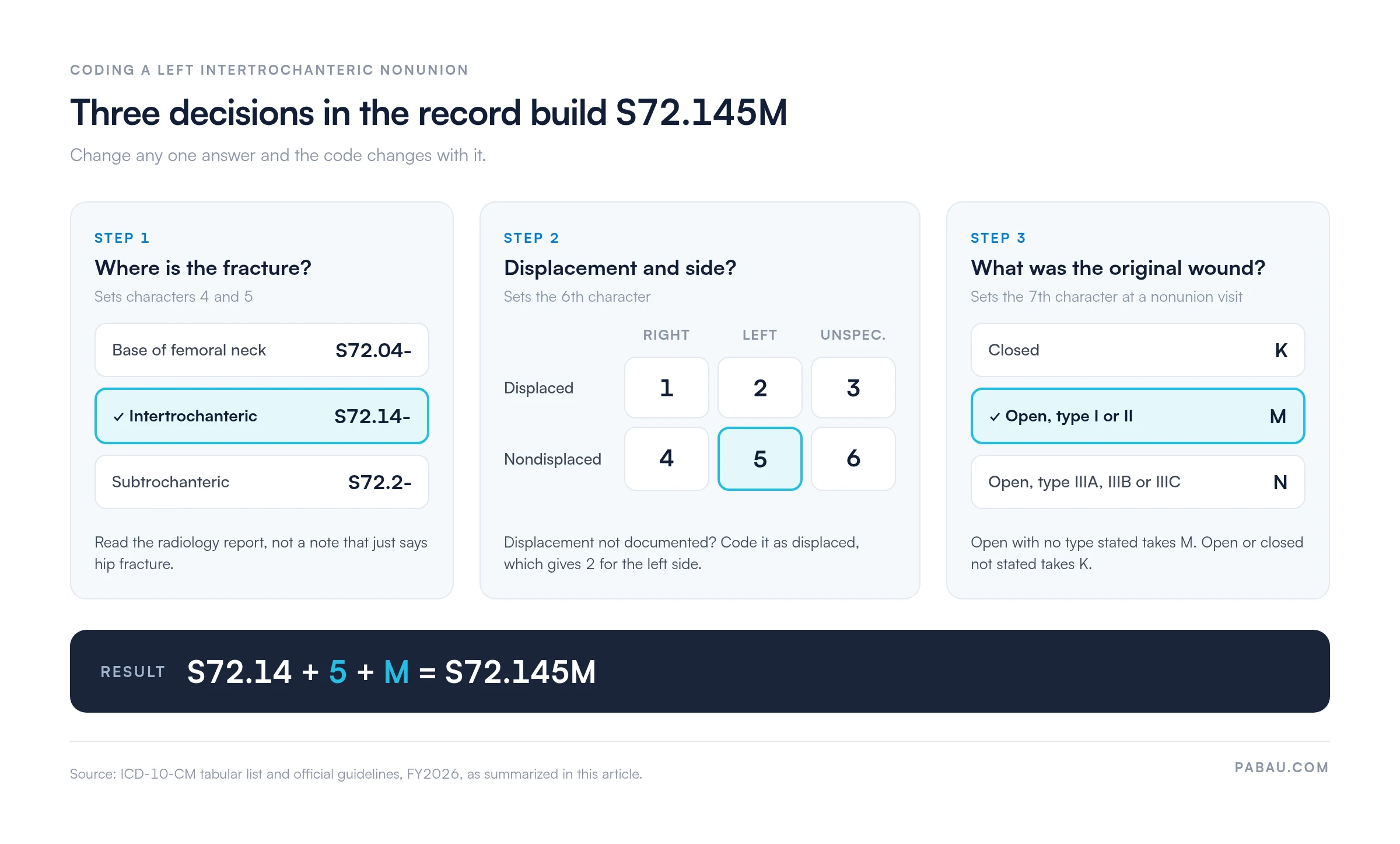
The sixth character carries two facts at once. In the S72.14- family, 1 to 3 are displaced fractures and 4 to 6 are nondisplaced. Each set runs right, left, then unspecified, so a 5 means nondisplaced and left.
Nondisplaced means the bone fragments stayed in anatomical alignment at the time of injury. Nonunion is a later complication, where the provider documents that the fracture has stopped progressing toward healing.
Official guidelines code a fracture not documented as displaced or nondisplaced as displaced. Without the word nondisplaced in the record, the code becomes S72.142M.
Put together, three decisions in the record build the code: the fracture site, then displacement and side, then the original wound.
Change the site, the side, the displacement or the wound type, and a different code applies. Built from the FY2026 ICD-10-CM tabular list and guidelines.
Intertrochanteric anatomy and why nonunion occurs
The intertrochanteric region is the stretch of the proximal femur between the greater trochanter and the lesser trochanter. It sits below the femoral neck and outside the hip joint capsule. That location is why ICD-10-CM files these fractures under S72.1, apart from the femoral neck codes in S72.0-.
Unlike the femoral neck, this region is mostly cancellous bone with a generous blood supply from the surrounding muscle attachments. Intertrochanteric fractures therefore usually heal, and nonunion is uncommon. When it does occur, the cause is more often mechanical than vascular.
Factors linked to intertrochanteric nonunion include:
An unstable fracture pattern that loses position after fixation
Fixation failure, such as lag screw cut-out through the femoral head or collapse into varus
Infection, a particular risk after an open fracture
Osteoporosis and poor bone quality, most often in older women
Smoking, diabetes and chronic corticosteroid use, which slow bone healing
Open intertrochanteric fractures are rare, because thick muscle covers the hip. They usually follow high-energy trauma such as a road collision or a fall from height. An M code on an older patient’s low-energy fall therefore deserves a second look at the original fracture record.
Nonunion is defined as failure of fracture healing, confirmed by imaging or surgery. For the coder, that confirmation is not optional. It must appear in the record before S72.145M can be assigned.
Understanding the 7th character M: Open fracture type I or II with nonunion
The 7th character M marks a follow-up encounter for an open fracture, Gustilo type I or II, that has not united. Category S72 uses the full 16-value fracture extension:
7th character
Full code
Meaning
A
S72.145A
Initial encounter for closed fracture
B
S72.145B
Initial encounter for open fracture type I or II
C
S72.145C
Initial encounter for open fracture type IIIA, IIIB, or IIIC
D
S72.145D
Subsequent encounter for closed fracture with routine healing
E
S72.145E
Subsequent encounter for open fracture type I or II with routine healing
F
S72.145F
Subsequent encounter for open fracture type IIIA, IIIB, or IIIC with routine healing
G
S72.145G
Subsequent encounter for closed fracture with delayed healing
H
S72.145H
Subsequent encounter for open fracture type I or II with delayed healing
J
S72.145J
Subsequent encounter for open fracture type IIIA, IIIB, or IIIC with delayed healing
K
S72.145K
Subsequent encounter for closed fracture with nonunion
M
S72.145M
Subsequent encounter for open fracture type I or II with nonunion
N
S72.145N
Subsequent encounter for open fracture type IIIA, IIIB, or IIIC with nonunion
P
S72.145P
Subsequent encounter for closed fracture with malunion
Q
S72.145Q
Subsequent encounter for open fracture type I or II with malunion
R
S72.145R
Subsequent encounter for open fracture type IIIA, IIIB, or IIIC with malunion
S
S72.145S
Sequela
Three characters cover nonunion, and the original wound decides between them. K covers a closed fracture, M an open type I or II fracture, and N an open type IIIA, IIIB, or IIIC fracture.
Gustilo type I and II wounds are smaller, with limited soft-tissue damage. Type III wounds involve extensive soft-tissue injury, and IIIC adds a vascular injury that needs repair.
ICD-10-CM guidelines set two defaults here. An open fracture with no documented Gustilo type takes M, the type I or II character. A fracture not documented as open or closed is coded as closed, so it takes K instead. Query the surgeon whenever the record could support N.
What S72.145M covers: Inclusions
S72.145M applies when all of the following are true at the time of the encounter:
The patient has a previously diagnosed nondisplaced intertrochanteric fracture of the left femur
The original fracture was open and documented as Gustilo type I or II, or as open with no type stated
The visit comes after active treatment of the original fracture, including surgery to repair the nonunion
Nonunion is confirmed by imaging (plain X-ray, CT, or MRI) or by surgical exploration
The treating provider explicitly documents nonunion, not just “slow healing” or “fracture not healed”
Typical visits assigned this code include nonunion repair, bone grafting, revision of failed fixation, and office evaluations to manage an established nonunion.
What S72.145M does not cover: Excludes notes and coding boundaries
The S72 category carries Excludes1 and Excludes2 notes, and the chapter sets further boundaries that affect code assignment:
Excludes1 (cannot code together): Traumatic amputation of hip and thigh (S78.-). When the encounter involves an amputation at hip or thigh level, S78.- applies and S72.145M is not reported with it.
Excludes2 (may code together when both are present): Fracture of lower leg and ankle (S82.-) and fracture of foot (S92.-). Report them alongside S72.145M when the patient has those injuries too.
Periprosthetic fractures: A fracture around a hip replacement is coded to periprosthetic fracture around internal prosthetic hip joint (M97.0-), not to S72.-.
Pathological fractures: Fractures due to neoplasm (M84.5-), osteoporosis (M80.-), or other disease (M84.6-) are classified separately. S72.145M applies to traumatic fractures only.
Failed hardware: A broken nail, plate, or screw is a mechanical complication of the internal fixation device, coded in T84.1-. Code it in addition when documented, and sequence by the reason for the visit.
Adjacent and commonly confused codes
The codes below are the closest neighbors of S72.145M and the ones most easily swapped in error. Use the AAPC Codify ICD-10-CM lookup to confirm full descriptors and any applicable notes.
Code
Descriptor (short)
Key distinguishing factor
S72.145K
Nondisplaced intertrochanteric fracture, left femur, closed fracture with nonunion
The original fracture was closed
S72.145N
Nondisplaced intertrochanteric fracture, left femur, open type IIIA, IIIB, or IIIC with nonunion
The original open wound was Gustilo type III
S72.145H
Nondisplaced intertrochanteric fracture, left femur, open type I or II with delayed healing
Healing is slow but progressing, and nonunion is not documented
S72.145Q
Nondisplaced intertrochanteric fracture, left femur, open type I or II with malunion
The fracture healed, but in a poor position
S72.144M
Nondisplaced intertrochanteric fracture of right femur, same encounter
The right femur is documented
S72.146M
Nondisplaced intertrochanteric fracture of unspecified femur, same encounter
No note in the chart names a side
S72.142M
Displaced intertrochanteric fracture of left femur, same encounter
The fracture is documented as displaced, or displacement is not stated
S72.045M
Nondisplaced fracture of base of neck of left femur, same encounter
Wrong anatomy: femoral neck (basicervical), not intertrochanteric
S72.25XM
Nondisplaced subtrochanteric fracture of left femur, same encounter
Wrong anatomy: the fracture lies below the lesser trochanter
Clinical documentation requirements for S72.145M
Nonunion fracture care draws close payer scrutiny, so denial management for these claims starts with the chart. Every element below must appear in the medical record before assigning ICD-10 Code S72.145M:
Original fracture diagnosis and date of injury. The record must establish when the fracture occurred and that it was an open, nondisplaced intertrochanteric fracture. Without that originating event, payers cannot verify the progression to nonunion.
Imaging confirming nonunion. A plain X-ray, CT scan, or MRI report should state that union has not occurred. “Fracture line still visible” is not enough on its own. The report should use the term nonunion or describe the absence of bridging callus.
Treating provider’s documentation of nonunion. The provider’s note must state that nonunion is the diagnosis driving this encounter. Coders cannot assign nonunion from imaging alone, because code assignment rests on provider documentation.
Site, side, and displacement. The record must name the intertrochanteric region, the left femur, and a nondisplaced pattern. If any one of the three changes, so does the code.
Open fracture type. Gustilo type I or II supports M, and type IIIA, IIIB, or IIIC supports N. An open fracture with no stated type defaults to M.
Current treatment plan. The note should outline how the nonunion will be managed. Options include a bone stimulator, nonunion repair with or without graft, revision fixation, or conversion to hip arthroplasty.
Pro Tip
Before assigning S72.145M, run a four-point check. Confirm the provider note says nonunion, the fracture is intertrochanteric, and the side is left. Then check that the original wound was open type I or II, or open with no type stated. A claim built on that record leaves the payer far less to question.
Laterality note: S72.145M is the left-side code
S72.145M already specifies the left femur, so it is a fully specific code. Laterality only becomes a problem when the record names a different side, or no side at all. ICD-10-CM guidelines require the most specific code the documentation supports.
Scenario
Correct code
Provider documents a left intertrochanteric nonunion
S72.145M
Provider documents a right intertrochanteric nonunion
S72.144M
No note anywhere in the chart names a side
S72.146M
Side missing from the current note but documented earlier in the same chart
The documented side (S72.144M or S72.145M)
Left side documented, but the fracture is recorded as displaced or displacement is not stated
S72.142M
Payers compare the side on follow-up claims with the side on the original fracture claim. A left-sided S72.145M after a right-sided S72.144B is likely to draw a review.
Payer requirements and Medicare coverage for nonunion fracture management
Medicare coverage for nonunion fracture management follows general medical necessity principles established by the CMS ICD-10 coding and billing guidance. Specific requirements vary by Medicare Administrative Contractor (MAC) jurisdiction. Always verify the applicable Local Coverage Determination before billing revision surgery.
Commonly required documentation elements across most MAC policies include:
Serial imaging showing no progress toward union, such as a persistent fracture line without bridging callus
A physician narrative explaining why nonunion occurred and what the current treatment plan addresses
Prior treatment history showing that conservative management was attempted before surgery is authorized
For surgical procedures, an operative report that ties the procedure to the nonunion diagnosis with enough specificity to meet medical necessity criteria
CPT code pairings for S72.145M
Procedure selection depends on the operative report. The pairings below reflect common scenarios for an intertrochanteric nonunion, and they do not replace documentation-driven code assignment.
CPT code
Descriptor
Notes
27470
Repair, nonunion or malunion, femur, distal to head and neck; without graft (eg, compression technique)
Nonunion repair without bone graft. The intertrochanteric region lies distal to the femoral neck, so this family fits.
27472
Repair, nonunion or malunion, femur, distal to head and neck; with iliac or other autogenous bone graft (includes obtaining graft)
Nonunion repair with autograft. Graft harvest is included, so do not add 20902 for the same graft.
27244
Treatment of intertrochanteric, peritrochanteric, or subtrochanteric femoral fracture; with plate/screw type implant, with or without cerclage
Fixation with a sliding hip screw or plate. It usually describes the original fracture surgery, so check the operative note before using it for a revision.
27245
Treatment of intertrochanteric, peritrochanteric, or subtrochanteric femoral fracture; with intramedullary implant, with or without interlocking screws and/or cerclage
Fixation with a cephalomedullary nail. The same caution applies as for 27244.
27238 / 27240
Closed treatment of intertrochanteric, peritrochanteric, or subtrochanteric femoral fracture; without manipulation (27238) or with manipulation, with or without skin or skeletal traction (27240)
Closed treatment of the fracture itself. These are rarely the plan once nonunion is established.
27132
Conversion of previous hip surgery to total hip arthroplasty, with or without autograft or allograft
Salvage when failed fixation is converted to a hip replacement.
20902
Bone graft, any donor area; major or large
Separate graft harvest only, when the primary procedure code does not already include it.
77080
Dual-energy X-ray absorptiometry (DXA), bone density study, 1 or more sites; axial skeleton (eg, hips, pelvis, spine)
Osteoporosis workup that often accompanies nonunion care. It needs its own diagnosis code.
99213-99215
Office or other outpatient visit, established patient
Follow-up evaluation visits. Confirm that any global surgery period from an earlier procedure has ended before billing separately.
CPT 27236 describes open treatment of a femoral neck fracture, so it does not pair with this intertrochanteric code. When the operative note describes a cephalomedullary nail, check the documentation rules for CPT 27245 before you pair it with S72.145M. A separately harvested graft goes to CPT 20902, and only when the primary code does not already include it.
Common claim denial reasons for S72.145M
Denials on S72.145M claims cluster around a predictable set of documentation and coding errors. Understanding the medical billing compliance requirements for nonunion fractures helps avoid the most common ones:
Wrong anatomy. A femoral neck diagnosis (S72.0-) or a neck procedure such as CPT 27236 conflicts with an intertrochanteric imaging and operative record.
K, M, and N mixed up. M requires an open type I or II fracture. If the original record shows a closed fracture or a type III wound, the claim is unsupported.
Wrong 7th character for the visit. A and B are for initial encounters only. A follow-up visit for nonunion takes a subsequent-encounter character.
No imaging confirming nonunion. Payers require objective evidence. A note saying “still has hip pain” does not establish nonunion without a radiology or surgical report.
Side conflicts with claim history. A left-sided code after right-sided claims for the same fracture triggers automated edits on many MAC systems.
Global period conflicts. Billing a separate visit inside the global surgery period of the original fixation creates a date conflict that triggers payer review.
Missing original injury date. Some MAC LCDs require the date of injury on the claim form. Confirm field 14 on the CMS-1500 is populated.
Our guide to the clean claim process covers the pre-submission checks that catch most of these errors before a payer sees them.
Coding tips and best practices for intertrochanteric nonunion
These practical steps apply each time ICD-10 Code S72.145M is under consideration:
Confirm the fracture site first. Intertrochanteric (S72.14-), base of neck (S72.04-), and subtrochanteric (S72.2-) fractures sit close together. Read the radiology report rather than relying on a note that just says hip fracture.
Verify the encounter type. Decide whether this is active treatment of the original fracture or a follow-up visit. If it is unclear, review the claim history and prior notes before assigning M.
Match K, M, or N to the original wound. Closed takes K, open type I or II takes M, and open type III takes N. Query the surgeon when the type is ambiguous.
Check side and displacement together. Both live in the sixth character. A left, nondisplaced fracture is 5; a left, displaced fracture is 2.
Distinguish nonunion from delayed healing. H is the open type I or II character for delayed healing that is still progressing. Reserve M for documented nonunion.
Link the code to the original injury date. Field 14 on the CMS-1500 should carry the date of the fracture, not the date of the current visit.
How Pabau keeps S72.145M nonunion claims clean
Errors on S72.145M claims usually start upstream. A femoral neck code gets picked from a hip fracture shortlist, or the 7th character is keyed from memory. Catching that by hand means rereading every follow-up chart before the claim goes out.
Pabau checks each claim in its claims management software before submission. Claims then go out through our Claim.MD clearinghouse integration, which validates ICD-10-CM codes against payer rules for thousands of US payers.
Seventh-character and laterality conflicts get caught before transmission. That gives a nonunion visit its best chance of being paid on the first pass, rather than after an appeal.
Pabau’s checkout screen closes the invoice and books the next follow-up from one view, so nonunion review visits stay on the schedule.
Reduce coding denials before they reach the payer
Pabau’s claims management and Claim.MD clearinghouse integration check 7th characters, laterality, and code pairings before submission. See how it works for orthopedic and surgical billing.
Coding S72.145M correctly starts with the anatomy. An intertrochanteric fracture sits below the femoral neck, so it belongs in S72.14-, not in the neck codes of S72.0-. Settle the site, then the side and displacement, and the sixth character follows.
The second judgment is the original wound. Closed fractures take K, open type I or II fractures take M, and type III wounds take N as the 7th character. Coding the wound the surgeon documented keeps these claims out of the denial queue.
Book a demo to see how Pabau checks fracture follow-up claims before they reach the payer.
Continue your research
Want to understand how clearinghouses process claims?How medical claims clearinghouses work explains the payer routing, eligibility checking, and ERA handling that sits between your practice and the MAC.
Researching revenue cycle fundamentals?What is revenue cycle management maps the process from encounter to payment posting, including the coding touchpoints where fracture claims stall.
Converting failed fixation to a hip replacement?CPT 27132 explains how to code conversion of previous hip surgery to total hip arthroplasty.
Frequently asked questions
What does ICD-10 Code S72.145M mean?
ICD-10 Code S72.145M is the billable code for a nondisplaced intertrochanteric fracture of the left femur, seen at a follow-up visit for nonunion. The original fracture was open, Gustilo type I or II. It applies once imaging or surgery shows the fracture has failed to heal, and never to the initial fracture visit.
What is the difference between S72.145M and S72.145K?
S72.145K is for a closed fracture with nonunion, while S72.145M is for an open fracture, Gustilo type I or II, with nonunion. Both describe the same nondisplaced left intertrochanteric fracture at a follow-up visit. The original fracture record decides which one applies.
What is the 7th character M in ICD-10 fracture codes?
The 7th character M means a subsequent encounter for an open fracture, Gustilo type I or II, with nonunion. In category S72 it sits between K, for closed fractures with nonunion, and N, for open type IIIA, IIIB, or IIIC fractures with nonunion. An open fracture with no documented Gustilo type defaults to M.
Is S72.145M valid for an initial fracture encounter?
No. S72.145M is a subsequent-encounter code. The initial encounter for an open type I or II fracture takes S72.145B. M applies only once the provider documents nonunion at a later visit.
Why would a claim with S72.145M be denied?
The most common reasons are a femoral neck code or procedure on an intertrochanteric claim, the wrong 7th character, and no imaging confirming nonunion. Side conflicts with earlier claims and a missing injury date in field 14 also trigger denials. A complete record before submission prevents most of them.
When should I use S72.145M vs. S72.144M or S72.146M?
Use S72.145M when the provider documents the left femur. Use S72.144M for the right femur, and S72.146M only when no note in the chart names a side. Choosing the unspecified code when a side is documented counts as incorrect coding.
Is S72.145M a femoral neck fracture code?
No. S72.145M sits in S72.14-, the intertrochanteric fracture codes, which cover the region below the femoral neck and outside the hip capsule. Femoral neck fractures are coded in S72.0-, such as S72.045M for a nondisplaced base-of-neck fracture of the left femur.