ICD-10 Code Y76.0: Diagnostic obstetric and gynecological devices
ICD-10 Code Y76.0: Definition and billable status ICD-10 Code Y76.0 is a valid, ...

Last Updated: Oct 23, 2026
Billable Code Specific Code
S72.113K is the billable ICD-10-CM code for displaced fracture of greater trochanter of unspecified femur, subsequent encounter for closed fracture with nonunion. It reports a closed greater trochanter fracture that has failed to unite when the record does not name the side.
The code sits in subcategory S72.11 (fracture of greater trochanter of femur), under S72.113, the displaced code for an unspecified femur. When documentation names the side, S72.111K (right) or S72.112K (left) replaces it. Seventh character K requires imaging or provider evidence of nonunion, not just a follow-up visit.
Let Pabau's smart automation suggest the right codes, reduce claim denials, and keep your practice compliant—effortlessly.
Automate repetitive tasks and focus on what matters most—your patients.
Reduce coding errors and ensure compliance with the latest regulations.
Clean claims, fewer denials, and faster reimbursements.
Powerful insights and reporting to help your practice thrive.
HIPAA compliant SOC 2 certified GDPR-compliant Trusted by 4,000+ clinics worldwide

S72.113K describes a displaced greater trochanter fracture of an unspecified femur at a subsequent encounter, where the closed fracture has failed to unite.
Seventh character K requires imaging evidence of nonunion, such as an X-ray or CT report. Time elapsed or visit count alone never justifies K.
S72.113K is the wrong code when the record names the side. Use S72.111K for the right femur or S72.112K for the left.
When no record documents laterality, query the provider before falling back on the unspecified-side code.
Pabau’s claims management software sends fracture nonunion claims through Claim.MD, which checks them for errors before they reach the payer.
ICD-10 Code S72.113K is a billable ICD-10-CM diagnosis code, valid for FY 2027 claims, according to the CDC/NCHS ICD-10-CM official code tool. The official descriptor is: Displaced fracture of greater trochanter of unspecified femur, subsequent encounter for closed fracture with nonunion.
The code reports a closed greater trochanter fracture that has failed to unite on a femur whose side the record does not name. When the documentation says right or left, a lateralized code replaces it.
S72.113K encodes five clinical facts in a single alphanumeric string. Each segment narrows the diagnosis from the fracture-of-femur category down to the anatomy, side, displacement status, and healing outcome. For S72.113K, the side segment reads “unspecified,” and that segment is the easiest one to misread.
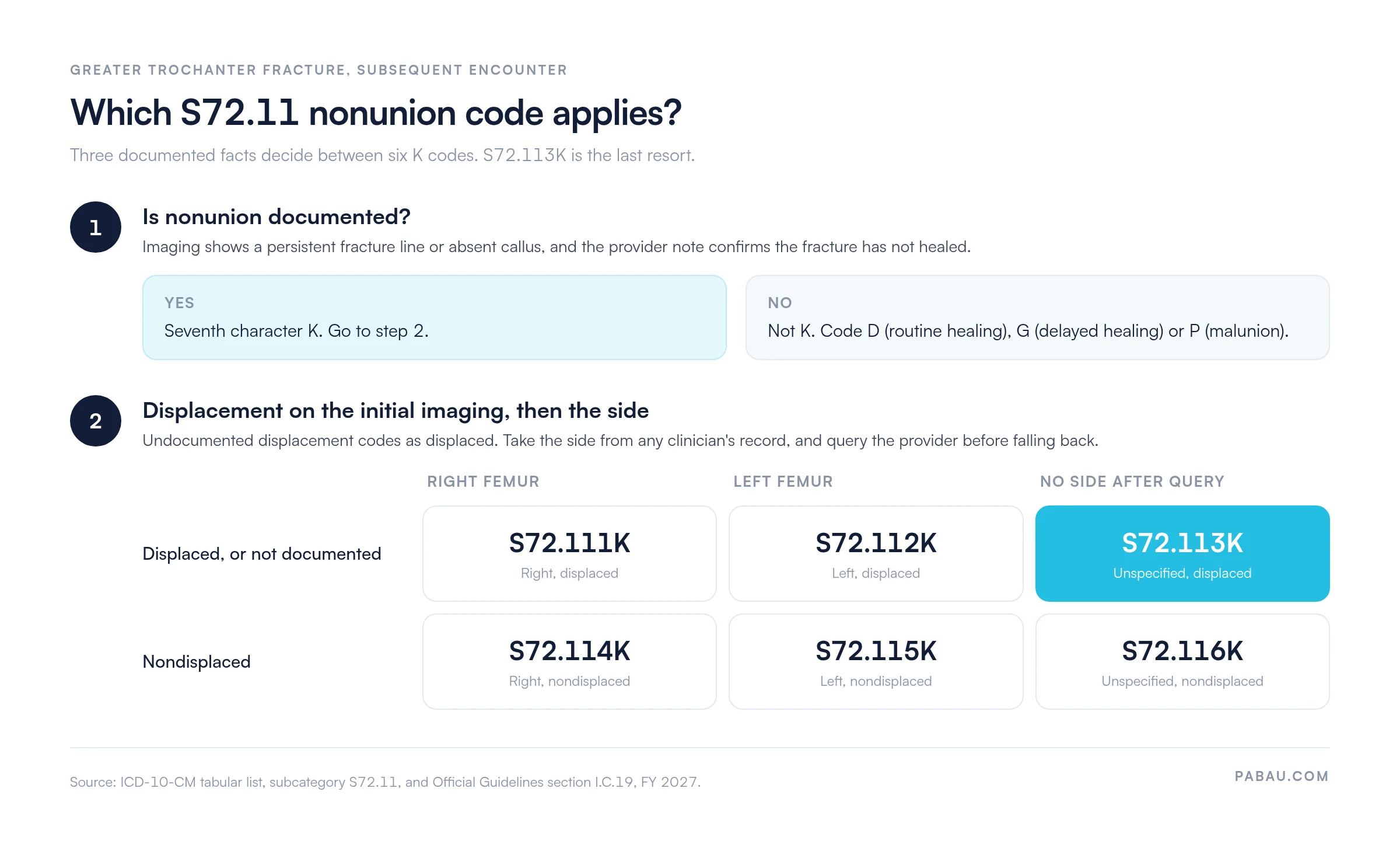
The sixth character in S72.113 encodes displacement and laterality together. Displaced fractures use 1 for the right femur, 2 for the left, and 3 for an unspecified side. Nondisplaced fractures follow the same pattern with 4 (right), 5 (left), and 6 (unspecified).
So a displaced right nonunion is S72.111K, and a displaced left nonunion is S72.112K. Reading the 3 as “left” turns a lateralized claim into an unspecified one. Payers can question an unspecified-side code when the record clearly names the side.
Seventh character K means the closed fracture has not healed at a subsequent encounter. Coders can assign it only when imaging or a provider note confirms the fragments have failed to unite. Section I.C.19.c of the ICD-10-CM Official Guidelines for Coding and Reporting covers the fracture seventh characters, nonunion included.
S72.113 takes sixteen seventh characters. They split along three lines: encounter type, healing status, and whether the fracture was closed or open. K is the closed-fracture nonunion character, so an open fracture that fails to unite codes to M or N instead.
The D-versus-K choice comes up at almost every orthopedic follow-up. D applies when the patient is progressing through expected healing, such as a routine six-week post-operative check.
K applies only when follow-up imaging shows the fracture line persists or callus formation is absent or insufficient. A treating physician who documents nonunion supports K as well. Selecting K for a straightforward follow-up without that evidence is incorrect and will likely trigger a medical necessity review.
K versus P matters just as much. Nonunion (K) means the bone has not healed. Malunion (P) means it healed in a malaligned or otherwise abnormal position.
The two findings call for different documentation and often different treatment. Coding K when the record documents malunion, or P when it documents nonunion, is a clinical accuracy error that payers and auditors flag.
Open versus closed matters too. The guidelines code a fracture not documented as open or closed as closed, which keeps K the default nonunion character for this code.
Nine codes sit closest to S72.113K in the S72.11 family. Coders tell them apart by three variables: side, displacement status, and seventh character. Laterality deserves the closest look, because S72.113K is the code for an unspecified side.
Four rules prevent the most common mix-ups:
The decision path below runs those checks in order, from the nonunion finding to the side.
Six documentation elements must be present in the medical record before a coder assigns S72.113K. Missing any one creates the conditions for denial or a medical necessity audit.
Run a documentation checklist at the point of charge capture, not at coding. When the orthopedic provider documents ‘nonunion confirmed on CT’ in the visit note and the imaging report is in the chart, coding K is defensible. When the note says only ‘not healing well,’ send a query before assigning K.
ICD-10-CM guidelines encourage external cause code reporting with injury codes, and many payers require it for orthopedic fracture claims. For greater trochanter fractures, falls are the most clinically common mechanism, according to the American Academy of Orthopaedic Surgeons. The external cause code documents how the injury occurred.
It is reported as a secondary diagnosis alongside S72.113K. An orthopedic EMR that prompts for the mechanism at the point of documentation keeps these secondary codes from being dropped at billing.
Match the seventh character of the external cause code to the encounter type. At a subsequent visit for nonunion, the W-code should carry seventh character D (subsequent encounter), not A (initial). Reporting W19.XXXA alongside S72.113K creates an encounter-type mismatch that some payer edits will flag.
Payer requirements for fracture nonunion claims vary by insurer, plan type, and state. These are general patterns, so coders and billing teams should verify individual payer guidelines before submission. Per CMS ICD-10-CM coding and billing guidance, S72.113K is accepted as a valid Medicare diagnosis code when supported by documentation.
S72.113K claims deny for predictable reasons. Most failures trace back to documentation that does not support the seventh character K, or to code selection errors in the S72.11 family.
Knowing the top denial patterns lets billing teams build prevention into the workflow instead of reacting after the remittance. Orthopedic denial management workflows start by finding which codes generate the most preventable rejections.
When denials do occur, referencing the applicable denial codes in medical billing shows what kind of rejection you are facing. It may be a claim edit, a medical necessity determination, or a documentation deficiency. Each one calls for a different appeal strategy.
Run a two-step check before finalizing any S72.113K claim. (1) Does a chart imaging report from the last six months describe nonunion or absent callus? (2) Does the provider note contain a statement confirming the fracture has not healed? If both are yes, K is defensible. If either is no, hold the claim and query.
Most S72.113K denials start before anyone opens the coding screen. The imaging report sits in one system and the provider note in another. The coder may never see the side and the nonunion finding together.
Pabau’s practice management software keeps clinical notes, attached imaging reports, and billing in one patient record. Coders can confirm laterality and the nonunion finding before choosing between S72.111K, S72.112K, and S72.113K.
From there, Pabau’s claims software for coders sends each claim through Claim.MD, its US clearinghouse partner. Pair it with a routine for submitting a clean claim, and documentation problems surface before the payer sees them.

Pabau’s claims management software integrates with Claim.MD to validate ICD-10-CM codes, track fracture nonunion claims, and reduce denials before they happen.

S72.113K is correct in a narrow set of cases. The fracture was displaced, the closed fracture has failed to unite on imaging, and no record names the side.
Treat the unspecified-side code as a last resort. Query the provider when laterality is missing, and switch to S72.111K or S72.112K once the side is documented. Pair that habit with a nonunion check on every K claim, and avoidable denials in this family become rare.
Book a demo to see how Pabau keeps fracture documentation and claims in one place, so coders can confirm side and healing status before submission.

Need a guide to medical billing compliance requirements? Medical billing compliance covers the regulatory obligations orthopedic and specialty practices must meet for accurate ICD-10-CM claim submission.
Want to understand how clearinghouse submissions work? Medical claims clearinghouse explains how claim scrubbing, payer routing, and remittance processing reduce denial rates for diagnosis-specific claims.
Looking for guidance on electronic remittance and ERA processing? Electronic remittance advice walks through how ERAs help billing teams reconcile fracture nonunion claim payments and identify denial patterns quickly.
ICD-10 Code S72.113K is the billable diagnosis code for a displaced fracture of the greater trochanter of an unspecified femur. It applies at a subsequent encounter where the closed fracture has failed to heal (nonunion). It belongs to category S72 (fracture of femur) and requires imaging and provider evidence of nonunion.
Yes, S72.113K is a billable, valid ICD-10-CM diagnosis code for fiscal year 2027. Medicare, Medicaid, and commercial payers accept it when documentation supports a displaced greater trochanter nonunion with no side recorded. If the record names the side, use S72.111K (right) or S72.112K (left) instead.
S72.113K describes nonunion, where the fracture has not healed. S72.113P describes malunion, where the fracture healed in an abnormal or malaligned position. Both are subsequent-encounter codes for a displaced greater trochanter fracture of an unspecified femur. Choose the seventh character from the finding the treating provider documents.
Use D when the fracture is progressing through expected routine healing. Use K only when imaging (X-ray or CT) shows the fracture has not healed and the provider attests to nonunion. Typical imaging findings are absent bridging callus or a persistent fracture line. K reports healing status, so the number of visits since the injury never decides it.
Report a W-series fall code alongside S72.113K when the mechanism is a fall. W19.XXXD (unspecified fall, subsequent encounter) is the most common choice when the fall location or activity is not specified. Give the external cause code the seventh character for the encounter type, which is D at a subsequent encounter. Activity and place-of-occurrence codes are reported only at the initial encounter.
Most denials come from five errors. Coders assign K without imaging-documented nonunion, or select K when D (routine healing) is correct. Others report S72.113K when the record names the side, which calls for S72.111K (right) or S72.112K (left). The last two are missing external cause codes and K on an initial encounter, which takes an A character instead.