

CCSD code G5100: Bypass of duodenum billing guide
CCSD code G5100 bills a bypass that leaves the duodenum in place CCSD code G5100...

Last Updated: Oct 16, 2026
27132 is the CPT code for conversion of previous hip surgery to total hip arthroplasty, with or without autograft or allograft. It applies when a patient already has hip hardware, such as a hemiarthroplasty or a fixation device, and the surgeon places a complete cup-and-stem construct.
Coders often reach for 27130 (primary THA) or the revision codes starting at 27134 instead. The prior implant decides it. An implant short of a complete THA makes the current surgery a conversion. Second-stage reimplantation after periprosthetic joint infection is the other common scenario for 27132.
Let Pabau's smart automation suggest the right codes, reduce claim denials, and keep your practice compliant—effortlessly.
Automate repetitive tasks and focus on what matters most—your patients.
Reduce coding errors and ensure compliance with the latest regulations.
Clean claims, fewer denials, and faster reimbursements.
Powerful insights and reporting to help your practice thrive.
HIPAA compliant SOC 2 certified GDPR-compliant Trusted by 4,000+ clinics worldwide

CPT code 27132 covers conversion of prior hip surgery to total hip arthroplasty, not a first-time primary replacement.
The operative note must document existing hardware, the prior procedure, and placement of both acetabular and femoral components.
Laterality modifiers LT or RT are required on Medicare claims for a lateralized hip procedure.
Modifier 58 applies when the conversion is a planned second stage after a periprosthetic joint infection spacer.
Practice management software like Pabau keeps the authorization number and prior operative report on the claim record.
The AMA CPT code set gives 27132 this official descriptor: conversion of previous hip surgery to total hip arthroplasty, with or without autograft or allograft. The word “conversion” carries the weight. It tells the payer that hardware was already in the hip, and that the surgeon built a complete ball-and-socket joint around it. That finished construct holds both an acetabular cup and a femoral stem.
The descriptor does not restrict 27132 to one type of prior procedure. Candidates include a patient with a hemiarthroplasty, a failed fixation device such as a dynamic hip screw or intramedullary nail, or a resurfacing prosthesis. What matters for coding is that the current surgery places a full total hip arthroplasty construct where an incomplete or non-THA implant existed before.
The descriptor ends with “with or without autograft or allograft.” Bone grafting to rebuild an acetabulum damaged by prior surgery is therefore bundled into 27132. Billing a separate bone graft code alongside 27132 will typically trigger a bundling edit. Bundling edits like this are easier to catch when the charge is built next to the note. Practice management software like Pabau puts tools for orthopedic billers in the same system as the patient record and the operative note.
A coder does not need surgical training to document 27132 correctly. Knowing what the operative note should describe helps you catch incomplete documentation before the claim is built. The billing workflow for an orthopedic conversion starts at the operative note rather than the charge sheet.
A hemiarthroplasty-to-THA conversion runs in five steps:
The acetabular preparation is the defining step. A hemiarthroplasty has no cup, so adding one is what makes the surgery a conversion.
In a second-stage reimplantation after periprosthetic joint infection (PJI), the first stage removed the infected hardware and placed an antibiotic-loaded spacer. At the second stage, the spacer is removed, the joint is debrided, and a new total hip arthroplasty construct is implanted. This scenario can support 27132, but only when the pre-infection implant was not a complete THA.
Selecting the wrong code from the hip arthroplasty family is the most frequent coder error on these claims. The decision hinges on two questions. Does prior hip hardware exist, and is the surgeon placing a whole construct or revising part of one? The decision tree below runs both questions in order.
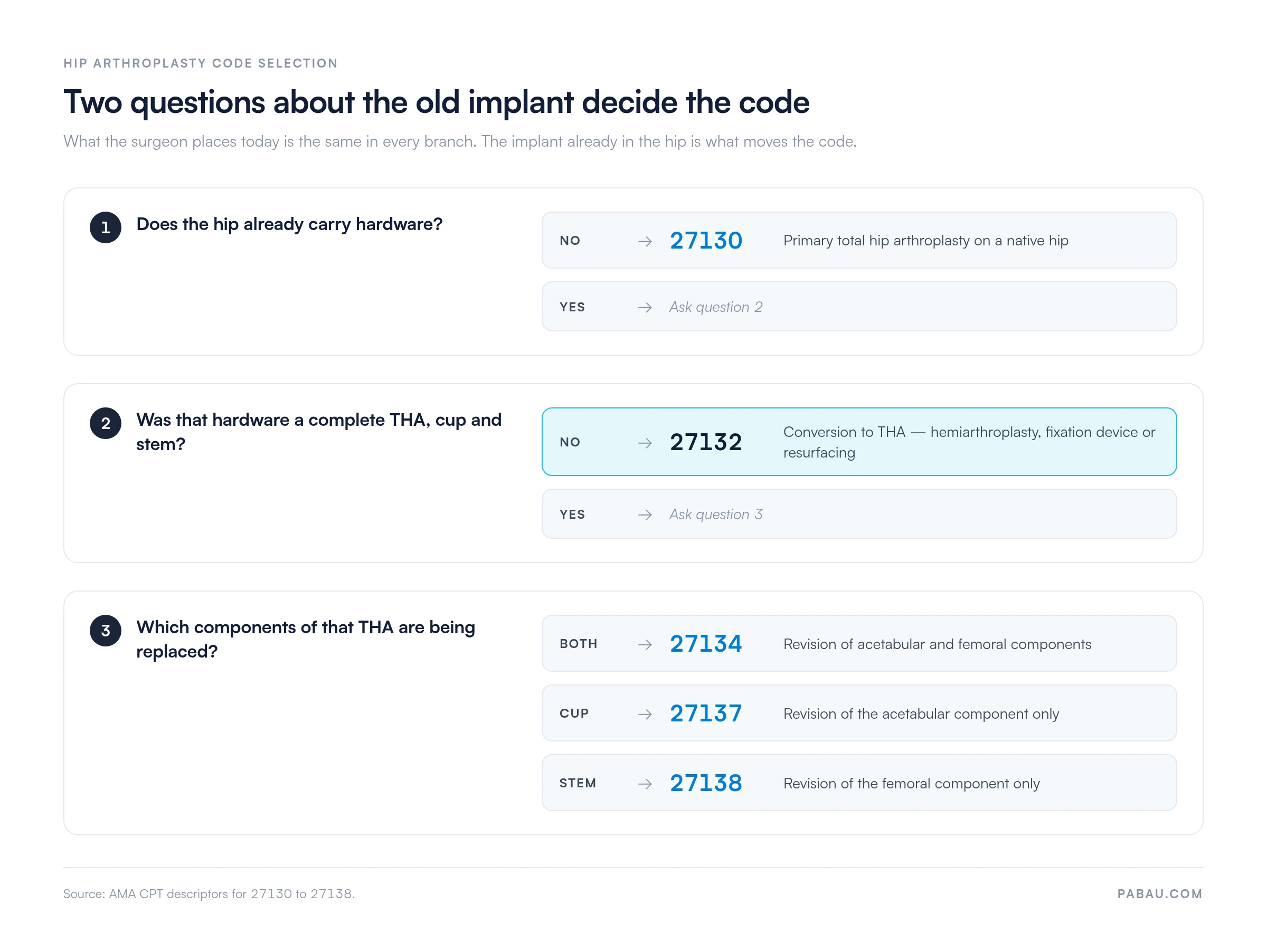
The distinction between 27132 and the 27134 to 27138 revision codes is the nature of the prior implant. If the patient previously had a complete THA, both cup and stem, later replacement of components falls under the revision family. If the prior implant was less than a complete THA, the surgery that creates one is a conversion, coded 27132. When the hip was native before this surgery, the claim belongs on 27130 instead.
Payers routinely deny 27132 claims over missing paperwork rather than clinical ineligibility. The operative note and supporting records have to establish what was in the hip before, what the surgeon did, and why. Pull the claim package from these sources.
Medicare coverage for CPT code 27132 runs through LCD L34163, Total Hip Arthroplasty, which sets out the indications that establish medical necessity. That policy replaced the retired L36573 on November 6, 2025. The ICD-10-CM codes below are among those most commonly accepted, and the ICD-10-CM code reference carries the full descriptors. Check your own MAC’s covered-diagnosis list before submission, since jurisdictions differ.
Always confirm that the selected primary ICD-10 code is on the payer’s covered list for 27132 before submission. Z96.64x codes function as secondary codes and do not establish medical necessity on their own. Each must accompany a primary diagnosis code that justifies the procedure.
Run your ICD-10 code selection against your MAC’s LCD L34163 covered-diagnosis list before building the claim. MAC jurisdictions differ on which secondary codes need clinical justification attachments. A quick eligibility check through your clearinghouse catches a coverage problem while you can still fix it.
Missing or incorrect modifiers account for a significant share of 27132 denials. The table below covers the modifiers most commonly required or encountered on these claims.
For commercial payers, laterality modifier requirements vary. Some apply LT or RT to musculoskeletal codes, and others do not. Check the payer’s own policy, along with eligibility and modifier rules, before the claim is built.
The CMS Medicare Physician Fee Schedule sets payment rates for CPT code 27132 annually. For 2026, 27132 carries 45.03 total relative value units (RVUs), which pays about $1,504.04 nationally. Geographic Practice Cost Index (GPCI) values move that figure up or down in every locality, so pull your own rate from the CMS lookup.
The 2026 RVU components behind that figure are:
The 2026 conversion factor is $33.4009. Clinicians who qualify as advanced alternative payment model participants are paid on a slightly higher factor of $33.5675.
Payability in an ambulatory surgery center (ASC) depends on the CMS ASC Covered Procedures List for that year. Hip arthroplasty has moved on and off that list with regulatory updates, so check CMS data before you assume facility payment.
CPT code 27132 carries a 90-day global period, consistent with major musculoskeletal surgical codes. The global surgical package includes all routine post-operative care furnished by the operating surgeon (or their group) within 90 days of the procedure date. Billing separate E/M codes for routine follow-up visits within that window will be denied by Medicare and most commercial payers.
Services that remain separately billable during the global period include:
Orthopedic practices running high arthroplasty volumes need the global period start date tracked from the day of surgery. Build that check into the billing process, so E/M charges inside the 90-day window are caught before they go out.
Commercial payers almost always require prior authorization for CPT code 27132, and Medicare Advantage plans usually do too. Traditional Medicare (Parts A and B) does not, though LCD L34163 criteria still govern coverage. Either way, document the clinical indication in full before you submit the authorization request.
LCD L34163 lists these conditions as covered indications for THA, which extend to 27132:
Most commercial insurers want the operative plan, preoperative imaging, documentation of conservative treatment failure, and the proposed ICD-10 diagnosis code. Some plans also require functional assessment scores, such as the Oxford Hip Score or HOOS, to establish baseline disability. Capture the authorization number at charge entry and attach it to the claim before it leaves your system.
Denials on CPT code 27132 follow a short list of patterns, and most are correctable upstream of submission. Pull your remittance reports and sort them by claim adjustment reason code (CARC) to see which of the categories below is costing you.
The second-stage reimplantation scenario is the most nuanced application of CPT code 27132, and the one that generates the most coder questions. In a two-stage revision for PJI, the first stage removes the infected implant and places an antibiotic-impregnated spacer. The second stage, weeks to months later, removes the spacer and implants a new total hip arthroplasty construct.
Whether 27132 is appropriate for the second stage depends on what was present before the infection developed. Use this decision framework:
Coding authorities agree that 27132 can apply to a second-stage reimplantation when the pre-infection implant was not a complete THA. Where the prior implant was a full THA, the revision codes govern instead. The determination stays a judgment call, so review the operative note against current AMA guidance before you settle on a code.
Flag every two-stage revision case at scheduling. When the first-stage hardware removal is booked, tag the case for second-stage code review. Record the original implant type, hemiarthroplasty or complete THA, in the patient record at first-stage coding. The second-stage coder then picks between 27132 and 27134 without digging back through the surgical history.
Most orthopedic billing teams assemble a 27132 claim by hand. The prior operative report sits in a scanned folder, the authorization number lives in a spreadsheet, and the implant stickers are photographed on a phone. A missing piece only surfaces weeks later, on the remittance.
Pabau keeps that material on the patient record, so the prior operative report, the imaging, the authorization number, and the implant details sit together. Claims go out electronically through Claim.MD, which checks each one against payer rules before it reaches the insurer.

The billing team then works from one list instead of three. Its time goes on the handful of 27132 claims that genuinely need a phone call, and rework stops eating the week.

Pabau keeps the operative report, the authorization number, and the implant details on one patient record, then submits through Claim.MD. Orthopedic billing teams spend less time rebuilding claims.

27132 claims fail for clerical reasons far more often than clinical ones. A missing laterality modifier, the wrong arthroplasty code, or a prior operative report left out of the package will each do it. All three are fixed upstream, at charge entry, rather than in an appeal.
Pabau submits 27132 claims through Claim.MD, which checks each claim against payer rules before the insurer sees it. To see how that fits an orthopedic billing workflow, book a demo with the team.

Need to understand how clearinghouse submissions work for surgical codes? Medical claims clearinghouse guide explains how 837 transactions, eligibility checks, and ERA reconciliation work together for high-value claims like 27132.
Working through a denial on a 27132 claim? Insurance credentialing for orthopedic practices covers how provider enrollment gaps can trigger denials on surgical claims and how to resolve them upstream.
Want a broader view of the billing lifecycle for surgical procedures? Best medical billing software for US practices compares platforms that handle complex orthopedic claim workflows, including modifier validation and prior auth tracking.
CPT code 27132 is the procedure code for conversion of previous hip surgery to total hip arthroplasty, with or without autograft or allograft. It applies when a prior hip implant, such as a hemiarthroplasty or a fixation device, is upgraded to a complete hip replacement. A native hip with no prior implant takes 27130, and replacing components of an existing THA takes 27134 through 27138.
Yes. Converting a hemiarthroplasty to a total hip arthroplasty is the primary clinical scenario the 27132 descriptor was written for. The operative note must confirm the existing hemiarthroplasty and document acetabular preparation and cup insertion. That cup is the step the original hemiarthroplasty never included, and the note must also record both components placed at this surgery.
Five patterns cover most of them. Coders submit 27130 instead of 27132, or leave the prior authorization number off the claim. Others omit the documentation that confirms prior hip hardware, or pick an ICD-10 code the LCD does not cover. The fifth is a missing laterality modifier, LT or RT, on a Medicare claim.
For 2026, CPT code 27132 carries 45.03 total RVUs, which pays about $1,504.04 nationally before geographic adjustment. The conversion factor behind that figure is $33.4009. Your locality’s Geographic Practice Cost Index moves the final amount, so check the CMS Physician Fee Schedule lookup for your own rate.



