ICD-10 code S92.321K: Right second metatarsal nonunion
S92.321K means a broken right second metatarsal has stopped healing ICD-10 code ...

Last Updated: Oct 21, 2026
Billable Code Specific Code
S65.899D is the billable ICD-10-CM code for other specified injury of other blood vessels at wrist and hand level of unspecified arm, subsequent encounter. It applies when the note identifies an injured wrist or hand vessel that has no dedicated S65 code and doesn't record the side.
The 7th character D applies only after active treatment has ended. Visits with new active treatment take A.
Let Pabau's smart automation suggest the right codes, reduce claim denials, and keep your practice compliant—effortlessly.
Automate repetitive tasks and focus on what matters most—your patients.
Reduce coding errors and ensure compliance with the latest regulations.
Clean claims, fewer denials, and faster reimbursements.
Powerful insights and reporting to help your practice thrive.
HIPAA compliant SOC 2 certified GDPR-compliant Trusted by 4,000+ clinics worldwide

S65.899D covers follow-up care for an injury to a documented wrist or hand blood vessel that has no dedicated S65 code.
The 7th character D is correct only once active treatment has ended. A visit with new surgery or active wound intervention takes A instead.
When the note records the right or left arm, use S65.891D or S65.892D. S65.899D is for notes that don’t document the side.
Documentation must confirm the prior injury, the current treatment phase and the injured vessel, or state that no more specific code applies.
Pabau’s claims management software validates S65.899D claims for missing or invalid details before they go out through the Claim.MD clearinghouse.
ICD-10 Code S65.899D is a valid, billable ICD-10-CM code. Its full official descriptor reads: Other specified injury of other blood vessels at wrist and hand level of unspecified arm, subsequent encounter. The code sits in category S65, Injury of blood vessels at wrist and hand level. That category falls under Chapter 19 of ICD-10-CM (Injury, poisoning and certain other consequences of external causes, S00-T88).
The “other specified” qualifier means the injured vessel has been identified clinically but has no dedicated code of its own in the S65 series. S65.899D is the unspecified-arm variant. When the note documents the side, use S65.891D for the right arm or S65.892D for the left.
The 7th character D signals a subsequent encounter. Active treatment is complete, and the visit is for routine monitoring, dressing changes, suture removal or follow-up imaging during healing.
The 7th character in injury codes (S00-T88) specifies the phase of treatment, not the nature or severity of the injury. The ICD-10-CM Official Guidelines (Section I.C.19.a) set out three encounter types that apply to S65.899:
The same guideline ties the 7th character to the treatment phase alone, so the provider seeing the patient doesn’t change it. A hand surgeon doing a wound check three weeks after the repair uses D, even as the operating surgeon. A primary care physician seeing the same patient for the first time at that wound check also uses D.
New surgery at a planned follow-up changes the code. A secondary debridement or vascular repair under anesthesia makes that encounter active treatment again, so the injury code used that day takes A.
All three codes share the same base descriptor, and the 7th character is the only difference. Picking the wrong one is a frequent cause of claim rejection for this code family. The table below maps clinical scenarios to each variant.
A common miscoding pattern: using S65.899A on a follow-up visit because the coder reads “initial” as the first time this provider sees the patient. Once active treatment has ended, each later visit takes D, whoever the provider is.
Category S65 covers injuries of blood vessels at the wrist and hand level. Most named vessels in it have their own codes. S65.899, and therefore S65.899D, applies only when the injured vessel is identified but doesn’t map to one of those more specific codes.
Named vessels with their own S65 codes (don’t use S65.899D for these):
S65.899D fits when the provider has documented the vessel in the visit or operative note, and that vessel matches none of the codes above. Common examples include small collateral vessels, unnamed palmar branches, or dorsal hand vessels identified during surgery. The decision path below runs the four checks that lead to this code, one character at a time.
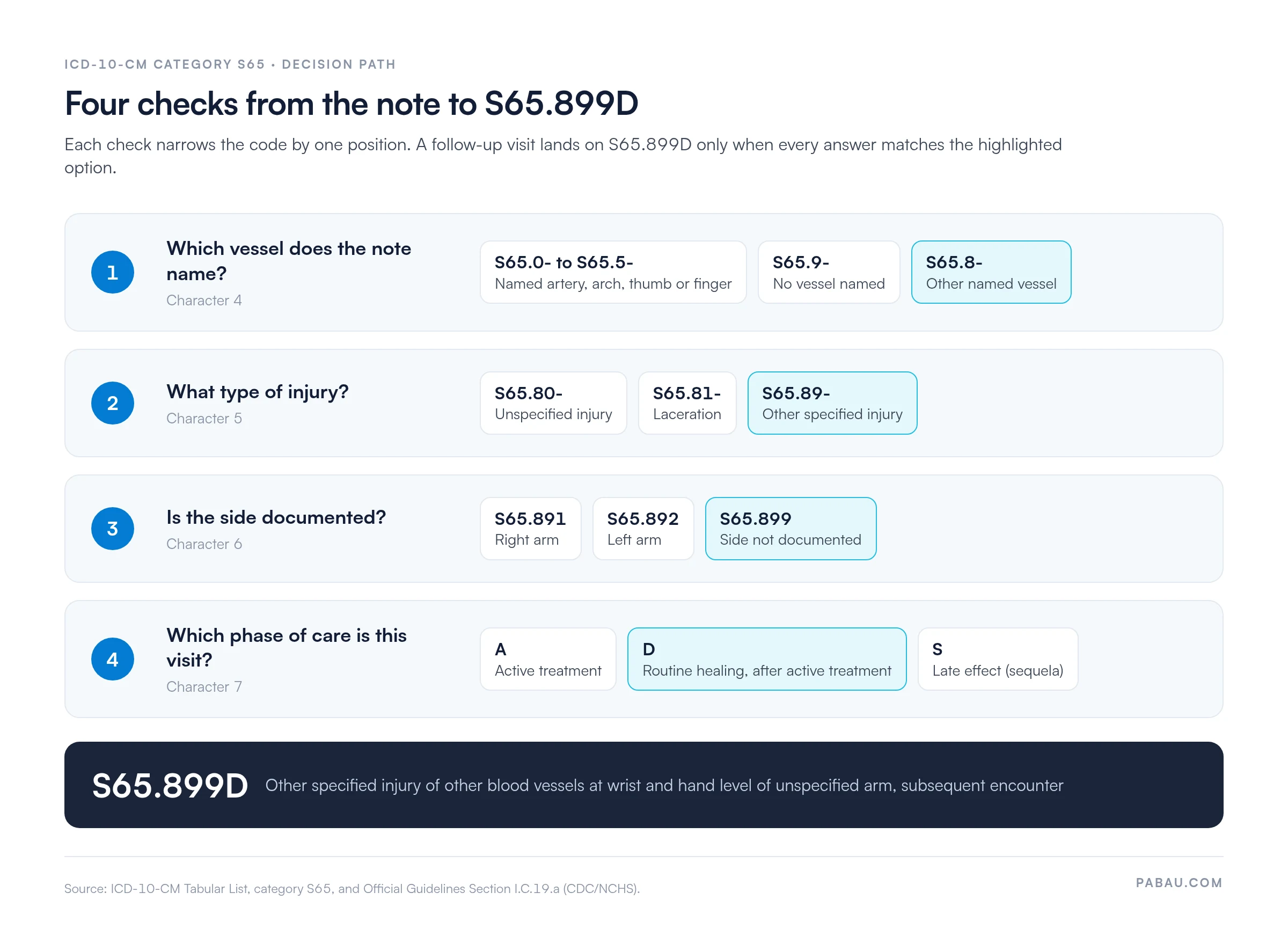
Neighboring codes coders confuse with S65.899D:
The medical record must support two things at once: the underlying injury (the S65.899 base) and the encounter type (the D). Auditors and payers check both, and missing either one is grounds for denial or recoupment.
What the record must contain for a clean S65.899D claim:
Structured documentation templates support the medical billing workflow, because coders no longer have to interpret ambiguous notes under time pressure. A follow-up encounter template can prompt the provider to confirm the treatment phase and the side explicitly.
The procedure codes billed alongside S65.899D depend on what happens at the follow-up visit. The table below covers the most common pairings.
Debridement billed under CPT 97597 is reported by wound surface area, so the note should record the size debrided. A unilateral or limited patency check after the repair is reported under 93931.
Active intervention at a follow-up visit: a secondary vascular repair or a return to the operating room is active surgical treatment. The injury code for that encounter reverts to S65.899A, not D. The 7th character follows the treatment episode, not the appointment type.
Payer policies for subsequent-encounter vascular injury codes vary. The overview below covers the main payer categories. Always check current local coverage determinations (LCDs) before submitting, as policies change.
Confirm active coverage and any plan-specific requirements before the visit. After submission, read the electronic remittance advice (ERA/835) for 7th-character rejections and correct them before they age into denials. A structured denial management workflow that tracks initial and subsequent encounter pairs by patient helps practices with high volumes of injury follow-up claims.
These are five denial patterns billing teams see with this code, along with the correction for each.
Before you submit an S65.899D claim, confirm that an S65.899A claim exists for the same patient and injury, from your practice or another facility. If it doesn’t, pull the initial encounter documentation and attach it up front. This one step prevents a common denial on subsequent-encounter vascular injury codes.
Catching these patterns before submission saves a resubmission cycle. The clean claim standard for injury codes means every mandatory field, including the encounter-type character, is correct before the claim leaves the practice.
Coders selecting S65.899D should know the surrounding S65 codes, so they can confirm they’re using the most specific one available. Our ICD-10-CM code library and the AAPC’s ICD-10-CM lookup help when reviewing the S65 hierarchy alongside the Tabular List.
Follow-up injury claims often get handled in pieces. Someone checks coverage by phone, someone else keys the claim, and a rejection only surfaces when the remittance arrives.
Pabau, the practice management and billing platform we build, keeps those steps in one place. Its claims software for practices validates each claim for missing or invalid details before submission. Claims then go out through the Claim.MD clearinghouse, which also handles eligibility checks, claim status and electronic remittance advice.
Your coder still picks A, D or S, and the right side code, from the note. Pabau handles the submission side. A rejected follow-up claim shows up in the remittance, so your team can correct it while the visit is still fresh.

Pabau validates claims for missing or invalid details before submission and sends them through the Claim.MD clearinghouse. See how it works for hand and wrist injury follow-up billing.

S65.899D comes down to checks you can make from the note before the claim goes out. Has active treatment ended? Does the documented vessel fall outside every named S65 code? Is the side missing from the note? Three yes answers point to S65.899D, and a recorded side moves the claim to S65.891D or S65.892D.
Build those checks into your follow-up visit template, and keep the initial-encounter record ready for every S65.899D claim. It adds a few lines to each note. In return, the claim answers a payer’s likely questions before they’re asked.
Book a demo to see how Pabau validates and submits hand and wrist injury follow-up claims from one system.

Need to understand the full clearinghouse claim pathway? Pabau’s Claim.MD clearinghouse guide explains how electronic claims travel from submission through ERA receipt.
Working through a denial on an injury claim? Denial codes in medical billing covers the most common CARC reason codes and correction steps for rejected claims.
Need to verify eligibility before a follow-up visit? Insurance eligibility verification outlines how real-time eligibility checks prevent coverage-related denials on subsequent-encounter claims.
Coding a left-arm vessel injury the note doesn’t name? ICD-10 code S65.992D covers the unspecified-vessel version of this follow-up code.
S65.899D is the billable ICD-10-CM code for other specified injury of other blood vessels at wrist and hand level of unspecified arm, subsequent encounter. The “other specified” qualifier means the injured vessel is identified clinically but has no dedicated code in the S65 series. The D shows the patient is in the routine healing phase after active treatment.
Use S65.899A while active treatment is ongoing. That includes emergency visits, surgical repair, and any encounter where the provider is actively managing the acute injury. Use S65.899D for each later visit once active treatment has ended, such as wound checks, suture removal, dressing changes and follow-up imaging during healing. If new surgery happens at a planned follow-up, use S65.899A for that encounter.
A subsequent encounter (7th character D) happens while the injury is still healing and the patient receives routine recovery care. A sequela (7th character S) applies once the injury itself has resolved and a late effect is the reason for the visit. Examples include scar contracture, chronic pain or reduced grip strength. The sequela character is never used while the wound is still healing.
Common denial causes include a missing initial-encounter record and a D character used on an active-treatment visit. Some payers may ask for the S65.899A record before paying a subsequent encounter. Confusion between an S65.9- code and S65.899D, an undocumented vessel, and an unspecified-arm code billed when the side is documented also lead to rejections.
Yes. S65.899D is valid for outpatient, office, and facility-based subsequent encounter visits. It fits any encounter for routine follow-up care while an other-specified wrist or hand blood vessel injury heals, whatever the care setting. The provider’s note must confirm the treatment phase to support the D character on any outpatient claim.
Yes, S65.899D is a valid billable code accepted by Medicare and Medicaid for FY2025 and FY2026. Medicare fee-for-service does not typically require prior authorization for routine follow-up wound care, but applicable LCD policies for wound management procedures (97597, 97598) may apply. Verify current LCD requirements through the relevant Medicare Administrative Contractor before billing complex wound care procedures alongside this diagnosis code.