ICD-10 Code Y76.0: Diagnostic obstetric and gynecological devices
ICD-10 Code Y76.0: Definition and billable status ICD-10 Code Y76.0 is a valid, ...

Last Updated: Oct 23, 2026
Billable Code Specific Code
S65.992D is the billable ICD-10-CM code for other specified injury of unspecified blood vessel at wrist and hand of left arm, subsequent encounter.
One word in that descriptor does a lot of work. "Unspecified" attaches to the blood vessel, not to the arm. The record does not name which vessel was injured, but it does place the injury on the left side.
Two characters decide whether the claim is paid. The sixth carries the side of the body, and the seventh carries the phase of care. Coders at orthopedic practices, hand surgery centers, and physical therapy practices meet this pair on every post-operative wrist claim.
Let Pabau's smart automation suggest the right codes, reduce claim denials, and keep your practice compliant—effortlessly.
Automate repetitive tasks and focus on what matters most—your patients.
Reduce coding errors and ensure compliance with the latest regulations.
Clean claims, fewer denials, and faster reimbursements.
Powerful insights and reporting to help your practice thrive.
HIPAA compliant SOC 2 certified GDPR-compliant Trusted by 4,000+ clinics worldwide

ICD-10 code S65.992D describes other specified injury of an unspecified blood vessel at wrist and hand of the left arm, subsequent encounter.
The only unspecified element in this code is which blood vessel was injured. The side of the body is specified, and S65.992 is the left arm.
S65.991 is the right arm and S65.999 is the unspecified arm, so laterality must be read from the sixth character before the code is assigned.
S65.992D is billable and HIPAA-valid for FY2026. The parent code S65.992 is not billable without a 7th character.
The 7th character D applies only when active treatment is complete and the patient is receiving routine care, wound checks, or monitoring during healing.
Practice management software like Pabau checks claim fields for completeness before submission, then tracks the payer’s response through its Claim.MD integration.
The sixth character in the S65.99 subcategory carries laterality, and mixing it up is an easy mistake to make. Three codes share the same injury description and differ only by side. Reading that character before assigning the code is the most reliable way to avoid a laterality mismatch on the claim.
S65.999 is the code to avoid wherever the chart supports a side. Payers read unspecified laterality as a note that never recorded which arm was hurt, and many plans review those claims more closely. If the note records a left wrist or left hand injury, S65.992 with the correct 7th character is the accurate choice.
The parent code S65.992 becomes billable only when a 7th character is added. Selecting the wrong character is the fastest route to a denial. Per the CMS ICD-10-CM guidelines, the 7th character signals the clinical phase of care, not the severity of the injury.
A common mistake is applying S65.992A to every visit associated with the injury. Once the surgeon or treating clinician has completed active intervention, all later visits use the D suffix. That holds even when the patient returns several times during recovery.
The hierarchy tells coders which related codes exist and when a more specific one should be used instead. ICD-10 Code S65.992D follows this classification path:
That same structure is readable straight off the code, one character at a time.
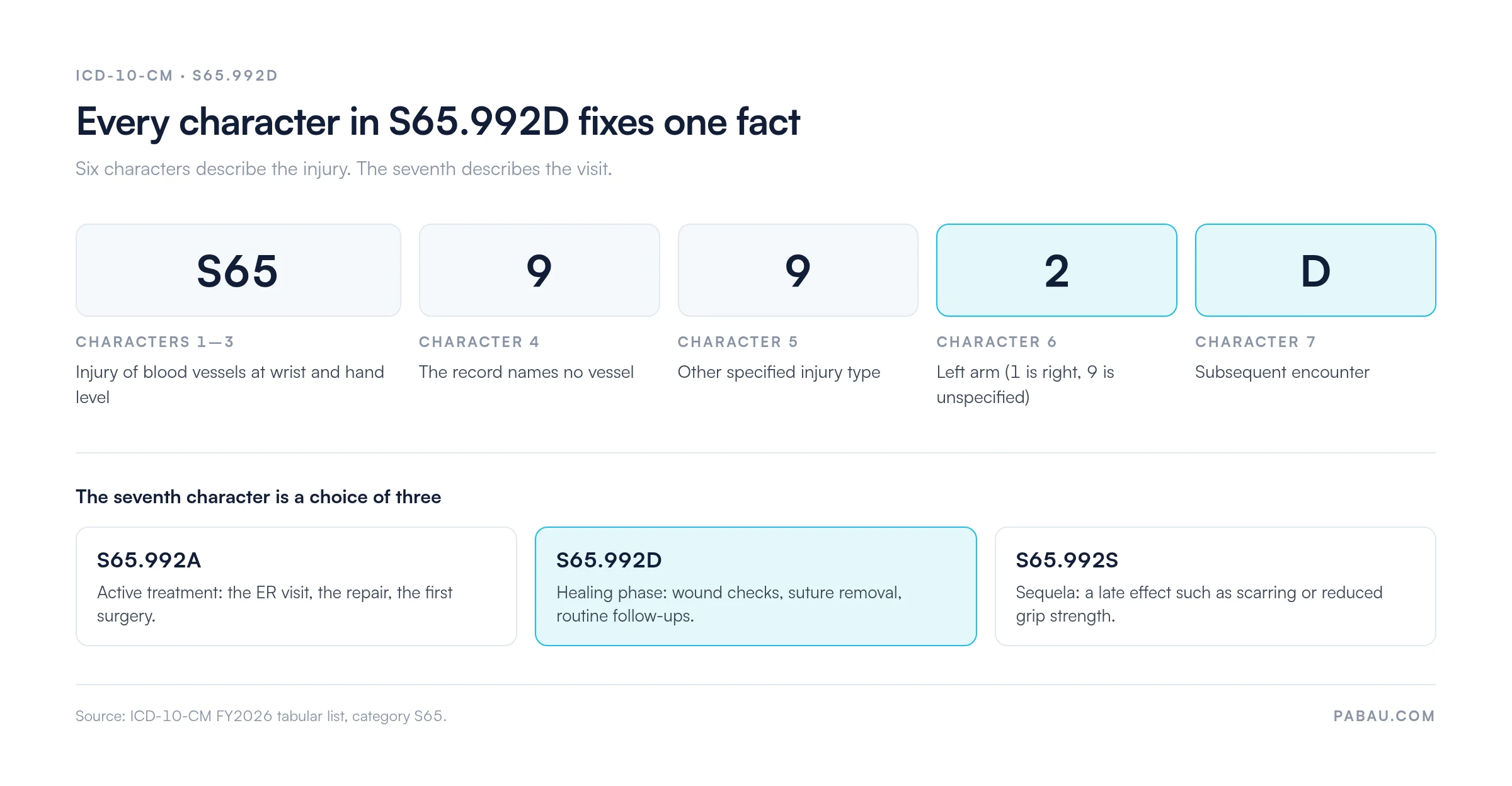
The “unspecified blood vessel” designation applies when the clinical documentation does not identify a named vessel, such as the radial or ulnar artery. It says nothing about laterality, which the sixth character already fixes as the left arm. If documentation does name a vessel, a more specific S65 code is appropriate. The CDC/NCHS ICD-10-CM web tool lets coders verify the full hierarchy before submission.
Always query the operative or clinical note for vessel identity before defaulting to ‘unspecified.’ If the radial artery, ulnar artery, or palmar arch is named, assign the corresponding specific S65 code for the left arm instead of S65.992D. Specificity reduces payer review risk.
S65.992D is appropriate when four conditions are met. The visit involves a blood vessel injury at the wrist or hand, and the documented side is the left arm. Active treatment has concluded, and the patient is receiving routine post-treatment care. The code does not require hospitalization, and it applies across outpatient, office, and physical therapy settings.
Typical clinical scenarios include:
This code does not apply to the initial emergency visit or surgical intervention. It also does not apply to visits where a new complication is actively treated. When a sequela such as ischemic change or scarring develops, shift to the S suffix. Practices that handle many hand surgery follow-ups benefit from 7th character prompts built into their documentation templates.
Submitting ICD-10 Code S65.992D without adequate clinical documentation is a common audit trigger. Payers expect the chart to substantiate the injury description, the side, and the encounter type. Missing any of these elements risks denial or post-payment review.
Required documentation elements:
Coders supporting orthopedic or hand surgery practices should build a documentation checklist that providers complete at each follow-up. Consistent notes also cut the time spent chasing denial codes when a payer questions the encounter type or the side. Digital intake and clinical note tools let a practice embed these prompts directly into its post-operative visit templates.
The S65 category carries one tabular instruction, and it shapes how S65.992D is reported alongside other diagnoses. Per AAPC’s ICD-10-CM reference, notes of this kind are binding, not advisory.
S65 carries no Excludes1 or Excludes2 note of its own, so the tabular list bars no code pair at this level. Watch for the neighboring blocks instead. An injury of the brachial vessels belongs to S45, and an injury at forearm level belongs to S55, so neither is coded from S65. Our guide to clean claim submission shows how these rules play out at billing.
Coders working with wrist and hand vascular injuries should know the sibling codes inside the S65.99x family and the categories next to it. The table below is a working cross-reference.
Two distinctions in that table are worth pinning down. S65.99x means the record describes a specific injury type that has no dedicated code, while S65.90x means the injury type itself was never described. Laterality then sits in the sixth character across both, which is why S65.992 and S65.902 both point to the left arm. Practices handling high volumes of wrist injury follow-ups can build a quick-reference card from this table.
Practices migrating legacy records or working with older payer data sometimes need the ICD-9-CM equivalent. The General Equivalence Mappings treat each 7th character differently, and the D suffix is the one that surprises people. ICD-9-CM recorded follow-up care with an aftercare V code rather than with the injury code, so S65.992D maps to V58.89.
Every row above is flagged approximate, so none of it is a billing instruction. The mappings exist for documentation continuity and research. ICD-9-CM carried neither laterality nor encounter type inside the code, which is why one ICD-9 code answers to many ICD-10 codes. The rows come from the CMS and NCHS diagnosis GEM files.
Clinical documentation may use different phrasing than the official ICD-10-CM code descriptor. The following terms and phrases map to S65.992D, and they commonly appear in operative notes, referral letters, and discharge summaries:
When the clinical note uses phrases like these, S65.992D is likely the appropriate code, provided active treatment has concluded. If the language suggests ongoing surgical or procedural management, query the provider before assigning the D suffix.
Build a synonym glossary for your wrist and hand injury code set. Map common operative note phrases to the correct ICD-10-CM codes, including laterality and 7th character variants. This reduces coder research time per claim and standardizes output across your billing team.
Accurate S65.992D assignment turns on two facts at every follow-up visit. The note has to show that active treatment ended, and it has to name the side. The billing workflow then has to carry both onto the claim without dropping either one.
Pabau is practice management software that keeps charting and billing in the same patient record. Its one-system claims management connects to the Claim.MD clearinghouse, which submits CMS-1500 and 837P claims to US payers. The integration also runs real-time eligibility checks, tracks claim status, and posts electronic remittance advice back to the practice.
A clearinghouse checks that the claim itself is complete and correctly formatted. It does not read your clinical note. That pathway cannot tell you that D should have been A, or that the chart says right where the claim says left. Those two checks belong upstream, at the point the note is written.
So put the questions in the follow-up template rather than in the claim scrub. Ask the clinician to state the side and to confirm that active treatment has ended. Pabau’s clinical note templates can carry both prompts, and the answers travel with the record through to the claim.

Pabau’s claims management software checks each claim for missing fields, submits it through Claim.MD, and tracks the payer’s response. Your billing team sees a rejection the same day instead of weeks later.

Wrist and hand vascular injury follow-ups are ordinary visits that get denied for unremarkable reasons. Some coders apply A at every visit, including the ones after active treatment ended. Others read “unspecified” in the descriptor as unspecified laterality, then pick the wrong sibling code.
S65.992D is the code for a left arm injury once active treatment is done and the patient is healing. Record the side and the phase of care in the note itself, and confirm vessel specificity with the treating clinician before you assign it. Do that consistently and the claim stops being a judgment call. Book a demo to see how Pabau moves those details from the note onto the claim without re-keying.

Coding the late effects of a wrist vessel injury? ICD-10 Code S65.919S works through the S suffix on a closely related wrist laceration code.
Want to reduce denials across your injury code submissions? Denial management in healthcare outlines the most common claim rejection patterns and how to address them systematically.
Need a full picture of the claims process from submission to payment? What is revenue cycle management covers the end-to-end billing workflow that connects ICD-10 coding to reimbursement.
ICD-10 Code S65.992D is a billable diagnosis code. It covers other specified injury of an unspecified blood vessel at wrist and hand of the left arm, subsequent encounter. The code applies when a patient returns for routine care, a wound check, or monitoring after active treatment of the vascular injury has been completed.
S65.992D is the left arm. The sixth character carries laterality in this subcategory, so S65.991 is the right arm, S65.992 is the left arm, and S65.999 is the unspecified arm. The word unspecified in the descriptor refers to the blood vessel, not to the side of the body.
Yes. S65.992D is a fully billable, HIPAA-valid ICD-10-CM code for FY2026. The parent code S65.992 without a 7th character is not billable; the D suffix makes it specific and submittable.
The parent code is S65.992, which is non-billable on its own. It describes other specified injury of unspecified blood vessel at wrist and hand of left arm, without specifying the encounter type. A 7th character of A, D, or S must be added to make it billable.
Directly related codes include S65.992A for the initial encounter, S65.992S for sequela, S65.991 for the right arm, and S65.999 for the unspecified arm. S65.902 covers an unspecified injury of an unspecified blood vessel in the left arm. For named vessel injuries, specific S65 codes covering the radial artery, ulnar artery, and palmar arch are more appropriate.