ICD-10 Code S88.119A: Complete traumatic amputation of lower leg
ICD-10 code S88.119A: Definition and code structure ICD-10 Code S88.119A is the ...

Last Updated: Oct 22, 2026
Billable Code Specific Code
S65.312S is the billable ICD-10-CM code for laceration of deep palmar arch of left hand, sequela. It applies at visits that treat a residual condition, such as scar contracture, grip weakness, or chronic pain, after the original laceration has healed.
The seventh character S separates it from S65.312A, used during active treatment, and S65.312D, used for routine healing-phase care. The condition being treated gets its own code, sequenced before S65.312S.
Let Pabau's smart automation suggest the right codes, reduce claim denials, and keep your practice compliant—effortlessly.
Automate repetitive tasks and focus on what matters most—your patients.
Reduce coding errors and ensure compliance with the latest regulations.
Clean claims, fewer denials, and faster reimbursements.
Powerful insights and reporting to help your practice thrive.
HIPAA compliant SOC 2 certified GDPR-compliant Trusted by 4,000+ clinics worldwide

S65.312S codes a laceration of the deep palmar arch of the left hand at a sequela encounter, and the right-hand code is S65.311S.
The seventh character S applies once the acute injury phase is over and the visit treats a late effect or residual condition.
The nature-of-sequela code is sequenced before S65.312S, per ICD-10-CM Official Guidelines Section I.C.19.a.
Using A or D at a sequela visit is the most common denial driver for this code.
Pabau’s claims management software helps practices submit and track sequela-phase claims through its Claim.MD clearinghouse integration.
ICD-10 Code S65.312S is the billable ICD-10-CM code for a laceration of the deep palmar arch of the left hand, reported at a sequela encounter. It is valid for fiscal year 2026, and the table below lists the reference fields coders check before submitting a claim.
The deep palmar arch is a vascular loop formed mainly by the terminal branch of the radial artery. The ulnar artery’s deep branch completes it. It runs across the palm at the level of the metacarpal bases. It sits deeper than the superficial palmar arch, which lies closer to the skin.
ICD-10-CM codes the two arches separately because they are distinct vessels at different depths. A laceration at the deep arch typically needs more complex vascular exposure than one at the superficial arch, and the operative report should say so. The documentation must clearly support three anatomical details:
Per the CDC/NCHS ICD-10-CM web tool, S65.312 is classified under category S65 (Injury of blood vessels at wrist and hand level). That category sits within the S60-S69 block, which covers injuries to the wrist, hand, and fingers.
Understanding the classification path helps coders audit whether a code is correctly selected and catch the instructional notes that apply higher up the tree.
Category S65 carries a “Code also” note for any associated open wound of the wrist, hand, and fingers (S61.-). At block level, S60-S69 has an Excludes2 note for burns and corrosions (T20-T32) and frostbite (T33-T34), which are coded separately when present.
ICD-10-CM assigns three seventh-character options to S65.312. Each maps to a distinct phase of care, and selecting the wrong one is a payer edit trigger.
Per ICD-10-CM Official Guidelines Section I.C.19.a (published by CMS), a sequela is a condition that results directly from a previous injury. It is not the same as a subsequent encounter. A subsequent encounter (character D) is still treating the original wound. A sequela encounter (character S) is treating something new that grew out of it.
The practical test: ask whether the wound itself is the reason for the visit. If it is, the visit takes D as its seventh character. If the wound healed long ago and the patient now has reduced hand function, pain, or scarring from that laceration, S applies. Then add the nature-of-sequela code first in the sequencing order. The decision flow below runs the same test in three questions.
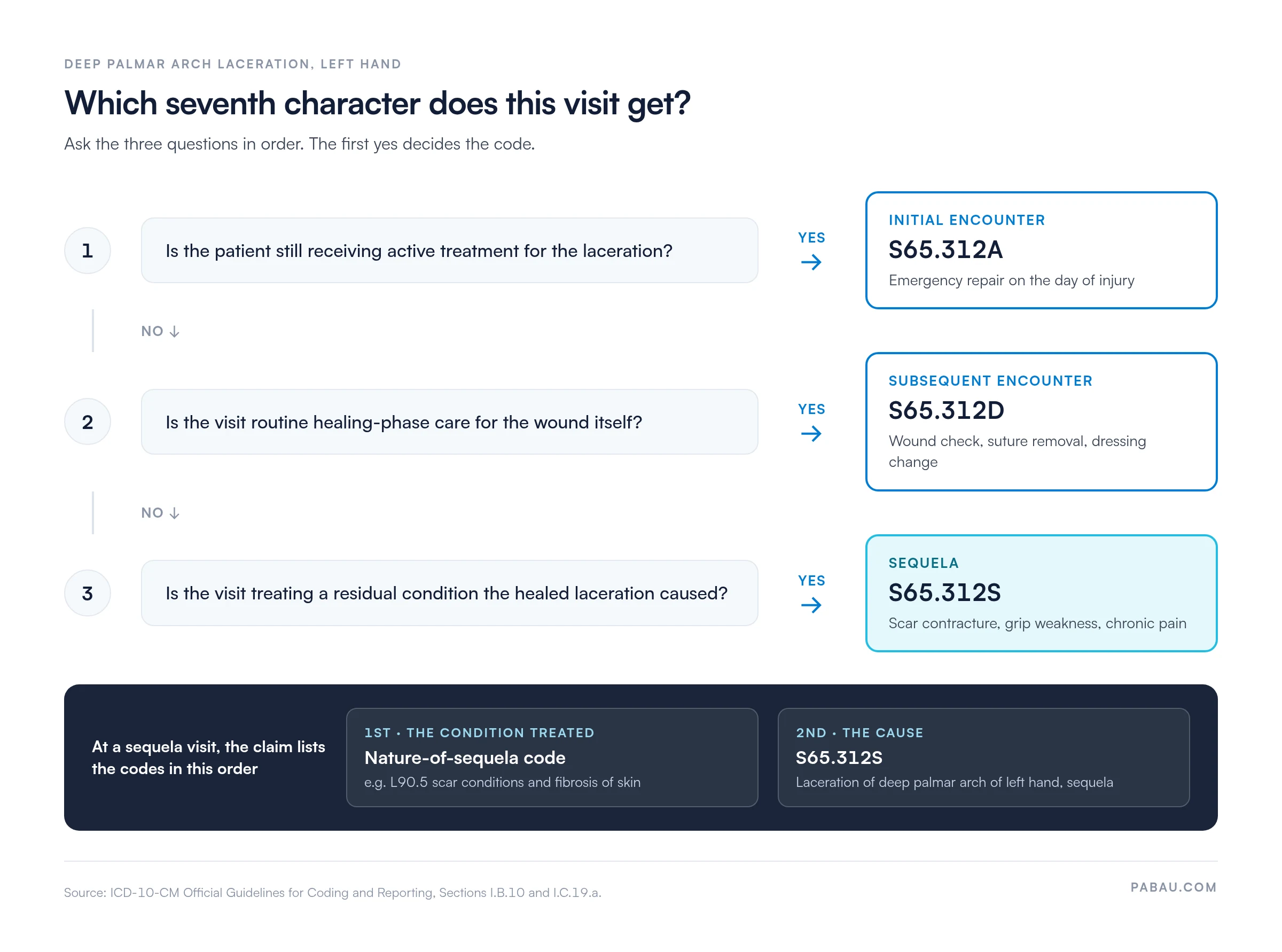
Coders working in hand surgery or vascular trauma will frequently encounter the sibling codes below. The table compares S65.312S with its closest coding neighbors and shows what separates each one.
Verify any specific code against the AAPC Codify ICD-10-CM lookup for the current fiscal year to confirm billable status before submission.
S65.312S is only defensible if the physician record explicitly supports every specificity element the code carries. Missing any one of these elements shifts the code to an unspecified or less specific alternative, which can trigger a medical-necessity denial.
Medical billing compliance processes, such as pre-visit documentation checklists and post-visit coding audits, catch a missing laterality or vessel name before the claim goes out.
Build a sequela-visit note template with four prompts for the treating physician. It should capture (1) the original injury date, (2) the named vessel, (3) the current residual condition, and (4) the causal link between them. A structured note template reduces back-and-forth with clinicians and shortens coding turnaround on sequela-phase claims.
The CPT code submitted alongside S65.312S depends entirely on what procedure is performed at the sequela visit. No single CPT is universally paired with this diagnosis code. The table below lists codes commonly seen in sequela-phase care of deep palmar arch injuries, in hand surgery and vascular repair settings.
Whichever CPT code is billed, the visit or operative note has to support it. The claim then lists the nature-of-sequela code first, with S65.312S after it.
Sequela-phase claims carry additional payer scrutiny because they require the provider to demonstrate a causal chain between a past injury and a current condition. Medicare, Medicaid, and most commercial payers apply specific adjudication rules to S-coded claims.
A clean claim for a sequela code pairs correct diagnosis sequencing with documentation that supports it. On returned claims, read the electronic remittance advice (ERA). Payers state the adjudication reason in the 835 transaction, which narrows the fix before resubmission.
Denials on S65.312S claims usually fall into five categories. Record each fix in the practice’s denial management process so the same error doesn’t repeat.
Track each denial type separately against the standard medical billing denial codes. That shows which problems are systemic (documentation workflow) and which are one-off (data entry errors).
ICD-9-CM had no code with the laterality and encounter-phase detail that S65.312S carries. The approximate predecessors are shown below, but the mapping is imprecise. ICD-9 grouped palmar artery injuries without separating the deep and superficial arches, and it had no seventh character for encounter phase.
For historical record reviews or payer audits involving pre-2015 claims, the Check ICD-10 lookup tool maps codes in both directions between ICD-9 and ICD-10-CM. ICD-9’s limited specificity is one reason medical billing now runs on ICD-10-CM for all current claims.
Without a connected system, coders often key S65.312S claims into a separate clearinghouse portal and check each payer response by hand. A sequela claim rejected for a missing nature-of-sequela code can then sit unnoticed for weeks.
Pabau, the practice management platform we build, keeps treatment notes, invoices and insurance claims in one system. Its claims management software submits claims through the Claim.MD clearinghouse integration and tracks the status of each one.
Code selection stays with your coder, who confirms the seventh character and the sequencing order against the note. What changes is the follow-up: rejected claims show up in the same place, so the team corrects and resubmits them sooner.

Pabau sends S65.312S claims through its Claim.MD clearinghouse integration and tracks each one’s status. Your team sees rejections early and resubmits corrected claims from the same system.

Reach for S65.312S only when the note proves three facts. The deep palmar arch was lacerated, the original wound has healed, and a named residual condition is being treated at this visit. If the note can’t show all three, the visit belongs to A or D instead.
The trade-off is setup time. A sequela note template takes a few hours to build, and it saves chasing clinicians for injury dates one claim at a time.
Book a demo to see how Pabau submits and tracks sequela-phase claims for hand and vascular injury practices.

Need a denial management framework? Denial management in healthcare walks through how to build a systematic process for tracking, appealing, and preventing claim rejections across code types.
Unfamiliar with clearinghouse workflows? Medical claims clearinghouse explains how electronic claims move from the practice to the payer and where sequencing errors get caught.
Want to understand ERA codes on returned claims? Electronic remittance advice covers how to read 835 transaction denial reason codes and use them to guide resubmissions.
ICD-10 Code S65.312S is the billable ICD-10-CM diagnosis code for laceration of the deep palmar arch of the left hand, sequela. It belongs to category S65 (Injury of blood vessels at wrist and hand level). It is used at visits that treat a late effect or residual condition of a prior laceration, not the acute wound itself.
Yes, S65.312S is a valid and billable ICD-10-CM code for fiscal year 2026. It is a complete seven-character code that meets payer submission requirements, provided it is paired with the correct nature-of-sequela diagnosis code sequenced before it.
Use the seventh character S when the visit treats a late effect of the original deep palmar arch laceration, after the wound has healed. If the wound is still actively being treated, use A (initial encounter) or D (subsequent encounter) instead.
S65.311S is the sequela code for laceration of the deep palmar arch of the right hand; S65.312S is for the left hand. The sixth character in the stem code (1 = right, 2 = left) determines laterality. Using the wrong code when laterality is clearly documented in the clinical record is a common denial trigger.
The most common denial reason is using the wrong seventh character: submitting S65.312A or S65.312D at a visit that is actually treating a sequela. Other frequent causes include a missing nature-of-sequela code, which must sequence first, and a laterality mismatch with the operative record. Thin documentation linking the current condition to the original laceration also triggers denials.
S65.312A applies at the initial encounter where active treatment of the acute laceration is provided, such as the emergency repair on the day of injury. S65.312S applies months or years later, once the wound has healed. The patient is then treated for a residual condition of that laceration, such as scar contracture or chronic pain.