ICD-10 Code S53.013D: Anterior subluxation of unspecified radial head
ICD-10 Code S53.013D: Quick reference summary Use the table below as your first ...

Last Updated: Nov 6, 2026
Billable Code Specific Code
S65.192S is the billable ICD-10-CM code for other specified injury of radial artery at wrist and hand level of left arm, sequela.
The 7th character S marks a sequela encounter. The patient presents with a lasting consequence of a prior left radial artery injury, such as cold intolerance or arterial scarring. The acute injury itself is not what is being treated. The condition the patient has now is coded first, and S65.192S follows it to name the cause.
Let Pabau's smart automation suggest the right codes, reduce claim denials, and keep your practice compliant—effortlessly.
Automate repetitive tasks and focus on what matters most—your patients.
Reduce coding errors and ensure compliance with the latest regulations.
Clean claims, fewer denials, and faster reimbursements.
Powerful insights and reporting to help your practice thrive.
HIPAA compliant SOC 2 certified GDPR-compliant Trusted by 4,000+ clinics worldwide

S65.192S codes a sequela of other specified left radial artery injury at wrist and hand level, distinct from initial (A) or subsequent (D) encounters.
The code is specific to the left arm, so a right-arm injury takes S65.191S and an unspecified arm takes S65.199S.
The sequela manifestation, such as chronic pain or a scar, is sequenced first, and S65.192S follows as the code for the causal injury.
A claim that reports S65.192S without the manifestation code breaks the sequencing rule and can trigger denials or payer queries.
Pabau, the practice and billing software we build, routes claims through Claim.MD edits that flag sequencing errors before submission.
ICD-10 code S65.192S reports other specified injury of the radial artery at wrist and hand level of the left arm, at a sequela encounter. It applies when the patient is treated for a lasting effect of the old injury, and that effect is coded first.
S65.192S sits within category S65, which the CDC/NCHS ICD-10-CM tabular list defines as injuries of blood vessels at wrist and hand level. The table below captures the key attributes coders need before submitting a claim.
S65.192S applies when a patient presents with a lasting consequence of a left radial artery injury at the wrist or hand level. The injury itself is historical. What the coder documents is the sequela, a condition that exists because of the original trauma.
The “other specified” qualifier is the key distinction. It means the documented injury was neither a laceration (S65.112S) nor left unspecified (S65.102S). Common scenarios that land here include arterial thrombosis after blunt trauma, post-traumatic arterial scarring, and documented pseudoaneurysms.
The physician’s documentation must explicitly connect the current condition to the prior radial artery injury. A vague reference to “wrist pain” without a link to the original trauma does not support S65.192S.
The ICD-10-CM Official Guidelines define three encounter types for injury codes through the 7th character. Picking the wrong one is a common coding error across the S65.192 family.
The clinical phase decides the switch from D to S, whatever the calendar says. A patient still healing from a repair is coded S65.192D, even months later. A patient whose injury has stabilized but who now has chronic vascular symptoms is coded S65.192S.
A practical test: Ask whether the treating clinician would describe the injury as “healing” or as “healed but causing ongoing problems.” Healing means D. Healed with lasting consequences means S.
S65.192S is tightly scoped. Several adjacent clinical scenarios require a different code entirely.
These are the codes coders reach for in error when S65.192S is the right answer, and vice versa. The difference is usually the vessel, the side, the injury type, or the anatomical level. Each character of the code carries one of those choices, as the breakdown below shows.
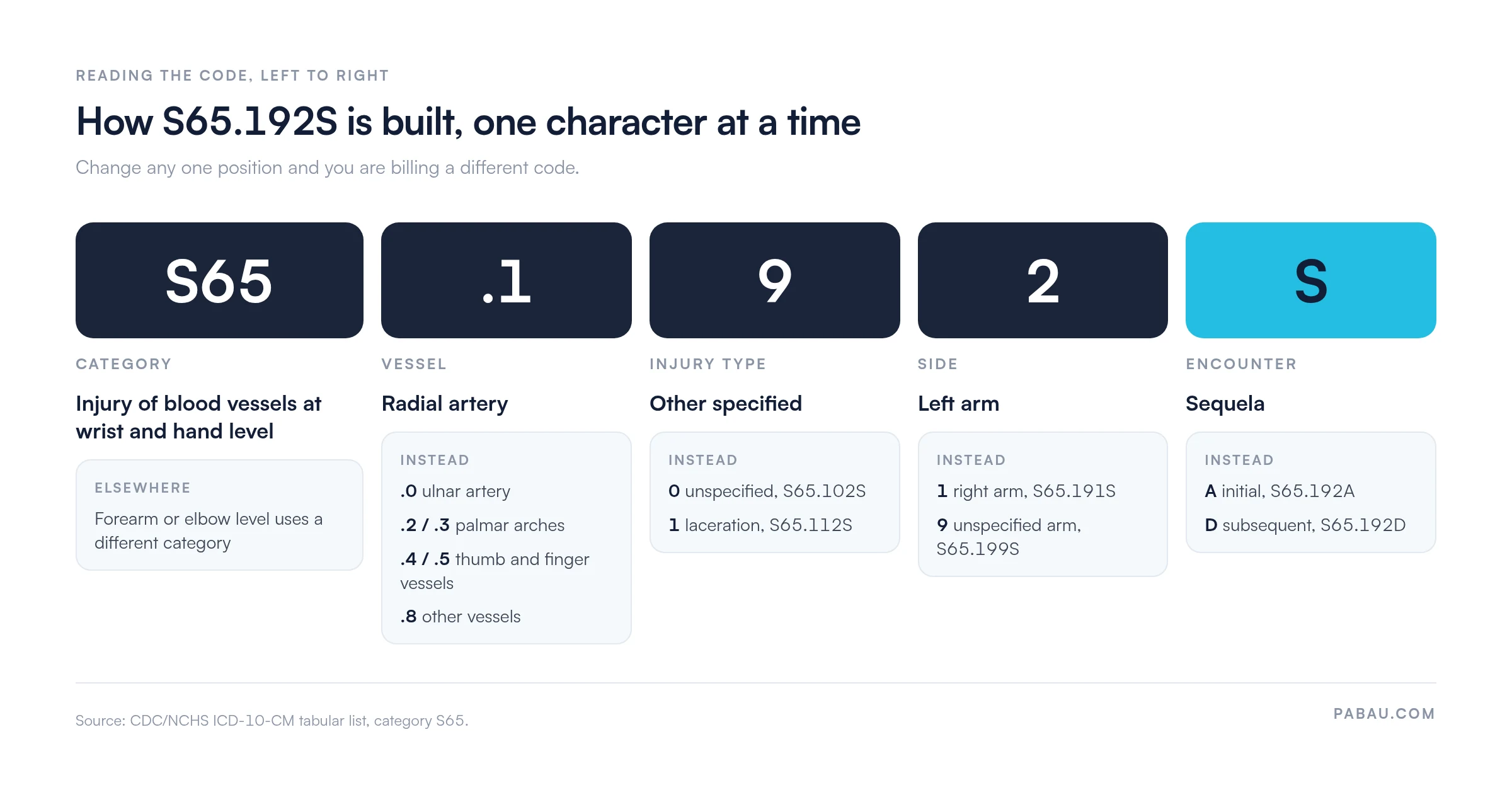
When documentation mentions a wrist vascular injury without saying radial or ulnar, query the physician before coding. Picking between the radial (S65.1-) and ulnar (S65.0-) subcategories on an assumption puts an anatomical error on the claim. Correcting it after submission needs an amended note.
Sequela encounters carry a higher documentation bar than initial or subsequent encounters. The medical record must support both the sequela condition itself and its causal link to the prior radial artery injury.
ICD-10-CM sequela coding rules require the sequela manifestation to be coded first. S65.192S is the causal injury code and sequences second, per ICD-10-CM Official Guidelines Section I.C.19.a. Omitting the manifestation code can trigger denials or payer queries.
Common secondary manifestation codes that pair with S65.192S:
The specific manifestation code depends entirely on what the physician documents. Never assume a manifestation code without explicit clinical support in the record.
No CMS National Coverage Determination (NCD) is specific to S65.192S. Coverage for treating radial artery injury sequelae follows the procedure performed, not the diagnosis code. The local coverage determination (LCD) and medical necessity rules for that procedure apply.
Key payer considerations for this code:
Always verify current LCD policies with your Medicare administrative contractor (MAC), as coverage parameters change with each fiscal year update. Billing platforms such as Pabau connect to the Claim.MD clearinghouse to run eligibility checks before submission. That surfaces payer-specific documentation flags before a claim is built.
Claims for S65.192S are denied for a predictable set of reasons, and most are preventable with documentation review before submission. Effective denial management starts with knowing which errors cause rejections for this code family. When a denial does arrive, our guide to denial codes explains how to read and answer the payer’s reason code.
Before submitting any S65.192S claim, run a two-step check. First, confirm the manifestation code appears first in the diagnosis list. Then confirm the physician note ties the current condition to the prior radial artery injury. Both must be present for the claim to clear payer edits.
Catching sequela errors on S65.192S usually comes down to two manual checks. Is the manifestation code listed first, and does the note state the causal link to the radial artery injury? On a busy billing day, either check can slip.
Pabau’s claims management software routes submissions through Claim.MD, which checks ICD-10-CM diagnosis combinations for pairing and sequencing issues. A missing manifestation code or a reversed sequence is flagged before the claim leaves the practice.
The platform also surfaces clean claim requirements by payer, and our clean claim guide covers them in depth. Your billing team fixes errors once, before submission, instead of working the same claim through a resubmission.

Pabau’s claims management tools flag sequencing errors and missing manifestation codes before submission, so S65.192S claims reach payers correctly the first time.

S65.192S is easy to look up and easy to get wrong on the claim. The trouble rarely starts with the code itself. It starts when the manifestation code is missing, listed second, or unsupported by the note, and that can trigger denials or payer queries.
The fix sits upstream of billing. Ask the clinician to name the lasting condition and tie it to the prior left radial artery injury in one sentence. Once that sentence is in the note, the sequencing follows from it.
Pre-submission edits then catch what slips through. To see how Pabau’s medical billing workflow checks sequela codes before a claim leaves your practice, book a demo.

Need to understand denial codes on rejected sequela claims? Denial codes in medical billing explains the most common CARC denial reason codes and how to respond to each.
Want to verify eligibility before a sequela encounter visit? Insurance eligibility verification covers how real-time eligibility checks catch payer mismatches before the patient arrives.
Looking for how electronic remittances map to denial patterns? Electronic remittance advice (ERA) explains how 835 transactions surface denial reason codes at the claim line level.
ICD-10 code S65.192S is the billable ICD-10-CM code for other specified injury of the left radial artery at wrist and hand level, sequela. It is used when a patient presents with a lasting complication of a prior left radial artery injury, not the acute injury itself. The 7th character S designates a sequela encounter per ICD-10-CM Official Guidelines Section I.C.19.a.
Yes, S65.192S is a valid, billable ICD-10-CM code confirmed in the CDC/NCHS ICD-10-CM database. It is valid for claim submission when the required sequela manifestation code is sequenced as the primary diagnosis. Submitting S65.192S without the manifestation code can trigger denials or payer queries.
S65.192A is for initial encounters when active treatment for the radial artery injury is ongoing. S65.192D is for subsequent encounters during the healing phase, such as wound checks and routine follow-up. S65.192S is for sequela encounters. The original injury has stabilized, but the patient now presents with a lasting consequence of it, such as chronic pain, arterial fibrosis, or functional impairment.
Use 7th character S when the original injury is past active treatment and healing. The patient must be presenting because of a lasting complication caused by that injury, and the treating clinician must document the causal relationship explicitly. If the injury is still healing, use D (subsequent encounter), even if significant time has passed since the original event.
Yes. ICD-10-CM sequela coding rules require the sequela manifestation to be coded first, with S65.192S sequenced second as the causal injury code. Examples include M79.642 for pain in the left hand or L90.5 for post-traumatic skin fibrosis. Submitting S65.192S without the manifestation code breaks the sequencing rules and can trigger denials or payer queries.
No NCD is specific to S65.192S. Coverage depends on the procedure being performed and the LCD applied by the local Medicare administrative contractor (MAC). Medicare accepts sequela codes when the record demonstrates treatment is for a consequence of a prior injury. Workers’ compensation payers require clear documentation linking the sequela to a work-related original injury. Always verify current MAC-level LCD policies, as parameters are updated each fiscal year.