ICD-10 Code T31.77: Burns involving 70-79% of body surface
ICD-10 code T31.77: Quick reference and code details ICD-10 code T31.77 is the b...

Last Updated: Nov 5, 2026
Billable Code Specific Code
S63.529A is the billable ICD-10-CM code for sprain of radiocarpal joint of unspecified wrist, initial encounter. It covers a ligament sprain where the distal radius meets the first row of carpal bones, coded while the patient receives active treatment.
Use it only when the record doesn't say which wrist was injured. When the note names a side, S63.521A (right) or S63.522A (left) is required, and S63.529A on that claim invites a payer query or denial.
Let Pabau's smart automation suggest the right codes, reduce claim denials, and keep your practice compliant—effortlessly.
Automate repetitive tasks and focus on what matters most—your patients.
Reduce coding errors and ensure compliance with the latest regulations.
Clean claims, fewer denials, and faster reimbursements.
Powerful insights and reporting to help your practice thrive.
HIPAA compliant SOC 2 certified GDPR-compliant Trusted by 4,000+ clinics worldwide

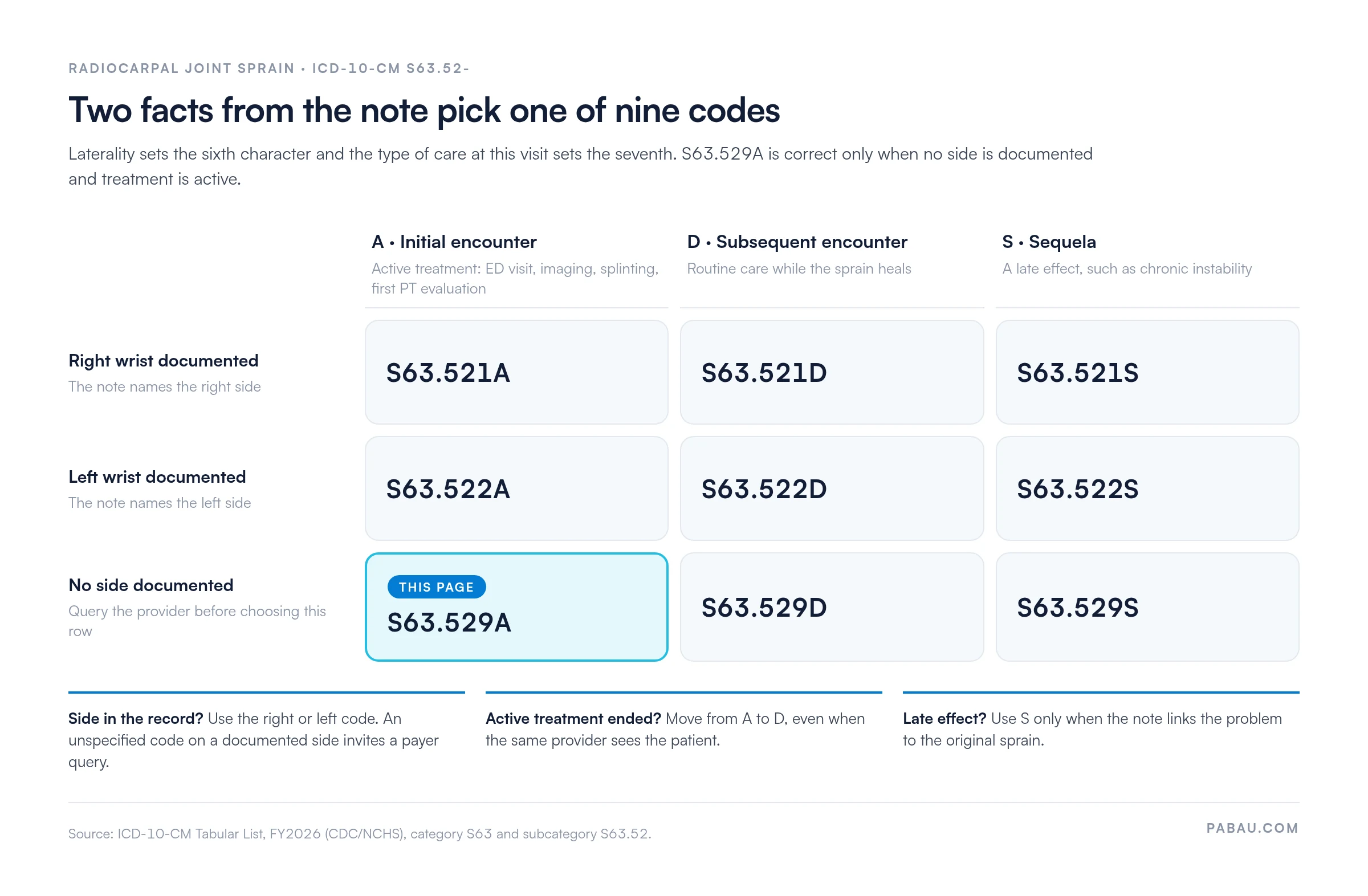
S63.529A codes a radiocarpal joint sprain of an unspecified wrist at the initial encounter. S63.521A covers the right wrist and S63.522A the left.
The 7th character A applies only while the patient receives active treatment. Switch to D for routine healing care and to S for a documented late effect.
Payers may query or deny S63.529A when the record names a side, so use the side-specific code whenever the documentation supports one.
Category S63 lists strains (S66.-) under Excludes2, so a wrist sprain and a tendon strain may both be coded when both are documented.
Pabau’s claims management software scrubs each claim for missing or invalid details before it leaves for the clearinghouse.
ICD-10 Code S63.529A is a specific, billable ICD-10-CM diagnosis code with the official descriptor: Sprain of radiocarpal joint of unspecified wrist, initial encounter. It became valid with the ICD-10-CM transition on October 1, 2015, and remains a valid, billable code in FY2026.
The ICD-10-CM tree narrows from body region to joint, then to side and episode of care:
The radiocarpal joint is the articulation between the distal radius and the proximal row of carpal bones (scaphoid, lunate, and triquetrum). It is the primary joint responsible for wrist flexion, extension, and radial/ulnar deviation. Ligaments that cross it include the palmar radiocarpal, dorsal radiocarpal, and ulnocarpal ligaments.
Coding accuracy depends on naming this joint, because wrist injury codes are anatomically specific. A radiocarpal sprain (S63.52-) is distinct from a sprain of the other wrist joints in S63.5. It also differs from a strain of the wrist muscles or tendons, which codes to category S66.
The note must name the radiocarpal joint, or record findings consistent with it, for S63.529A to hold up under audit.
The 7th character on S63.529 records the episode of care. Under the ICD-10-CM Official Guidelines for Coding and Reporting (Section I.C.19.a), you choose it by the treatment given at that encounter. The number of earlier visits doesn’t decide it.
A frequent 7th character error on wrist sprain claims is keeping A on every visit of the treatment course. Active treatment ends when the provider stops managing the acute injury. Once the patient moves to routine physical therapy for strength and mobility, 7th character D applies. A claim that keeps A past that point is open to denial.
S63.529A is the unspecified-side version of a radiocarpal joint sprain at the initial encounter. Use it only when the record does not say which wrist was injured. Unclear documentation calls for a provider query, and it is no reason to default to unspecified.
ICD-10-CM guidelines call for the most specific code the documentation supports. If the note says “right wrist” anywhere in the record, S63.521A is correct. Assigning S63.529A to a documented side is a specificity error. Some commercial payers and workers’ compensation carriers answer it with a records request or a denial.
When both wrists are sprained, report S63.521A and S63.522A together, because this subcategory has no bilateral code. The matrix below shows how the documented side and the type of care combine into one of nine codes.
Several neighboring codes look like S63.529A but describe a different injury or a different level of detail. Knowing where each one starts prevents both undercoding and crosswalk errors.
Category S63 carries an Excludes2 note for strain of muscle, fascia and tendon of wrist and hand (S66.-). Excludes2 means the strain is not part of S63, but a patient can have both injuries at once. When the note documents a radiocarpal sprain and a wrist tendon strain, code S63.529A and the matching S66 code together.
Subcategory S63.52 adds an Excludes1 note for traumatic rupture of radiocarpal ligament (S63.32-). Excludes1 means the two are never coded together, so a documented ligament rupture codes to S63.32- instead of a sprain code.
A claim submitted with S63.529A must be supported by a medical record that documents each of the following elements. Missing any one of them is enough for a payer to request additional documentation or issue a medical necessity denial. Clean claim submission starts with documentation that answers every element before the claim leaves the practice.
S63.529A doesn’t trigger prior authorization on its own. The CPT codes billed with it often do, particularly physical therapy services. The table lists common pairings in orthopedic and physical therapy settings, and payer bundling and medical necessity rules still apply.
Imaging usually comes first, and 73100 covers the two-view wrist X-ray that rules out a scaphoid fracture. Once treatment moves to rehabilitation, therapeutic exercise bills under 97110, and the diagnosis moves from 7th character A to D.
S63.529A alone doesn’t carry a prior authorization requirement under most commercial plans. Authorization rules attach to the CPT codes billed with it, and each payer type handles them differently.
Five denial patterns come up repeatedly on S63.529A claims. Each has its own fix, and lumping them together as “coding errors” slows resolution. A denial management workflow routes each denial to its fix using the reason codes on the remittance.
Most denied S63.529A claims can be corrected, because the cause is usually code selection or documentation and seldom a coverage exclusion. Follow these five steps in order.
Before resubmitting a denied S63.529A claim, run an eligibility check for the original date of service (DOS). Workers’ comp and secondary-payer coverage sometimes changes between injury and treatment. If the patient had no active coverage on the DOS, accurate coding won’t save the claim.
Many practices code a wrist sprain from the visit note, then rekey it into a separate billing tool. A laterality or 7th character problem then surfaces weeks later, on the remittance, when the provider has moved on.
Pabau, the practice management platform we build, keeps the visit note and the claim in one patient record. The coder reads the documented side and the treatment phase from the chart itself.
Pabau’s claims management software scrubs every claim for missing or invalid details before it leaves Pabau. A flagged claim links straight to the field that needs fixing.
Claims go out through the Claim.MD clearinghouse, and eligibility checks run before the visit. A lapsed workers’ comp or secondary policy then shows up at booking. Rejections come back with their reason, and ERA files settle payments against the same record.

Pabau scrubs each claim for missing or invalid details, checks eligibility through Claim.MD, and shows the reason behind any rejection. See how it fits your wrist injury billing.

S63.529A is a narrow code. It fits one situation: a radiocarpal sprain at an active-treatment visit, in a record that never names a side. Once the note says right or left, or care moves to routine rehab, a different code applies, and payers notice.
The cheapest correction happens before the claim goes out. Check the side and the treatment phase against the note at coding, and query the provider when either is missing.
Do that, and the denial fixes in this guide become rare. Book a demo to see how Pabau keeps the visit note and the claim in one record for wrist injury billing.

Need to understand how clearinghouse submission works for musculoskeletal claims? Medical claims clearinghouse guide covers how EDI transactions flow from practice to payer and what happens when they reject.
Looking for a primer on the 837P claim format for wrist injury submissions? 837 file format explained walks through the transaction set structure that carries S63.529A to commercial payers.
Want to understand electronic remittance advice for denial follow-up? Electronic remittance advice (ERA) guide explains how to read CARC and RARC codes to route each denial correctly.
ICD-10 Code S63.529A is the billable ICD-10-CM code for a sprain of the radiocarpal joint of an unspecified wrist, at the initial (active-treatment) encounter. It sits in subcategory S63.52, within block S60-S69 of Chapter 19. It is valid for US claims under HIPAA-mandated ICD-10-CM coding.
S63.521A specifies the right wrist, S63.522A the left wrist, and S63.529A applies when the documentation doesn’t identify which wrist was injured. Use S63.529A only when the side is unknown. If the note names a side, the side-specific code is required, and a bilateral sprain takes both S63.521A and S63.522A.
Use 7th character A while the patient receives active treatment for the acute sprain. Examples are an ED visit, a first PT evaluation, splinting, or imaging. Switch to D (S63.529D) once the injury is healing and the patient receives routine care, such as physical therapy for strength and mobility.
Yes, S63.529A is valid on a workers’ compensation claim for a work-related injury. Those claims also need causation documentation linking the sprain to a workplace event, a First Report of Injury, and any state-specific forms. Carriers scrutinize laterality closely, so use S63.521A or S63.522A whenever the note names the injured wrist.
Five reasons come up most often. The first two are 7th character A on a follow-up visit where D applies, and S63.529A on a record that names a side. The others are a note with no mechanism of injury and thin medical necessity documentation for paired PT services. Bundling errors on the accompanying CPT codes round out the list.
Payers typically request the full visit note. It should document the mechanism of injury, the joint involved, and the injury type, meaning a sprain rather than a strain or fracture. It should also give the side or the reason it is unknown, and confirm an active-treatment encounter. Imaging reports and the plan of care are often requested when physical therapy is billed alongside S63.529A.