ICD-10 Code S53.013D: Anterior subluxation of unspecified radial head
ICD-10 Code S53.013D: Quick reference summary Use the table below as your first ...

Last Updated: Nov 6, 2026
Billable Code Specific Code
S63.591D is the billable ICD-10-CM code for other specified sprain of right wrist, subsequent encounter. It covers routine care while the sprain heals after active treatment is complete, such as splint changes, medication adjustments, follow-up visits and physical therapy.
Assignment turns on two facts in the note. The documentation must name the right wrist, and it must place the visit in the healing or recovery phase rather than active treatment.
Let Pabau's smart automation suggest the right codes, reduce claim denials, and keep your practice compliant—effortlessly.
Automate repetitive tasks and focus on what matters most—your patients.
Reduce coding errors and ensure compliance with the latest regulations.
Clean claims, fewer denials, and faster reimbursements.
Powerful insights and reporting to help your practice thrive.
HIPAA compliant SOC 2 certified GDPR-compliant Trusted by 4,000+ clinics worldwide

S63.591D is a billable ICD-10-CM code for routine follow-up care of an other specified right wrist sprain during healing and recovery.
The 7th character D applies once active treatment is complete, while A covers every encounter where the patient receives active treatment.
Aftercare Z codes such as Z47.89 are not used for injuries, so recovery-phase visits stay on S63.591D.
The note must state right-side laterality and the encounter phase, or the claim can fall back to S63.599D or deny.
Pabau’s claims management software checks each claim for missing or invalid details before it goes out to the payer.
ICD-10 code S63.591D reports an other specified sprain of the right wrist at a subsequent encounter, which means routine care while the injury heals. The code builds from the S63 category down to seven characters, and each level narrows what a payer reads on the claim. The table below maps each level to its descriptor.
The parent codes S63.5, S63.59 and S63.591 are not billable. A claim carrying fewer than seven characters will reject. The full seven-character form S63.591D is required for a clean claim.
Yes. S63.591D is a valid, billable ICD-10-CM code confirmed in the official tabular list maintained by the CDC/NCHS ICD-10-CM web tool. It meets the requirement for full 7-character specificity.
“Other specified” means the physician documents a wrist sprain at a site that none of the named sprain codes covers. Carpal and intercarpal sprains classify to S63.51-, and radiocarpal sprains to S63.52-, so neither belongs under S63.591D.
What the code captures and what it excludes are worth knowing before you code:
When the note says only “right wrist sprain” with no site, the unspecified code S63.501D is the better fit. S63.591D needs a documented site, plus a visit in the healing phase after active treatment.
The 7th character D in S63.591D marks a subsequent encounter, which is routine care while the sprain heals after active treatment is complete. Coders often read D as “any visit after the first.” That misreading sits behind many wrist sprain claim errors.
The ICD-10-CM Official Guidelines assign A to each encounter where the patient receives active treatment, not only the first visit. D applies once that treatment is complete and the visit is for healing or recovery. Typical D visits include a splint change or removal, a medication adjustment, a follow-up check, and physical therapy.
The three 7th character options for this code each describe a distinct phase of the injury episode. Use the table below to identify the correct character for the visit being coded.
“Subsequent encounter” does not mean the injury has resolved. It means active treatment is complete and the patient is healing. The panel below sets the three characters side by side, with the one rule that decides each.
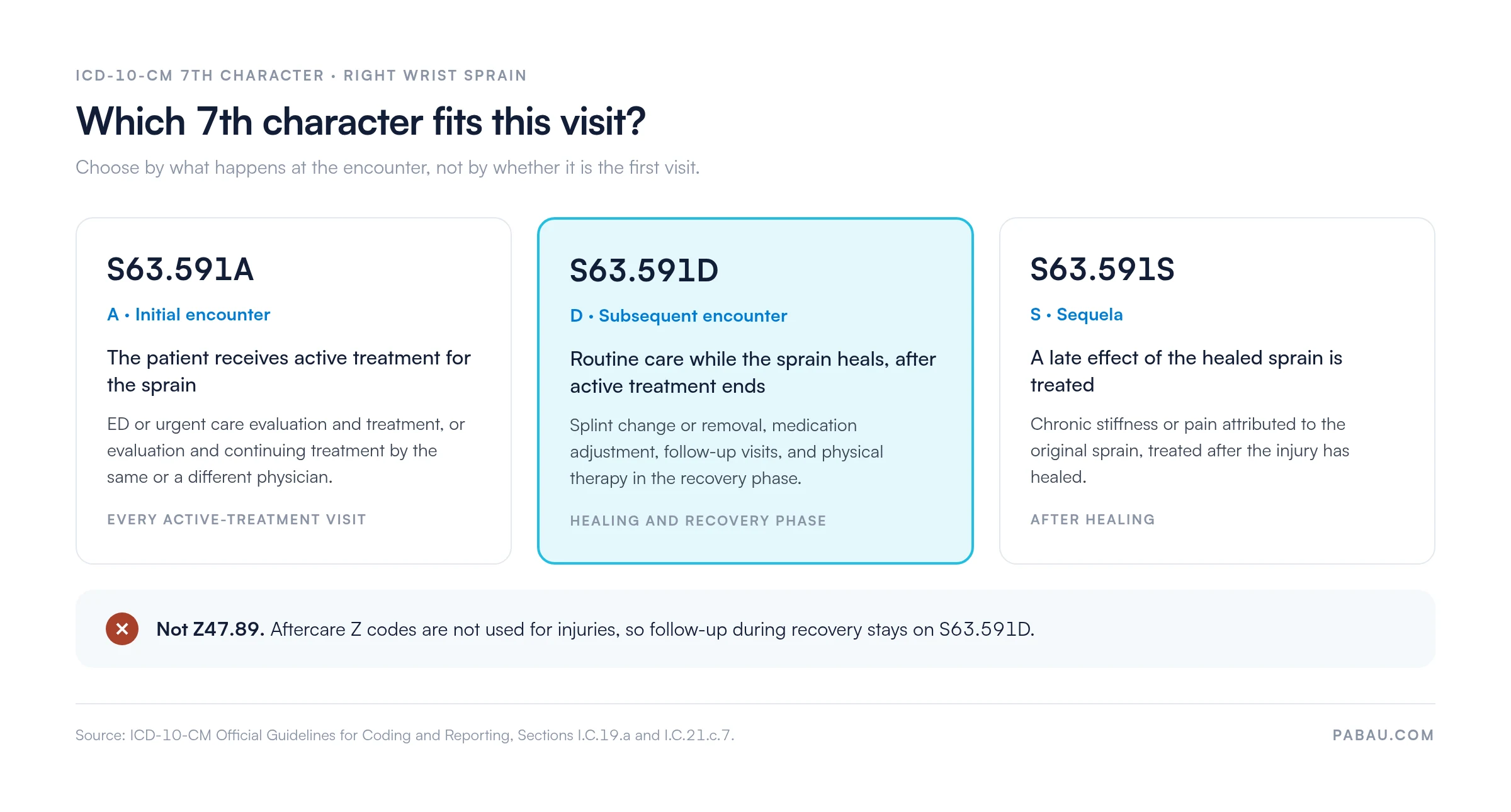
The ICD-10-CM tabular list and guidelines carry instructions on which codes can sit on the same claim as ICD-10 code S63.591D. For this code, the rules that matter most cover aftercare codes, open wounds, muscle strains, and neighboring sprain sites.
In practice, a recovery-phase visit for this sprain carries S63.591D, with no Z47.89 aftercare code beside it.
Several neighboring codes share similar descriptors with S63.591D and get swapped at the point of code selection. The table below covers the most common mix-ups.
The AAPC ICD-10-CM lookup and the ICD List code database both allow side-by-side comparison of these neighboring codes. That helps when the physician note is unclear about injury type or laterality.
A claim for S63.591D holds up in payer review when the treating clinician’s note contains four elements. Missing any one of them can trigger a denial or a records request.
Structured clinical notes with a required side field make the laterality element hard to skip. A clean claim starts with capturing the right fields at the point of care, not at the point of billing.
Run a documentation audit on 10 recent S63.591D claims and check each physician note for an explicit right side. A note that says only ‘wrist’ can push the claim to S63.599D or a denial. The physician can fix it at sign-off in a few seconds.
S63.591D typically pairs with procedure codes for evaluation and management, physical therapy services, imaging, and splinting. The table below lists the most common combinations, with notes on payer requirements that apply to physical therapy practices.
Physical therapy practices billing 97110 or 97530 with S63.591D should check whether the payer’s coverage policy limits PT visits before prior authorization. Tracking visit counts per episode of care flags when authorization is needed before the next appointment.
Claims management software catches missing or invalid claim details before the claim reaches a payer. In Pabau, the practice management platform we build, claim validation checks each claim before it leaves. US practices then submit through the Claim.MD clearinghouse.
Most S63.591D denials trace back to one of five coding or documentation errors. Each has a straightforward prevention step.
Denial management starts with tracking which reason code appears most often on S63.591D claims. That tells the billing team which documentation fix recovers the most revenue. The list of medical billing denial codes explains the claim adjustment reason codes (CARCs) and remark codes (RARCs) payers attach to these denials.
Each visit in the injury episode takes the 7th character that matches what happens at it. Aftercare Z codes stay off the claim throughout. The scenarios below show where the move from A to D, or from D to S, happens.
Coverage rules for wrist sprain follow-up visits vary by payer type. Knowing where they differ keeps authorizations current and cuts avoidable denials.
Medicare: CMS has no National Coverage Determination (NCD) specific to wrist sprains. Local Coverage Determinations (LCDs) from Medicare Administrative Contractors (MACs) govern when PT billed with S63.591D is reimbursable. Documentation must show that skilled PT is required, not just maintenance exercise. The CMS ICD-10 coding resources are the starting point, and practices should find their MAC’s LCD before billing PT past the initial evaluation.
Commercial payers: Many commercial plans cap PT visits per year, and limits vary by plan. An S63.591D claim past that cap without an approved authorization denies, whatever the clinical documentation says. Practices that run insurance eligibility verification at scheduling can confirm visit limits before the appointment.
Workers’ compensation: Workers’ comp coding for S63.591D follows jurisdiction-specific rules that may differ from standard ICD-10-CM guidelines. Some state systems require every claim to link the injury code to the date of injury. Encounter phase documentation (initial vs. subsequent) also gets audited more closely than in commercial billing. A grounding in medical billing across payer types helps coding staff apply the right rules to each claim.
Check your MAC’s current LCD for physical therapy services and filter your S63.591D claims by visit count per patient episode. Claims beyond the LCD’s coverage threshold that lack a signed plan of care or functional outcome documentation are the most predictable denial category. They are also the easiest to prevent with a pre-submission worklist.
On a wrist sprain claim, the costly errors usually start in the note. The physician writes “wrist” without a side, or records a recovery visit without saying active treatment has ended. Days later, the coder has to guess between A, D and the unspecified code.
Pabau’s digital forms and treatment notes can capture laterality and encounter phase as fields at the visit. The coder then reads the side and the phase from the record instead of reconstructing them.
Before submission, Pabau’s claim validation checks each claim for missing or invalid details. US claims go to payers through Claim.MD, and a rejected claim comes back with its reason, so your team can correct it and resubmit.

Pabau checks each claim for missing or invalid details before it leaves, and US claims go out through Claim.MD. Laterality and encounter phase sit in the treatment note, so the claim matches the record.

S63.591D is the right code when three facts line up in the note. It names the right wrist, documents a sprain at a specified site, and places the visit in the healing phase.
If your team still reads D as “any visit after the first,” change that rule before anything else. Active-treatment visits take A, recovery visits take D, and Z47.89 stays off sprain claims. That one change removes a common reason these claims come back.
Capturing the side and the phase at the visit is what makes the rule stick. Book a demo to see how Pabau records both in the treatment note and checks the claim before it goes out.

Need a clearinghouse that handles musculoskeletal claims at scale? Medical claims clearinghouse guide explains how clearinghouses validate ICD-10 pairings and route claims to the right payers.
Getting repeat claim edits on injury codes? Claim.MD clearinghouse overview covers the payer network, real-time eligibility checks, and ERA processing that reduces manual denial follow-up.
Want a structured approach to reducing musculoskeletal billing errors? Medical billing compliance guidance outlines the documentation standards that keep injury-code claims clean across payer types.
ICD-10 code S63.591D is the billable diagnosis code for other specified sprain of the right wrist, subsequent encounter. It covers routine care while the sprain heals, after active treatment is complete. The code is valid in physician offices, physical therapy, and outpatient and inpatient settings.
The 7th character D means subsequent encounter. It applies to routine care during the healing or recovery phase, after active treatment is complete. Examples include a splint change, a medication adjustment, a follow-up visit, and physical therapy. A visit where the patient still receives active treatment takes A instead.
S63.591D covers the right wrist, and S63.592D covers the left wrist. Laterality is the only difference. Both are subsequent encounter codes for other specified wrist sprains. A claim with the wrong side code can deny when it conflicts with the record or with earlier claims.
Use S63.591D for follow-up visits during the healing or recovery phase of the sprain. Aftercare Z codes such as Z47.89 are not used for injuries. The official guidelines direct coders to report the injury code with 7th character D instead. Z47.89 never replaces S63.591D during recovery.
Common denial reasons include using D during active treatment, adding Z47.89 to a recovery visit, and missing right-side laterality in the note. Weak medical necessity documentation for ongoing PT and unbundling errors between 97110 and 97530 also cause denials. Pre-submission documentation and coding checks prevent all five.
The treating clinician’s note must state right-side laterality and describe the injury as a sprain at a specified site, not a fracture or tendon injury. It must also show that active treatment is complete and record the recovery care given at the visit. Missing any of these elements gives payers grounds to deny or request records.