

HCPCS code E0198: Water pressure pad billing guide
HCPCS code E0198 is a water pad for a standard mattress HCPCS code E0198 is the ...

Last Updated: Oct 13, 2026
Billable Code
73100 is the CPT code for radiologic examination, wrist; 2 views.
Wrist fracture assessments, trauma evaluations, and routine wrist pain workups qualify for this code. Billing 73100 when three or more projections were taken is upcoding, a form of healthcare fraud. The 2026 Medicare rate differs between the global service, the professional component (modifier 26), and the technical component (modifier TC). Locality adjustments under each MAC mean your fee schedule figure can sit well away from the national average.
Let Pabau's smart automation suggest the right codes, reduce claim denials, and keep your practice compliant—effortlessly.
Automate repetitive tasks and focus on what matters most—your patients.
Reduce coding errors and ensure compliance with the latest regulations.
Clean claims, fewer denials, and faster reimbursements.
Powerful insights and reporting to help your practice thrive.
HIPAA compliant SOC 2 certified GDPR-compliant Trusted by 4,000+ clinics worldwide

CPT code 73100 covers a radiologic examination of the wrist with exactly 2 views, not 3 or more.
Code from the signed radiology report, not the order, because the radiologist may add a third view.
Modifier 26 covers the professional component and TC covers the technical component when two entities bill separately.
The 2026 Medicare rate varies by MAC locality, so check the CMS Physician Fee Schedule before billing.
Pabau’s claims management software links CPT codes, modifiers, and ICD-10 diagnoses at the point of care, reducing modifier-omission denials.
CPT code 73100 is the five-digit procedure code that describes a radiologic examination of the wrist using two radiographic projections. The American Medical Association (AMA), which owns and maintains the CPT code set, publishes the official descriptor as: Radiologic examination, wrist; 2 views.
A “view” here means a distinct radiographic projection, such as posteroanterior (PA), lateral, or oblique. The code is valid for the 2026 billing year and is a HIPAA-covered transaction.
It sits in the Diagnostic Radiology (Diagnostic Imaging) Procedures of the Upper Extremities range (73000-73225). The other upper extremity plain-film codes in that range are covered later in this article.
Use CPT code 73100 when the clinical record documents a wrist X-ray performed with exactly two radiographic projections. Medical necessity rests on the presenting complaint the ordering note documents. The indications below are the ones that support it.
Do not use 73100 when the radiology report confirms three or more views were taken. That scenario requires CPT 73110. Billing 73100 when the documentation shows three projections is under-coding. Billing 73110 when only two views were performed is upcoding, a form of healthcare fraud. The view count documented in the radiology report must match the code billed, every time.
CPT 73110 describes a radiologic examination of the wrist with a minimum of three views. That single distinction, the view count, is the entire basis for selecting one code over the other. When a radiologist documents two projections, the code is 73100. When the report documents three or more, the code is 73110.
Some radiologists add an oblique view to every wrist study. Those practices need an internal protocol that sends coders the finalized view count from the report, before billing. The order may request two views; the radiologist may add a third based on clinical findings. Coding from the order rather than the final report is a common audit trigger.
Four modifiers apply regularly to CPT code 73100. Choosing the wrong one, or omitting one entirely, is the leading cause of denials on this code. Modifier rules vary by payer and by setting (facility vs. non-facility), so confirm with each commercial payer before assuming a universal rule applies.
The modifier 26/TC split is one of the most frequently misapplied rules in radiology billing. When a physician owns the imaging equipment and performs and interprets the X-ray in their own office, they bill the global service with no modifier.
When the imaging is performed at a hospital or free-standing facility and the radiologist bills independently, the facility submits 73100-TC and the radiologist submits 73100-26. Submitting the global code from a facility setting, or omitting TC when billing from a facility, triggers payer edits and denials. The three arrangements below show which modifier each one calls for.
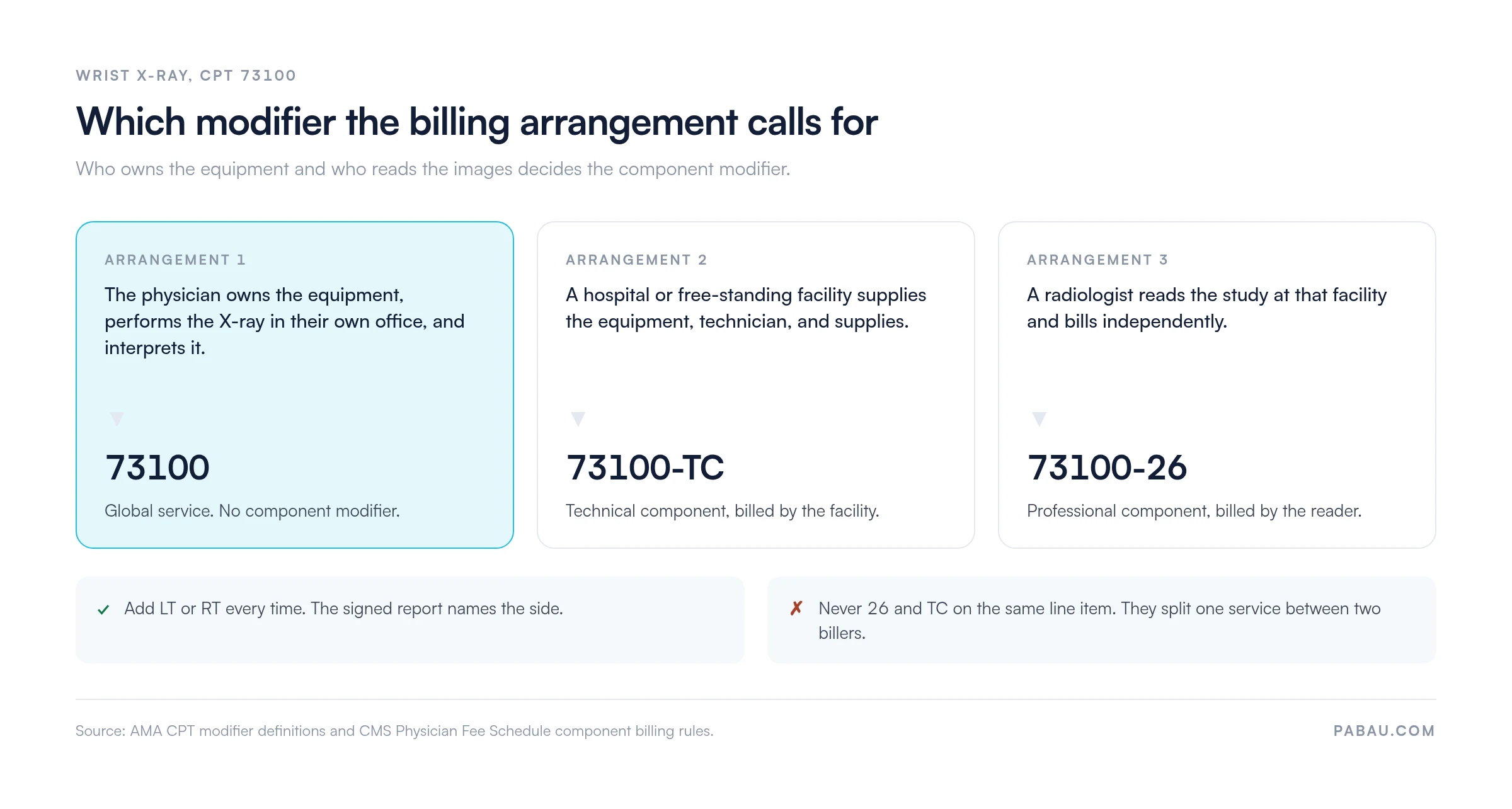
Check your MAC’s billing guidelines before applying modifier 26 or TC. Some Medicare Administrative Contractors publish separate instructions for facility-based radiologists that differ from the CMS baseline. A five-minute check at your MAC’s website can prevent a batch of modifier-related denials.
The 2026 Medicare reimbursement rate for CPT code 73100 is set by the CMS Physician Fee Schedule (MPFS) and varies by MAC locality. National average figures are a useful reference point, but the payment a practice receives depends on the geographic practice cost index (GPCI) for its location.
Use the MPFS lookup tool with your locality code to verify current rates before quoting patients or negotiating payer contracts.
The global rate covers both the professional and technical components when a single provider bills both. The modifier 26 rate (professional component only) and the TC rate (technical component only) together sum to approximately the global rate. Rounding differences can apply.
Radiology practices should verify reimbursement separately by modifier using the FastRVU 2026 RVU lookup tool, which pulls directly from CMS data and allows location-adjusted calculations.
Commercial payers negotiate rates independently and may reimburse above or below Medicare. Many base their fee schedules on a percentage of the Medicare rate (for example, 115% of MPFS), but this varies by contract.
Medical necessity for CPT code 73100 must be supported by a billable ICD-10-CM diagnosis. The diagnosis should reflect the clinical reason the X-ray was ordered. Listing an ICD-10 code that does not logically connect to a wrist imaging study invites a medical necessity denial. Selecting the diagnosis code is as important as selecting the CPT code itself.
Payer Local Coverage Determinations (LCDs) issued by Medicare Administrative Contractors may restrict which ICD-10 codes support medical necessity for CPT 73100. No specific diagnosis code guarantees reimbursement. Check your MAC’s active LCD for radiology imaging before assuming a diagnosis code is sufficient.
When the documented presentation does not match one of these, the full ICD-10-CM index lists the alternatives by body system.
Incomplete documentation is the second-most-common reason CPT 73100 claims are denied or flagged in audits, after incorrect code selection. The documentation requirements for radiology studies are specific. The finalized radiology report must drive the claim, not the order.
Digital intake and clinical forms that capture the ordering provider’s clinical indication at the visit make it easier to pull at billing time.

CPT code 73100 sits within a family of upper extremity plain-film codes. Practices billing wrist and hand imaging should have every one of them mapped in their billing system. That prevents inadvertent code substitution when the coder is working at speed.
The same 73000-73225 upper extremity range runs up the arm. A two-view humerus study bills under CPT code 73060, not a forearm or wrist code. A forearm study of the radius and ulna shafts bills under CPT code 73090.
The most important boundary is between 73100 and 73110, covered above. The second most important is between 73100 (wrist) and 73130 (hand). A wrist X-ray images the carpal bones and distal radius/ulna. A hand X-ray images the metacarpals and phalanges.
The hand side of that boundary splits on view count too. A hand study with only two views bills as CPT code 73120, not 73130.
When an imaging order says “wrist and hand,” two separate codes may be appropriate. That requires documentation showing both anatomical sites were imaged with the requisite number of views. Review AAPC’s CPT code reference for descriptor-level clarification on adjacent codes in this range.
Run a quarterly audit of your 73100 and 73110 claim volumes. If 73110 claims outnumber 73100 by more than 3:1, check whether radiologists are routinely adding a third view and whether coders are capturing it. The opposite ratio, more 73100 than 73110, is worth checking too if your imaging protocol typically uses three projections.
The errors below account for most denials and audit findings on wrist radiology claims. Each one is preventable with a documented internal check.
Tracking denials by code shows whether 73100 rejections cluster around one modifier or one missing piece of documentation. Submitting a clean claim the first time removes the administrative cost of an appeal.
Most radiology billing errors happen between the point of care and the point of claim submission. Three causes come up repeatedly:
Practice management software like Pabau closes all three by embedding CPT code selection, modifier assignment, and ICD-10 linking into the encounter itself. The claim is built during the visit instead of reconstructed hours later from notes.
Pabau’s first-pass claims management surfaces denial patterns by CPT code, so you can see whether 73100 rejections come from modifier omissions or laterality errors. The Claim.MD integration then supports billing end to end. Eligibility is verified before the visit, the claim goes out in the 837P format, and the remittance advice comes back for reconciliation.
Diagnosis coding sits in the encounter record too, so the ICD-10 code that drives the 73100 claim is documented alongside the clinical note. A biller no longer adds it afterwards from an incomplete record.


Pabau links CPT codes, modifiers, and ICD-10 diagnoses within the patient encounter, so your claims leave the practice correctly coded the first time.

CPT code 73100 has a narrow definition: exactly two views of the wrist. The costly errors around it are process failures, and three of them recur. Coders work from the order instead of the signed report, laterality modifiers get left off, and the TC/26 split is misapplied in facility settings. Fixing those three removes most 73100 denials.
Pabau connects CPT selection, modifier logic, and ICD-10 linking into one clinical workflow. The claim is accurate before it leaves the practice. To see how that works on radiology claims, book a demo.

Need to understand how clean claims reduce revenue leakage? What makes a clean claim covers the elements that get radiology and other claims paid on first submission.
Want to understand how clearinghouse submissions work? Medical claims clearinghouse guide explains how 837P electronic claims flow from practice to payer.
Looking for denial tracking guidance? Denial codes in medical billing maps common CARC denial reason codes to corrective actions for coders and billers.
CPT code 73100 is a billable procedure code for a radiologic examination of the wrist using exactly two radiographic views. Providers use it for a plain film wrist X-ray with two projections, typically posteroanterior and lateral. The study evaluates trauma, fracture, pain, or structural wrist conditions.
CPT 73100 covers a wrist X-ray with exactly two views. CPT 73110 covers a complete wrist study with a minimum of three views. The only distinction is the view count documented in the finalized radiology report. Billing 73110 when only two views were taken constitutes upcoding.
Yes, CPT code 73100 is active and billable for the 2026 billing year. It remains a valid HIPAA-covered transaction code within the Diagnostic Radiology section of the AMA CPT code set.
Four modifiers apply regularly to CPT code 73100. Modifier 26 covers the professional component, when the interpreting physician bills separately. TC covers the technical component, when the facility bills separately. LT and RT identify the left and right wrist. Modifier 52 applies if fewer views were captured than planned, and modifier rules vary by payer and setting.
The 2026 Medicare rate for CPT 73100 varies by MAC locality. Use the CMS Physician Fee Schedule lookup tool with your locality code to find the current rates. It returns the global, modifier 26, and TC figures for your geographic area. National average figures are available but do not substitute for locality-adjusted verification.
No. Modifier 26 and TC are mutually exclusive on a single line item. They split billing between two separate entities, the interpreting radiologist (modifier 26) and the imaging facility (TC). A single provider billing the global service uses neither modifier.



