

ICD-10 Code S53.013D: Anterior subluxation of unspecified radial head
ICD-10 Code S53.013D: Quick reference summary Use the table below as your first ...

Last Updated: Nov 6, 2026
Billable Code Specific Code
S62.351D is the billable ICD-10-CM code for nondisplaced fracture of shaft of second metacarpal bone, left hand, subsequent encounter for fracture with routine healing. It covers follow-up visits for a left index-finger metacarpal shaft fracture that is healing as expected.
The 7th character D applies once active treatment is complete, at visits such as cast checks and union X-rays. The first visit where the fracture is treated takes S62.351A for a closed fracture, or S62.351B for an open one.
Let Pabau's smart automation suggest the right codes, reduce claim denials, and keep your practice compliant—effortlessly.
Automate repetitive tasks and focus on what matters most—your patients.
Reduce coding errors and ensure compliance with the latest regulations.
Clean claims, fewer denials, and faster reimbursements.
Powerful insights and reporting to help your practice thrive.
HIPAA compliant SOC 2 certified GDPR-compliant Trusted by 4,000+ clinics worldwide

S62.351D covers follow-up visits for a nondisplaced left second metacarpal shaft fracture that is healing as expected.
The first visit where the fracture is treated takes S62.351A (closed) or S62.351B (open), never D.
The note must name the second metacarpal, the left hand and the shaft, and imaging must support nondisplaced.
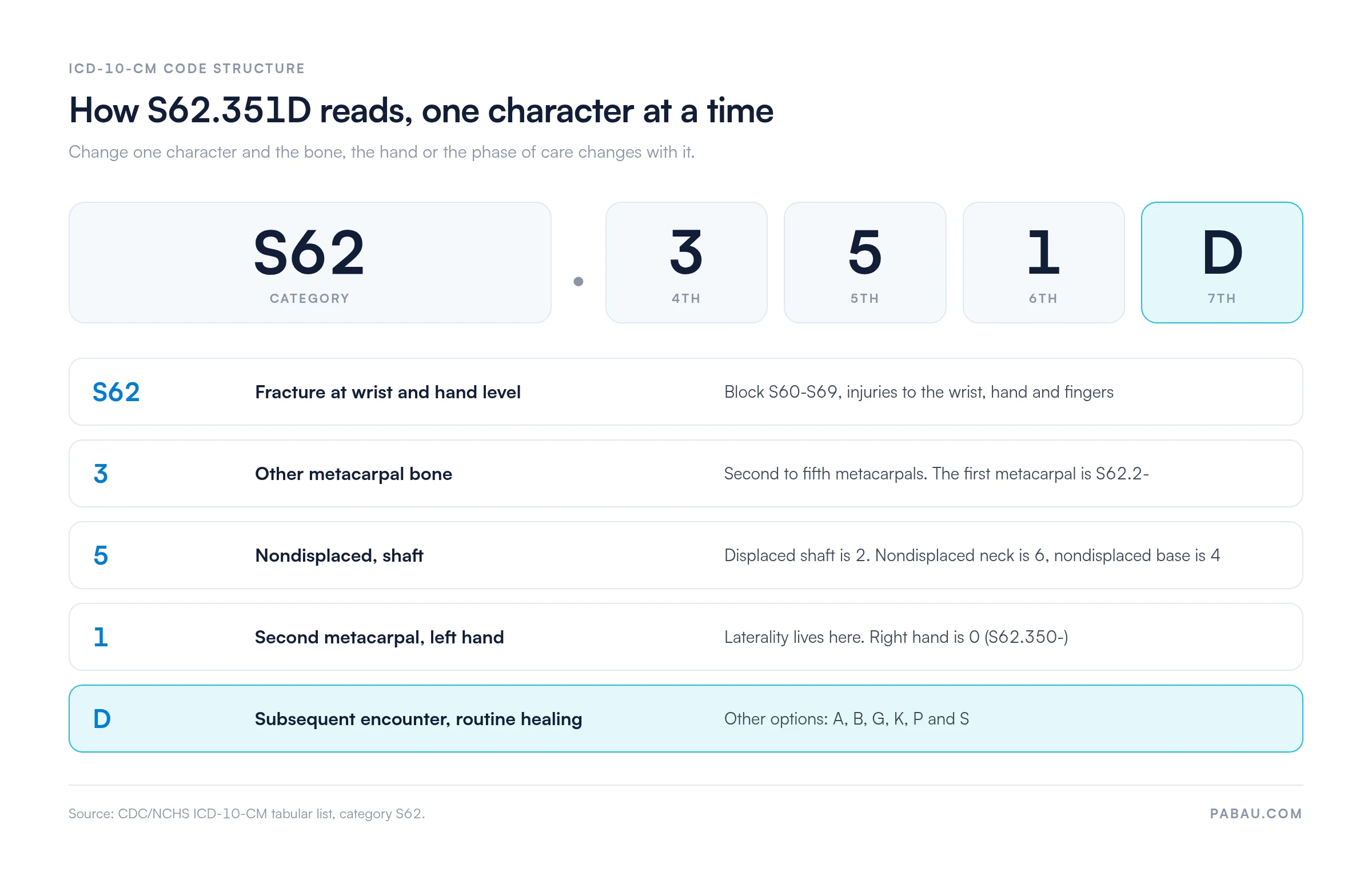
Laterality sits in the 6th character, so the same fracture in the right hand codes to S62.350D.
Pabau’s claims software validates each claim before it leaves the practice and links rejected claims straight to the field that needs fixing.
ICD-10 Code S62.351D is the billable ICD-10-CM diagnosis code for a nondisplaced fracture of the shaft of the second metacarpal bone in the left hand. It applies at a subsequent encounter, once the fracture is healing routinely.
It sits in category S62 (fracture at wrist and hand level) and is valid in the current ICD-10-CM edition. Check it against the CDC/NCHS ICD-10-CM web tool for the fiscal year of the date of service.
In the medical billing process, S62.351D is the diagnosis that supports each follow-up service on the claim. That covers the office visit, a splint change and any therapy billed on the same date.
The second metacarpal is the long bone that connects the wrist (carpals) to the base of the index finger. It’s the longest metacarpal, and its shaft is a common fracture site in direct-impact injuries.
The shaft (also called the body) is the tubular midportion of the bone. It sits between the neck, just below the metacarpal head, and the base, where the bone meets the carpals.
For coding, the fracture site within the bone sets the 5th character. Subcategory S62.3 covers the second to fifth metacarpals and splits displaced from nondisplaced fractures of the base, shaft and neck. The first metacarpal has its own subcategory, S62.2, and fractures of the finger and thumb phalanges sit in S62.5 and S62.6. For example, a nondisplaced base fracture of the right fifth metacarpal at the initial encounter for an open fracture codes to S62.346B code.
Applying S62.351D to a neck fracture is a specificity error, because a nondisplaced neck fracture of the left second metacarpal codes to S62.361D.
The diagram below decodes S62.351D one character at a time, including where laterality sits.
Nondisplaced defined: A nondisplaced fracture has a fracture line, but the bone fragments haven’t shifted from their normal alignment. The cortex may be cracked or buckled without separation or angulation.
The treating provider establishes this from imaging, not the coder. The coder assigns the displacement character from the provider’s interpretation of the imaging report.
The 7th character in S62.351 sets the phase of care, and payers check it against the services on the claim. Seven 7th characters are valid for S62.351 (A, B, D, G, K, P and S). Three of them describe active treatment or late effects, and four describe how a healing fracture is progressing.
When D starts: The switch from A to D isn’t triggered by a calendar date or a number of weeks. It’s triggered by the phase of care. Section I.C.19 of the ICD-10-CM Official Guidelines for Coding and Reporting applies D once active treatment is complete. From then on, the patient receives routine care while the fracture heals.
A cast check at week two already falls in the subsequent-encounter phase, so D applies there. A provider who starts fracture treatment for the first time uses A, even if the injury is weeks old.
When a patient transfers to a new provider during routine healing, the new provider uses the D character from the first visit. The 7th character reflects the phase of fracture care, not the patient’s history with one practice. Document that you are continuing management of a fracture that was already diagnosed and treated.
Several codes surround S62.351D in the tabular list, and picking the wrong one misreports the injury even when the claim pays. The table below compares the codes most often confused with it, along with the one axis that separates each.
Telling the second metacarpal from the third gets harder when the note says “index finger” or “long finger” without naming the bone. The second metacarpal belongs to the index finger, and the third belongs to the middle (long) finger. When the note is ambiguous about the digit, query the provider before assigning the code.
Supporting documentation must establish four elements of S62.351D: the bone, the hand, the site within the bone and the phase of care. For this code those are the second metacarpal, the left hand, the shaft and a routine-healing follow-up. A record missing any one of them leaves the code exposed in a retrospective audit.
CMS and most major commercial payers follow the ICD-10-CM Official Guidelines when they review subsequent-encounter fracture claims. For S62.351D, their checks center on code specificity, CPT-to-ICD matching, visit frequency and global surgery period compliance.
The CPT codes submitted alongside S62.351D depend on the service rendered at the follow-up visit. The most common pairings fall into three groups: evaluation and management (E/M) visits outside a global period, cast and splint codes, and therapy procedure codes.
Closed treatment of the fracture without manipulation is billed under CPT 26600, which carries a 90-day global period. Follow-up visits by the same provider in that window are part of the surgical payment. Those visits are usually reported with CPT 99024 (postoperative follow-up visit) rather than a billable E/M code. If the fracture was pinned through the skin, the procedure is billed under percutaneous fixation code 26608 instead.
S62.351D denials follow predictable patterns, and most trace back to five root causes. Knowing them lets you build a pre-submission checklist instead of an appeals queue. Strong denial management workflows start before the claim is submitted, not after the explanation of benefits arrives.
When a denial arrives via electronic remittance advice, check its claim adjustment reason code (CARC) first. CARC 97 (benefit included in another service) usually means a global period overlap. CARC 96 (non-covered charges) points to a coverage limit in the patient’s plan.
CARC 16 (claim lacks information) and CARC 252 (an attachment or other documentation is required) mean the payer wants more records. A prior authorization denial comes back as CARC 197.
Accurate reimbursement on S62.351D comes down to a routine you run before each follow-up claim goes out.
Submitting a clean claim on the first pass means verifying five elements before the claim leaves the practice. They are the code, the encounter character, the CPT pairing, the supporting documentation and global period compliance. Clearinghouse edits catch code-level errors, but they can’t confirm that the note supports the code.
Build a fracture follow-up coding checklist into your workflow: (1) Pull the imaging report, not just the note. (2) Confirm bone, hand and site. (3) Check displacement language. (4) Assign the 7th character based on phase of care, not visit number. (5) Verify the global period before billing E/M. Running all five on every follow-up claim removes the most common S62 denial triggers.
Fracture aftercare means the same diagnosis goes out on claim after claim. Each cast check is another chance for an A to slip in where a D belongs. The error only surfaces when the remittance comes back.
Pabau, the practice management platform we build, handles end-to-end claims management for US practices. Each claim opens pre-filled from the visit’s invoice, and claim validation scrubs it for missing or invalid details before it leaves. Claims then reach US payers through Claim.MD, our clearinghouse partner.
If a payer rejects a claim, Pabau flags it as Needs action and links straight to the field that needs correcting. Eligibility checks run before the visit, and electronic remittance advice comes back against each claim. So your billing team fixes a rejected follow-up claim from one screen instead of rebuilding it from the chart.
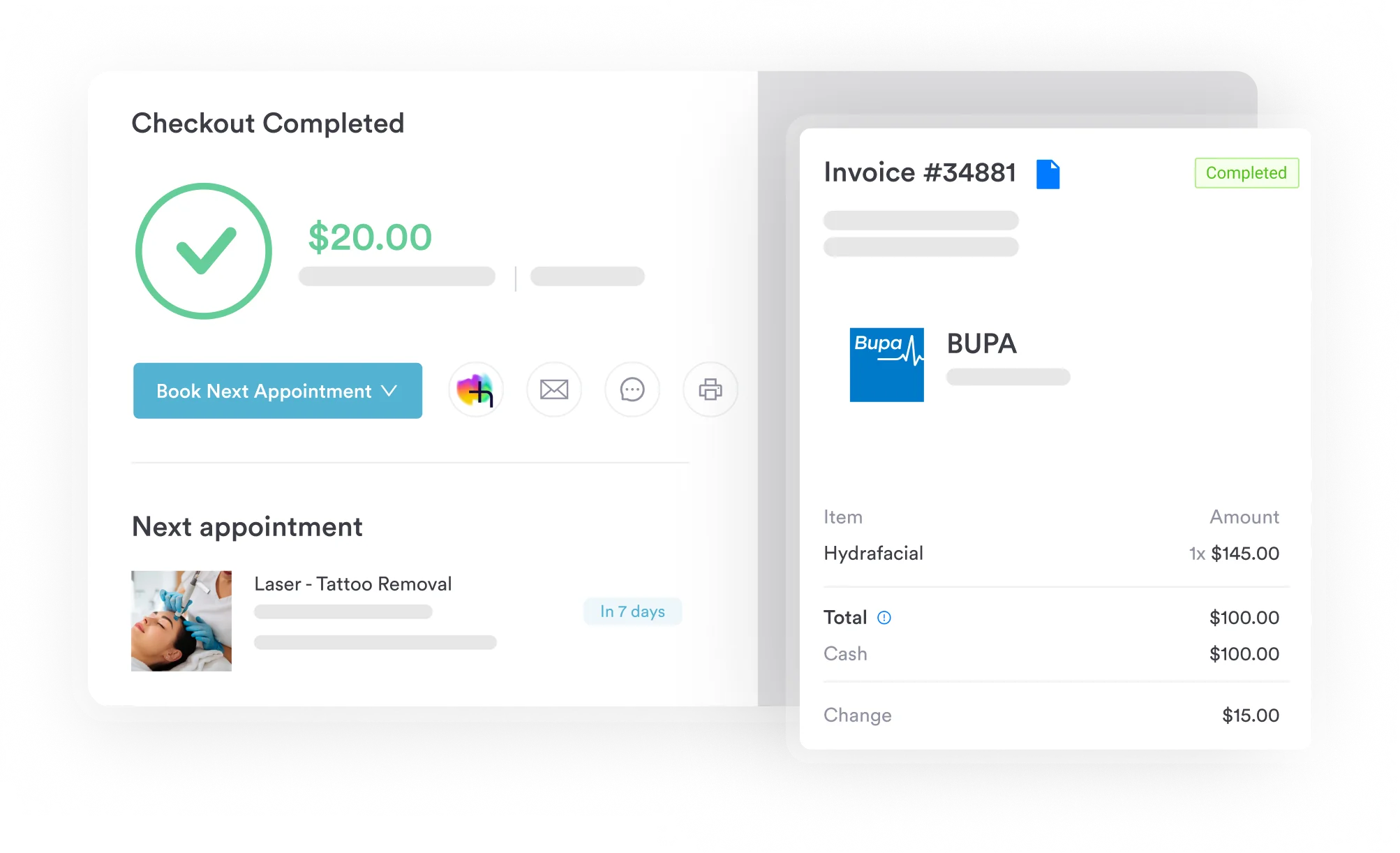

Pabau pre-fills each claim from the visit’s invoice, validates it before submission and sends it through Claim.MD. Follow-up fracture claims go out complete the first time.

S62.351D fails in a few predictable ways. The usual culprits are the wrong 7th character, the wrong hand, an unspecified code, or a displacement status the imaging doesn’t support. Each one costs less to catch before submission than to appeal after a denial.
So make the imaging report and the last two characters of the code your first check on every follow-up claim. Those two characters carry the hand and the phase of care, and they change more often than the rest of the code.
Book a demo to see how Pabau validates fracture follow-up claims before they reach the payer.

Need to understand how clearinghouse submissions work? Medical claims clearinghouse guide explains how claims are validated and routed between practices and payers.
Curious about the 837 file format? 837 file guide explains how electronic claim transactions are structured and submitted to payers.
ICD-10 Code S62.351D is the billable diagnosis code for a nondisplaced shaft fracture of the left second metacarpal at a routine healing follow-up. It applies to follow-up visits during the healing phase, after active treatment of the fracture is complete.
A subsequent encounter (7th character D) is any visit after active treatment of the fracture is complete, while the bone heals. Under Section I.C.19 of the ICD-10-CM Official Guidelines, that includes cast checks, healing X-rays and therapy referrals. It excludes the visit where fracture treatment was first started.
S62.351A is used during active treatment of a closed fracture, and S62.351B during active treatment of an open one. S62.351D is used for routine healing follow-up visits. S62.351S applies only after healing is complete, when treating a residual effect such as stiffness. The fracture anatomy and displacement status are identical across all of them, and only the phase of care differs.
The most common denial triggers are using 7th character A instead of D on a follow-up visit, and coding the wrong hand. Others include a displacement status that doesn’t match the chart and an unspecified metacarpal code where the note supports a specific one. Billing a separate E/M during the provider’s own global period also triggers denials.
No. S62.351D can’t be used for a visit where a fracture is diagnosed and treated for the first time. That visit takes S62.351A for a closed fracture or S62.351B for an open one. The D character is reserved for routine healing follow-up.
Common pairings include E/M codes 99213 or 99214 for providers outside a global period. Others are 29130 (finger splint), 29280 (hand strapping) and 97110 (therapeutic exercise at the same visit). The right pairing depends on the service rendered and whether a global period restricts separate E/M billing.



