ICD-10 code S61.201A: Open wound of left index finger without nail damage
ICD-10 code S61.201A covers a left index finger wound of unstated type ICD-10 co...

Last Updated: Oct 16, 2026
Billable Code Specific Code
S62.011K is the billable ICD-10-CM code for displaced fracture of distal pole of navicular [scaphoid] bone of right wrist, subsequent encounter for fracture with nonunion.
Let Pabau's smart automation suggest the right codes, reduce claim denials, and keep your practice compliant—effortlessly.
Automate repetitive tasks and focus on what matters most—your patients.
Reduce coding errors and ensure compliance with the latest regulations.
Clean claims, fewer denials, and faster reimbursements.
Powerful insights and reporting to help your practice thrive.
HIPAA compliant SOC 2 certified GDPR-compliant Trusted by 4,000+ clinics worldwide

S62.011K describes a displaced fracture of the navicular (scaphoid) bone of the right wrist. It is reported at a subsequent encounter once the fracture has failed to unite.
The 7th character K is not interchangeable with D (routine healing) or G (delayed healing). Using the wrong suffix is a common audit trigger and denial reason.
Scaphoid nonunion is clinically distinct from malunion. Nonunion means the fragments have not bridged, while malunion means they healed in an incorrect position.
Surgery to repair a documented nonunion keeps the K suffix. It does not restart active treatment, so the encounter is not recoded to S62.011A.
Claims management software like Pabau helps orthopedic and hand surgery practices submit and track clean claims through the Claim.MD clearinghouse integration.
S62.011K is the billable ICD-10-CM code for a displaced fracture of the navicular (scaphoid) bone of the right wrist. It is reported at a subsequent encounter where the fracture has resulted in nonunion. Specifically, the code applies from the point imaging confirms the fragments have not bridged. Until then, the routine-healing (D) or delayed-healing (G) suffix is correct.
The code sits in the ICD-10-CM structure for injuries of the wrist and hand. It belongs to category S62 (fracture of wrist and hand) and subcategory S62.0 (fracture of navicular bone). The 011 subcode then specifies that the fracture is displaced and involves the right wrist.
The trailing K identifies the encounter as a follow-up visit where healing has not occurred as expected. Per the CMS ICD-10-CM guidelines, the code is therefore billable and valid for the current fiscal year.
ICD-10-CM codes are alphanumeric and encode several clinical facts at once. For example, each segment of S62.011K has a precise meaning. As a result, reading the structure is what prevents the most common coding errors.
ICD-10-CM uses the term “navicular bone”, while orthopedic clinicians almost universally call it the scaphoid. In other words, both terms name the same carpal bone, and the bracketed notation “navicular [scaphoid]” exists to acknowledge that split. The same A/D/G/K/P/S structure runs across the whole S60-S69 chapter. In addition, the ICD-10-CM code library lists the neighboring injury codes a wrist claim often touches.
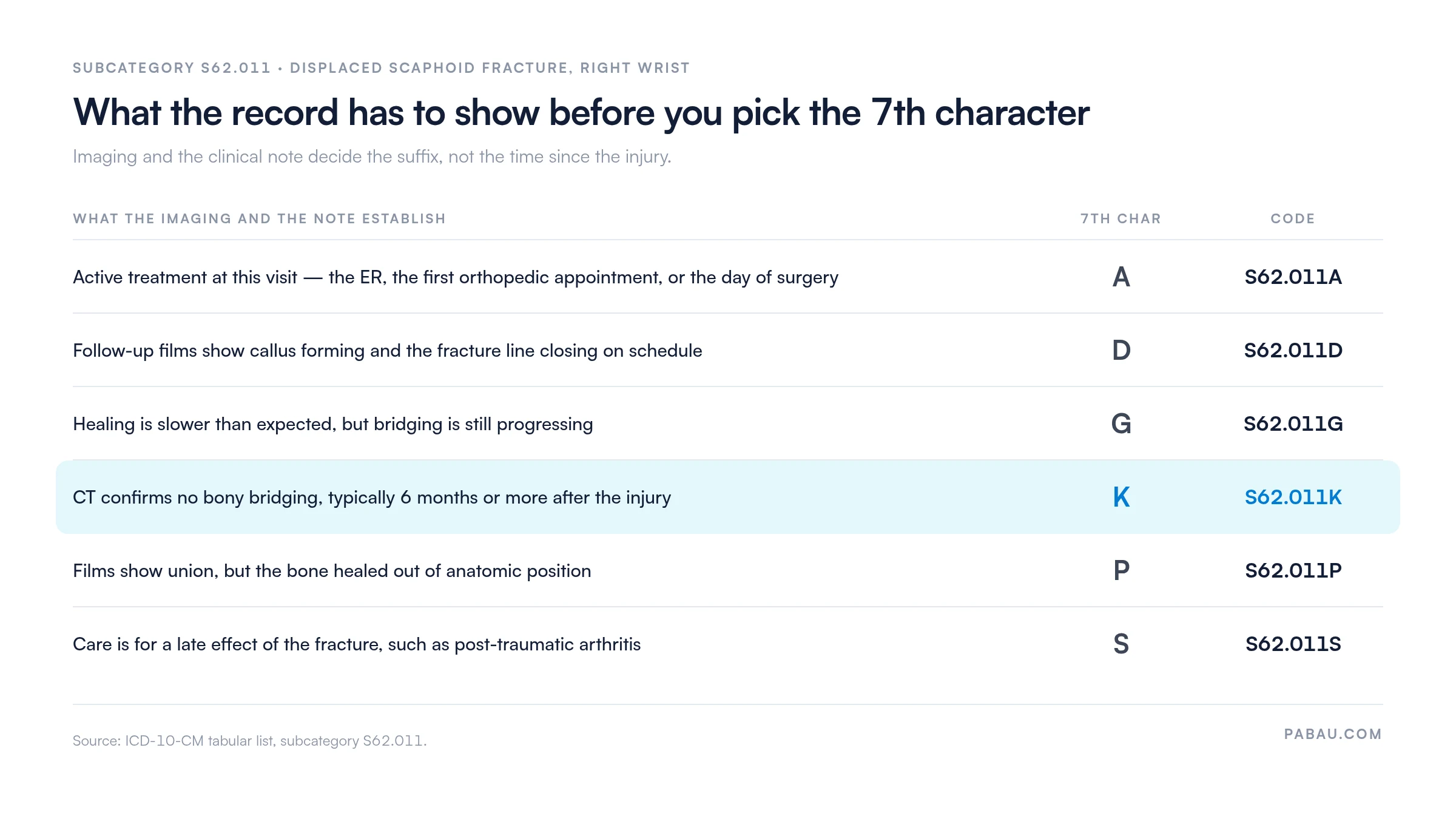
Assigning the wrong 7th character for a fracture encounter is one of the most frequently cited audit findings in orthopedic billing. For that reason, the table below shows the full S62.011 family across all valid 7th characters.
The K and P codes are the easiest pair to conflate. Nonunion (K) means the fracture gap remains open, with no bony bridging confirmed on imaging. In contrast, malunion (P) means the bone has healed, but in an incorrect position that produces deformity or functional loss.
Those are different clinical and surgical problems, and payers treat them differently on review. So, document which one is confirmed radiographically before you assign the 7th character.
Check the imaging report before assigning K versus G. Delayed healing (G) means the fracture line is still visible but callus formation is progressing. Nonunion (K) requires radiographic confirmation that no bridging has occurred, typically at 6 months or more post-injury. Assigning K without imaging documentation is an audit risk.
Scaphoid fracture coding requires both the correct displacement status and the correct laterality. The table below covers the most frequently referenced adjacent codes for quick coder comparison. Still, verify against the CDC/NCHS ICD-10-CM web tool for the current fiscal year before billing.
For a wider view of how 7th character families work across the injury chapters, the AAPC ICD-10-CM lookup offers keyword search with full tabular context.
Scaphoid fractures account for roughly 60-70% of all carpal bone fractures. As a result, they are the most common carpal injury seen in orthopedic and hand surgery practices.
The scaphoid’s vulnerability to nonunion comes from its retrograde blood supply. The distal pole is vascularized adequately, but the proximal pole is fed by vessels that enter distally and travel proximally. As a result, a fracture across the waist interrupts that flow to the proximal fragment.
Nonunion develops in approximately 10-15% of scaphoid fractures, with displaced fractures carrying a substantially higher risk than nondisplaced ones. In particular, several factors increase the likelihood of a nonunion outcome:
For orthopedic and hand surgery practices, recognizing scaphoid nonunion early is critical. Patients often present with persistent radial-sided wrist pain, reduced grip strength, and wrist stiffness months after the original injury. In addition, anatomical snuffbox tenderness persists on examination. CT imaging is the standard for confirming nonunion, since plain films may underestimate fragment separation.
Three conditions must all be true before S62.011K is the correct code. Otherwise, getting any one wrong produces a technically incorrect claim.
The record, not the calendar, decides which suffix is correct at each of those encounters. A follow-up visit where imaging shows the fracture healing normally takes S62.011D instead. Fracture site and open status drive the digits ahead of the suffix. A nondisplaced proximal third fracture that is open at the initial encounter, with laterality undocumented, takes S62.036B.
One sequencing question comes up whenever surgical repair of the nonunion is scheduled. Coders often assume the operation restarts active treatment and switch the 7th character back to A. In fact, it does not.
Per the ICD-10-CM Official Guidelines, surgery to correct a documented nonunion or malunion still takes the subsequent-care 7th character. As a result, S62.011K stays on the claim for the bone grafting encounter. The one exception is a patient who delayed treatment of the original fracture and is only now presenting for initial care.
Document laterality in every note, not just the admission note. Coders working from visit notes often cannot assign the correct 6th character. The treating physician recorded ‘wrist’ without specifying right or left. A single laterality line in the SOAP note prevents a query back to the physician and a coding delay.
Accurate diagnosis coding for S62.011K is only half the claim. In addition, the procedure codes and documentation attached to it determine whether the claim clears the clearinghouse and pays on first submission.
Scaphoid nonunion typically requires surgical intervention. Accordingly, the CPT codes used depend on the procedure performed at the encounter being coded.
Practices that also code the non-surgical side of scaphoid care should check CPT 25624 for closed treatment with manipulation. Notably, it pairs with the initial-encounter and routine-healing suffixes rather than K.
Every claim carrying S62.011K should be supported by documentation that clearly establishes all three code elements: displacement status, laterality, and nonunion confirmation.
Both the code set and the payer rules shift every year. CMS publishes annual ICD-10-CM updates that can change the valid code set, and payer LCD policies for scaphoid nonunion repair vary by carrier. For that reason, re-check the code against the CDC/NCHS web tool linked above before the first claim of each fiscal year.
Most orthopedic billing teams work a nonunion claim across three disconnected places. The coder reads the imaging report in the chart, then keys S62.011K and the CPT code into a separate billing tool. A denial explanation arrives weeks later in a paper or PDF remittance.
Practice management software like Pabau keeps that sequence in one record. For example, Pabau’s claims software for specialists submits electronically through the Claim.MD clearinghouse, which reaches thousands of US payers. Each electronic remittance advice, or ERA, posts back against the claim it belongs to.
So when a scaphoid nonunion claim comes back short-paid, the adjustment reason code is already on the claim your biller opens. They can correct the encounter suffix or the procedure code and resubmit the same day, rather than reconciling a remittance file by hand.
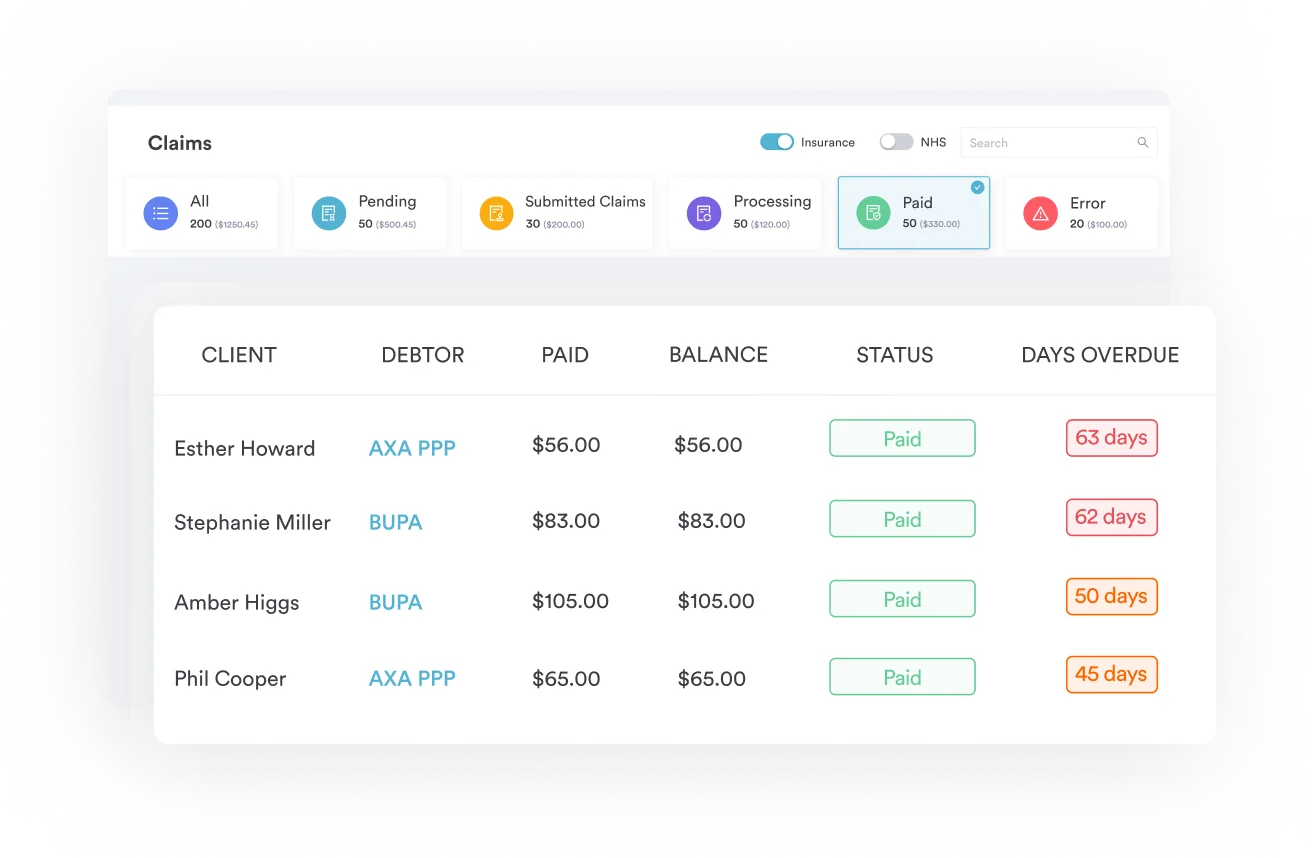

Pabau’s claims management tools submit orthopedic claims through the Claim.MD clearinghouse and track every ERA. Your billers see a denial reason the day it lands, not weeks later.

S62.011K is the right code when three facts sit in the same encounter: displacement, right-wrist laterality, and radiographically confirmed nonunion. First, two of those come from the note. The third, meanwhile, comes from the imaging report, which is why the CT result belongs in the chart before the claim goes out.
The suffix is the part worth slowing down for. In fact, K survives the surgical encounter. Switching it back to A because an operation happened is the error that brings an auditor back through the whole episode. Book a demo to see how Pabau tracks a scaphoid nonunion claim from the imaging note through to the remittance.

Need to understand how claim denials are handled? Denial management in healthcare covers the denial workflow from ERA receipt to resubmission, with guidance on reducing denial rates for complex specialty codes.
Looking for guidance on clean claim requirements? What makes a clean claim explains the elements payers check before processing, including diagnosis coding accuracy and procedure-to-diagnosis pairing.
Want to understand how clearinghouse submissions work? How a medical claims clearinghouse works explains the role of clearinghouses in the claim lifecycle, from 837P submission to ERA response.
S62.011K is the ICD-10-CM code for a displaced fracture of the navicular (scaphoid) bone of the right wrist. It is reported at a subsequent encounter where the fracture has resulted in nonunion, meaning the fragments have not healed together. Accordingly, orthopedic surgeons, hand surgeons, and sports medicine physicians use it for established right-wrist scaphoid nonunion.
The displaced scaphoid fracture family uses S62.011 for the right wrist, S62.012 for the left, and S62.013 for unspecified laterality. Specifically, each is extended by a 7th character for encounter type. A is initial, D is routine healing, and G is delayed healing. K is nonunion, P is malunion, and S is sequela. Always document laterality so the unspecified code is not needed.
In ICD-10-CM injury codes, the 7th character K indicates a subsequent encounter for a fracture with nonunion. The patient has returned for care after the initial treatment phase, and the fracture has not achieved bony union. In contrast, K is distinct from D (routine healing) and G (delayed healing), both of which indicate healing progress.
CPT 25440 covers repair of nonunion of the scaphoid carpal bone, with or without radial styloidectomy. It is the procedure code most directly paired with surgical treatment of scaphoid nonunion. In contrast, CPT 25430 applies when a vascularized bone graft pedicle is used for cases involving avascular necrosis. Non-surgical follow-up visits use E/M codes such as 99213 or 99214 depending on complexity.