ICD-10 code S61.201A: Open wound of left index finger without nail damage
ICD-10 code S61.201A covers a left index finger wound of unstated type ICD-10 co...

Last Updated: Oct 16, 2026
Billable Code Specific Code
S62.011D is the billable ICD-10-CM code for a displaced fracture of the distal pole of the right scaphoid, subsequent encounter with routine healing.
It applies to follow-up visits after the fracture's initial treatment, such as cast checks and repeat X-rays, when the physician documents normal healing. Delayed healing, nonunion, and malunion take the 7th characters G, K, and P instead.
Let Pabau's smart automation suggest the right codes, reduce claim denials, and keep your practice compliant—effortlessly.
Automate repetitive tasks and focus on what matters most—your patients.
Reduce coding errors and ensure compliance with the latest regulations.
Clean claims, fewer denials, and faster reimbursements.
Powerful insights and reporting to help your practice thrive.
HIPAA compliant SOC 2 certified GDPR-compliant Trusted by 4,000+ clinics worldwide

S62.011D describes a displaced distal-pole fracture of the right scaphoid at a follow-up encounter with routine healing.
The 7th character D is correct only when the physician documents normal healing. So delayed healing takes G, nonunion takes K, and malunion takes P.
S62.011 without a 7th character is not billable, so every claim needs the full seven-character code.
Laterality and displacement set the 6th character, so a left-wrist or nondisplaced fracture belongs to a different code.
Practice management software like Pabau pre-fills claims from the patient record and checks insurer details before each claim goes out.
ICD-10 code S62.011D is a valid, billable ICD-10-CM code for FY2026, confirmed by the CDC/NCHS official ICD-10-CM tool. In fact, it covers a displaced fracture of the distal pole of the right scaphoid, seen at a follow-up encounter while the fracture heals as expected. Orthopedic surgeons, primary care physicians, urgent care coders, and physical therapists use it through the post-acute phase of wrist fracture care.
Each segment of the code carries a specific clinical meaning. So breaking it down helps coders confirm they have the right code before submission.
Billable status: Yes. S62.011D is billable for FY2026 with no age restrictions, so it applies to adult and pediatric patients alike. In fact, the CMS ICD-10 codes page carries the current fiscal year’s code files, where the code remains active without amendment.
The 7th character D denotes a subsequent encounter for fracture with routine healing. In fact, Section I.C.19.c of the ICD-10-CM Official Guidelines for Coding and Reporting sets out the rule. A subsequent encounter begins the moment the patient receives their first definitive treatment (cast application, surgical fixation, splinting) and leaves that initial setting. So every visit after that point, including cast checks, follow-up imaging, and physical therapy, is a subsequent encounter.
The distinction that matters most is routine versus delayed healing, and the physician’s documentation decides it. Use D when the record says the fracture is healing normally, progressing as expected, or showing appropriate callus formation. Instead, slower-than-expected healing or delayed union calls for G.
Physical therapy visits during rehabilitation also count as subsequent encounters when the documentation supports routine healing. Therapy progress notes alone don’t establish healing status. Instead, the treating physician’s encounter record has to state it.
S62.011 without a 7th character is a non-billable header code. In short, every claim needs the complete seven-character code, or the payer rejects it as structurally invalid, however accurate the documentation is. The AAPC ICD-10-CM lookup lists every valid suffix for this code family.
S62.011D sits in a tightly clustered family of scaphoid fracture codes, and laterality and displacement cause most of the coding errors. In fact, the 6th character carries both. Displaced distal-pole fractures run S62.011 (right wrist), S62.012 (left wrist), and S62.013 (unspecified wrist). Nondisplaced ones run S62.014, S62.015, and S62.016 in the same order, as the grid below shows.
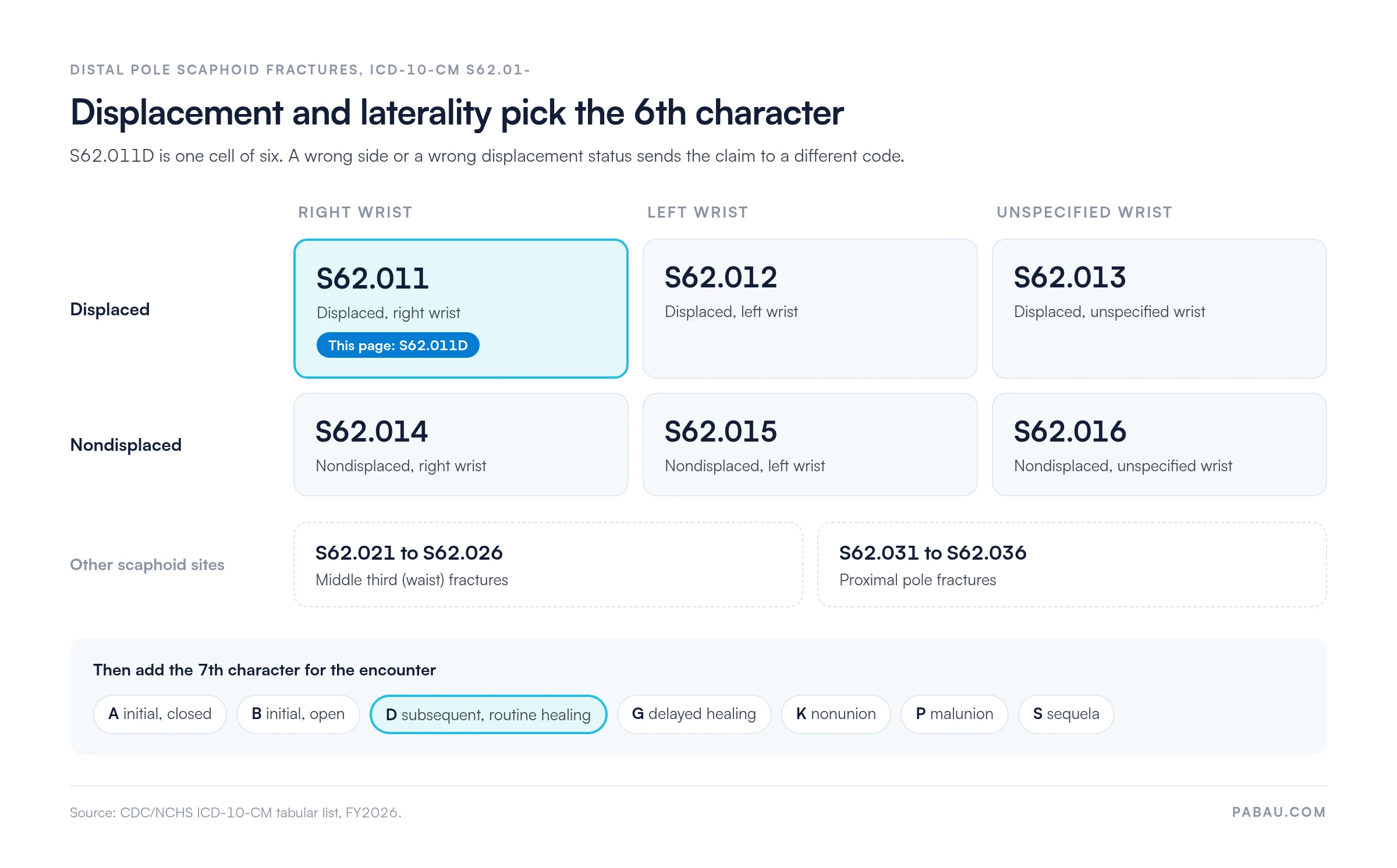
The table narrows the same family to the follow-up codes coders most often swap for S62.011D.
The S62.011D versus S62.011K distinction carries the most clinical weight. So coding D when the record documents nonunion misstates the patient’s healing status. It can also cause authorization problems if surgical revision is requested later.
A 34-year-old construction worker falls on an outstretched right hand. The emergency department diagnoses a displaced fracture of the distal pole of the right scaphoid, confirmed on X-ray and CT. Then a short-arm cast is applied, and the encounter is coded S62.011A.
Three weeks later, the patient returns for a scheduled follow-up. New films show early callus formation, and the physician documents “healing progressing normally” and adjusts the cast. So this visit is coded S62.011D, and the two-view wrist film is typically billed as CPT 73100.
The same logic applies at the six-week visit if the physician again documents routine healing. So the code stays S62.011D until the fracture is declared united, healing status changes, or a complication develops. Athletes on accelerated rehabilitation protocols need the physician’s note to state healing status at each encounter, because therapy progress notes alone won’t support the code.
Medical records must support every element of ICD-10 code S62.011D, or the claim is at risk in an audit. So six documentation elements are required, and a missing one leaves the code unsupported.
S62.011D covers displaced fractures of the distal pole of the right scaphoid at subsequent encounters. It doesn’t cover left-wrist fractures (S62.012x) or displaced distal-pole fractures of an unspecified wrist (S62.013x). Instead, nondisplaced distal-pole fractures go to S62.014x, S62.015x, or S62.016x. Middle third (waist) fractures are coded S62.021x-S62.026x, and proximal pole fractures S62.031x-S62.036x. Within that range, S62.036B is the nondisplaced proximal-third fracture of an unspecified wrist at an initial open-fracture encounter.
The CPT codes on a subsequent encounter must reflect the service rendered at that visit, not the original procedure. So billing open treatment code 25628 on a routine cast-check visit is a common audit trigger.
Watch the global period too. If the same physician billed closed treatment such as 25622, routine follow-ups inside its 90-day global period are reported with 99024. Instead, they are not paid as separate office visits. Check current National Correct Coding Initiative (NCCI) edits before pairing any CPT code with S62.011D, because CMS updates them every quarter.
Before pairing CPT 25628 with S62.011D on a follow-up visit, confirm the operative note is in the record for that date of service. Payers routinely request operative reports when a surgical CPT code appears with a subsequent-encounter ICD-10 diagnosis code, and missing documentation is an audit-ready denial.
Scaphoid fracture claims in the subsequent-encounter phase draw a common set of denials. Most stem from 7th character errors or laterality mismatches rather than disputes over the diagnosis. So cross-checking the encounter type against the chart’s fracture history, and confirming all six documentation elements, catches most of them before the claim leaves the practice.
Standard fracture follow-up visits coded S62.011D generally don’t need prior authorization from commercial payers or Medicare. Payers treat them as routine care after an established fracture diagnosis. Instead, physical therapy paired with the code (CPT 97110, 97012) is different. It often carries visit limits or authorization thresholds that vary by payer and plan.
Medicare sets no fixed visit cap for outpatient therapy. So claims above the annual therapy threshold need the KX modifier and documented medical necessity. Medicare Administrative Contractors (MACs) can add documentation expectations through their Local Coverage Determinations (LCDs), so check your MAC’s policies before building a rehabilitation schedule.
NCCI edits govern bundling between the E/M codes (99213/99214) and any therapy codes billed on the same date of service. So review the current quarter’s files on the CMS NCCI edits page before building claim templates for orthopedic follow-ups. Electronic remittance advice (ERA) files then show which payers deny these claims, and why.
Knowing where S62.011D sits in the ICD-10-CM hierarchy lets coders move up to check category-level instructions and down to confirm no more specific code exists.
Submitting the S62.011 header is a frequent structural error. A billing system that doesn’t enforce code length for Chapter 19 will accept it and pass it to the clearinghouse, where it’s rejected as invalid. So requiring seven characters for every S-chapter injury code at entry stops the error before the claim is built.
Follow-up claims for S62.011D often stall on office details rather than the diagnosis. So a coder re-keys the patient’s insurer and policy number, sends the claim, and only hears about a missing field when the rejection arrives.
Practice management software like Pabau pulls the patient, treatment, and insurer details from the patient record into a pre-filled submission. Its medical claims management tools run validation checks each time you send a claim, so membership numbers and authorization codes are in place first. Also, US practices send claims through Claim.MD without leaving Pabau.
Each claim then sits in one dashboard as pending, submitted, processing, paid, or error. When the payer pays, you record the payment against the right invoice. So a six-week follow-up claim that stalls is visible long before it ages into a write-off.

Pabau pre-fills each claim from the patient record and checks insurer details before it goes out. Track every orthopedic follow-up claim from submission to payment in one view.

Treat the 7th character on S62.011D as a decision you make again at every visit. So the code that fit the three-week cast check can be wrong at week six if the physician now documents delayed union.
The cost is a minute of reading per claim, checking healing status, side, and displacement against that day’s note. In contrast, the payoff is fewer rejected follow-ups to rework weeks later. Book a demo to see how Pabau keeps orthopedic follow-up claims pre-filled, checked, and tracked through to payment.

Coding the first visit instead? ICD-10 code S62.011A covers the initial encounter for the same displaced right distal-pole fracture.
Has the fracture failed to unite? ICD-10 code S62.011K explains the nonunion code and the documentation that supports it.
Working a stack of rejected claims? Denial management in healthcare walks through the causes of denials and how to prevent them.
Want claims accepted on the first pass? What is a clean claim in medical billing? lists what a payer needs to accept a claim without edits.
Want to understand how clearinghouse claims work? What is a medical claims clearinghouse? explains how electronic claims move from practice to payer and where they get rejected.
ICD-10 Code S62.011D codes a displaced fracture of the distal pole of the right scaphoid at a subsequent encounter with routine healing. So it applies to follow-up visits after the initial fracture treatment when the physician documents that healing is progressing normally.
Yes, S62.011D is a fully billable ICD-10-CM code valid for FY2026 with no age restrictions. In contrast, the six-character truncated version S62.011 without the D suffix is not billable and will be rejected by payers as a structurally incomplete code.
The most common denial reason is submitting the initial encounter code S62.011A on a follow-up visit. In fact, other frequent causes include a missing 7th character and a laterality mismatch between the chart and the claim. Pairing a surgical CPT code with S62.011D on a non-operative visit date also triggers denials.
Standard fracture follow-up encounters coded S62.011D generally do not require prior authorization. Instead, physical therapy paired with this diagnosis often carries visit limits and may need authorization after a payer-defined threshold. Coders should verify each payer’s Local Coverage Determination, as rules vary by plan and MAC jurisdiction.