ICD-10 Code S53.013D: Anterior subluxation of unspecified radial head
ICD-10 Code S53.013D: Quick reference summary Use the table below as your first ...

Last Updated: Nov 6, 2026
Billable Code Specific Code
S62.154K is the billable ICD-10-CM code for nondisplaced fracture of hook process of hamate [unciform] bone, right wrist, subsequent encounter for fracture with nonunion.
It applies at a follow-up visit after active treatment, once the provider documents that the hook fracture has failed to unite. A fracture that is still healing normally takes S62.154D, and the left wrist takes S62.155K.
Let Pabau's smart automation suggest the right codes, reduce claim denials, and keep your practice compliant—effortlessly.
Automate repetitive tasks and focus on what matters most—your patients.
Reduce coding errors and ensure compliance with the latest regulations.
Clean claims, fewer denials, and faster reimbursements.
Powerful insights and reporting to help your practice thrive.
HIPAA compliant SOC 2 certified GDPR-compliant Trusted by 4,000+ clinics worldwide

S62.154K codes a nondisplaced hook of hamate fracture of the right wrist at a subsequent encounter where the fracture has not united.
The 7th character K means nonunion. Use D for routine healing, G for delayed healing, and P for malunion at subsequent encounters.
Support K with a documented nonunion: Imaging or a clinical assessment showing the fracture has failed to unite, plus the type, bone, and side.
Code the left wrist with S62.155K and an undocumented side with S62.156K. Displaced hook fractures use S62.151_ to S62.153_.
Pabau, the practice management platform we build, checks each claim for missing or invalid details before submission, so nonunion follow-up claims go out complete.
ICD-10 code S62.154K is the billable code for a follow-up visit on a nondisplaced right-wrist hook of hamate fracture that has failed to unite. It is valid in the FY2026 and FY2027 ICD-10-CM Tabular List. Its official descriptor comes from the Centers for Medicare and Medicaid Services (CMS).
“Nondisplaced fracture of hook process of hamate [unciform] bone, right wrist, subsequent encounter for fracture with nonunion.”
Breaking that descriptor into its four coding components clarifies when the code applies:
Confirm billability before submission using the CDC/NCHS ICD-10-CM web tool. It mirrors the official annual release and shows inclusion notes, exclusion notes, and the applicable 7th characters for the full S62 block.
The hamate is the most medial bone in the distal row of carpal bones, on the ulnar side of the wrist. It sits between the lunate proximally and the fourth and fifth metacarpals distally. Its hook-shaped projection, the hamulus, extends toward the palm and forms the ulnar border of the carpal tunnel.
Hook of hamate fractures are common in golf, baseball, and racquet sports, because the grip presses directly on the hamulus. Hamate fractures make up roughly 2% to 4% of carpal fractures. The hook has a poor blood supply, so delayed union and nonunion are frequent complications. Nonunion follow-ups for this fracture therefore reach the billing desk regularly.
Sports medicine and hand surgery practices see these injuries often. Recording displacement and the side correctly at the first visit keeps the wrong base code out of every follow-up claim.
The 7th character K in S62.154K means the patient is at a subsequent encounter and the fracture has failed to heal. The bone ends have not united, or only a fibrous union has formed. K is a complication character, so it needs documented evidence of nonunion.
Under ICD-10-CM Official Guidelines Section I.C.19.c.1, the initial characters A and B apply while the patient receives active treatment. Examples include surgical treatment, an emergency department visit, and evaluation and continuing treatment by a physician. The subsequent characters apply once active treatment is complete and the patient is in the healing or recovery phase.
Cast changes, X-rays to check healing, medication adjustments, and follow-up visits are all subsequent care. The same guideline says care for nonunion and malunion takes the matching subsequent character. That means K applies to encounters for the nonunion itself.
The healing status in the note decides the 7th character, not the number of visits or the time since injury. Match the provider’s own words to the character, and query when the note is silent.
Assign K only when the provider documents the nonunion. A coder should never infer nonunion from a persistent fracture line on an imaging report alone. If imaging suggests nonunion but the provider’s assessment does not say so, query before coding. A G that later progresses to nonunion moves to K at the visit where the provider confirms it.
The S62.154 base code captures a nondisplaced fracture of the hook process of the hamate in the right wrist. Each 7th character produces a distinct billable code. Check the full family to confirm the encounter type and healing status before selecting ICD-10 code S62.154K.
Every fracture code in the S62 category uses these same letters with the same meanings. K always means nonunion, and D always means routine healing. Settle displacement and laterality first, then choose the 7th character from the documented healing status.
The S62.15 subcategory covers fractures of the hook process specifically. Six base codes split it by displacement and laterality. Picking the wrong side is a common reason these claims come back.
S62.154K is a right-wrist code. A nondisplaced hook nonunion in the left wrist is S62.155K, and S62.156K is for notes that genuinely do not state a side. Query the provider before defaulting to unspecified, because payers prefer laterality and unspecified codes draw audits. The matrix below crosses the documented side with the documented healing status.
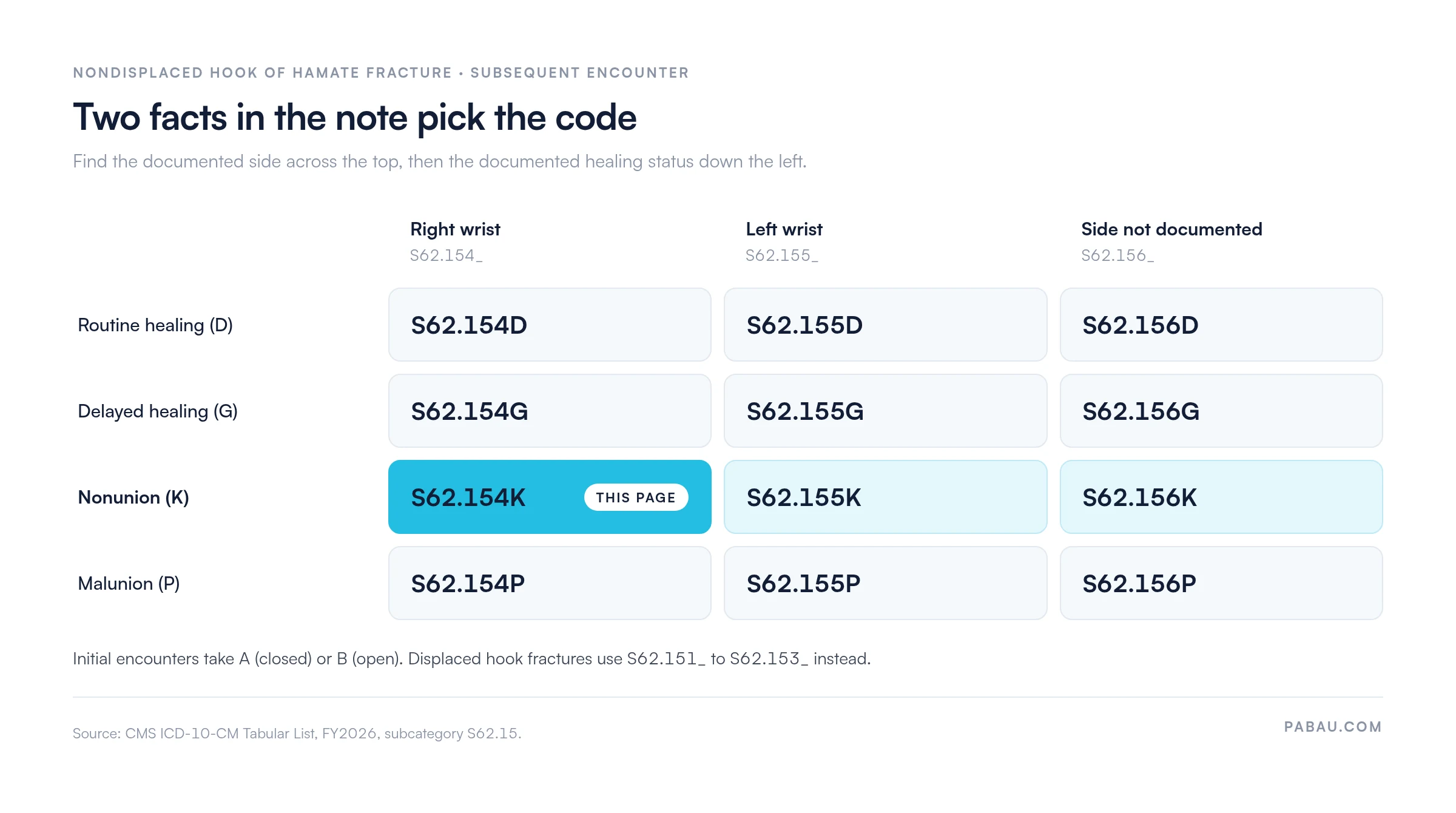
Two other neighbors cause trouble. A fracture of the body of the hamate, rather than the hook, codes to S62.14_. A wrist fracture with no named carpal bone codes to S62.10_, such as S62.109_ for an unspecified wrist.
For ICD-10 code S62.154K, the provider’s note must establish four elements. If any one is missing, the coder cannot support the code and has to query the provider.
Coders who cannot find explicit healing status language should query the provider before assigning the code. Guessing a nonunion that is not documented risks upcoding, and missing one that is risks undercoding. A standard query template for carpal fracture follow-ups helps. Consistent medical billing workflows with structured provider queries reduce rework and appeals on these claims.
Run a quarterly audit of every S62.154_ claim billed with 7th character K. Flag any claim where the provider’s assessment does not state nonunion. Providers often record the fracture type and side but leave the healing status to the imaging report.
The procedure codes billed with ICD-10 code S62.154K depend on what the provider does at the encounter. A nonunion visit often confirms the diagnosis with CT, then moves the patient toward surgery. That makes the pairings different from routine-healing follow-ups.
Plain films often show the hook poorly, so the CT billed as 73200 is usually the study that confirms the nonunion. Pair it with S62.154K only once the provider’s read documents the failed union.
Workers’ compensation claims for hamate fractures follow state-specific fee schedules. These may bundle the E&M visit with fracture follow-up services, so check the state schedule before separating codes.
Medicare Part B covers subsequent fracture encounters when medical necessity is established. For a nonunion visit, the note must document the assessment of healing and the clinical decision about next steps. A simple check-in will not carry the claim.
Key payer-specific considerations for S62.154K claims:
A clean claim submission for a nonunion encounter needs the right 7th character, correct laterality, and an E&M level the documentation supports. Any mismatch between these elements is a denial risk.
Denials on ICD-10 code S62.154K follow predictable patterns, and catching them before submission costs far less than an appeal. Build the five checks below into your denial management workflows so each one runs before a claim goes out.
When appealing a 7th character denial, include the note language that documents the healing status and the imaging report. Add the relevant text of ICD-10-CM Official Guidelines Section I.C.19.c.1. Look up the denial codes to match the remittance code to the right appeal strategy. CARC 50 (not medically necessary) and CARC 11 (diagnosis inconsistent with the procedure) are common on these denials.
Build a monthly audit checklist for all S62.15_ claims. Check that the 7th character matches the documented healing status, and the code’s side matches the note. Confirm the provider states nonunion on every K claim, and the E&M level matches documented complexity.
In most practices, the healing status makes two journeys. The provider records it in the follow-up note, and someone at the billing desk reads that note and picks a 7th character. If the note says “not healing” without the word “nonunion,” the coder has to guess or chase a query.
Pabau keeps the clinical note and the claim in the same record, so the coder reads the assessment where it was written. Pabau’s claims software for coders checks each claim for missing or invalid details before it leaves the practice. In the US, claims go out through Claim.MD, and rejected claims are marked for action with the field to fix.
The result is a nonunion claim that agrees with the note it came from. Your team spends less time rebuilding the healing history for a payer weeks after the visit.

Pabau keeps clinical notes, coding, and claims in one record, and checks each claim for missing or invalid details before submission. Your nonunion claims go out matching the provider’s documentation.

Treat S62.154K as a code you assign on the provider’s word, never on the imaging alone. A right-wrist, nondisplaced hook fracture earns K once the assessment says “nonunion.”
The hook’s poor blood supply means these claims will keep coming. A standing nonunion query in your carpal fracture follow-ups costs one message to the provider. Skipping it costs an appeal later.
Book a demo to see how Pabau keeps follow-up notes and claims in one record, so the claim’s 7th character matches the chart.

Need to understand how clearinghouse submission works for fracture codes? Claim.MD clearinghouse overview explains how electronic claim validation catches code-level errors before payer submission.
Looking for guidance on what makes a fracture claim clean? Clean claim submission requirements covers the documentation and coding elements payers check on musculoskeletal claims.
Want to reduce overall denial volume across your practice? Revenue cycle management fundamentals outlines the end-to-end workflow that keeps denial rates low on complex orthopedic accounts.
ICD-10 code S62.154K is the billable code for a nondisplaced hook of hamate fracture of the right wrist. It covers a subsequent encounter for fracture with nonunion. Use it at a follow-up visit after active treatment, when the provider documents that the fracture has failed to unite.
Use 7th character K at a subsequent encounter when the provider documents a nonunion, meaning the fracture has failed to heal. Per ICD-10-CM Official Guidelines Section I.C.19.c.1, care for a nonunion takes the subsequent nonunion character. Character D covers routine healing, G covers delayed healing, and P covers malunion.
S62.154D codes a subsequent encounter for this fracture with routine healing, and S62.154K codes the same fracture with nonunion. Both are subsequent encounters, but the healing outcome differs. Assign D when the note documents normal healing. Assign K when imaging or clinical assessment confirms the fracture has not united, and the provider documents it.
The note must document four elements. These are a nondisplaced fracture, the hook process of the hamate as the bone, and the right wrist as the side. The fourth is a nonunion confirmed on imaging or by clinical assessment. A missing element calls for a provider query before the code is assigned.
Use S62.155K for a nondisplaced hook of hamate fracture with nonunion in the left wrist. S62.154K is the right wrist, and S62.156K is for notes that do not state a side. Displaced hook fractures use S62.151_ to S62.153_ instead.
Common triggers are an initial character on a follow-up visit, and D or K that does not match the documented healing status. A side that conflicts with the note and an unsupported E&M level also cause denials. CARC 50 and CARC 11 often appear on the remittance advice for these denials.
Common pairings are established-patient E&M codes 99213 or 99214, wrist X-ray code 73100, and CT code 73200 to confirm the nonunion. When the nonunion is treated surgically, open treatment code 25645 or carpectomy code 25210 may apply. Confirm the surgical code against the AMA CPT manual and payer policy.