

ICD-10 code S61.201A: Open wound of left index finger without nail damage
ICD-10 code S61.201A covers a left index finger wound of unstated type ICD-10 co...

Last Updated: Oct 16, 2026
Billable Code Specific Code
S62.036B is the billable ICD-10-CM code for nondisplaced fracture of proximal third of navicular [scaphoid] bone of unspecified wrist, initial encounter for open fracture.
Coders most often confuse this code with S62.035B (left wrist), S62.034B (right wrist), or S62.036A (the closed-fracture variant). Claims get denied when the seventh character, laterality, or open-fracture status doesn't match the documentation.
Let Pabau's smart automation suggest the right codes, reduce claim denials, and keep your practice compliant—effortlessly.
Automate repetitive tasks and focus on what matters most—your patients.
Reduce coding errors and ensure compliance with the latest regulations.
Clean claims, fewer denials, and faster reimbursements.
Powerful insights and reporting to help your practice thrive.
HIPAA compliant SOC 2 certified GDPR-compliant Trusted by 4,000+ clinics worldwide

S62.036B covers a nondisplaced proximal-third scaphoid fracture of an unspecified wrist at the initial encounter for an open fracture. Use S62.034B for the right wrist and S62.035B for the left.
In category S62, seventh character B means any open fracture at the initial encounter. Wrist and hand codes have no Gustilo split, so S62.036C does not exist.
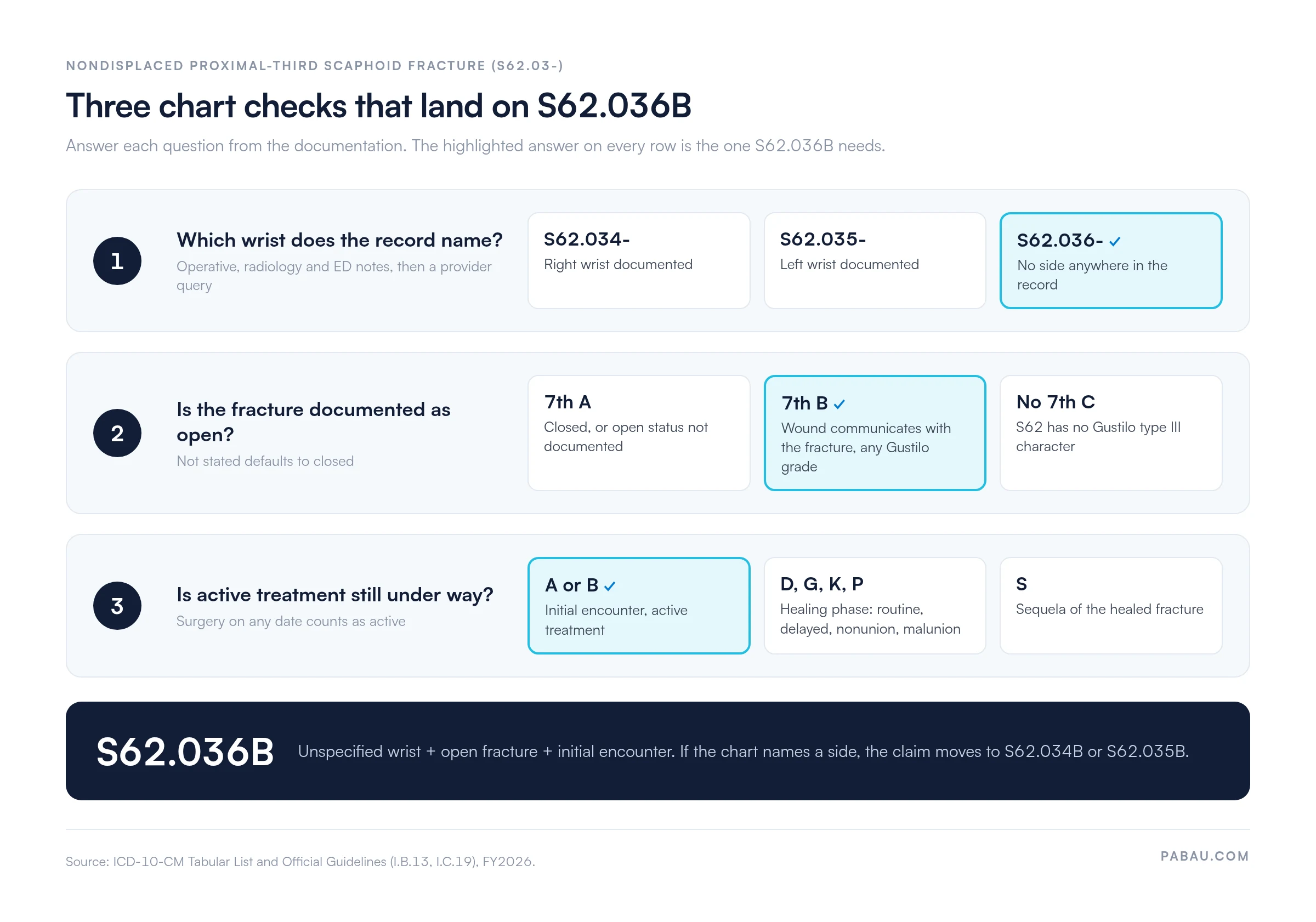
The record must describe a wound that communicates with the fracture. A fracture not documented as open is coded as closed, which makes it S62.036A.
An open scaphoid fracture that reaches surgery almost always has a documented side. Check the operative, radiology and emergency notes before you settle on the unspecified code.
Practice management software like Pabau runs validation checks on every claim before it goes out, so missing details surface before a payer rejects the claim.
ICD-10 Code S62.036B is the billable ICD-10-CM code for a nondisplaced fracture of the proximal third of the scaphoid in an unspecified wrist.
It applies at the initial encounter for an open fracture, and it is valid for fiscal year 2026. The code belongs to category S62, fracture at wrist and hand level, in Chapter 19 (Injury, Poisoning and Certain Other Consequences of External Causes).
Each character in S62.036B carries a distinct clinical meaning. Misreading any one of them produces a different billable code, usually one that does not match the operative report.
The seventh character B marks the initial encounter for an open fracture. The ICD-10-CM Official Guidelines for Coding and Reporting (Section I.C.19) define “initial encounter” as the period of active treatment. Every visit while the patient receives active treatment for the fracture counts, including surgery on any date. The subsequent-encounter characters apply only once active treatment ends and the patient is in the healing or recovery phase.
Category S62 uses a shorter seventh-character set than the long-bone fracture categories. Radius and ulna (S52), femur (S72) and lower leg (S82) codes use the Gustilo type to choose between B and C for an open fracture. Wrist and hand codes don’t, so every open S62 fracture takes B at the initial encounter. The full set for the S62.036 code family is shown below.
Surgeons often grade open fractures with the Gustilo-Anderson classification, which scores wound size, contamination and soft-tissue damage. That grade decides between seventh characters B and C on radius, femur and tibia fractures. It has no effect on an S62 code. A small Type I puncture and a contaminated Type III wound over the scaphoid both code to S62.036B at the initial encounter.
Coders who carry the long-bone rule over to the wrist end up searching for S62.036C, a code that doesn’t exist. What the claim does need is proof that the fracture is open. The note must describe a wound that communicates with the fracture site, such as a laceration or puncture over the break. If the record never says whether the fracture is open or closed, Guideline I.C.19.c.1 directs you to code it as closed, which is S62.036A.
S62.036B sits within a tightly grouped family of codes that differ by a single dimension — laterality, displacement status, open vs closed, or encounter type. An error in any one dimension produces a code that will not match the supporting documentation and may trigger a payer edit or denial. The laterality split is simple. S62.034 is the right wrist, S62.035 the left, and S62.036 an unspecified wrist.
The sixth character 6 in S62.036B means the record doesn’t say which wrist is fractured. Section I.B.13 of the ICD-10-CM Official Guidelines tells coders to assign the unspecified side only when the medical record doesn’t identify it. The injury S62.036B describes is the same one S62.034B and S62.035B describe. Only the documentation of the side is missing.
In practice, an open scaphoid fracture that reaches surgery almost always has a documented side. Before you settle on S62.036B, check these sources in order:
Many payers scrutinize unspecified-laterality codes more closely, and some edit them out on surgical claims. A documented side that never made it onto the claim is one of the easiest denials to prevent.
The three checks below run in the order a coder meets them in the chart, and each one narrows the S62.03- family.
Category S62 carries one Excludes1 note and one Excludes2 note. An Excludes1 condition is never coded alongside S62.036B for the same injury. An Excludes2 condition isn’t part of the S62 code, so it gets its own code when the patient has both.
Auditors reviewing S62.036B claims look for six specific documentation elements. When one is missing, payers can deny the claim or recoup the payment later. Confirm all six before you assign the code, rather than after the claim goes out. A superbill that pre-populates these fields from the operative note reduces the risk of a missed element at charge entry.
CPT code selection for a proximal scaphoid fracture depends entirely on what the surgeon performed. The ICD-10 code describes the diagnosis, while the CPT code describes the service. Open fractures coded to S62.036B usually pair with open surgical treatment and debridement of the fracture site. Check each descriptor in our CPT code library before charge entry.
Sending CPT and ICD-10 pairs through a clearinghouse lets it check the pairing against payer edits before the claim reaches the insurer. That catches mismatches that manual review misses.
The table below lists the CPT codes that most often appear with S62.036B, plus one frequent mismatch.
Confirm CPT code 25628 documentation includes the approach (dorsal vs volar), fixation method (headless compression screw vs K-wire), and intraoperative imaging notes. Incomplete operative reports are a common reason for additional documentation requests on scaphoid ORIF claims.
Medicare does not routinely require prior authorization for scaphoid fracture surgery, but individual Medicare Advantage plans and commercial payers vary significantly. Always verify prior authorization requirements with the specific plan before scheduling elective ORIF. Emergent open fracture repair generally proceeds without authorization, but the claim must still meet medical necessity criteria on review. Check the MAC’s Local Coverage Determinations (LCDs) and each commercial payer’s policy for scaphoid fracture surgery. Remittance advice from past claims also shows which payers have denied this code before.
Claim denials for S62.036B cluster around five root causes. Each one is preventable with a documentation checklist applied before the claim leaves the practice. Routing open-fracture claims through a pre-submission review cuts rework. A denied open-fracture claim typically needs the operative report resubmitted, not just a corrected claim form. A clean claim on the first pass depends on verifying all six documentation elements before charge entry.
Proximal scaphoid fractures have higher nonunion rates than distal-pole fractures, a pattern attributed to the retrograde blood supply of the proximal pole. Even so, coders should rely on physician confirmation of nonunion, not anatomical inference, when selecting subsequent-encounter codes. When a fracture originally coded as S62.036B develops nonunion, switch to S62.036K (subsequent encounter for fracture with nonunion). Do not keep using S62.036B. The switch requires a note from the treating physician that explicitly diagnoses nonunion.
A patient may return for hardware removal after a healed scaphoid ORIF originally coded as S62.036B. The guidelines list removal of an internal fixation device as subsequent care, so that visit codes to S62.036D. Keeping seventh character B on a hardware-removal visit is a common audit finding.
Open-fracture claims often stall on details that were in the chart all along. A coder picks the unspecified-wrist code, or re-keys insurer details by hand, and the problem only shows up when the rejection arrives.
Pabau pulls the patient, treatment, and insurer details from the patient record into a pre-filled submission. Its medical claims management tools run validation checks each time you send a claim. US practices then submit through Claim.MD without leaving Pabau.
Each claim sits in one dashboard as pending, submitted, processing, paid, or error. So an S62.036B claim that comes back for laterality or missing open-fracture documentation is visible right away, not weeks later.

Pabau pre-fills each claim from the patient record and runs validation checks before it goes out. Track every open-fracture claim from submission to payment in one view.

S62.036B is rarely the final code for an open scaphoid fracture that reaches surgery. The side is almost always somewhere in the chart, and finding it moves the claim to S62.034B or S62.035B.
The other trap is importing Gustilo logic from radius and tibia codes. On a wrist fracture, the wound grade shapes the surgical plan but leaves the seventh character alone. Any open S62 fracture at the initial encounter takes B.
Build those two checks into charge entry, and the code on the claim will match the operative report. To see how Pabau supports orthopedic and urgent care billing, book a demo.

Need guidance on denial codes and how to respond to them? Denial codes in medical billing covers the most common CARC and RARC codes and what each one requires for appeal.
Submitting claims electronically for the first time? Understanding the 837 file format explains how diagnosis and procedure codes map to claim transactions for clearinghouse submission.
Tracking eligibility before an orthopedic visit? Insurance eligibility verification outlines how to confirm coverage and benefits before the patient arrives, reducing claim rejections tied to eligibility errors.
Want the fracture details captured at charge entry? What is a superbill explains the fields that carry diagnosis and procedure codes onto the claim.
Building a process for denied claims? Denial management in healthcare shows how to track, appeal and prevent repeat denials.
ICD-10 code S62.036B is the billable diagnosis code for a nondisplaced fracture of the proximal third of the scaphoid (navicular) bone of an unspecified wrist. It applies at the initial encounter for an open fracture. Each character specifies a distinct detail: category, location, displacement, laterality, and encounter type. All of them must match the supporting documentation.
In category S62, seventh character B marks the initial encounter for an open fracture. “Initial encounter” covers the whole period of active treatment, including surgery. In the radius, femur and lower-leg categories, B instead means a Gustilo type I or II open fracture, and C covers type III.
S62.035B covers the left wrist, S62.034B covers the right wrist, and S62.036B covers an unspecified wrist. Every other coding dimension is identical. All three describe a nondisplaced proximal-third scaphoid fracture at the initial encounter for an open fracture. When the record names the injured side, use the side-specific code, because unspecified-laterality claims draw more payer scrutiny.
The most common cause is unspecified laterality, where S62.036B goes out although the note documents the right or left side. Others include a wound that is described but never documented as an open fracture. Coders also use B at a healing-phase follow-up when D applies. Some payers deny claims that lack a Chapter 20 external cause code for traumatic injuries. Each of these is preventable with a pre-submission documentation checklist.
No. Category S62 has no Gustilo split, so every open scaphoid fracture takes seventh character B at the initial encounter. The grade still belongs in the operative note because it guides treatment. It just doesn’t change the code, and S62.036C does not exist.
Yes, S62.036B is a valid and billable ICD-10-CM diagnosis code for fiscal year 2026. It has not been revised or inactivated in the current tabular list. Coders should verify against the CDC/NCHS ICD-10-CM web tool annually, as ICD-10-CM updates take effect each October 1.



