HCPCS code V2221: Lenticular bifocal lens billing guide
HCPCS code V2221 bills one lenticular bifocal lens at a time HCPCS code V2221 de...

Last Updated: Oct 19, 2026
25628 is the CPT code for open treatment of a carpal scaphoid (navicular) fracture. Internal fixation is included in the code when the surgeon performs it.
It applies when the surgeon opens the wrist to expose and reduce the scaphoid fracture under direct vision. Open treatment of any other carpal bone is reported with 25645, and closed scaphoid care uses 25622 or 25624. Many payers also expect an RT or LT modifier on the claim line.
Let Pabau's smart automation suggest the right codes, reduce claim denials, and keep your practice compliant—effortlessly.
Automate repetitive tasks and focus on what matters most—your patients.
Reduce coding errors and ensure compliance with the latest regulations.
Clean claims, fewer denials, and faster reimbursements.
Powerful insights and reporting to help your practice thrive.
HIPAA compliant SOC 2 certified GDPR-compliant Trusted by 4,000+ clinics worldwide

CPT code 25628 covers open treatment of a carpal scaphoid (navicular) fracture and applies only when the surgeon exposes the fracture site.
Open treatment of any other carpal bone is reported with 25645, while 25622 and 25624 cover closed scaphoid treatment.
Many payers expect an LT or RT laterality modifier on the claim line, so confirm it before the claim goes out.
The 90-day global period bundles most post-operative visits, cast changes, and routine follow-up. Billing them separately requires a modifier and supporting documentation.
Bone graft codes (CPT 20900/20902) may be separately reportable when the graft comes from a separate donor site. Check current NCCI edits before billing.
CPT code 25628 describes open treatment of a carpal scaphoid (navicular) fracture. According to the American Medical Association’s CPT code set, it applies when the surgeon opens the fracture site through a direct incision and reduces it. Internal fixation is included in the code when performed, such as a Herbert screw or cannulated screw, so it is not coded separately.
The scaphoid is the most commonly fractured carpal bone, accounting for roughly 60-70% of all carpal fractures. Its proximal pole has a tenuous blood supply, which is why displaced scaphoid fractures that fail closed treatment are managed surgically. Open treatment is indicated when the fracture is displaced or closed reduction has failed. It is also used for proximal pole fractures, where healing risk is highest.
Open scaphoid fracture repair follows a consistent surgical sequence. Because CPT code 25628 is an operative-note-supported code, every step must be reflected in the surgeon’s documentation. Missing elements are the most common reason payers request additional records or issue medical necessity denials.
When bone graft is also harvested and placed, the operative note must separately describe the donor site, graft type (cancellous vs corticocancellous), and quantity. This documentation supports separate billing of bone graft codes under current NCCI guidelines.
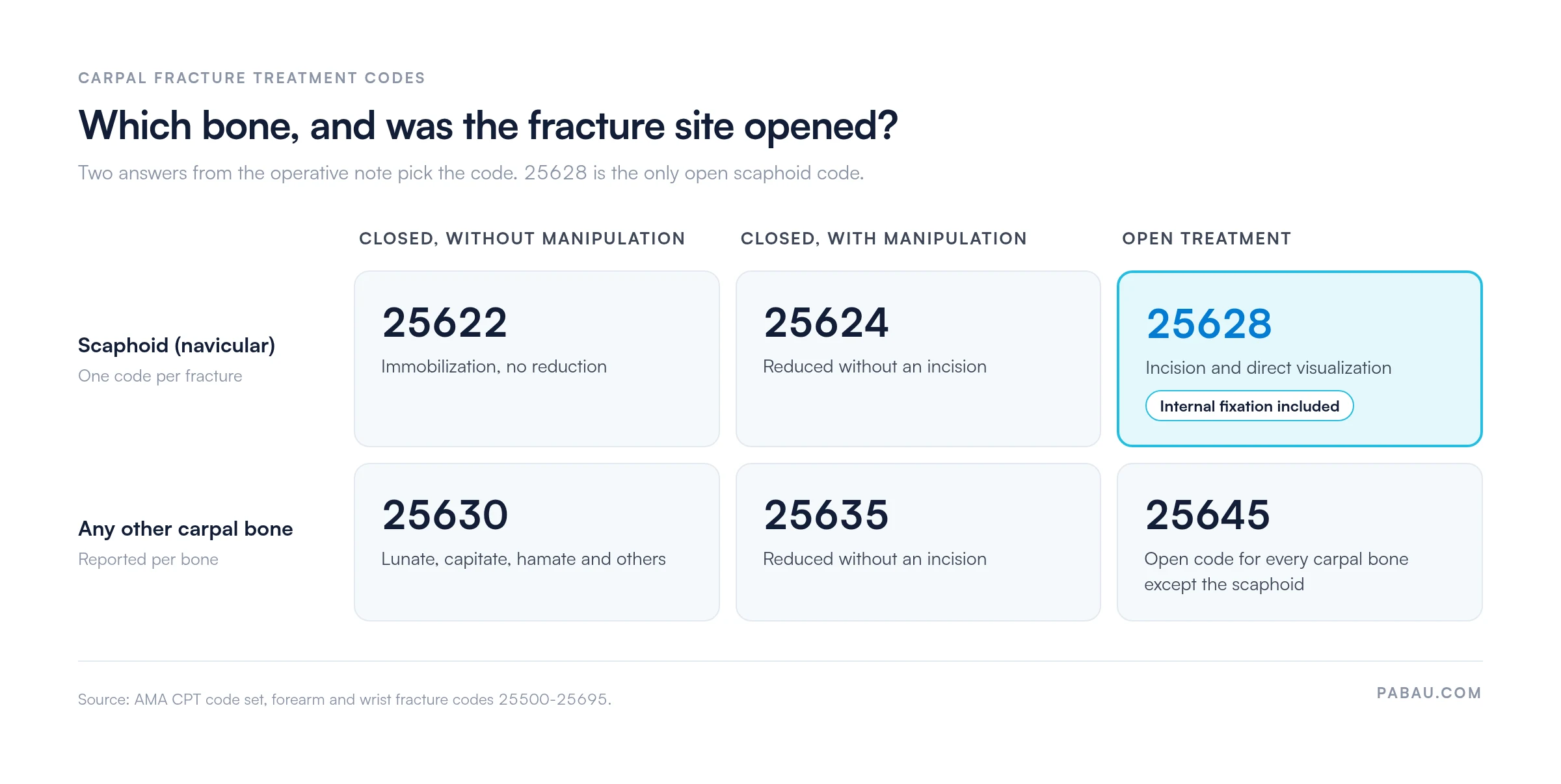
CPT 25628 belongs to a small group of carpal fracture codes that split on two questions. Which bone was treated, and did the surgeon open the fracture site? The table below shows where each neighboring code applies.
The scaphoid split matters because 25628 covers the scaphoid (navicular) only. Open treatment of any other carpal bone is reported with 25645, once per bone. CPT 25630 and 25635 are the closed codes for those bones, and 25624 is the closed scaphoid code with manipulation.
Confirm from the operative note which bone was treated, and whether the site was opened, before choosing a code. The grid below puts the two questions side by side. A distal radius fracture belongs to a different family, since 25600 is closed treatment of a distal radial fracture without manipulation.
Accepted ICD-10-CM diagnosis codes for CPT code 25628 come from the S62.0 category, which covers fractures of the navicular (scaphoid) bone. According to the CDC/NCHS ICD-10-CM coding tool, coders must specify laterality (right or left), displacement status (displaced or non-displaced), and encounter type (initial or subsequent). Payer local coverage determinations (LCDs) may further restrict payable code combinations.
Always use the “A” (initial encounter) suffix when coding the surgical visit itself. Subsequent encounters for follow-up use the “D” suffix. Confirm coverage with your MAC’s LCD before assuming a specific pairing is payable.
Displacement is carried in the sixth character. Displaced fractures use 1 (right), 2 (left) or 3 (unspecified), as in S62.011A for the right distal pole. Non-displaced fractures in the same S62.01x-S62.03x subcategories use 4, 5 or 6, such as S62.014A or S62.015A.
Check whether your MAC’s LCD restricts CPT 25628 to displaced fractures only. Some local coverage determinations require radiographic evidence of displacement documented in the pre-operative imaging report, not just the operative note. Pull the imaging report before submitting the claim.
Modifier selection for CPT code 25628 affects both payment and bundling. The table below covers the modifiers coders encounter most frequently on scaphoid fracture claims, along with the clinical situations that trigger each one.
Never append modifier 59 without first checking the current CMS NCCI edits table. NCCI edits update quarterly, and a combination that was payable last quarter may be bundled today. The edit that governs bone graft codes alongside 25628 is the one most frequently cited in audit findings for hand surgery practices.
Payers reviewing CPT code 25628 claims focus on two documents: the operative report and the pre-operative imaging. Both must be complete before the claim leaves the practice.
Medicare fee-for-service does not require prior authorization for CPT 25628 in most circumstances, but Medicare Advantage plans and commercial payers vary widely. Medicaid programs in many states require prior auth for all elective orthopedic procedures. Confirm requirements with each payer before scheduling surgery, because retroactive authorization is rarely granted once the claim has been denied. Document the authorization number on the claim when obtained.
Yes, in many cases, but with significant conditions. Bone graft harvested from a separate anatomical site during the same session as CPT code 25628 may be separately reported. The codes are CPT 20900 (bone graft, any donor area; minor, or small) and CPT 20902 (bone graft, any donor area; major or large). The key factor is whether the graft comes from a distinct donor site that requires its own surgical exposure.
Per current NCCI edits, bone graft harvested from the distal radius at the same operative site is typically bundled into 25628 and not separately billable. Graft from the iliac crest or a remote site has a stronger case for separate billing with modifier 59 to indicate distinct anatomy. Verify against the current CMS Physician Fee Schedule and NCCI table before submitting, as these edits change quarterly.
When billing bone graft alongside CPT 25628, attach the operative note pages covering the donor site harvest as a separate section. Many clearinghouses and payers will auto-deny the bone graft code without documentation clearly describing the donor site anatomy distinct from the wrist fracture site.
Medicare pays CPT code 25628 from the Medicare Physician Fee Schedule (MPFS) RVU values, which CMS updates annually. Facility and non-facility payment rates differ because non-facility rates include a practice expense component for in-office procedures. The facility rate excludes it, because the hospital absorbs facility overhead separately.
Because MPFS figures change each January with the conversion factor update, never rely on a prior-year figure. The CMS MPFS Look-up Tool returns current-year RVU values and geographic pricing multipliers by MAC jurisdiction. Commercial payers typically negotiate rates above or below the Medicare allowable depending on contract terms.
Pabau, the practice management platform we build, connects to the Claim.MD clearinghouse for real-time eligibility checks and electronic submission of CPT 25628 claims. Its built-in CPT and ICD-10 code catalogues help coders pick codes before the claim reaches the payer.
CPT code 25628 carries a 90-day global period under the CMS Medicare Physician Fee Schedule. That 90-day window starts on the day of surgery and runs through the 90th post-operative day. During that window, routine follow-up visits, cast changes, suture removal, and standard x-rays are all bundled into the original surgical payment.
Services that fall outside the global bundle and may be separately billed with appropriate modifiers include:
Commercial payers do not universally follow the CMS global period definition. Some payers apply a shorter global window or define bundled services differently. Always verify the global period policy with each payer before billing a separate E/M during the post-op period.
Scaphoid fracture claims denied at first submission share a short, predictable list of root causes. The denial management process for CPT code 25628 is more straightforward when coders know what to look for before the claim goes out. The medical billing denial codes on the remittance show which cause applied.
The clean claim standards that reduce first-pass denial rates call for modifier validation, diagnosis-to-procedure crosschecks, and authorization tracking before submission. By the appeals stage, the denial has already happened. Orthopedic practices using automated claim scrubbing through integrations like electronic clearinghouses catch the majority of these errors at the practice level.
Hand surgery and orthopedic practices billing CPT code 25628 often keep the appointment, the eligibility check, and the claim in separate systems. Pabau’s denial-tracking claims software brings those steps into one workflow, from checkout to the payer’s response.
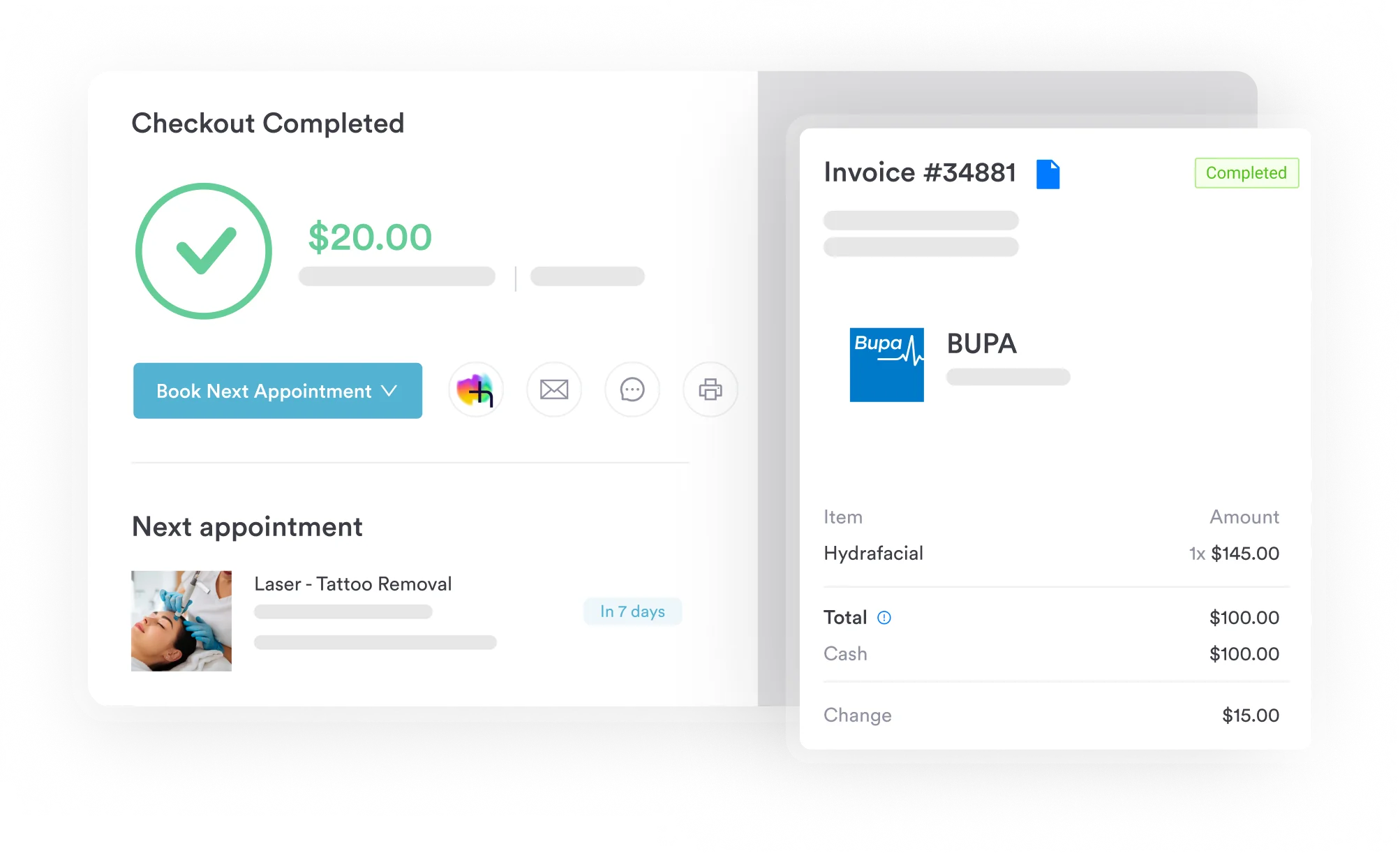
The result is fewer manual handoffs between the surgical encounter and the claim, and a clear record of where each 25628 claim stands.

Pabau sends CPT 25628 claims to thousands of US payers through Claim.MD and tracks each one from submission to payment or denial.

CPT code 25628 asks for open surgical exposure, a confirmed scaphoid fracture, and documentation that covers laterality, approach, reduction, and fixation. Before coding, settle two questions from the operative note. Was it the scaphoid, and was the fracture site opened?
If either answer is no, the claim belongs under 25622, 25624, 25630, 25635 or 25645 instead. Getting that choice right first time costs less than any appeal.
Pabau’s claims management tools bring code catalogues, eligibility checks, and Claim.MD submission and tracking into one workflow for orthopedic and hand surgery practices. To see how it fits your billing process, book a demo.

Need a reference for denial codes on orthopedic claims? Denial codes in medical billing covers the most common CARC codes and how to respond to each one on appeal.
Want to understand how electronic claims reach payers? 837 file billing guide explains the 837P transaction set used to submit CPT 25628 claims electronically.
Looking for guidance on ERA and payment posting? Electronic remittance advice (ERA) explained walks through how 835 remittance files map to your claim lines after adjudication.
Treating the scaphoid without opening the wrist? CPT code 25624 covers closed scaphoid fracture treatment with manipulation.
Need the diagnosis code for a distal pole fracture? ICD-10 code S62.011A explains the displaced distal pole code for the right wrist.
CPT code 25628 covers open treatment of a carpal scaphoid (navicular) fracture. It applies when the surgeon makes an incision to expose the fracture site and reduces the fracture under direct vision. Internal fixation is included in the code when it is performed.
Yes. Internal fixation hardware (Herbert screw, cannulated screw, or K-wire) placed during the same operative session is included in CPT 25628. It is not coded separately. Work beyond fixation, such as a bone graft from a separate donor site, can be separately reportable when NCCI edits allow it.
CPT 25628 carries a 90-day global period under the CMS Medicare Physician Fee Schedule. Routine follow-up visits, cast changes, and standard x-rays within that 90-day window are bundled into the surgical payment. Services for new conditions, complications, or planned staged procedures may be separately billed with the appropriate modifier (24, 58, 78, or 79).
Common denial triggers start with a missing laterality modifier (LT or RT) or an ICD-10 code that does not map to a scaphoid fracture. Payers also deny for a missing prior authorization from a Medicare Advantage or commercial plan. An NCCI bundling conflict on a co-billed bone graft code is another cause, as is an operative note without open visualization language. Settle laterality and ICD-10 matching before submission to prevent the most avoidable denials.