ICD-10 code S42.226P: Displaced lesser tuberosity fracture, malunion
ICD-10 code S42.226P: Quick reference ICD-10 code S42.226P is a billable diagnos...

Last Updated: Oct 21, 2026
Billable Code Specific Code
S61.309D is the billable ICD-10-CM code for unspecified open wound of unspecified finger with damage to nail, subsequent encounter. It covers routine healing-phase visits, such as wound checks and suture removal, once active treatment has ended.
Coders switch from A to D when active treatment ends, not on the second visit. Billing S61.309A on a routine follow-up wound check is a frequent source of coding errors.
Let Pabau's smart automation suggest the right codes, reduce claim denials, and keep your practice compliant—effortlessly.
Automate repetitive tasks and focus on what matters most—your patients.
Reduce coding errors and ensure compliance with the latest regulations.
Clean claims, fewer denials, and faster reimbursements.
Powerful insights and reporting to help your practice thrive.
HIPAA compliant SOC 2 certified GDPR-compliant Trusted by 4,000+ clinics worldwide

S61.309D is a billable ICD-10-CM code for an unspecified open wound of an unspecified finger with damage to the nail, at a subsequent encounter.
The 7th character D applies once active treatment ends, and choosing the wrong character is a frequent source of coding errors.
Use S61.309D, not a Z48 aftercare code, for traumatic wound follow-up, because the ICD-10-CM guidelines do not use aftercare codes for injuries.
Pabau’s claims management software records the diagnosis your coder chooses, then submits and tracks the claim through the Claim.MD integration.
ICD-10 Code S61.309D is the billable ICD-10-CM code for a follow-up visit on an unspecified open wound of an unspecified finger with nail damage. It applies once active treatment has ended. The code sits in Chapter 19 (Injury, poisoning and certain other consequences of external causes), under category S61 (Open wound of wrist, hand and fingers). The full official descriptor is: Unspecified open wound of unspecified finger with damage to nail, subsequent encounter.
The code breaks into three clinical components. The first is the wound: a traumatic open wound whose type is not documented. The second is the site: a finger other than the thumb, digit not identified, with damage to the nail bed or nail plate. The third is the encounter phase: subsequent, meaning active treatment is complete. All three must be confirmed in documentation before you assign this code. Coders new to injury coding can review medical billing basics first.
The 7th character D designates a subsequent encounter in ICD-10-CM injury codes. It means the patient is receiving routine care after the active treatment phase has concluded. A second visit does not trigger it on its own. A patient can present for wound care three times in one week. If active treatment is still underway, every one of those visits takes A.
The CDC/NCHS ICD-10-CM Official Guidelines for Coding and Reporting define what counts as active treatment. It includes surgical treatment, an emergency department encounter, and evaluation and continuing treatment by the same or a different physician. Once the wound is managed and the patient enters the healing phase, every subsequent visit carries the D extension. The guidelines tie the 7th character to whether active treatment is ongoing, and the visit count plays no part.
The S61.309 family has three 7th-character variants, and wounds that leave the nail intact sit in a separate subcategory, S61.2-. Getting the right code requires answering two questions before you touch the encoder: is the nail involved, and is this an active-treatment or post-treatment visit?
Nail involvement splits finger wounds into two subcategories. S61.2- covers open wounds of a finger without damage to the nail, and S61.3- covers those with it. If the note describes a nail bed laceration or nail plate avulsion, the code comes from S61.3-. If the nail is intact, S61.209D applies instead.
Within S61.3-, S61.30- is reserved for wounds whose type is not documented. Sibling subcategories take over once the type is recorded, so a laceration without foreign body of an unspecified finger is S61.319D. The CDC/NCHS ICD-10-CM web tool lists every subcategory under S61.3, and the three questions below settle the code in order.
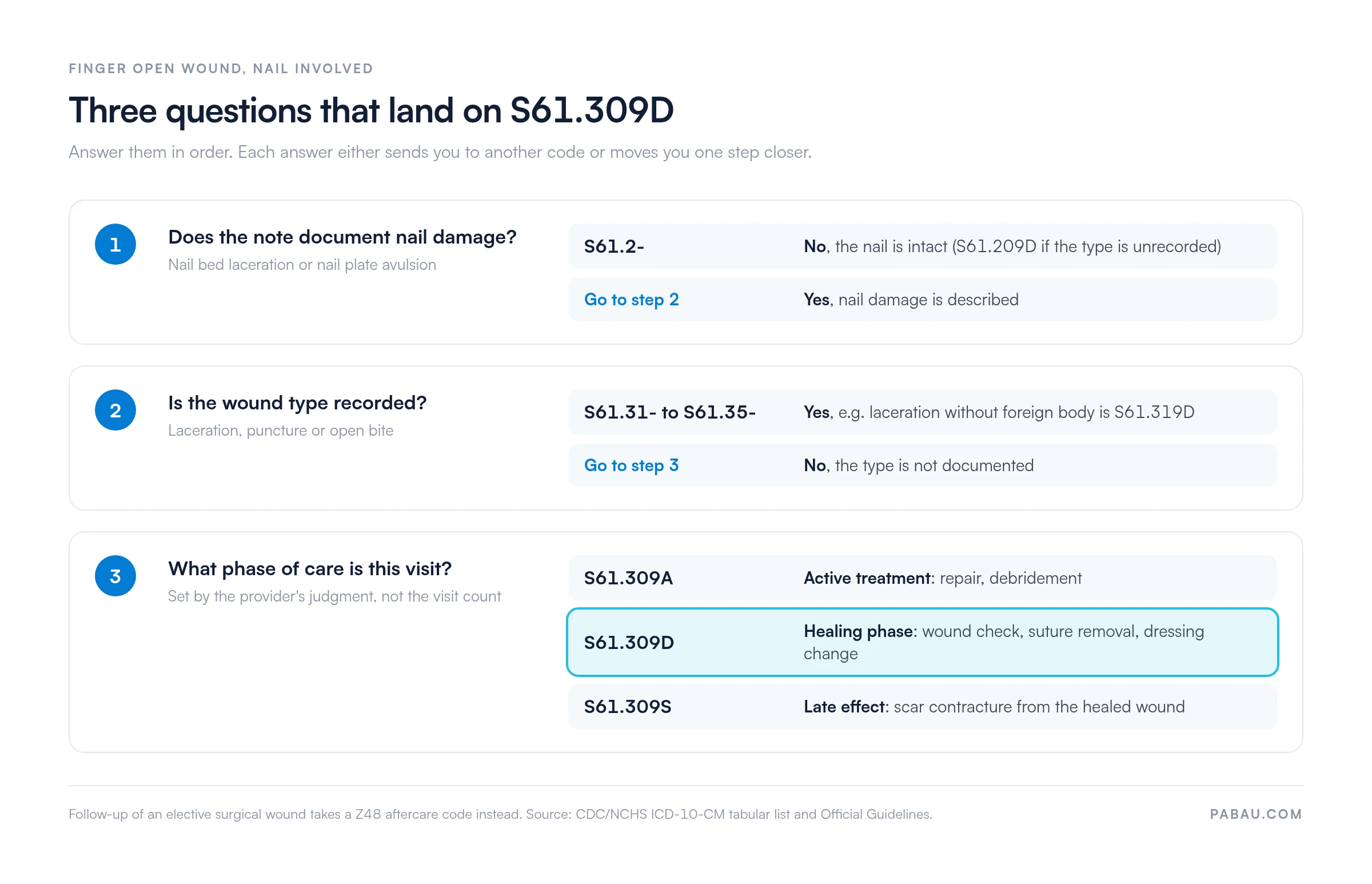
The notations that govern S61.309D determine which wounds qualify and which require a different code. Misreading them can lead to denials.
Use “unspecified finger” only when the record leaves the digit unclear. Per the ICD-10-CM Official Guidelines, an unspecified code fits only when the clinical record does not identify the specific digit. A note that names the finger, paired with an unspecified code on the claim, can draw payer audits.
Z48.xx aftercare codes do not belong on a traumatic wound follow-up visit. Using them there is a coding error that can draw payer audits.
The ICD-10-CM Official Guidelines do not use aftercare Z codes (Z42-Z49, Z51) for injuries. For a healing injury, the guidelines assign the injury code with 7th character D instead. A patient returning after repair of a finger wound with nail damage is in the subsequent encounter phase of a traumatic injury. S61.309D is the correct code there, and Z48.xx is wrong.
Effective medical billing compliance for wound care practices means training staff on this distinction at onboarding. Claims teams that routinely use Z48 codes for traumatic wound follow-up can draw payer audits.
Run a quarterly audit of claims where Z48.xx appears alongside any S61.3x code on the same patient encounter. That combination usually signals an error, because traumatic finger wounds in the healing phase take the injury code with the D character. Flag those claims for coder education before a payer review finds them.
A valid S61.309D claim needs documentation that confirms each component the code encodes. Missing any one of these elements can lead to denials on medical necessity or coding accuracy review.
Practices that want clean claim submission for wound care follow-up visits can build a documentation checklist into their wound care note templates. The five elements above give the coder what S61.309D needs.
S61.309D claims tend to fail on a short list of coding and documentation problems. Each pattern below can lead to denials in urgent care, wound care and primary care billing.
A structured denial management workflow for wound care encounters should include a pre-submission check. It flags S61.309 claims where nail damage is undocumented, the encounter type is ambiguous, or procedure codes conflict with the 7th character.
For a full reference on the codes payers return when these claims are rejected, see medical billing denial codes and their CARC/RARC reason descriptions. Practices submitting through Claim.MD can read each CARC reason on the ERA and trace it to the documentation or coding error behind it.
S61.309D does not usually trigger prior authorization on its own, because a diagnosis code alone does not drive authorization workflows. What matters is the procedure code paired with it at the encounter.
Selective debridement codes 97597 (first 20 sq cm) and 97598 (each additional 20 sq cm) pair with S61.309A when debridement is the active treatment. Medicare and many commercial payers apply medical necessity edits to these procedure codes rather than to the diagnosis code. Payers still check that the diagnosis supports the procedure billed. A D-coded encounter paired with debridement can prompt a clinical edit if the documentation does not show why.
Coders should confirm the LCD (Local Coverage Determination) policies for wound care procedure codes in their MAC jurisdiction, which the Medicare Coverage Database lists. Coverage criteria for debridement and wound management CPTs vary by payer and region.
Without a structured wound note, coders chase providers for nail status and care phase after the visit. Pabau, the practice management platform we build, includes claims software for practices. It records the diagnosis code your coder has already chosen, then submits and tracks the claim. For an S61.309D follow-up visit, the workflow runs in five steps.
Configure a wound care note template in Pabau that includes nail status, finger laterality, and encounter phase as structured fields. When these data points are captured at the point of care, coders can assign S61.309D with confidence rather than querying the provider after the visit. Structured capture can reduce coding queries on high-volume wound care schedules.

Pabau records the diagnosis your coder chooses and submits and tracks the claim through the Claim.MD integration. Denials and ERA data come back to the same place.

The fastest fix for S61.309D sits upstream of the coder. When every follow-up note records nail status, wound type and care phase, the code follows from the note. The A-versus-D and Z48 errors then stop reaching payers.
The trade-off is a slightly longer wound care note. Those extra seconds at the point of care cost less than a provider query or a resubmitted claim later.
Pabau’s clinical note templates can make those fields required, and its claims software submits and tracks the claim through Claim.MD. Book a demo to see how Pabau keeps wound care follow-up claims clean from note to payment.

Need to understand how clearinghouse claim validation works? Medical claims clearinghouse overview explains how payer edits, ERA reconciliation, and real-time eligibility fit into the claim lifecycle.
Want to reduce wound care claim rejections systematically? Clean claim submission guide covers the documentation and coding checks that prevent the most common denial triggers before claims leave the practice.
Looking for the ERA and remittance framework behind wound care payments? Electronic remittance advice explained covers how 835 ERA files map denial codes back to specific claim lines for wound care and other outpatient services.
S61.309D is the billable ICD-10-CM code for an unspecified open wound of an unspecified finger with damage to the nail, at a subsequent encounter. The patient is in the post-active-treatment healing phase. The 7th character D distinguishes this from S61.309A (active treatment) and S61.309S (sequela of a healed wound). If the nail is intact, the code is S61.209D instead.
S61.309A applies when active treatment is still underway, such as initial wound repair, debridement or definitive care. S61.309D applies once active treatment is complete and the patient returns for routine healing monitoring, suture removal, or dressing changes. The switch is based on treatment phase, not visit number.
S61.309D covers a finger wound where the clinical documentation does not identify the specific finger. When the record names the index, middle, ring or little finger, use the more specific code from the S61.30- subcategory. The thumb is not part of S61.30-: a thumb wound with nail damage codes to S61.1-. “Unspecified” is appropriate only when documentation does not identify the digit.
Three 7th character extensions apply to S61.309. A is the initial encounter (active treatment), D is the subsequent encounter (post-active-treatment healing) and S is sequela (a late effect of the healed wound). Each maps to a distinct phase of care and cannot be used interchangeably without creating a coding error.