ICD-10 Code T31.77: Burns involving 70-79% of body surface
ICD-10 code T31.77: Quick reference and code details ICD-10 code T31.77 is the b...

Last Updated: Nov 5, 2026
Billable Code Specific Code
S61.216S is the billable ICD-10-CM code for laceration without foreign body of right little finger without damage to nail, sequela. It applies once the cut has healed and the visit treats a late effect, such as a scar.
The code sits in category S61, open wound of wrist, hand and fingers. Assigning it depends on documenting the side, the digit, any foreign body, nail involvement and the encounter type. Use S61.216A or S61.216D while the wound is still open or healing. A wrong 7th character is among the leading reasons claims in this code family are denied.
Let Pabau's smart automation suggest the right codes, reduce claim denials, and keep your practice compliant—effortlessly.
Automate repetitive tasks and focus on what matters most—your patients.
Reduce coding errors and ensure compliance with the latest regulations.
Clean claims, fewer denials, and faster reimbursements.
Powerful insights and reporting to help your practice thrive.
HIPAA compliant SOC 2 certified GDPR-compliant Trusted by 4,000+ clinics worldwide

S61.216S is a billable ICD-10-CM code for the sequela of a right little finger laceration without foreign body or nail damage.
The 7th character “S” means the wound has healed and the visit treats a late effect, such as a scar.
The late-effect code is sequenced first, with S61.216S listed after it.
Documentation must confirm the right side, the little finger, no foreign body, no nail damage, and a healed wound.
Common denials stem from the wrong 7th character, a mismatched digit or side, and a missing sequela code.
ICD-10 Code S61.216S describes a sequela visit after a laceration of the right little finger. The original cut had no foreign body in it and did not damage the nail. The code is valid for fiscal year 2027 claims, effective October 1, 2026, per the CMS ICD-10-CM code files.
Each part of the descriptor carries coding weight. “Laceration without foreign body” means a cut with no object left in the wound. “Right little finger” fixes both the side and the digit. “Without damage to nail” places the code in subcategory S61.2 rather than S61.3. “Sequela” marks the visit as late-effect care rather than active treatment.
S61.216S sits within the ICD-10-CM injury chapter and inherits coding rules from every level above it. Knowing the hierarchy helps coders find adjacent codes and read Excludes notes correctly.
Read the S61 code one character at a time. The 4th character sets the site and nail status: 2 means other finger without nail damage, and 3 means other finger with nail damage. The 5th character sets the wound type: 1 is laceration without foreign body, and 2 is laceration with foreign body. The 6th character sets the digit and side, where 6 is the right little finger.
The 7th character “S” designates a sequela encounter, per ICD-10-CM Official Guidelines Section I.C.19.a. The provider treats a condition that arose as a direct result of a previous injury. The original wound has healed, but a late effect such as scarring, nerve sensitivity or reduced range of motion needs care.
Many coders confuse sequela with ongoing wound care. If the wound is still open or under active treatment, the correct character is “A” (initial encounter) or “D” (subsequent encounter). Applying “S” while the wound is still healing inverts the clinical scenario and invites a medical necessity denial.
ICD-10-CM guidelines require two codes when “S” is used: the injury code and a code for the sequela itself. The specific sequela, such as a scar, is sequenced first, followed by S61.216S. The “S” goes on the injury code only, never on the sequela code.
S61.216A covers active treatment, S61.216D covers routine healing visits, and S61.216S covers sequela care. Only one applies to any single visit. The base code S61.216 is identical across all three, and the 7th character decides whether the claim is defensible.
The quickest test is whether the wound is still open. If it is, use “A” or “D”. If the wound has healed and the patient returns for a complication of the original injury, use “S” alongside a code for that sequela.
Excludes1, Excludes2 and “code also” notes at several levels govern which conditions can sit alongside S61.216S. They come from category S61, subcategory S61.2, block S60-S69 and the injury chapter.
Excludes1 notes mean the listed condition is never coded together with S61.216S. Category S61 excludes open fracture of wrist, hand and finger (S62.- with 7th character B) and traumatic amputation of wrist and hand (S68.-). Subcategory S61.2 also excludes open wound of finger involving the nail matrix, which is coded to S61.3-.
Excludes2 conditions are not part of S61.216S, but both may be coded when both are present. Subcategory S61.2 lists open wound of thumb without damage to nail (S61.0-).
Block S60-S69 lists burns and corrosions (T20-T32), frostbite (T33-T34) and venomous insect bites or stings (T63.4). The injury chapter lists birth trauma (P10-P15) and obstetric trauma (O70-O71).
Category S61 carries a “code also” note for any associated wound infection. The injury chapter also calls for a secondary code from Chapter 20 to show the external cause of the injury. For post-laceration scar contracture of the right little finger, the scar code comes first and S61.216S follows it.
Codes near S61.216S differ by one character, and each character changes the clinical meaning. The 6th character sets the digit and side, the 5th sets the wound type, and the 4th sets nail involvement. The diagram maps each character and the neighboring code a single change produces.
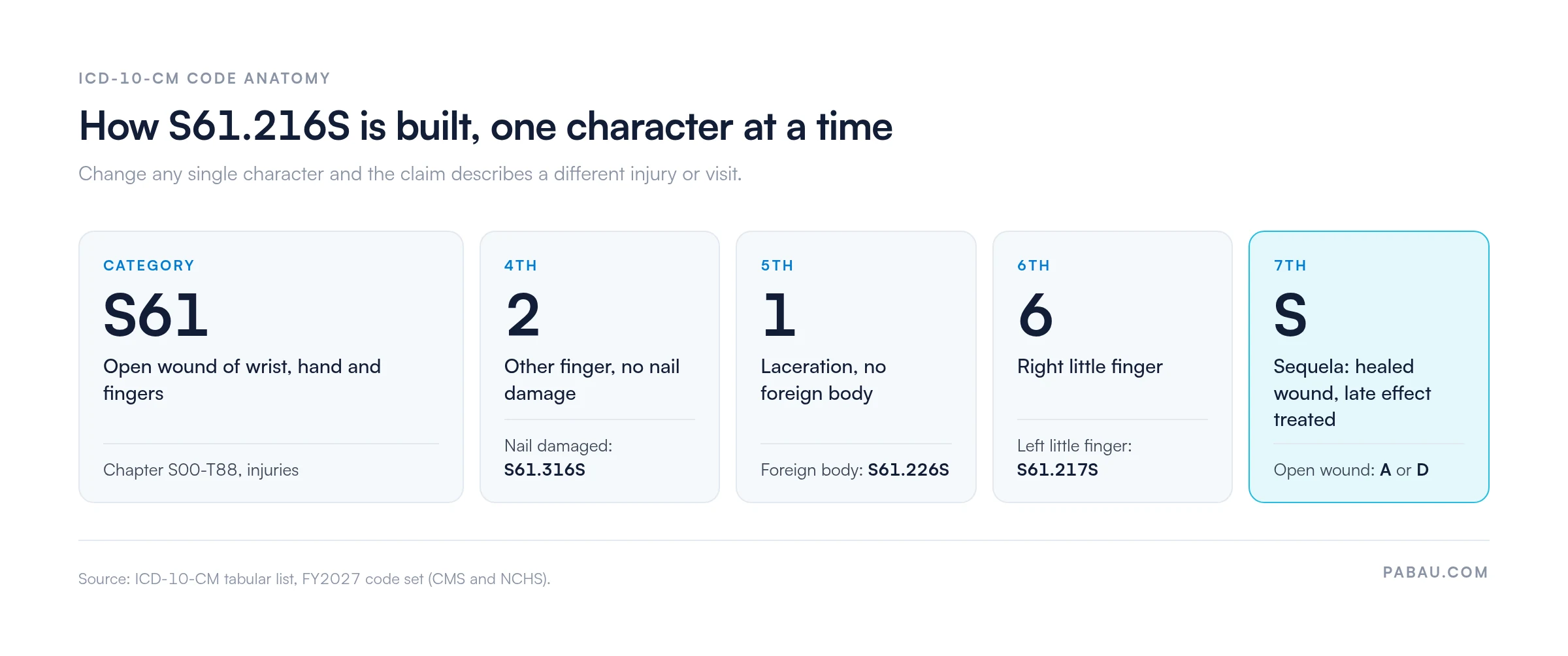
S61.217S and S61.215S each sit one digit away from S61.216S in the code string. Confirm the side and finger in the visit note before finalizing the code.
Every element of the S61.216S descriptor must be supported by the medical record. An audit that finds one missing element is grounds for denial or recoupment. Documentation that supports submitting a clean claim includes each of the following.
Medicare, Medicaid and commercial payers each apply their own medical necessity criteria to sequela claims. What follows reflects general payer patterns. Always check the current Local Coverage Determination (LCD) or payer policy for the date of service.
For Medicare claims, the ICD-10 code itself generally needs no standalone prior authorization. A procedure billed alongside S61.216S, such as scar revision or tenolysis, may need prior authorization under some Medicare Advantage plans. Fee-for-service Medicare does not typically require prior authorization for scar management office visits.
Commercial insurers vary widely. Some require proof of conservative management before they approve a scar revision. A claim pairing S61.216S with a high-complexity procedure and no conservative treatment history is a common audit trigger.
Claims coded with S61.216S are denied most often for five reasons. Each maps to a documentation or coding step that a structured review can catch before submission. Tracking them as part of denial management in healthcare lets a practice fix the cause before the same error reaches the next claim.
Before you submit, check three points. Does the 7th character match the note? Is “right little finger” documented? Is the sequela code present and listed first? These three checks prevent most S61.216S denials.
A sequela claim depends on notes from two visits, often months apart. If the original laceration note sits in a paper chart or another system, the biller has to chase it before the claim goes out.
Pabau, the practice management platform we build, links the S61.216S visit to the earlier injury visits in the same patient file. When a payer asks for the initial laceration record, your team can pull it in a few clicks.
Pabau’s built-in claims software for practices flags CPT-to-ICD-10 pairing issues before the claim leaves the practice. Claims then go out through the Claim.MD clearinghouse integration, which checks common payer edits before the payer sees them.
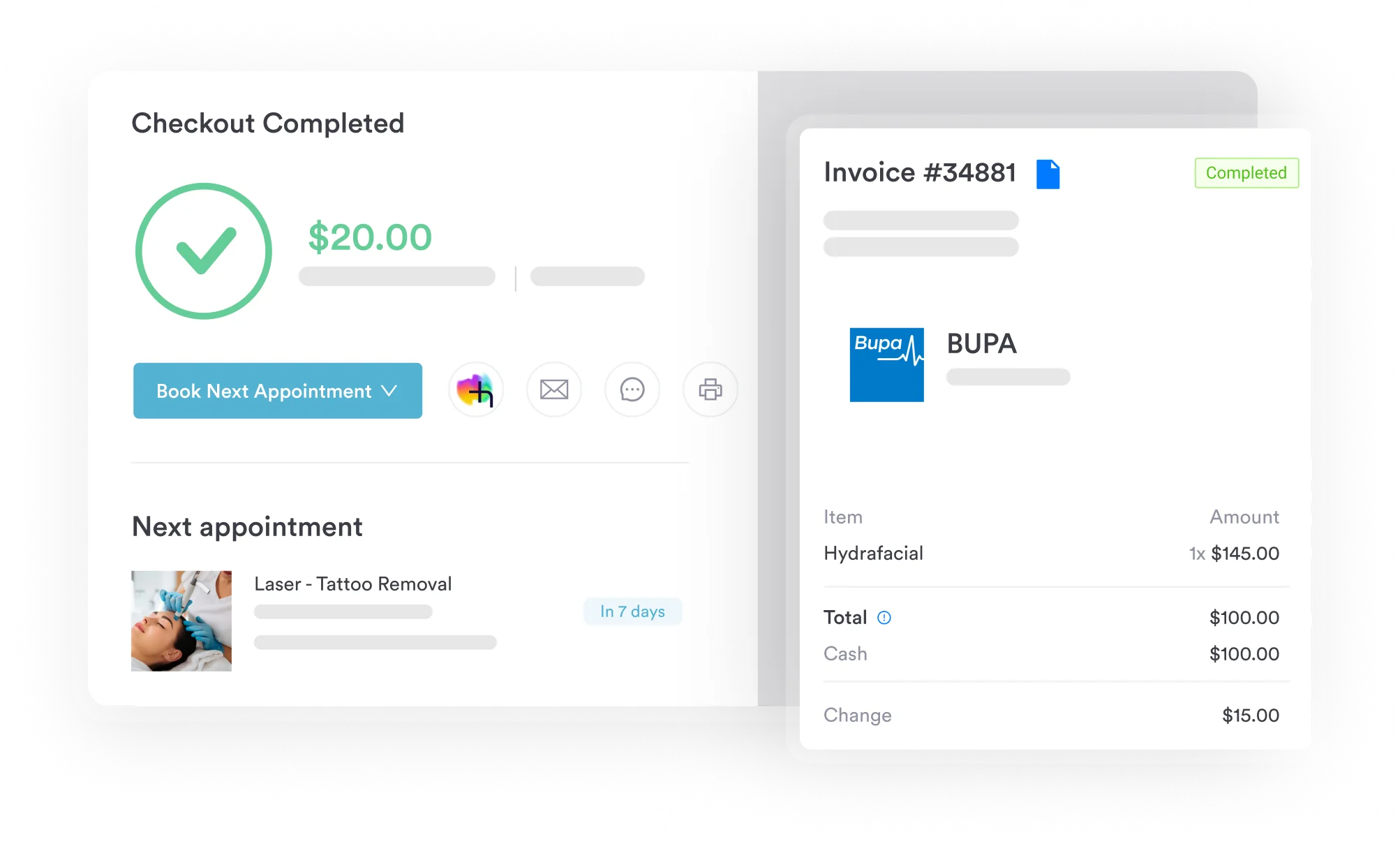

Pabau embeds diagnosis code search directly in the clinical workflow. Your team can attach the correct ICD-10-CM codes, document laterality and encounter type, and submit cleaner claims from one system.

S61.216S claims are won or lost on the 7th character. Before you pick “S”, check that the note describes a healed wound and names the late effect being treated. Then list that late-effect code first.
Once those checks hold, the remaining risk is a CPT code that doesn’t fit a sequela visit. Watch the electronic remittance advice on your first few claims. A repeat denial there usually points to one pairing rule worth fixing at the source.
Book a demo to see how Pabau keeps the injury code, the sequela code and the original visit note together on one claim.

Need to understand how clearinghouse edits catch claim errors before they reach payers? Claim.MD clearinghouse overview explains how real-time claim validation works and what it catches.
Looking for a structured approach to reducing coding-related denials? Medical billing compliance guidance covers documentation standards and audit preparation for practices handling complex injury codes.
Want to confirm coverage before the sequela visit? Insurance eligibility verification outlines how to confirm coverage before the patient arrives.
ICD-10 Code S61.216S is the billable ICD-10-CM code for laceration without foreign body of right little finger without damage to nail, sequela. It identifies a visit for a late effect of a healed right little finger cut. The original wound held no foreign body and did not damage the nail.
Yes, S61.216S is a valid, billable ICD-10-CM code for FY2027 claims, effective October 1, 2026. It is a 7-character leaf-level code that payers accept on a claim, provided the documentation supports a sequela visit and each element of the descriptor.
S61.216A covers an initial encounter during active wound treatment. S61.216D covers subsequent visits during routine healing. S61.216S applies once the wound has healed and the patient is treated for a late effect such as a scar. Only one applies per visit.
Use “S” when the original injury has healed and the visit treats a condition that is a direct late effect of it. Guidelines also require a code for the specific sequela, such as a scar or contracture code. The “S” goes on the injury code only.
No, not as a rule. ICD-10-CM guidelines sequence the specific sequela condition first, such as a scar or contracture code. S61.216S follows it to identify the injury that caused the late effect. Confirm any payer-specific sequencing policy before submission.
The most common reason is the wrong 7th character: “S” on an active wound, or “A” or “D” on a sequela visit. Other reasons include a mismatched finger or side, Excludes1 conflicts, and a missing or misordered sequela code. A CPT code that does not fit a sequela visit also triggers denials.