ICD-10 Code T31.77: Burns involving 70-79% of body surface
ICD-10 code T31.77: Quick reference and code details ICD-10 code T31.77 is the b...

Last Updated: Nov 5, 2026
Billable Code Specific Code
S52.362E is a billable ICD-10-CM code. It describes a displaced segmental fracture of shaft of radius, left arm, subsequent encounter for open fracture type I or II with routine healing.
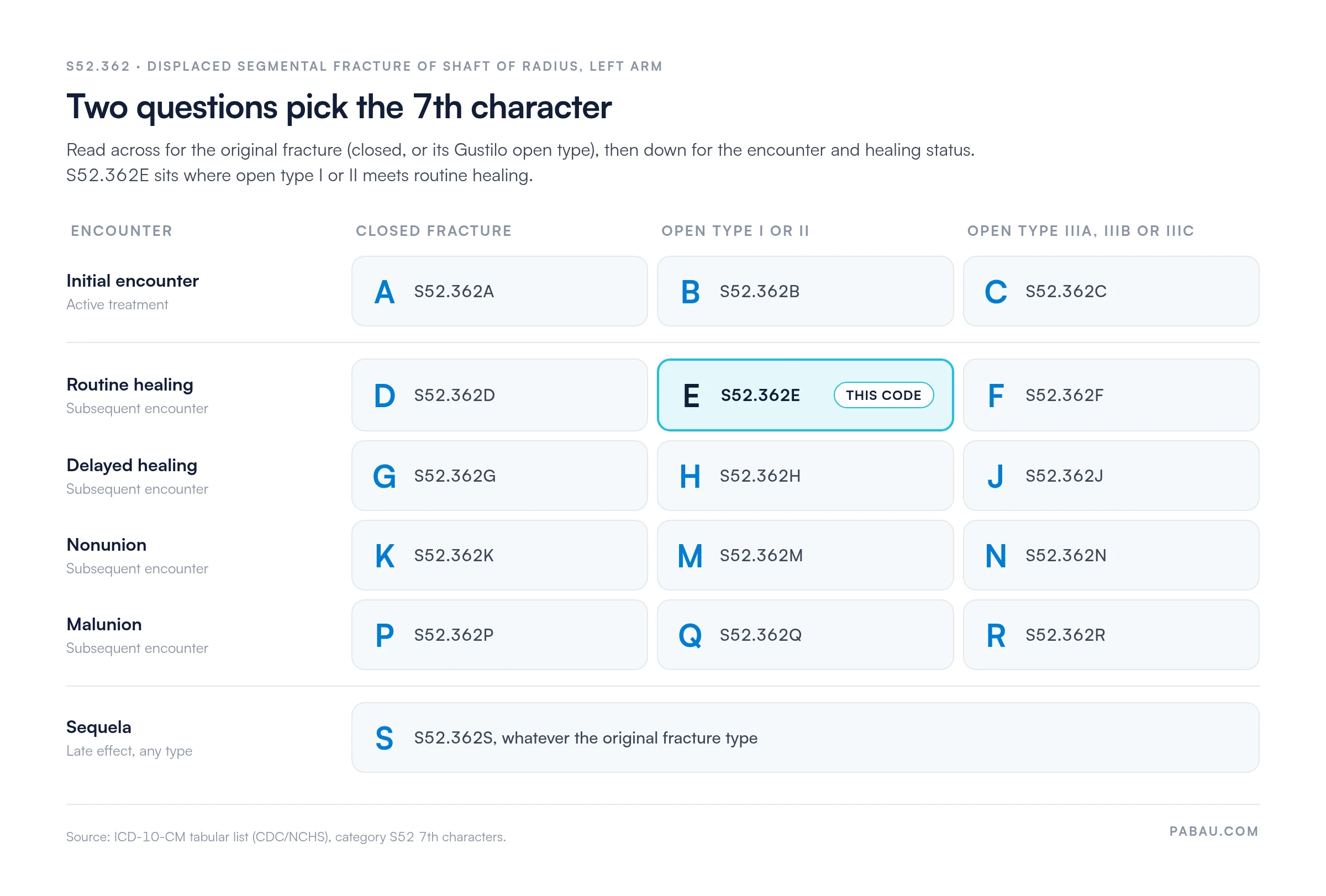
The 7th character E applies only when the original fracture was open and classified as Gustilo type I or II, and healing is now routine. A closed fracture at the same follow-up stage codes to S52.362D, and an open type III fracture to S52.362F. The code sits in category S52, fracture of forearm.
Let Pabau's smart automation suggest the right codes, reduce claim denials, and keep your practice compliant—effortlessly.
Automate repetitive tasks and focus on what matters most—your patients.
Reduce coding errors and ensure compliance with the latest regulations.
Clean claims, fewer denials, and faster reimbursements.
Powerful insights and reporting to help your practice thrive.
HIPAA compliant SOC 2 certified GDPR-compliant Trusted by 4,000+ clinics worldwide

S52.362E covers aftercare for a displaced segmental fracture of the left radius shaft. The fracture was open, Gustilo type I or II, and is healing routinely.
The 7th character E is for open type I or II follow-up. Use D for closed fracture follow-up and F for open type IIIA, IIIB or IIIC follow-up.
Once nonunion or malunion is confirmed, retire S52.362E and switch to S52.362M (nonunion) or S52.362Q (malunion), with the clinical change documented in the record.
Pabau’s claims management software submits claims through the Claim.MD clearinghouse and tracks each one from eligibility check to remittance.
ICD-10 Code S52.362E is the billable ICD-10-CM code for an aftercare visit after a displaced segmental fracture of the left radius shaft. The original fracture was open, Gustilo type I or II, and it is now healing routinely. The code is valid in the FY2026 and FY2027 code sets and sits in category S52, fracture of forearm.
Per the CMS ICD-10-CM code files and tabular list, S52.362E is a valid code for the current fiscal year. ICD-10-CM updates every October 1, so re-verify the code each year in case it is revised or retired.
Each character of S52.362E adds one layer of detail, from the body region down to the encounter type. The record has to support every layer, or payers can reject the code as unsupported.
The clinical record must support each of these elements:
The 7th character is the most consequential part of ICD-10 Code S52.362E for billing purposes. Under ICD-10-CM Official Guidelines Section I.C.19.c, a subsequent encounter is defined as any visit after the active treatment phase is complete.
The fracture has been treated, surgically or conservatively, and the current visit is aftercare. Typical examples are a wound check, suture or staple removal, implant monitoring, or physical therapy during healing.
The ‘E’ character narrows that follow-up to an open fracture that was Gustilo type I or type II. Type I is a wound smaller than 1 cm with minimal contamination. Type II is a laceration larger than 1 cm without extensive soft tissue damage. If the original fracture was Gustilo type IIIA, IIIB, or IIIC, routine healing takes ‘F’ instead. On the tibial shaft, a displaced segmental fracture at that type III stage takes tibia code S82.263F.
So the 7th character answers two questions at once: what the original fracture was, and where the patient is in treatment. The grid below lays out all 16 answers for S52.362.
A displaced segmental fracture of the radius shaft has two separate fracture lines that isolate a free-floating bone segment. The fragments have also shifted out of alignment. The diaphysis is broken in two places, so the middle fragment has no bony continuity above or below.
Displacement is confirmed on plain X-ray or CT and recorded in the radiology report. The S52 tabular note sets the default: a fracture not documented as displaced or nondisplaced is coded as displaced. A fracture documented as nondisplaced moves to the nondisplaced codes instead.
The same segmental pattern in the ulna shaft codes to subcategory S52.26- instead. A displaced segmental ulna fracture in an unspecified arm, healing routinely after a closed injury, is S52.263D.
The codes most likely to appear on the same chart or cause confusion during code selection are listed below. Each has a distinct clinical trigger that separates it from ICD-10 Code S52.362E.
The CDC/NCHS ICD-10-CM web tool shows the complete S52 tabular list, including its includes and excludes notes. Use it to confirm each descriptor is current for the fiscal year of service.
S52.362E requires documentation that links every element of the code back to the medical record. Missing even one item gives payers grounds for denial.
Check the linkage before an aftercare claim goes out: the initial encounter claim for the same fracture should already be in the billing history. Clearinghouse edits then check eligibility and claim format before the claim reaches the payer.
Subsequent encounter visits for a healing open radius fracture generate a range of CPT codes depending on what service is provided at that visit. The table below identifies the most common pairings and flags where additional documentation is required.
Routine follow-up inside the 90-day global period after open fixation is part of the surgical package, so it is not billed separately. An E&M for an unrelated problem in that window needs modifier 24.
A visit that adds a new splint is covered in our 29125 guide, and aftercare therapy sessions usually bill 97110.
The AAPC ICD-10-CM code lookup and its crosswalk tools help confirm medical necessity pairings against payer-specific policies.
Before submitting any subsequent encounter claim for S52.362E, confirm the initial encounter claim (7th character B) is in the billing system and was paid. Some payers run automated edits that reject a subsequent encounter code with no matching initial encounter on file.
Denials for S52.362E cluster around three root causes: the wrong 7th character, missing Gustilo documentation, and E&M billing inside the global period. Practices with high denial volumes on orthopedic claims should fix those causes through denial management workflows rather than re-billing claims one by one.
Pair the fracture-specific patterns above with the payer reason codes in medical billing denial codes. Together they make a checklist that covers documentation as well as modifiers and global periods. Claims sent through a medical claims clearinghouse also pass automated edits that catch many of these issues first.
Routine healing (7th character E) ends at the visit where the provider documents that healing has stalled or set in poor alignment. Billing S52.362E after that visit is a coding error that audits pick up.
The new code takes effect on the encounter date when the clinical change is documented, never retroactively. The note has to state the change explicitly, for example “fracture nonunion confirmed on today’s X-ray”.
A physical therapist treating the patient through this phase needs the updated code from the referring orthopedist. The plan of care should change with it.
ICD-10 Code S52.362E follows the ICD-10-CM Official Guidelines for Coding and Reporting, Section I.C.19.c, on coding fractures. That section defines the initial, subsequent and sequela encounters that decide the 7th character.
A patient can have several encounters during active treatment, and each one keeps the initial encounter character. The switch to subsequent happens only once active treatment has ended and routine aftercare has begun.
The American Hospital Association’s Coding Clinic for ICD-10-CM/PCS publishes official guidance on fracture aftercare questions. Check its advice on aftercare transitions before changing a coding workflow or policy. New billers can start with medical billing fundamentals before tackling 7th character rules.
Aftercare coding for an open fracture depends on details spread across several documents. The Gustilo type sits in the operative note, the healing status in today’s visit note, and the initial encounter in the billing history.
Pabau, the practice management platform we build, keeps the clinical record and the claim in one system. Its medical practice claims software submits claims through the Claim.MD clearinghouse, checks eligibility, tracks claim status, and posts remittances against the patient record.
When an aftercare claim comes back rejected, the operative note and visit history sit in the same patient record. The billing team can add the missing Gustilo type or initial encounter reference and resubmit the same week.

Pabau’s claims management software submits claims through the Claim.MD clearinghouse, checks eligibility, and posts remittances against the patient record. See how it handles fracture aftercare billing.

S52.362E is a narrow code, and it stays correct only while three facts hold. The original fracture was open type I or II, the patient is in aftercare, and healing is on track.
Check all three at every visit, not only on the first aftercare claim. The day an X-ray shows delayed healing, nonunion or malunion, the 7th character changes with it. Book a demo to see how Pabau keeps the operative note, the visit note and the claim together for orthopedic practices.

Coding a spiral break instead of a segmental one? ICD-10 code S52.341E covers a displaced spiral radius shaft fracture at the same open type I or II aftercare stage.
Looking for a primer on the medical billing workflow? What is revenue cycle management covers how practices move from coding through payment posting.
Want to reduce claim rejection rates across your practice? Clean claim requirements in medical billing outlines the data elements payers check on submission and where orthopedic claims most commonly fail.
ICD-10 Code S52.362E is the billable ICD-10-CM code for a displaced segmental fracture of the left radius shaft at an aftercare visit. The original fracture was open, Gustilo type I or II, and it is now healing routinely. It is used once active treatment has ended.
S52.362D is for aftercare when the original fracture was closed, with no break in the skin. S52.362E applies when the original fracture was open, Gustilo type I or II. Both require a current visit that is aftercare with routine healing documented. Using E for a closed fracture is a common audit finding.
Yes, S52.362E is a valid, billable 7-character ICD-10-CM code in the FY2026 and FY2027 code sets. Re-verify its status each October 1, when the annual ICD-10-CM update takes effect.
In ICD-10-CM fracture coding, the 7th character ‘E’ means a subsequent encounter for an open fracture type I or II with routine healing. Active treatment is complete and the patient is in aftercare. The original wound was Gustilo type I (under 1 cm, minimal contamination) or type II (over 1 cm, without extensive soft tissue damage).
The most common denials involve the wrong 7th character, such as E for a fracture that was closed. Others come from no matching initial encounter claim on the payer’s file, or a missing Gustilo classification in the operative note. E&M visits billed inside the 90-day global period without modifier 24 also trigger denials.
Retire S52.362E on the visit date when the provider documents a change in healing. Switch to S52.362H for delayed healing, S52.362M for nonunion, or S52.362Q for malunion. Once the fracture has fully healed and the patient presents with a late effect, use S52.362S with a secondary code for the residual condition.