ICD-10 Code V78.7XXD: Person on outside of bus in noncollision traffic accident, subsequent encounter
ICD-10 Code V78.7XXD: Definition and billable status ICD-10 Code V78.7XXD is a b...

Last Updated: Oct 20, 2026
Billable Code Specific Code
S52.341E is a billable ICD-10-CM code. It describes a displaced spiral fracture of shaft of radius, right arm, subsequent encounter for open fracture type I or II with routine healing.
The 7th character E applies only when the fracture was open, Gustilo type I or II, at the initial encounter and is now healing routinely. A closed fracture at the same follow-up visit codes to S52.341D. The code sits in category S52, fracture of forearm, and is valid in the FY2027 code set.
Let Pabau's smart automation suggest the right codes, reduce claim denials, and keep your practice compliant—effortlessly.
Automate repetitive tasks and focus on what matters most—your patients.
Reduce coding errors and ensure compliance with the latest regulations.
Clean claims, fewer denials, and faster reimbursements.
Powerful insights and reporting to help your practice thrive.
HIPAA compliant SOC 2 certified GDPR-compliant Trusted by 4,000+ clinics worldwide

S52.341E codes a routine-healing follow-up visit for a displaced spiral fracture of the right radius shaft that was open, Gustilo type I or II.
E applies only to a fracture that was open at the initial encounter. A closed fracture at the same routine-healing visit codes to S52.341D.
Open status and Gustilo type come from the initial encounter, so a fracture first billed with B carries forward to E at routine follow-up.
Confirm six elements before you assign E: displacement, spiral pattern, shaft site, right side, open type I or II status, and routine healing.
Pabau, through its Claim.MD integration, submits CMS-1500 claims to thousands of US payers, checks eligibility, and tracks ERA remittances.
ICD-10 Code S52.341E is the billable code for a routine-healing follow-up of a displaced spiral fracture of the right radius shaft. The fracture must have been open, Gustilo type I or II, at the initial encounter.
Use the table below to verify code details before you submit a claim. Values reflect the FY2027 ICD-10-CM code set, which you can confirm in the CDC/NCHS ICD-10-CM browser tool.
S52.341E means a displaced spiral fracture of the right radius shaft, seen at a follow-up visit after an open type I or II fracture. In short, the fracture is healing without problems. As with other ICD-10-CM codes, each character narrows the code one step further.
A spiral fracture results from a twisting load along the axis of the radius. This sets it apart from transverse fractures, caused by a direct, straight-on force, and oblique fractures, which are angled but not helical. For this reason, the record should say “spiral” or “helical” so the coder can assign S52.34- with confidence.
The open-fracture part of the descriptor records how the fracture presented at the initial encounter. Today’s wound status, however, does not change it. A type I or II wound often closes well before the bone unites. Even so, every routine-healing follow-up for that fracture still takes E, because the open designation stays with the fracture for the whole episode.
The 7th character E means a subsequent encounter for an open fracture, Gustilo type I or II, with routine healing. Under the ICD-10-CM Official Guidelines, Section I.C.19.c.1, fracture codes follow the patient through healing instead of aftercare Z codes.
In other words, the character records the phase of care and the open or closed status together. For example, a closed radius shaft fracture takes S52.341D instead. Likewise, a fracture not documented as open or closed is coded as closed. The grid below crosses both facts.
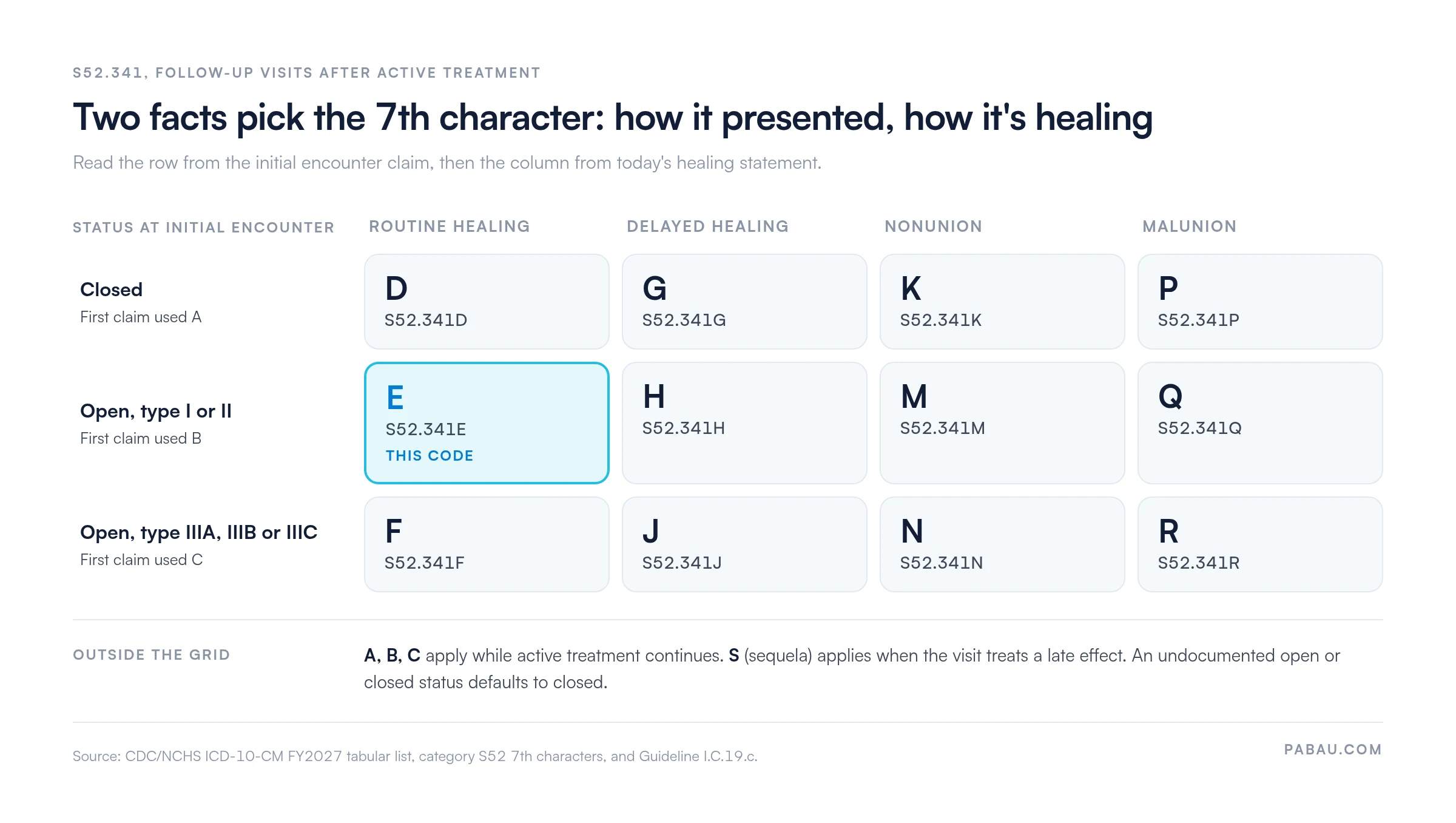
Read the initial encounter claim before you code the first follow-up. S52.341B leads to S52.341E for routine healing. S52.341A leads to S52.341D, unless the record shows the fracture was open.
S52.341 covers only the right-side, displaced spiral shaft fracture. Left-side and unspecified-side codes have their own lines, and nondisplaced fractures carry separate codes. Therefore, verify the side from the operative or clinical note, because left and right cannot be swapped at audit.
S52.343E, the unspecified-arm code, does not belong on a claim when the record names the side. In addition, unspecified-side codes can prompt record requests from payers before payment.
The CPT codes for an S52.341E visit depend on how the fracture was treated and whether a global surgical period is running. Open radius shaft fractures are often fixed surgically, so early follow-ups can fall inside the 90-day global period for CPT 25515. As a result, routine postoperative visits by the surgeon are reported with CPT 99024 and are not paid separately.
This CPT guidance is educational. Payer policy, National Correct Coding Initiative edits, and the global surgical package govern what you bill. First, a cast or splint applied during the initial fracture treatment is included in that procedure. However, a replacement cast later in the episode may be reported separately with CPT 29075. CPT 25607, 25608 and 25609 cover distal radius fixation, so they do not apply to a shaft repair.
Assigning ICD-10 Code S52.341E requires all six of these elements in the clinical record. If one is missing, query the provider rather than assume, because guesses lead to denials. In fact, each denial then needs denial management work to resolve.
Each item on the clean claim checklist for S52.341E is a common failure point. The table below maps each scenario to its correction.
Medicare, commercial payers, and workers’ compensation programs handle subsequent encounter fracture claims differently. Check each payer’s rules before you settle on a billing pattern.
Medicare Administrative Contractors (MACs): S52.341E supports follow-up orthopedic visits when the notes show medical necessity, such as healing progress, range of motion, and imaging review. However, casting that runs past the usual timeline may draw medical necessity review. Also, Box 14 of the CMS-1500 carries the injury date, which links follow-up claims to the original episode.
Commercial payers: Prior authorization rules for surgical follow-up visits vary widely. For example, a plan that approved the ORIF may not cover every postoperative visit. Therefore, verify the approval scope before you schedule and code visits beyond the global surgical period.
Workers’ compensation: Workers’ compensation payers often expect the external cause code on every claim, not just the first. They also expect the fracture code at each visit, which keeps the injury link intact for coverage.
Aftercare codes: Guideline I.C.21.c.7 states that aftercare Z codes are not used for injuries. For follow-up of this fracture, assign S52.341E rather than Z47.89 (Encounter for other orthopedic aftercare).
The codes most often confused with S52.341E differ by a single character: open or closed status, Gustilo type, laterality, displacement, or healing. The AAPC ICD-10-CM code lookup and Check ICD-10 allow side-by-side comparison. Overall, the table below captures the distinctions that matter most at claim submission.
Orthopedic and sports medicine practices bill S52.341E across many follow-up visits, and each one depends on the initial encounter. When open or closed status gets lost between visits, the same 7th-character error can repeat across a billing cycle.
Pabau, the practice management platform we build, keeps that billing in one system. Through its Claim.MD integration, Pabau sends CMS-1500 claims online to thousands of US payers. It also checks patient coverage before the visit and tracks claim status after submission.
Electronic remittance advice (ERA) comes back into Pabau alongside each claim’s status. Your team sees each denial reason against the right claim, so a repeated suffix error shows up as a pattern. With claims management software doing that tracking, less time goes on paper explanation of benefits (EOB) forms. Code selection stays with your coders, so the documentation checks above remain part of the workflow.
Review S52.341 denials each month, grouped by claim adjustment reason code (CARC). CARC 16 (claim lacks information or has billing errors) and CARC 11 (diagnosis inconsistent with the procedure) often point to suffix or laterality problems. Pabau brings ERA data back alongside each claim, so these codes surface without manual EOB review.

Pabau’s Claim.MD integration submits CMS-1500 claims to thousands of US payers, checks eligibility, and tracks ERA remittances. Your team follows every S52.341E claim from submission to payment in one system.

Get the first follow-up right and the rest of the episode follows. E applies only when the fracture was open, Gustilo type I or II, and is healing on schedule. Otherwise, code a closed fracture at that visit as S52.341D.
Settle open or closed status once, by reading the initial encounter claim and the operative note. After that, each later visit turns on laterality and on the provider’s healing statement. In contrast, when the provider documents delayed healing or nonunion, the character changes with it.
Pabau’s revenue cycle management tools keep submission, eligibility checks, and ERA tracking for these claims in one place. Book a demo to see how Pabau supports fracture follow-up billing for orthopedic practices.

Need to understand how denials are categorized and appealed? Denial management in healthcare covers the full workflow for resolving rejected claims by root cause.
Submitting claims electronically for the first time? How medical claims clearinghouses work explains the role of EDI transmission, payer networks, and validation in the claims pipeline.
Want to understand the 837P format behind electronic claim submission? The 837 file guide breaks down the electronic claim transaction standard used for professional claims.
ICD-10 code S52.341E is a billable diagnosis code for a displaced spiral fracture of the right radius shaft. It applies at a subsequent encounter for an open fracture, Gustilo type I or II, that is healing routinely. A closed fracture at the same stage codes to S52.341D.
A frequent problem is an open or closed mismatch, such as E billed for a closed fracture that should be S52.341D. Another is an initial-encounter character, A or B, kept on a routine follow-up. Laterality errors and a day-of-surgery ORIF code paired with E also appear. Missing healing-status documentation can prompt a payer request before payment.
Yes. S52.341E is a valid, billable code in the FY2027 ICD-10-CM code set, effective October 1, 2026 through September 30, 2027. Check each new CDC/NCHS release before October 1 every year.
S52.341E applies to the right arm, and S52.342E applies to the left arm. Both describe a displaced spiral radius shaft fracture at a routine-healing follow-up for an open type I or II fracture. Confirm laterality against the imaging report before you assign the code.