ICD-10 code S12.591B: Nondisplaced C6 fracture, open
ICD-10 code S12.591B: Definition and billable status ICD-10 code S12.591B is the...

Last Updated: Nov 2, 2026
Billable Code Specific Code
S52.263D is the billable ICD-10-CM code for displaced segmental fracture of shaft of ulna, unspecified arm, subsequent encounter for closed fracture with routine healing.
It applies at follow-up visits after active treatment ends, when the physician documents that the closed fracture is healing as expected. If the note names the arm, S52.261D (right) or S52.262D (left) replaces it.
Let Pabau's smart automation suggest the right codes, reduce claim denials, and keep your practice compliant—effortlessly.
Automate repetitive tasks and focus on what matters most—your patients.
Reduce coding errors and ensure compliance with the latest regulations.
Clean claims, fewer denials, and faster reimbursements.
Powerful insights and reporting to help your practice thrive.
HIPAA compliant SOC 2 certified GDPR-compliant Trusted by 4,000+ clinics worldwide

S52.263D is the unspecified-laterality variant, while S52.261D covers the right ulna and S52.262D the left. Use the unspecified code only when the record genuinely omits the arm.
The 7th character D designates a subsequent encounter for a closed fracture with routine healing, per ICD-10-CM Official Guidelines Section I.C.19.c.
Healing status (routine, delayed, nonunion or malunion) is a physician determination documented in the record. Coders report it and never assign it themselves.
Pabau’s claims management software links the encounter note to the claim, which cuts retyping errors on serial subsequent-encounter visits.
ICD-10 code S52.263D reports a displaced segmental ulna shaft fracture, arm unspecified, at a follow-up visit for a closed fracture that is healing normally. It sits within category S52 (Fracture of forearm), subcategory S52.2 (Fracture of shaft of ulna), group S52.26 (Segmental fracture of shaft of ulna). The code is active and billable in ICD-10-CM FY2025 and FY2026.
Each character in S52.263D encodes a specific clinical fact. Misreading any one character produces the wrong code and a likely denial. The table below decodes every position.
The 5th character (6) is the segmental fracture signal. A segmental fracture involves two fracture lines that isolate a free bone segment between them. If the record describes a simple transverse or oblique fracture instead, S52.26x is wrong. The correct base code then sits in S52.22x (transverse) or S52.23x (oblique).
The 7th character D designates a subsequent encounter for a closed fracture with routine healing. The patient has completed active treatment and now receives routine care during the healing or recovery phase, per ICD-10-CM Official Guidelines Section I.C.19.c.
A subsequent encounter is any visit once active treatment is no longer the purpose of care, so a second surgery doesn’t qualify. Cast checks, X-ray reviews, physical therapy follow-ups and wound checks during normal healing all take the D extension.
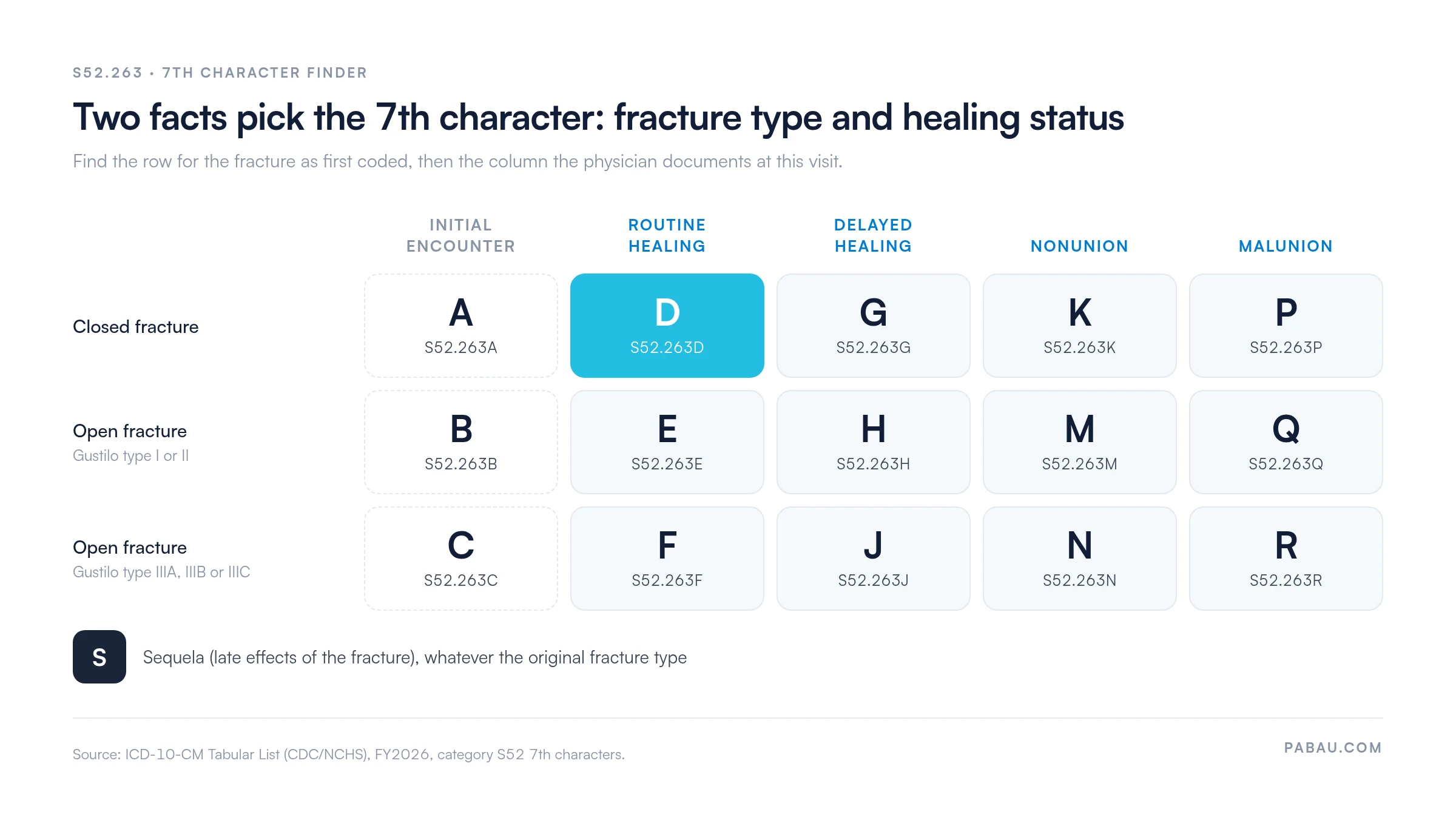
S52.263 supports the following 7th characters. Healing status and fracture type (open vs. closed) drive the selection.
Gustilo-Anderson type assignment is a clinical determination made by the treating physician. Coders report it from the documented type, not from their own assessment. Laid out by those two facts, the subsequent-encounter letters form a simple grid, with D in the closed, routine-healing corner.
A segmental fracture of the ulna shaft involves two distinct fracture lines that create an isolated bone segment between them. This pattern is mechanically unstable and typically results from high-energy trauma: Direct blows, motor vehicle accidents, or a twisting fall on an outstretched arm.
Displacement means the fracture fragments have shifted out of anatomical alignment. The medical record must document the segmental pattern for S52.263D to be defensible on audit. When the record says only “ulna shaft fracture” without naming the pattern, the coder cannot assign S52.263D. A query to the provider is required.
The decision tree for S52.263 hinges on two questions: Is this the initial or a subsequent encounter? And what is the documented healing status?
Key principle: The physician’s documentation controls the 7th character on every subsequent encounter. If the note for visit 3 says “healing well, on track,” D is correct. If visit 4 says “no evidence of bridging callus at 16 weeks,” switch to K. The coder cannot infer healing status from elapsed time alone.
Track healing status changes across visits in your practice management system. When a fracture code shifts from D to K (nonunion) or G (delayed healing), the claim profile changes significantly. Payers may flag a sudden shift without supporting documentation, so audit the notes before changing the 7th character.
Incomplete documentation is the most direct path to a denial on S52.263D. The following elements must all appear in the medical record for the code to be defensible.
When any of these elements is absent, issue a clinical documentation query rather than selecting a less specific code. Coding to S52.263D without adequate documentation creates audit exposure, and a payer can recoup the payment later.
CPT code selection is the treating provider’s responsibility. The coder’s role is accurate ICD-10 pairing. The table below shows the CPT codes most frequently submitted with S52.263D on subsequent-encounter claims.
A CPT-ICD mismatch is a leading denial cause for this code. The fracture surgery itself, such as ORIF under 25545, is billed with the A extension at the initial encounter. Routine post-op visits fall inside that surgery’s global period, so 25545 doesn’t belong on a claim with S52.263D.
Checking the CPT and ICD-10 pairing before submission is one of the habits behind a clean claim. For the validation step between practice and payer, see the guide to medical claims clearinghouses.
S52.263D generates a recognizable set of denial patterns. Most stem from misapplying the encounter type or documenting healing status insufficiently.
Tracking which diagnosis codes generate repeat rejections is the core of denial management in healthcare. Reviewing S52.26x denials monthly shows whether one documentation habit is behind them before they age into write-offs. The payer’s adjustment reason codes on each remittance point to the cause, and the guide to medical billing denial codes explains each one.
CMS does not require prior authorization for fracture aftercare visits. Most subsequent-encounter fracture claims under Medicare process on medical necessity grounds alone. The CMS ICD-10-CM coding guidance and the ICD-10-CM Official Guidelines Section I.C.19.c govern them.
Commercial payers vary. Some require a referral from a primary care provider for specialist fracture follow-up. Others apply Local Coverage Determinations (LCDs) that specify documentation standards for fracture aftercare claims. Always verify with the specific payer before assuming CMS rules apply.
Check the AAPC Codify ICD-10-CM lookup and the CDC/NCHS tool at the start of each fiscal year (October 1). Confirm that S52.263D and any adjacent codes you use regularly are still valid. A retired code generates an immediate technical denial that looks identical to a documentation denial, but the fix is completely different.
Fracture aftercare means a run of near-identical claims for the same patient over several months. In many practices, a biller rekeys the diagnosis from each follow-up note into a claim form. The 7th character from the last visit often gets carried forward without anyone rereading the new note.
Pabau, the practice management platform we build, links the encounter note to the claim in its claims management software. Claim validation then scrubs every claim for missing or invalid details before it leaves Pabau. Claims go out as CMS-1500s through Claim.MD, and a rejection comes back flagged “Needs action” with its reason attached.
The result is fewer rejections to rework and a clear record of which S52.263D visits were paid. Your billing team spends its time on the notes that changed, not on retyping the ones that didn’t.

Pabau’s claim validation checks every claim for missing or invalid details before it reaches the payer, so S52.263D follow-up claims go out complete. See the claims workflow in action.

S52.263D is correct only while three facts hold: The fracture was closed, active treatment is over, and the physician says healing is on track. When any one of them changes, the 7th character changes with it.
So read every follow-up note for healing language before the claim goes out, rather than copying the last visit’s code forward. A switch to G, K or P needs the note to back it, and an open-fracture history rules out D entirely.
Practices that build that check into each visit stop paying for the same denial twice. Book a demo to see how Pabau keeps follow-up fracture claims complete before they reach the payer.

Need a structured overview of denial codes and how to respond? Denial codes in medical billing covers the most common CARC reason codes and resolution steps.
Want to understand the clearinghouse step in claim submission? How medical claims clearinghouses work explains the validation layer between practice and payer.
Looking for a primer on the broader revenue cycle? What is revenue cycle management maps every step from encounter to payment posting.
ICD-10 code S52.263D is the diagnosis code for a displaced segmental ulna shaft fracture, subsequent encounter for a closed fracture with routine healing. It is used on follow-up visits after active treatment is complete and the physician documents that healing is progressing normally.
S52.263A is used at the initial encounter, when the treatment decision is made. S52.263D is used at subsequent encounters once active treatment is complete and healing is on track. The fracture pattern and displacement are the same, and only the encounter type and healing status differ.
Use the 7th character D on subsequent encounters for closed fractures when the physician documents routine or normal healing. It applies from the first follow-up after active treatment through the end of healing, unless a complication (delayed healing, nonunion, malunion) is documented.
Routine healing (7th character D) means the fracture is progressing normally toward union. Nonunion (7th character K on a closed fracture) means union has failed to occur despite adequate time. The physician must document which condition exists, and coders may not infer it from elapsed time or imaging alone.
No. S52.263D is specifically for closed-fracture subsequent encounters with routine healing. Open fractures with routine healing use S52.263E (Gustilo type I/II) or S52.263F (Gustilo type IIIA/B/C). Using D on a patient whose initial fracture was open is a coding error that can generate a denial.
The most common pairings are E/M codes 99213 and 99214 for follow-up office visits, plus physical medicine codes such as 97010 and 97530 during rehabilitation. Fracture surgery such as 25545 is billed with the A extension, and routine post-op visits fall inside its global period.