ICD code S52.101P – Right radius fracture with malunion
Billable Code•Specific Code
Code Definition
S52.101P is the billable ICD-10-CM code for unspecified fracture of upper end of right radius, subsequent encounter for closed fracture with malunion.
Coders most often confuse it with S52.101D (routine healing) or S52.101K (nonunion). Using the wrong 7th character is a common cause of claim denials for this fracture family. The 7th character P applies specifically when the fracture has healed in mal-alignment and the patient is returning for active clinical management of that complication.
Related Information
Chapter
S00-T88 Injury, poisoning and certain other consequences of external causes
Category
S52 Fracture of forearm
Group
S52.101 Unspecified fracture of upper end of right radius
Billable
Yes
Code also known as
proximal radius fracture malunion, right forearm fracture malunion
Save time. Improve accuracy. Get paid faster.
Automate coding with Pabau
Let Pabau's smart automation suggest the right codes, reduce claim denials, and keep your practice compliant—effortlessly.
S52.101PRight radius fracture with malunionHigh match
Confidence score
98%
Why this code?
Matches patient diagnosis
Supported by clinical notes
Commonly used for this condition
Why practices choose Pabau
Save hours every week
Automate repetitive tasks and focus on what matters most—your patients.
Improve accuracy
Reduce coding errors and ensure compliance with the latest regulations.
Get paid faster
Clean claims, fewer denials, and faster reimbursements.
Grow with confidence
Powerful insights and reporting to help your practice thrive.
HIPAA compliant•SOC 2 certified•GDPR-compliant•Trusted by 4,000+ clinics worldwide
Key takeaways
S52.101P covers a follow-up visit for a closed fracture of the upper end of the right radius that has healed in malunion.
The 7th character P is distinct from D (routine healing), G (delayed healing), K (nonunion) and S (sequela). Picking the wrong one is a common denial trigger for this code family.
The note must name malunion or describe mal-alignment on imaging. It must also confirm the right side and a closed fracture to support the P suffix at audit.
Pabau, the practice management platform we build, pulls existing record data into a pre-filled claim and submits it through Claim.MD. Code selection stays with your coder and the provider’s note.
ICD-10 Code S52.101P: definition and code details
ICD-10 Code S52.101P is a billable ICD-10-CM diagnosis code for an unspecified fracture of the upper end of the right radius. It covers a subsequent encounter for a closed fracture with malunion. It has been valid since October 1, 2015 (FY2016) and is still valid, with no descriptor change. Use it when a follow-up visit addresses a closed proximal radius fracture that healed out of alignment and is still being treated.
Field
Value
Code
S52.101P
Full descriptor
Unspecified fracture of upper end of right radius, subsequent encounter for closed fracture with malunion
Billable
Yes (valid for claim submission)
Valid date range
Valid since October 1, 2015 (FY2016) and still valid; no descriptor change
Code type
Diagnosis (ICD-10-CM)
ICD-10-CM chapter
Chapter 19: Injury, poisoning and certain other consequences of external causes (S00-T88)
Category
S52: Fracture of forearm
Subcategory
S52.10: Unspecified fracture of upper end of radius
Encounter type
Subsequent encounter (7th character P)
Anatomy: what is the upper end of the radius?
The upper end of the radius has three parts. The radial head is the disc-shaped joint surface at the top, and the radial neck is the narrow segment below it. The radial tuberosity is the bony prominence where the biceps tendon inserts. Together, these structures form the proximal radius and participate in both elbow flexion and forearm rotation.
The term “unspecified” in S52.101P signals that the fracture site within the upper end has not been further differentiated in the documentation. Coders should use more specific codes when the provider clearly identifies the radial head (S52.12) or radial neck (S52.13) as the fracture site. When the record is ambiguous, S52.101P is appropriate.
Radial head fractures account for roughly 20% of all elbow fractures and are among the most common upper extremity injuries in adults.
Laterality matters: digit 1 in the 5th position of S52.101P specifies the right radius. Left radius carries digit 2 (S52.102P); unspecified laterality uses digit 9 (S52.109P).
“Unspecified” site does not mean unspecified laterality. Laterality is always required in ICD-10-CM when known.
Understanding the 7th character “P”: subsequent encounter for closed fracture with malunion
The 7th character P denotes a subsequent encounter for a closed fracture of the upper end of the right radius that has healed with malunion. The bone fragments united, but in a position that deviates from normal anatomical alignment. Active clinical management is still ongoing at the time of the visit.
Full list of S52.101 7th character extensions
7th character
Full descriptor suffix
Encounter context
A
Initial encounter for closed fracture
Active treatment, first encounter
B
Initial encounter for open fracture type I or II
Active treatment, open fracture
C
Initial encounter for open fracture type IIIA, IIIB, or IIIC
Active treatment, severe open fracture
D
Subsequent encounter for closed fracture with routine healing
Follow-up, normal progress
G
Subsequent encounter for closed fracture with delayed healing
Follow-up, healing slower than expected
K
Subsequent encounter for closed fracture with nonunion
Follow-up, bone failed to unite
M
Subsequent encounter for open fracture type I or II with nonunion
Follow-up, open fracture nonunion
N
Subsequent encounter for open fracture type IIIA, IIIB, or IIIC with nonunion
Follow-up, severe open fracture nonunion
P
Subsequent encounter for closed fracture with malunion
Follow-up, healed in mal-alignment (this code)
Q
Subsequent encounter for open fracture type I or II with malunion
Follow-up, open fracture malunion
R
Subsequent encounter for open fracture type IIIA, IIIB, or IIIC with malunion
Follow-up, severe open fracture malunion
S
Sequela
Late effect, active fracture treatment has ended
Malunion vs. nonunion vs. sequela: choosing the right suffix
Malunion means the fracture has united, but the bone healed in a position that deviates from normal anatomical alignment. The patient may present with reduced range of motion, pain with rotation, or functional limitation. Clinically, malunion is confirmed on follow-up imaging showing bridging callus in a mal-aligned position.
Three related concepts cause the most coding errors for this fracture family:
Concept
7th character
Clinical definition
Active treatment?
Malunion
P (S52.101P)
Healed in mal-alignment; bone united but angulated or shortened
Yes
Nonunion
K (S52.101K)
Bone failed to unite; fracture gap persists beyond expected healing window
Yes
Delayed healing
G (S52.101G)
Slower-than-expected progress toward union; outcome not yet determined
Yes
Sequela
S (S52.101S)
Late effect after active fracture treatment has ended; the fracture is the historical cause of a current problem
No (late effect)
The S suffix is a common mis-selection when a patient presents years after a fracture with residual stiffness or pain. Per ICD-10-CM official guidelines Section I.C.19.c, use S only when the fracture itself is no longer being actively treated. The current encounter must address a sequela of that historical injury. If a clinician is still managing the complication (ordering corrective surgery, PT, or repeat imaging for the malunion), P is correct.
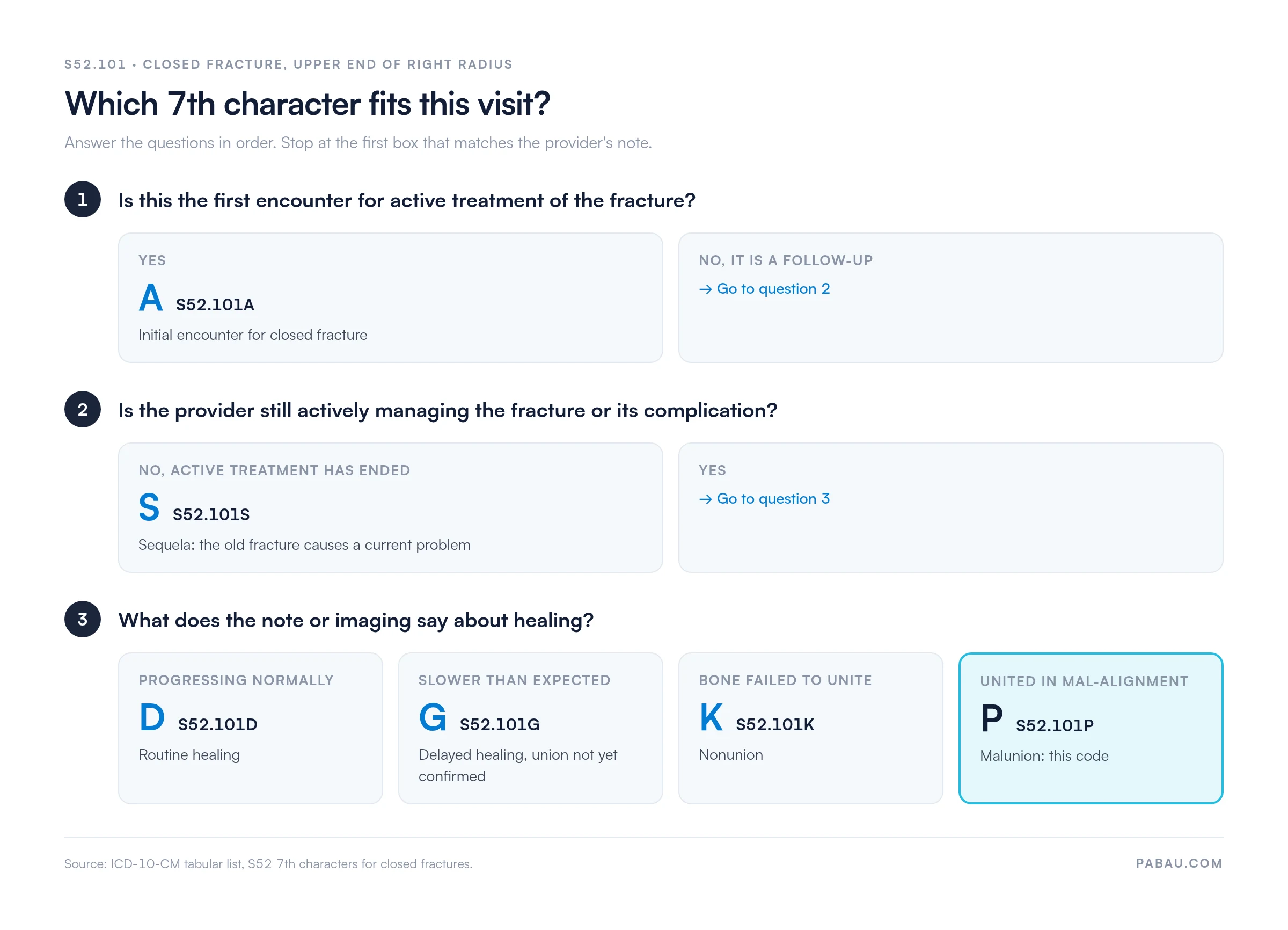
The decision path below asks the same questions in the order a coder should answer them.
P only applies once the note confirms a follow-up visit, ongoing treatment and union in mal-alignment. Source: ICD-10-CM tabular list, S52 7th characters.
Codes commonly confused with S52.101P
Several codes share most of the S52.101P descriptor but differ in a single dimension. Checking laterality, fracture type (closed vs. open), or complication type before finalizing the code prevents the most common errors.
Subsequent encounter, open fracture type I or II, malunion
Open fracture (skin disruption), not closed
Includes, excludes, and code-also notes for S52.101P
Two S52 category notes and one Chapter 19 instruction affect code selection for S52.101P.
Excludes1 (S52 category): Traumatic amputation of forearm (S58.-).
Excludes2 (S52 category): Fracture at wrist and hand level (S62.-) and periprosthetic fracture around internal prosthetic elbow joint (M97.4).
Chapter 19 guidance: External cause codes (e.g. W19 for an unspecified fall) may be added to show how the original fracture happened. Some practices also add aftercare Z codes such as Z47.89 as secondary codes by local policy. S52.101P stays the principal diagnosis for active malunion management.
When to use ICD-10 Code S52.101P: clinical scenarios
S52.101P fits several encounter types. The documentation must confirm malunion of a closed fracture at the upper end of the right radius, and the visit must involve active clinical management. In orthopedic and sports medicine workflows, accurate 7th character selection at the point of care prevents downstream billing corrections.
Orthopedic follow-up: Patient returns 8 weeks after closed reduction of a proximal radius fracture. Imaging shows bridging callus with 15 degrees of angular deformity. The provider documents malunion and discusses corrective osteotomy options. S52.101P is correct.
Surgical planning visit: A patient is seen for pre-operative assessment of a malunited right proximal radius fracture, site not specified. The provider’s note references imaging-confirmed malunion and planned corrective surgery. S52.101P applies for the planning encounter.
Rehabilitation referral: An occupational therapist receives a referral for range-of-motion deficits following right proximal radius malunion. The referring diagnosis on the order specifies malunion. S52.101P is the working diagnosis for the rehabilitation episode.
Second-opinion consultation: A patient seeks a second opinion on management of a documented right radius malunion. S52.101P is appropriate provided the consultant reviews the malunion and provides clinical recommendations.
Documentation requirements for S52.101P
Supporting S52.101P through audit requires documentation that explicitly establishes five elements. Strong medical billing documentation starts in the provider’s note, not in the coder’s abstract.
Malunion confirmed: The note must state “malunion” by name or include imaging language such as “healing in mal-alignment,” “angular deformity,” or “shortening with callus bridging.” Vague terms like “poor healing” or “slow progress” do not establish malunion.
Laterality documented: Right side must be specified in the clinical note, not assumed from procedure laterality.
Site specified: The upper end or proximal radius must be identified. If the radial head or neck is documented, use S52.12- or S52.13- instead.
Fracture type confirmed as closed: If the original fracture was open, a P suffix is not applicable. The original injury type must be traceable in the record.
Encounter context is subsequent: The note should confirm the visit is for ongoing management of a previously diagnosed fracture, not a new injury. A reference to prior imaging or prior treatment (cast, ORIF, splinting) anchors the subsequent encounter designation.
Per clean claim submission best practices, missing documentation is fixed before the claim goes out, not after a denial. A brief addendum from the treating provider confirming malunion imaging findings takes significantly less effort than a formal appeal.
Pro Tip
Run a documentation check on every S52.101P claim before submission. Confirm the note says ‘malunion’ or uses equivalent imaging language, specifies the right side, and references a prior fracture encounter. A claim missing any one of these three elements gives the payer an easy reason to deny it.
Payer and billing considerations for S52.101P
Medicare and most commercial payers cover active treatment of fracture malunion when medical necessity is established. Coverage is driven by the encounter type and the clinical rationale, not by the diagnosis code alone.
Medicare Part B: Covers physician evaluation, surgical correction planning, and physical or occupational therapy visits where the underlying diagnosis is a documented malunion. The CMS ICD-10 codes page maintains the annual tabular list that governs coverage edits.
CPT pairings (examples only): Osteotomy of the radius (25350/25355) or repair of malunion/nonunion of the radius (25400) may pair with S52.101P for surgical encounters. Therapy CPT codes in the 97000 series (therapeutic exercise, manual therapy) pair for rehabilitation encounters. Specific pairing is encounter-dependent and should be validated against NCCI edits.
Prior authorization: Surgical correction of malunion commonly triggers prior authorization requirements with commercial payers. Imaging reports and operative planning notes are the primary supporting documents.
Medical necessity letter: When the payer asks for supporting rationale, a brief narrative from the treating provider strengthens the claim. It should state the functional limitation the malunion causes and the planned intervention.
Common claim denial reasons for S52.101P
Most denials on S52.101P claims trace back to one of six root causes. Understanding them in advance makes pre-submission review faster. Robust denial management workflows treat these as a standard checklist rather than a reactive audit.
Wrong 7th character: Using D (routine healing) when imaging shows malunion is the most common error. The provider’s note and the coded suffix must align. Coders should not assume routine healing when a complication is documented.
Initial encounter code used for follow-up: Submitting S52.101A (initial encounter, closed fracture) for a follow-up visit is flagged by payer edits. If prior treatment is documented in the record, subsequent encounter codes are required from that visit onward.
Malunion not documented: When the coder selects P but the physician note only references “fracture” or “healing,” payers deny for lack of supporting documentation. The clinical note must support the suffix selected.
Laterality mismatch: Selecting S52.102P (left) when the procedure or operative report specifies the right side triggers a laterality mismatch denial. Confirm laterality against the visit note before submission.
Sequela coded instead of subsequent encounter: Using S52.101S when the provider is still actively managing the malunion (prescribing PT, planning surgery) is clinically incorrect. S is reserved for late effects after active treatment has ended.
Diagnosis not linked to procedure on claim: Some clearinghouses and payers require the claim form to link each procedure code to its ICD-10 diagnosis pointer. Unlinked codes are rejected as incomplete claims.
How to appeal a denied S52.101P claim
Identify the denial reason code on the Explanation of Benefits (EOB) or electronic remittance advice (ERA). Common claim adjustment reason codes for fracture suffix errors include CARC 11 (diagnosis inconsistent with procedure) and CARC 16 (claim lacks information).
Obtain the imaging report from the date of the encounter or the most recent imaging confirming malunion. This becomes the primary supporting document for the appeal.
Request a provider addendum if the original note does not explicitly state malunion. The addendum must be signed, dated, and clearly reference the encounter in question.
Resubmit with corrected code if the denial was due to the wrong 7th character (e.g. D submitted instead of P). Corrected claims generally require a claim frequency code of 7 (replacement).
Include a medical necessity letter if the payer requests clinical rationale. The letter should state the fracture site, laterality, malunion confirmation with imaging date, and the clinical impact on the patient’s function.
S52.101P in physical therapy and rehabilitation settings
Physical and occupational therapy practices often see ICD-10 Code S52.101P as the referring diagnosis. These patients are treated for functional limits left by a malunited right proximal radius fracture. Per ICD-10-CM Official Guidelines Section I.C.19.c, the subsequent encounter fracture code is the principal diagnosis during active rehabilitation for a fracture complication. Aftercare Z codes don’t replace it. For physical therapy teams managing these referrals, having the correct referring diagnosis on file supports clean claim submission from the first visit.
Correct principal diagnosis: S52.101P, not Z47.89, when active malunion treatment is the reason for the therapy episode.
Medicare Part B therapy: Requires functional goals tied to the malunion (e.g. restore forearm pronation/supination, reduce pain with grip) documented in the plan of care.
CPT therapy pairing: Common therapy codes include 97110 for therapeutic exercise, 97530 for therapeutic activities and 97140 for manual therapy. These are illustrative; code selection must reflect the actual services provided at each visit.
Documentation tip: Ensure the initial evaluation note references the referring diagnosis of malunion and the specific functional deficits attributable to it. Payers may request the referring physician’s note confirming the malunion diagnosis during utilization review.
Therapy claims tied to S52.101P go out cleaner when eligibility is verified before the first visit. Staying current with billing compliance requirements keeps the documentation behind these claims audit-ready.
Pro Tip
Verify payer eligibility before the first physical therapy visit using S52.101P as the presenting diagnosis. Some commercial plans require a separate prior authorization for rehabilitation tied to fracture malunion. An authorization for the original fracture treatment doesn’t cover it.
How Pabau supports cleaner S52.101P claims
Many orthopedic and therapy practices still confirm coverage by phone and rekey visit details into a separate billing portal. Each manual step is another chance for the wrong side or 7th character to reach the claim.
Pabau, the practice management platform we build, includes billing software for practices that pulls existing record data into a pre-filled claim. You can submit claims through the Claim.MD clearinghouse, check eligibility and track claim status without leaving Pabau.
Code selection stays with your coder and the provider’s note. The claim carries the same details the note supports. Your team also stops calling each payer to confirm coverage before a therapy episode starts.
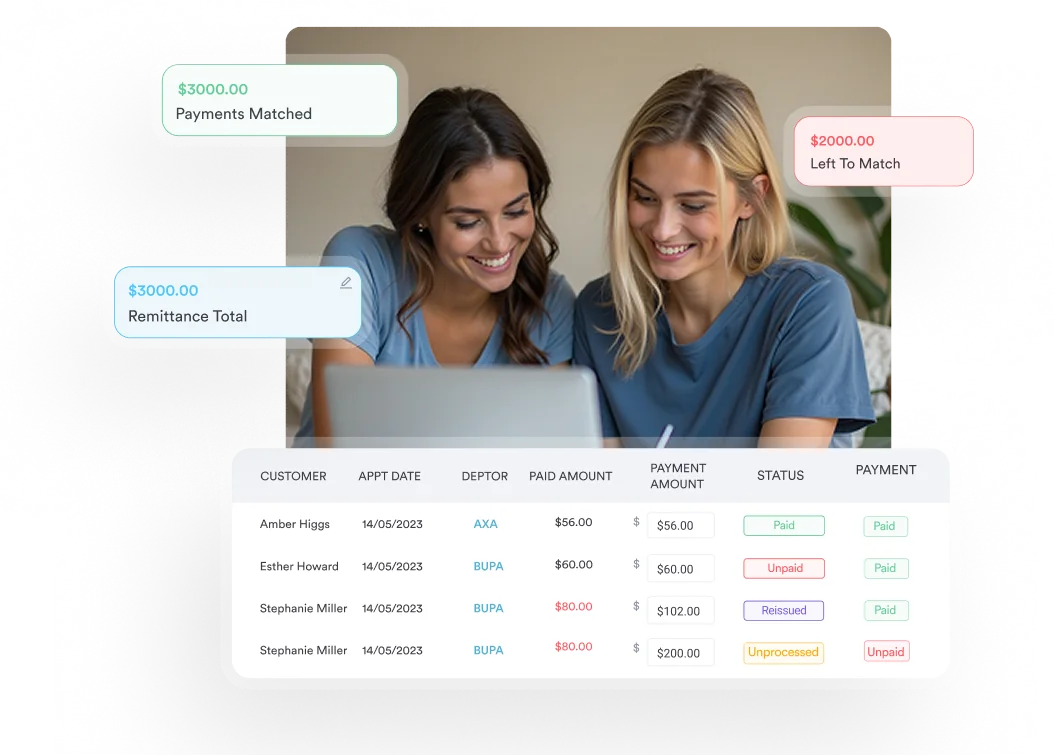
Pabau’s billing view matches each remittance to its claim, so an unpaid S52.101P malunion visit stands out before it ages.
Reduce claim rework on complex orthopedic codes
Pabau pulls existing record data into pre-filled claims, then runs eligibility checks and tracks claim status through Claim.MD for orthopedic and rehabilitation practices.
Code S52.101P only when the note proves three facts: the fracture was closed, this is a follow-up visit, and imaging shows malunion. If one is missing, ask the provider for an addendum before the claim goes out rather than defending it on appeal.
Practices that build this check into the visit spend less time on corrected claims for complex fracture follow-ups. With Pabau, you can pull existing record data into a pre-filled claim, then submit and track it via Claim.MD with eligibility checks.
Book a demo to see how Pabau carries a fracture follow-up from the visit note to a submitted claim.
Continue your research
Need guidance on managing denials across your claim portfolio?Denial management in healthcare covers root cause analysis and the workflows that reduce repeat denials.
Looking to understand how clearinghouses process your fracture claims?How Claim.MD works as a clearinghouse explains the submission, validation, and ERA cycle for outpatient practices.
Want a plain-English overview of the medical billing process?What is revenue cycle management explains how ICD-10 diagnosis coding fits into the end-to-end billing workflow.
Frequently asked questions
What does ICD-10 Code S52.101P mean?
ICD-10 Code S52.101P is the billable diagnosis code for an unspecified fracture of the upper end of the right radius. It covers a subsequent encounter for closed fracture with malunion. It applies when a previously treated closed fracture has healed in mal-alignment and the patient is seen for active ongoing management of that complication.
When should you use the 7th character P for a fracture code?
Use the 7th character P at a visit after the initial fracture encounter, once imaging or clinical findings confirm the closed fracture healed in mal-alignment. The three required conditions are: subsequent encounter (not initial treatment), closed fracture type, and confirmed malunion. All three must be supported by documentation.
Why would a claim using S52.101P be denied?
The most common denial reason is the wrong 7th character, such as D for routine healing instead of P for malunion. Others are an initial encounter code (A) on a follow-up visit, or a note that never names malunion. Payers compare the submitted suffix against the clinical documentation, so a mismatch triggers automatic denial. See the AAPC ICD-10 code lookup to cross-check descriptor language before submission.
Can S52.101P be used for physical therapy visits?
Yes. Per ICD-10-CM Official Guidelines Section I.C.19.c, subsequent encounter fracture codes such as S52.101P are the principal diagnosis for these visits. That holds while the patient is in active rehabilitation for fracture malunion. Z codes for aftercare are not used in place of the fracture code when active treatment is ongoing.