ICD-10 code S61.201A: Open wound of left index finger without nail damage
ICD-10 code S61.201A covers a left index finger wound of unstated type ICD-10 co...

Last Updated: Oct 16, 2026
Billable Code Specific Code
S52.511P is the billable ICD-10-CM code for displaced fracture of right radial styloid process, subsequent encounter for closed fracture with malunion.
Swap P for D and the claim reports routine healing instead, which the imaging will not support. This page covers the code's billable status, all 16 seventh-character options, the documentation it needs, and a check before you submit.
S52.511P is valid in the FY2026 ICD-10-CM code set. That set is maintained jointly by the Centers for Medicare and Medicaid Services (CMS) and the National Center for Health Statistics (NCHS).
Let Pabau's smart automation suggest the right codes, reduce claim denials, and keep your practice compliant—effortlessly.
Automate repetitive tasks and focus on what matters most—your patients.
Reduce coding errors and ensure compliance with the latest regulations.
Clean claims, fewer denials, and faster reimbursements.
Powerful insights and reporting to help your practice thrive.
HIPAA compliant SOC 2 certified GDPR-compliant Trusted by 4,000+ clinics worldwide

S52.511P is a billable ICD-10-CM code for a displaced fracture of the right radial styloid process, reported at a subsequent encounter with malunion.
The 7th character P means the bone healed in the wrong position, so use it only when the physician documents malunion.
Malunion, nonunion and delayed healing each take a different 7th character, and the note has to name which one applies.
The parent code S52.511 is not billable on its own, and every S52 fracture claim needs a full seven characters.
Practice management software like Pabau carries ICD-10-CM and CPT lookup libraries, and checks required claim fields before submission.
S52.511P can go on a claim exactly as it stands. The seventh character is what makes it billable, and the parent code S52.511 will not pass without one.
Code validity is refreshed each October, so check the fiscal year against the CMS ICD-10 codes page before you submit. Once the code itself is confirmed, the work moves to the last character.
P marks a subsequent encounter for a closed fracture that healed in malunion. Active treatment has ended, the bone has united, and it united out of position. That is the whole meaning of the letter, and it is the part payers audit.
Twelve of the 16 characters describe a subsequent encounter. The grid below sorts them by the healing status the physician documented and the fracture type recorded at the injury.
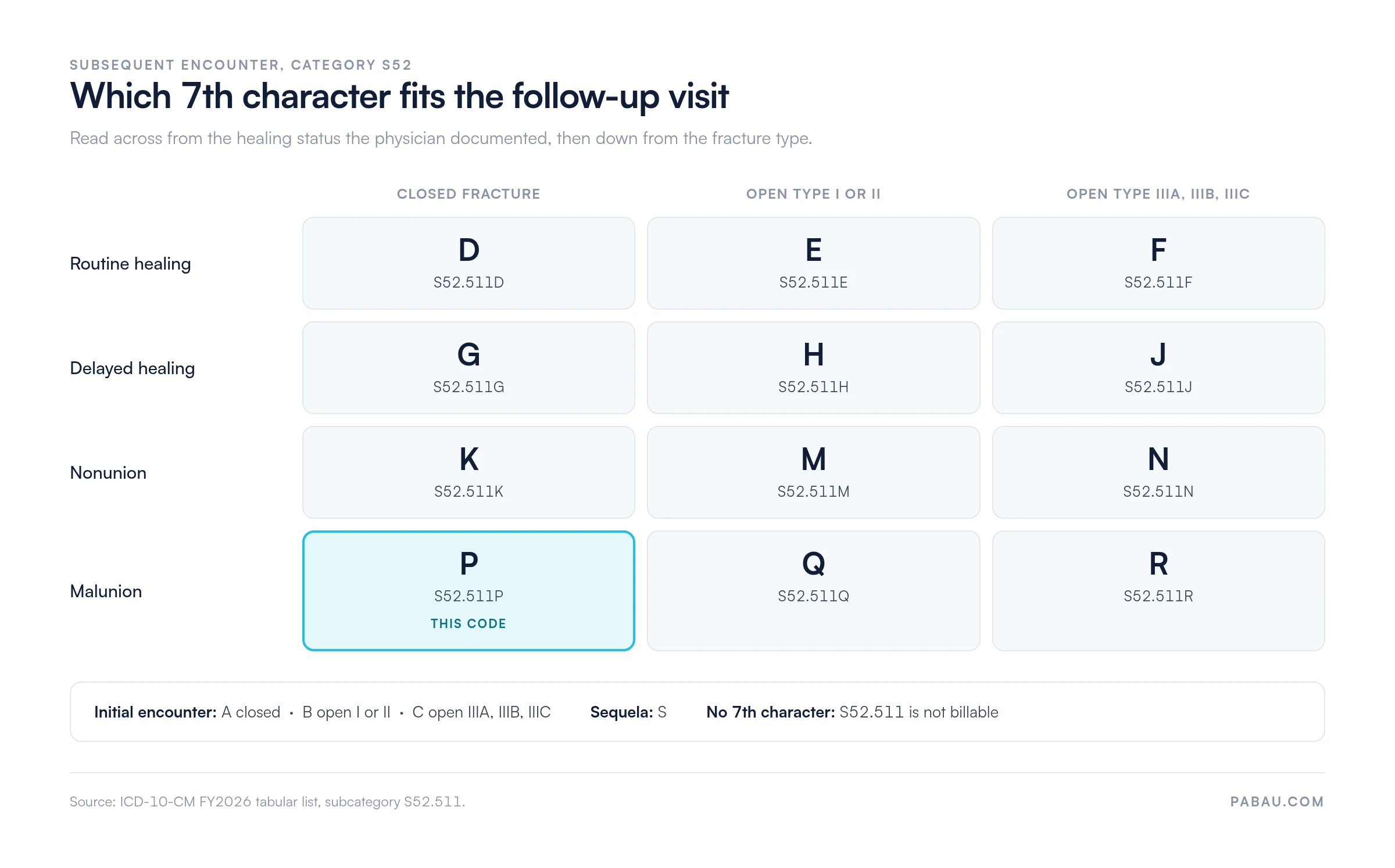
The table below spells out each option in full, including the ones that are easy to mix up. Note that the set skips I, L and O, which is why the letters jump from H to J and from K to M.
Use the CDC/NCHS ICD-10-CM web tool to confirm the valid character set for any S52 code. The characters only help, though, once the note is clear about the healing status.
Malunion means the fracture united, but in an abnormal position. The bone has healed, which separates it from nonunion (K, M, N), where healing has not happened at all. It also separates it from delayed union (G, H, J), where healing is slower than expected but still moving.
A displaced radial styloid fracture that heals in malunion can leave lasting wrist pain, weaker grip, and a limited range of motion. Patients often arrive at follow-up with angular or rotational deformity on the X-ray. The physician has to identify that finding and write it down for P to hold.
For orthopedic and physical therapy practices, that distinction drives both the treatment plan and the code on the claim.
A subsequent encounter is any visit after active treatment has ended. Once the patient has had definitive treatment, such as a cast, reduction or fixation, every follow-up is a subsequent encounter. Visit number does not matter. The ICD-10-CM Official Guidelines for Coding and Reporting tie the character to the phase of care.
Reach for ICD-10 code S52.511P when all four of these hold at the time of the visit:
Here is how that plays out. A patient breaks the right radial styloid in February and comes out of a cast in April. At the June visit, the X-ray shows dorsal angulation and the physician writes malunion. That encounter codes to S52.511P. Had the note said healing on track, the same visit would have coded to S52.511D.
Change one of those four elements and a sibling code takes over:
Check the AAPC ICD-10-CM code lookup for the full sibling set when laterality or displacement is in doubt.
Document the imaging finding explicitly. “X-ray demonstrates malunion of the right radial styloid process fracture with dorsal angulation” is sufficient to support S52.511P. “Fracture follow-up” alone is not. The physician note must confirm healing in malposition, not just record the visit.
Six data points have to appear in the physician’s record before a coder can assign S52.511P. Coders may not assume any of them, so every element of the code has to be written down somewhere in the chart.
Two elements slip more often than the rest: displacement and the open or closed status. Both were settled months earlier at the initial encounter, and the follow-up note rarely repeats them.
Query the physician whenever an element is missing. A coder cannot infer malunion from an imaging report on its own, however clear the film looks. The physician has to acknowledge the finding in the clinical note first.
Reading the hierarchy is a quick way to confirm you are at the right level of specificity. It also prevents the most common error on these claims, which is billing the parent code S52.511.
Submitted bare, S52.511 fails claim validation before it reaches the payer. That rule runs across every S52 fracture code, not just the radial styloid group.
These are the alternatives that turn up on radial styloid claims, with the detail that decides between them.
The ICD List lookup tool shows the S52.511 siblings alongside their DRG groupings, which is useful once the claim moves to billing.
On an office claim, S52.511P is the diagnosis that justifies the service billed at the visit. The service itself comes from the CPT code library, whether that is an office visit, wrist imaging, or manipulation. A diagnosis pointer on the claim line ties the two together.
Then the path is short. A charge posts at checkout, the claim is built with S52.511P against the right service line, then it goes to the clearinghouse. The clearinghouse forwards it to the payer, the remittance returns as an electronic remittance advice (ERA), and the payment posts against the visit.
Inpatient claims work differently. S52.511P maps to MS-DRG groups for fractures of the forearm. The specific assignment depends on any procedure code on the claim, plus complications or comorbidities (CC/MCC). Relative weights change every year, so do not quote a dollar figure without checking the current CMS fee schedule.
One step is worth taking early. Some plans require prior authorization for malunion management procedures, so read the policy before the visit rather than after the denial.
Denials on these claims usually trace back to one of five details. Run this list while the note is still open:
If a claim does come back denied, start with the 7th character, then the note behind it. A broader clean claim submission checklist covers the payer, provider and patient fields that sit around the diagnosis.
Where the record and the billing system are separate, the diagnosis gets typed twice. A coder reads the note, picks S52.511P, then re-enters it in a separate billing system along with the payer, provider and authorization details. Every re-entry is a chance to drop a character.
Pabau, our practice management platform, removes that second pass. The claim form pre-fills from the patient record, so the codes already attached to the visit land on the charge lines.
Search icons open ICD-10-CM and CPT lookup libraries, refreshed with each official release, when a coder wants to confirm a character. The Send button stays locked until the claim’s required fields are complete, including membership and authorization numbers.
In the US, claims route through the Claim.MD clearinghouse, with real-time eligibility checks, ERA posting and claim-status tracking in the same screen.
Pabau’s medical claims management does not read the clinical note or decide whether P is the right character, so that judgment stays with the coder. What it removes is the retyping, the half-filled claim, and the wait for a paper remittance.
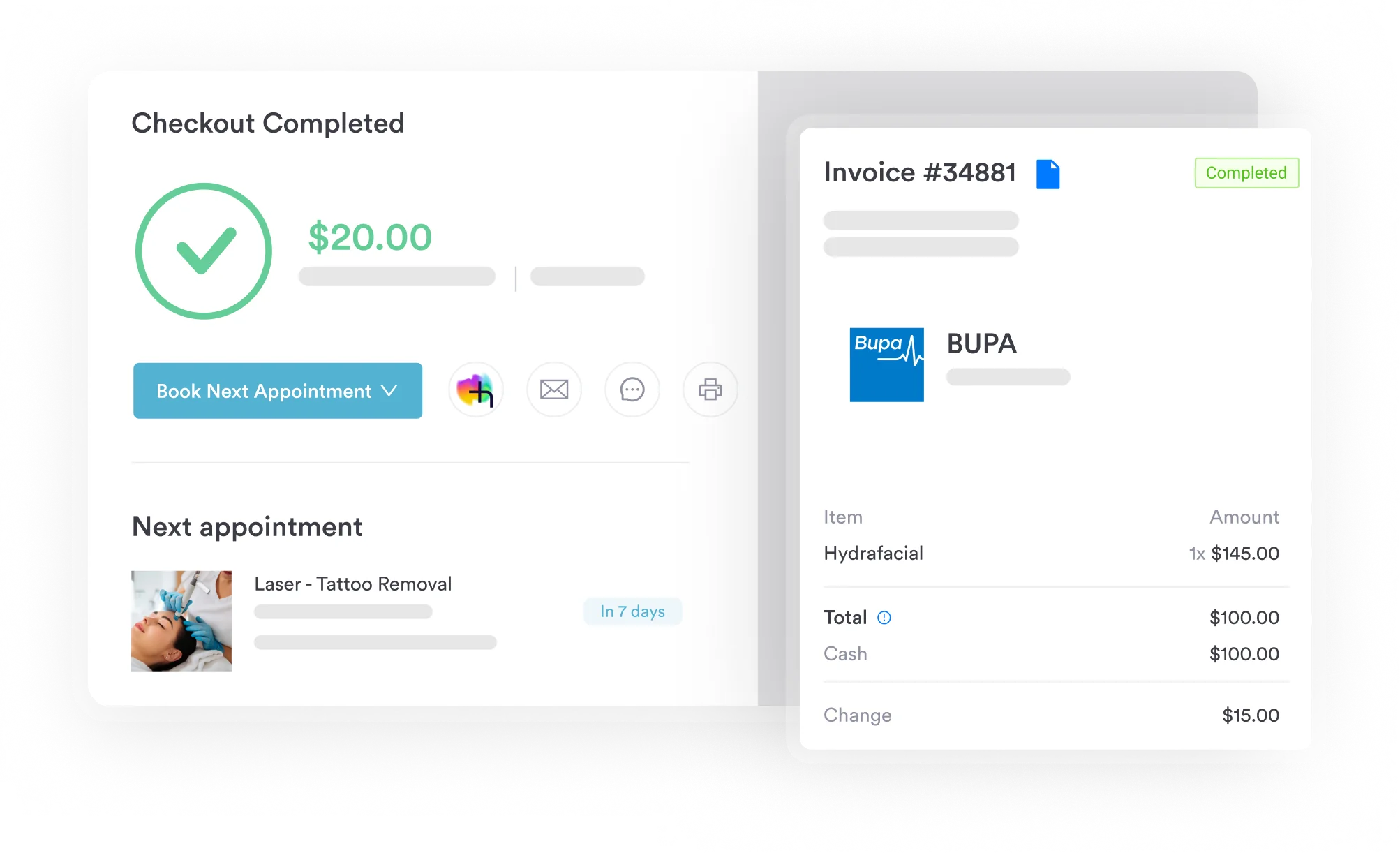

Pabau pre-fills the claim from the patient record, then checks that every required field is complete before submission. In the US, Claim.MD handles eligibility checks, ERA remittances and claim-status tracking.

S52.511P is a narrow code, and that is the point of it. One side, one fracture site, one healing outcome, one phase of care. Read the physician’s note first and the seven characters follow from it.
P against D is still the pair worth watching. Routine healing and malunion look alike at a busy follow-up visit, yet they are two different claims. Ask for the imaging finding in the note, in words, and the rest of the code takes care of itself.
Pabau keeps the coding, the invoice and the claim on one patient record. Book a demo to see how a fracture claim leaves your practice with its codes, charges and required fields already complete.

Need the full picture of how a claim gets paid? What is revenue cycle management follows the money from documentation through to remittance.
Want the rules behind a compliant submission? Medical billing compliance sets out the documentation and submission standards for HIPAA-covered claims.
Got a denial on a fracture claim? Denial codes in medical billing explains the common CARC reason codes and how to appeal them.
Reworking denials by hand? Denial management in healthcare gives you a workflow for catching them earlier in the cycle.
Pick from the S52.5x series for the lower end of the radius. Use S52.6x when the lower end of both the radius and ulna is fractured. A Colles’ fracture with malunion is S52.531P on the right, and a Smith’s fracture is S52.541P. S52.511P applies only to the radial styloid process.
No. The phase of care sets the character, not the calendar. Keep using P while the malunion is treated or monitored after active treatment has ended. Move to S52.511S once only the late effects of the injury remain.
Yes. S52.511P is the diagnosis that supports the procedure, and the procedure is coded separately in CPT. Check the payer’s policy first, since some plans require prior authorization for malunion repair.
Yes, as long as active treatment has finished. The character reports the phase of care, not your first visit with the patient. Someone arriving with a healed malunion from another practice still codes to S52.511P.