ICD-10 code S12.591B: Nondisplaced C6 fracture, open
ICD-10 code S12.591B: Definition and billable status ICD-10 code S12.591B is the...

Last Updated: Nov 2, 2026
Billable Code Specific Code
S52.281Q is the billable ICD-10-CM code for bent bone of right ulna, subsequent encounter for open fracture type I or II with malunion.
It is used at follow-up visits after active treatment, once the plastically deformed right ulna has healed in a bowed or angled position. These visits cover imaging of the deformity, checks on forearm rotation, and planning or carrying out a corrective procedure.
Let Pabau's smart automation suggest the right codes, reduce claim denials, and keep your practice compliant—effortlessly.
Automate repetitive tasks and focus on what matters most—your patients.
Reduce coding errors and ensure compliance with the latest regulations.
Clean claims, fewer denials, and faster reimbursements.
Powerful insights and reporting to help your practice thrive.
HIPAA compliant SOC 2 certified GDPR-compliant Trusted by 4,000+ clinics worldwide

S52.281Q covers follow-up visits for a bent (plastically deformed) right ulna after an open type I or II fracture that has healed in malunion.
Right laterality is built into the sixth character, so the left ulna takes S52.282Q and an undocumented side takes S52.283Q.
Q means malunion, not routine healing. Routine healing is E, delayed healing is H, and nonunion is M for the same open type I or II fracture.
Most denials trace back to a missing malunion statement, a wrong 7th character, or a CPT code that doesn’t match a malunion visit.
ICD-10 code S52.281Q is a billable ICD-10-CM code for a malunited bent bone of the right ulna. It applies at follow-up visits after an open type I or II fracture. Its full official descriptor is: Bent bone of right ulna, subsequent encounter for open fracture type I or II with malunion.
The code sits in Chapter 19 (S00-T88) under category S52, Fracture of forearm, as listed in the CMS ICD-10-CM code files. Within S52 it belongs to subcategory S52.28, Bent bone of ulna.
A bent bone is a plastic deformation, also called a bowing fracture. The ulna bends under load without a clean break line, which happens mostly in children. Malunion means the bone has healed in a bowed or angled position, which can limit forearm rotation.
The code carries four specifications at once. They are the injury (a bent ulna shaft), the side (right), the fracture type (open, Gustilo I or II), and the care phase. The record must support all four before the code is assigned.
Each character in S52.281Q narrows the diagnosis. The table maps every position to its value and what it tells the coder and the payer.
The bent-bone subcategory is easy to confuse with its neighbors. A greenstick fracture of the ulna shaft is coded to S52.21-, and a Monteggia fracture of the ulna to S52.27-. A bent radius goes to S52.38-, so the bone named in the imaging report decides the subcategory.
A subsequent encounter is any visit after the patient has completed active treatment of the fracture. The ICD-10-CM Official Guidelines (Section I.C.19.c.1) say that malunion and nonunion are reported with the subsequent-care 7th characters. Malunion care therefore takes P, Q or R, with one exception. A patient who delayed seeking treatment for the fracture gets the initial-encounter character instead.
For an open type I or II fracture of the right ulna, the 7th character follows the phase and the healing status:
The most common error here is billing E (routine healing) at a visit where the physician has diagnosed malunion. Once malunion is documented, every follow-up for that deformity takes Q, including a corrective osteotomy.
The open-fracture 7th characters in category S52 are based on the Gustilo-Anderson classification. The surgeon grades the wound by size, soft tissue damage, contamination, and vascular injury. The coder does not assign the grade, but translates the documented grade into the matching 7th character.
Q applies to open fractures graded type I or II. Q is also assigned for an open fracture with no documented grade. If the operative note records type IIIA, IIIB, or IIIC, a malunion visit takes S52.281R instead.
A closed bent ulna that healed in malunion takes S52.281P. The chart below runs those choices as three questions, in the order a coder answers them.
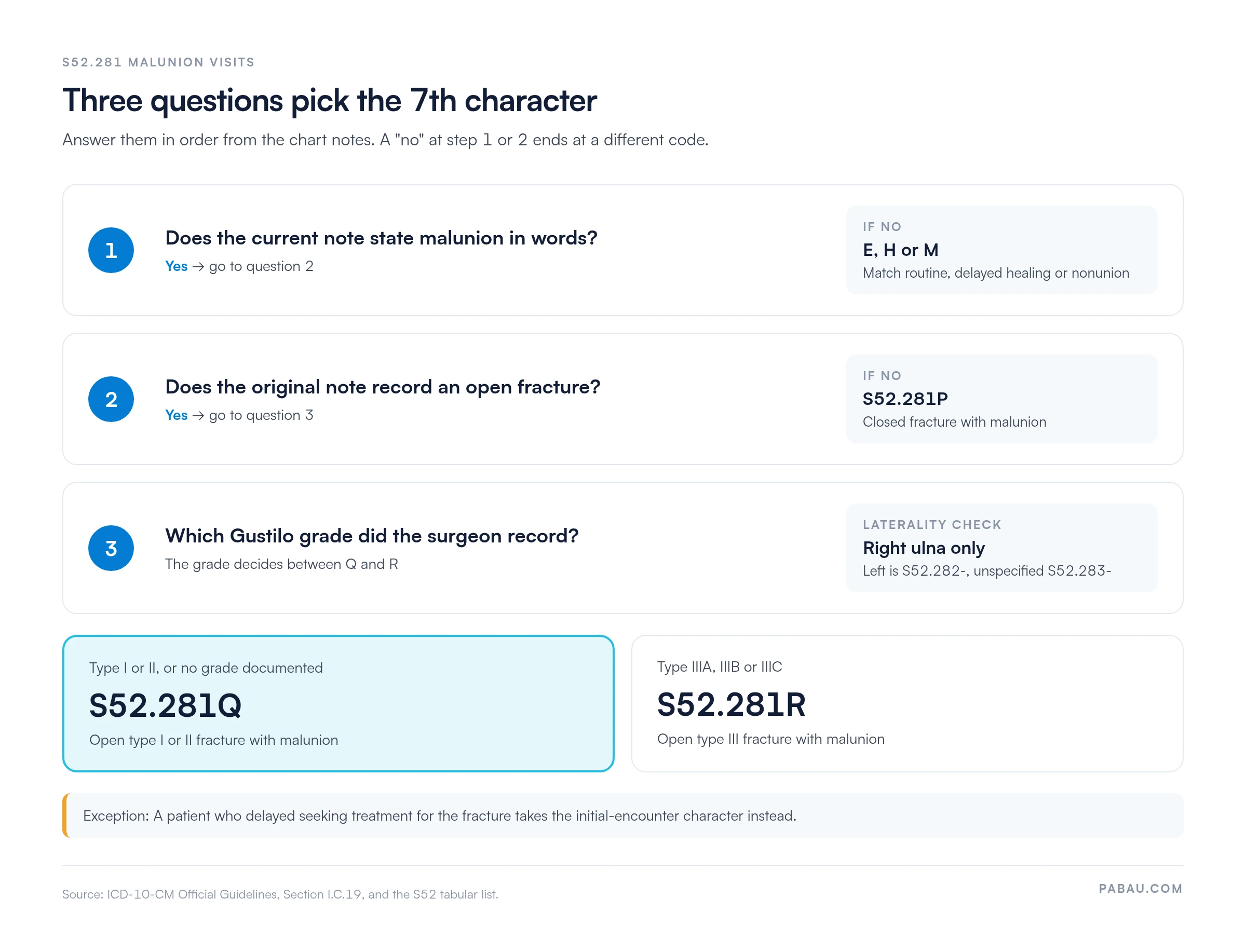
Codes in the S52.281 family differ only by the 7th character, and S52.282 differs only by side. The wrong choice is simple to audit after the fact, but it causes repeated claim rework when it slips through.
The E versus Q confusion matters most. Suppose the note describes healing with residual bowing and lost supination. That is malunion, so the claim needs Q. Billing E at that visit understates the condition and weakens medical necessity for any corrective procedure.
Category S52 carries instructional notes that affect how ICD-10 code S52.281Q is reported with other codes. Confirm them against the current tabular in the CDC/NCHS ICD-10-CM web tool for the applicable fiscal year, since notes can change in annual updates.
The medical record must support each element encoded in S52.281Q, or the payer has grounds to deny or downcode the claim. Medical billing compliance reviews often flag open-fracture malunion codes. Their elements are spread across the original injury note and the current follow-up note.
Follow-up office visits for a malunion rarely need prior authorization. A planned corrective osteotomy or malunion repair often does, so check the payer policy before scheduling surgery. Running insurance eligibility verification before each visit also prevents coverage-lapse denials unrelated to the code.
Medicare and commercial payers expect each visit to show a clinical reason, a functional assessment, and a plan for the deformity. Medicare Administrative Contractor (MAC) policies vary by jurisdiction. Practices billing across regions should check the local coverage rules for forearm malunion surgery.
A clean claim for S52.281Q pairs the diagnosis with a matching CPT code and a date of service after the initial treatment. It also carries any modifier the visit needs, such as -25 for a separately identifiable E/M on the day of a minor procedure. A missing or mismatched element stalls the claim or triggers a denial.
ICD-10 code S52.281Q draws a predictable set of denials, and most are preventable with a check before submission. Each reason below carries its CO adjustment code, and the full set is explained in our denial codes for billers reference. Effective denial management workflows start by spotting the pattern, and these five come up most often:
Before submitting any S52.281Q claim, check three things. The current note states malunion. The original note records an open fracture graded Gustilo type I or II, or gives no grade. The CPT code on the claim matches a malunion visit and sits outside any active global period. These checks prevent most S52.281Q denials before they reach the clearinghouse.
The CPT code for an S52.281Q visit depends on what the physician does at that visit. S52.281Q is the diagnosis, and the CPT code describes the service. Payers compare the two to check medical necessity, so the pairing has to make clinical sense. The AAPC ICD-10-CM code lookup lists current crosswalk references.
Forearm radiographs billed under CPT 73090 often come from the imaging department or facility rather than the treating practice. The medical billing workflow for the orthopedic visit should still note the order, so documentation is complete on both sides.
Malunion codes depend on details spread across two or more notes, which makes them a steady source of preventable rework. Catching the mismatch while the visit is being coded costs far less than fixing a denied claim weeks later.
Pabau, the practice software we build for clinical teams, links the clinical note to the claim through its claims software for coders. The coder can open the signed note and confirm the malunion statement before choosing the 7th character.
For orthopedic and physical therapy practices with a steady flow of fracture follow-ups, that cuts the manual audit before submission. Claims then go out through the Claim.MD clearinghouse integration.

Pabau links each clinical note to its insurance claim, so coders can check the record before a fracture claim goes out. See how orthopedic practices use Pabau to cut denials on follow-up claims.

S52.281Q is a narrow code, and each of its seven characters can be wrong on its own. Bone, injury pattern, side, open grade, and healing status all have to agree across the original note and the current one.
Practices that read the healing status before choosing the 7th character avoid most S52.281Q denials. Treat malunion as its own diagnosis, written in words, and bill E, H, M, or Q to match. To see how Pabau keeps those checks inside the coding workflow, book a demo.

Need guidance on submitting clean claims through a clearinghouse? Medical claims clearinghouse guide covers how 837P claims are validated before reaching payers.
Want to understand how ERA remittance works after a claim is paid or denied? Electronic remittance advice (ERA) explains 835 remittance files and how to read CARC denial codes.
Looking for a full breakdown of denial codes on the remittance? Denial codes in medical billing maps the most common CO and PR reason codes to their root causes.
Billing a splint at a malunion follow-up? CPT code 29125 covers static short arm splint application and how to report it.
S52.281Q is a billable ICD-10-CM code for follow-up care of a bent right ulna after an open type I or II fracture. It applies when malunion is documented, meaning the bone healed in a deformed position after active treatment.
In category S52, Q means a subsequent encounter for an open fracture type I or II with malunion. The fracture was open and graded Gustilo type I or II, and it has healed out of alignment. Q is also assigned for an open fracture with no documented grade.
S52.281E is for follow-up visits where the open type I or II fracture is healing routinely. S52.281Q is for visits after the physician has documented malunion. The healing status in the note decides which one applies.
A bent bone of the left ulna with the same open grade and malunion is coded S52.282Q. When the record does not state the side, the code is S52.283Q.
The record must show a bent bone of the right ulna and an open fracture, with the Gustilo grade where known. Q is also assigned for an open fracture with no documented grade. The current note must confirm that active treatment has ended and state malunion. Imaging findings on the angulation strengthen the claim.
Common pairings are office visits 99213 or 99214, forearm X-rays such as 73090, and splint codes 29125 or 29126. When the malunion is corrected surgically, repair code 25400 may apply, with a 90-day global period.