ICD-10 Code S42.444P: Medial epicondyle fracture, right humerus
ICD-10 Code S42.444P: full descriptor and code validity ICD-10 Code S42.444P car...

Last Updated: Oct 13, 2026
Billable Code Specific Code
S52.201B is the billable ICD-10-CM code for unspecified fracture of shaft of right ulna, initial encounter for open fracture type I or II.
It belongs to category S52 (fracture of forearm) and is valid for FY2024, FY2025, and FY2026 claims. Three mistakes drive most denials on this code. Coders assign the wrong 7th character, mismatch the fracture side, or bill a closed-treatment CPT code against an open-fracture diagnosis. Reading each part of the descriptor prevents all three.
Let Pabau's smart automation suggest the right codes, reduce claim denials, and keep your practice compliant—effortlessly.
Automate repetitive tasks and focus on what matters most—your patients.
Reduce coding errors and ensure compliance with the latest regulations.
Clean claims, fewer denials, and faster reimbursements.
Powerful insights and reporting to help your practice thrive.
HIPAA compliant SOC 2 certified GDPR-compliant Trusted by 4,000+ clinics worldwide

S52.201B is a billable ICD-10-CM code for an open type I or II fracture of the right ulna shaft, initial encounter.
The 7th character B denotes an initial encounter for open fracture type I or II, unlike A (closed) and C (type III open).
Documentation must state laterality (right), fracture site (shaft/diaphysis), open fracture type, and that the visit is active treatment.
Practice management software like Pabau checks the fields insurers require before a fracture claim goes out, then tracks it to payment.
ICD-10 code S52.201B reports an unspecified fracture of the right ulna shaft at an initial encounter for open fracture type I or II.
The table below gives the code’s core facts at a glance. The sections after it cover the 7th character, adjacent codes, documentation, and CPT pairings.
Each word in the descriptor carries a coding implication. Reading them together is what keeps laterality and fracture type from being assigned on assumption.
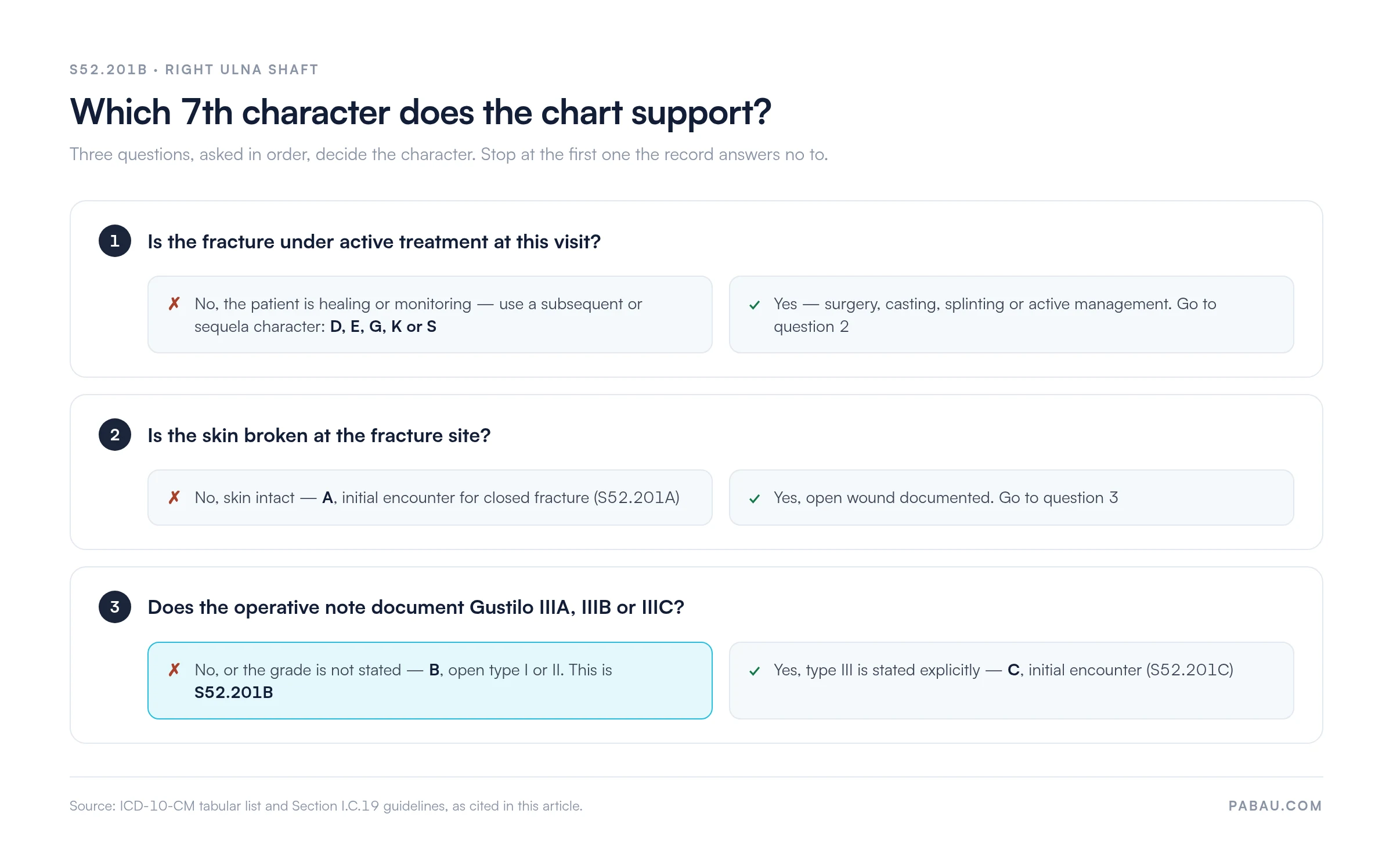
When the surgeon’s operative report does not specify a Gustilo-Anderson grade, ICD-10-CM guidelines default the open fracture to type I or II. B is then the correct 7th character. Per the CMS ICD-10 coding guidance, coders should not assign type IIIA/B/C (character C) without explicit documentation of that severity level.
The 7th character in S52 codes defines both the fracture type (open vs. closed) and the encounter phase (initial vs. subsequent vs. sequela). It is the highest-risk element in the code string. Assign A when the chart documents an open wound, or D while the patient is still in active treatment, and the claim is denied. Clearing that denial takes a resubmission and corrected documentation.
The B vs. A distinction is the most common coding error on ulna shaft fractures. A claim carrying 7th character A alongside a CPT code for open surgical repair is an automatic mismatch denial. Always confirm the wound description in the emergency or operative note before selecting the character. Three questions settle the choice, and the record answers all three.
Five codes sit close enough to S52.201B to cause assignment errors in busy orthopedic and urgent care practices. The decision logic below covers laterality, fracture type, and the related radius code.
When both the radius and ulna are fractured (a both-bone forearm fracture), assign separate codes for each. Reporting S52.201B alone when the radius is also fractured is undercoding. Validate laterality against the radiologist’s report, not the clinical note, since side is sometimes transcribed inconsistently. ICD-10-CM requires laterality specificity across the injury chapters, and forearm codes are no exception.
Category S52 carries several tabular instructions that affect how S52.201B is reported. Missing an excludes note is one of the quieter denial triggers coders encounter.
Read the tabular list at the category level, not only at the individual code. The S52 instructions apply to every code in the category, S52.201B included.
Audit the chart before any S52.201B claim goes out. Confirm the external cause code is present. Verify the fracture site is the shaft and not the olecranon. Cross-check the operative report for a Gustilo grade. Each missing element is a denial the biller has to work twice.
Four elements must appear in the clinical record to support S52.201B without triggering a documentation-related denial or audit flag.
According to the CDC/NCHS ICD-10-CM coding tool, the official tabular list is the authoritative source for all S52 documentation instructions. Coders should consult the current fiscal year’s guidelines rather than relying on prior-year memorization, since 7th character assignments are occasionally revised.
Procedure code selection depends on what the surgeon did, not on the diagnosis alone. The table below maps the most common CPT codes to their clinical scenarios. Verify the CPT against the operative note first, then read it back against the ICD-10 code before the claim is submitted.
A common billing error pairs S52.201B with CPT 25535 (closed treatment with manipulation). An open-fracture ICD-10 code paired with a closed-treatment CPT is a clinical impossibility on paper. Payers flag it as a medical necessity mismatch. When the surgeon converts from attempted closed management to open repair, update the CPT accordingly. Debridement carried out at the fracture site has its own code family. CPT 11011 covers debridement performed at the site of an open fracture.
Most payer systems apply their clinical edits after the claim arrives, so the open-closed pairing is worth checking while the claim is still editable. A short review step, with the operative note open beside the claim, catches the mismatch that clinical edits would otherwise return days later.
S52.201B denials cluster around six predictable patterns. Each one is avoidable with a pre-submission checklist, and naming the pattern is what shortens the rework when a claim does come back.
Three denial codes appear most often on S52.201B rejections. They are CO-4 (inconsistent modifier or procedure), CO-11 (diagnosis inconsistent with procedure), and CO-97 (payment included in another service). Knowing which CARC code landed on the EOB narrows the appeal strategy immediately.
Requirements vary by payer and change annually. Treat the points below as a starting-point checklist, not a definitive payer policy statement.
Getting paid on the first pass means mapping each payer’s authorization triggers against the CPT codes billed with S52.201B. Building that into a pre-authorization routine for orthopedic surgical codes removes most of the rework. Review the AAPC’s ICD-10-CM code reference for crosswalk data, and ICD List for DRG grouper lookups when the admission context affects the reimbursement level.
Once the coder has settled on S52.201B and the matching CPT, the claim usually moves into a separate portal. Someone rekeys it, and the status of that claim then lives somewhere nobody looks at daily. A rejection can sit unread for a week before anyone starts the appeal.
Practice management software like Pabau keeps that step in the same system as the patient record. Its claims management software runs validation checks each time you send a claim, confirming that the details insurers ask for are present. Membership numbers and authorization codes are the two that most often hold a fracture claim up.
From there, claims go to Claim.MD without leaving Pabau, or by email where an insurer is not connected. Every claim carries a live status of pending, submitted, processing, paid, or error, filterable by date, insurer, or invoice ID. When payment arrives, you record it against the right invoice from the same dashboard.
Choosing between A, B, and C on the 7th character stays a coding judgment, made from the operative note. What changes is the time between a fracture claim being rejected and someone noticing.

Pabau validates the details insurers need on every claim, sends it without rekeying, and shows a live status for each one. See how it works for orthopedic and urgent care practices.

S52.201B is a straightforward code when the documentation is right, and a persistent denial source when it is not. The 7th character assignment, laterality, and CPT alignment account for most claim rejections on right ulna shaft fractures.
Almost none of that is a software problem. It is a documentation discipline, built into the few seconds between reading the operative note and choosing the character. Software earns its place afterward, by validating the fields insurers require and showing where each claim stands. Book a demo to see how Pabau handles fracture claims for orthopedic and urgent care teams.

Need guidance on trauma coding workflows? Revenue cycle management fundamentals covers denial tracking and resubmission processes applicable across orthopedic trauma codes.
Working through a denial on a fracture claim? Denial management in healthcare walks through systematic appeal strategies and CARC code interpretation.
Want to understand what makes a claim accepted first time? Clean claim requirements breaks down the elements payers check before adjudicating any fracture or trauma code.
ICD-10 Code S52.201B is the billable diagnosis code for an unspecified fracture of the right ulna shaft. It applies at an initial encounter for open fracture type I or II. The code sits in ICD-10-CM category S52, fractures of the forearm. It covers active-treatment visits where the skin is broken at the fracture site, with a Gustilo-Anderson grade of I, II, or undocumented.
Yes, S52.201B is a billable ICD-10-CM code valid for FY2024, FY2025, and FY2026 claim submissions. It is a terminal code with sufficient specificity to be submitted on a claim without additional specificity required.
S52.201A codes a closed fracture of the right ulna shaft during the initial encounter; the skin remains intact. S52.201B codes the same fracture when the skin is broken at the site, classifying it as an open fracture type I or II. Using A when the chart documents an open wound is the most common denial trigger on this code pair.
CPT 25545 (open treatment of ulnar shaft fracture) is the most commonly paired procedure code for surgically managed open fractures. CPT 25535 covers closed treatment of the ulnar shaft with manipulation, and it should not be paired with S52.201B. The open-fracture ICD-10 code signals that the skin was broken, which makes a closed-treatment claim clinically inconsistent.
The clinical record must confirm four elements. They are laterality (right), fracture site (shaft or diaphysis), an open fracture with a wound description, and an encounter representing active treatment. If the surgeon does not document the Gustilo-Anderson grade, ICD-10-CM guidelines allow B as the default. That default covers open fractures of type I or II.
Six patterns account for most of them. The coder assigns the wrong 7th character, A instead of B. The laterality on the claim contradicts the operative report. A closed-treatment CPT sits beside an open-fracture diagnosis. The external cause code that workers’ comp and many commercial payers require is missing. A subsequent encounter character is used during active treatment. Wound debridement already bundled into the fracture repair CPT is billed separately.
Subsequent encounter codes replace S52.201B once active treatment has concluded. Use E for routine healing, H for delayed healing, and N for nonunion. By then the patient has moved into the monitoring and healing phase. If the patient still requires active wound management, surgical revision, or fracture fixation, S52.201B remains the correct code.