ICD-10 Code V91.84XS: Other burn due to burning watercraft
ICD-10 Code V91.84XS: overview and key facts ICD-10 Code V91.84XS identifies the...

Last Updated: Oct 30, 2026
Billable Code Specific Code
S52.042N is a billable ICD-10-CM code. It describes displaced fracture of coronoid process of left ulna, subsequent encounter for open fracture type IIIA, IIIB, or IIIC with nonunion.
ICD-10 code S52.042N applies when a displaced coronoid process fracture of the left ulna has failed to unite after an open Gustilo type III injury. Two facts decide it. The original wound grade separates N from K and M, and the provider's note must state nonunion rather than delayed healing.
Let Pabau's smart automation suggest the right codes, reduce claim denials, and keep your practice compliant—effortlessly.
Automate repetitive tasks and focus on what matters most—your patients.
Reduce coding errors and ensure compliance with the latest regulations.
Clean claims, fewer denials, and faster reimbursements.
Powerful insights and reporting to help your practice thrive.
HIPAA compliant SOC 2 certified GDPR-compliant Trusted by 4,000+ clinics worldwide

S52.042N codes nonunion of a displaced coronoid process fracture of the left ulna. The original fracture was open, Gustilo type IIIA, IIIB, or IIIC.
It is a billable, specific ICD-10-CM code in category S52, subcategory S52.0 (fracture of upper end of ulna).
The N character needs three facts on the chart: An open Gustilo type III original fracture, documented nonunion, and a visit that treats the nonunion.
Closed-fracture nonunion takes S52.042K, open type I or II nonunion takes S52.042M, and the right ulna takes S52.041N.
Pabau, the practice software we build, pre-fills claims from the patient record and checks required fields before an orthopedic claim goes to the payer.
ICD-10 code S52.042N is the billable diagnosis code for nonunion of a displaced coronoid process fracture of the left ulna. It applies at a subsequent encounter for an open fracture type IIIA, IIIB, or IIIC. The descriptor comes from the CDC/NCHS ICD-10-CM classification system, and each segment of the code string carries its own meaning.
Nonunion vs. delayed union: Nonunion means the fracture has ceased any biological attempt to heal. Delayed union describes a fracture that is still healing but progressing more slowly than expected. Only confirmed nonunion justifies the N character. A fracture without radiographic bridging is not automatically a nonunion, so the provider’s note must state the diagnosis rather than note slow progress.
The coronoid process is a triangular projection on the front of the proximal ulna. It forms the lower part of the trochlear notch, which articulates with the humerus to make the elbow’s hinge. It also resists the ulna sliding backward, so a coronoid nonunion leaves the elbow unstable as well as stiff.
That is why surgeons plan a coronoid nonunion repair around elbow stability as well as bone healing. Laterality, displacement, wound type, and healing status all shape the surgical plan, and payers check each one in medical-necessity review.
Per the CMS ICD-10-CM Official Guidelines, every fracture code in category S52 takes a seventh character. It specifies both the episode of care and the healing status. The base code S52.042 accepts the following seventh-character extensions.
Critical N vs. K distinction: K denotes a subsequent encounter for a closed fracture with nonunion. N denotes a subsequent encounter for an open fracture (Gustilo IIIA, IIIB, or IIIC) with nonunion. If the original fracture was closed and has progressed to nonunion, the correct code is S52.042K, not S52.042N. Verify the open or closed status of the initial fracture in prior encounter records before assigning N.
The S52.042 code accepts several closely related seventh characters, and the S52.04 subcategory adds sibling codes for the other side. The differences hinge on healing status, fracture type (open vs. closed), and laterality. Check each sibling’s full descriptor in our searchable ICD-10-CM library before you settle on a seventh character.
Use S52.043N only when the record never names a side. Where the chart says left, S52.042N is the code, and an unspecified-side claim invites a specificity edit.
Before assigning ICD-10 code S52.042N, verify three facts in the chart. The original fracture was open and graded Gustilo IIIA, IIIB, or IIIC. The provider has documented nonunion rather than delayed healing. The visit treats the nonunion, including nonunion surgery, rather than the original fracture. If any one is missing, the seventh character changes.
The Gustilo-Anderson classification grades open fractures by wound size, periosteal stripping, and vascular injury. ICD-10-CM maps each Gustilo grade to a specific seventh-character set. Confirm the original grade from the initial encounter records before you assign a subsequent-encounter code.
S52.042N is therefore only applicable when the original fracture was classified Gustilo IIIA, IIIB, or IIIC. If the initial operative report documents a Gustilo I or II wound, the nonunion subsequent encounter maps to S52.042M, not S52.042N. Pull the original encounter note and operative report before you assign the seventh character.
One guideline default matters here. When the record documents an open fracture but never states its Gustilo type, ICD-10-CM codes it as type I or II. A nonunion on that chart lands on S52.042M, so N needs the type III grade written down. Put together, the chart has to clear three checks in order before N applies.
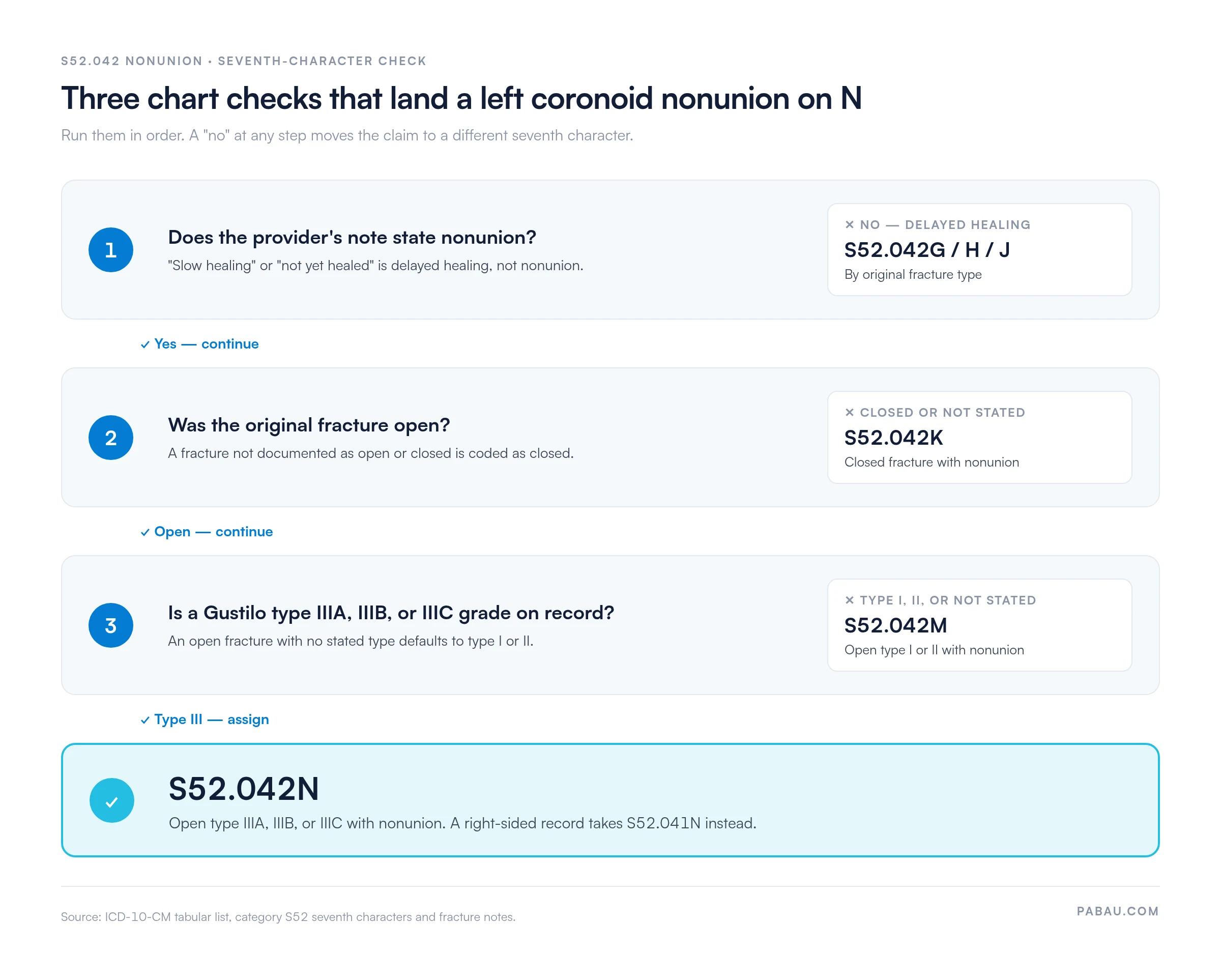
Payers conducting medical-necessity review for S52.042N typically look for each of the following in the clinical note. A single missing element is enough to trigger a denial or a medical record request.
Run this checklist against the chart before the claim is built. In most medical billing workflows, that pre-claim check is the cheapest point to catch a missing nonunion statement or Gustilo grade.
CPT code selection is independent of the ICD-10 diagnosis code, but the two must align clinically. The following CPT codes appear most often alongside S52.042N, depending on what happened at the encounter.
Repair of both the radius and the ulna moves to 25415 or 25420, so check the operative report for which bones were treated. Claims pairing 25400 or 25405 with S52.042N attract the most scrutiny. Payers often request operative notes to confirm that imaging, prior treatment, and the surgical approach all support the nonunion diagnosis.
A superbill that pre-populates these pairings with the full ICD-10 string means coders stop working from memory. Read each descriptor in the current AMA CPT manual before you submit.
Fracture codes in the S52 category generate a predictable set of denial patterns. The following are the most common denial reasons for ICD-10 code S52.042N, along with the corrective action for each.
Patterns across these denials point to one root issue: The claim is submitted before documentation has been audited against the code’s requirements. Systematic denial management in orthopedic billing means catching these problems at the pre-claim review stage. Tracking denial rates by code also shows whether S52.042N claims fail more often than your other fracture codes.
Physical and occupational therapists treating a coronoid nonunion work on elbow flexion, forearm rotation, and joint stability. Their claims follow the same injury code as the surgeon’s, with a few rules worth knowing.
Elbow rehabilitation visits often bill 97110 for therapeutic exercise or 97530 for therapeutic activities, with S52.042N as the linked diagnosis. Practice software that shows the active diagnosis codes beside the therapist’s visit notes keeps the therapy claim in line with the surgeon’s. Payers look closely when two providers bill the same nonunion under different characters.
Before a therapy claim for this patient goes out, check that it carries the same seventh character as the surgeon’s most recent claim. If the surgeon has recoded to S52.042S after the fracture healed, the therapy claim should follow, not stay on N.
The current ICD-10-CM tabular list carries several notes that affect how S52.042N is coded and sequenced. Confirm them against the current-year CMS ICD-10-CM tabular list or the AAPC ICD-10-CM lookup.
A fracture caused by disease does not belong in S52 at all. A pathological fracture of the ulna, from a tumor or another bone disease, is coded from category M84 in Chapter 13. Assigning S52.042N in that scenario misrepresents the etiology and conflicts with the oncology codes in the record.
Submitting a clean claim for a complex nonunion encounter means each element has to agree across the claim form. That covers the S52.042N diagnosis, the external cause code, the CPT code, any modifier, and the provider NPI. One mismatch with the supporting documentation can route the claim to manual review or denial.
Pabau’s error-checked claims management builds the claim from the patient record, so nobody retypes the codes already attached to the visit. Claim validation checks each claim for missing or invalid details before it leaves Pabau.
US practices submit through the Claim.MD integration, which supports thousands of US payers and handles electronic CMS-1500 claims. It also returns electronic remittance advice, so denial reasons appear in Pabau.

Pabau builds claims from the patient record and checks them for missing or invalid details. Rejected claims are flagged with the reason, so orthopedic claims go out complete.

S52.042N is a narrow code, and that is its value. It says the left ulna’s coronoid process broke through an open type III wound, and the bone has failed to unite. Change any one of those facts and the claim needs K, M, J, or S52.041N instead.
So the work sits upstream of the claim. Get the Gustilo grade, the nonunion statement, and the imaging reference into the note before coding starts. Then the seventh character stops being a judgment call.
Pabau then carries that detail from the record to the claim and flags any claim that comes back rejected, with the reason. Book a demo to see how it shortens the trip from orthopedic note to paid claim.

Need to understand how medical claims move through the system? Medical claims clearinghouse guide explains the end-to-end path from practice to payer.
Seeing repeated denials across your orthopedic claims? Denial codes in medical billing covers CARC codes, denial categories, and appeal frameworks.
Want to streamline ERA processing after claim submission? Electronic remittance advice covers how 835 files work and how to read denial reason codes from the ERA.
ICD-10 code S52.042N means a displaced coronoid process fracture of the left ulna that has not united. The original fracture was open, Gustilo type IIIA, IIIB, or IIIC. It is billable and sits in category S52, fracture of forearm.
The difference is the fracture type at the initial encounter. S52.042K applies to nonunion of a closed fracture. S52.042N applies to nonunion of an open fracture classified Gustilo IIIA, IIIB, or IIIC. An open type I or II fracture with nonunion takes S52.042M.
Nonunion means the fracture has stopped attempting to heal, so no bridging callus forms and the fracture line remains. Malunion means the fracture has healed, but in a deformed position that may limit function. In ICD-10-CM, nonunion maps to K, M, or N, while malunion maps to P, Q, or R.
CPT 25400 and 25405 cover repair of an ulnar nonunion, without and with autograft. 24685 covers open treatment of a proximal ulnar fracture such as the coronoid process. Office follow-ups use 99213 or 99214, and therapy visits typically use 97110 or 97530.
The most common reasons are an initial-encounter character on a nonunion visit and a note with no explicit nonunion statement. N on a closed fracture, which needs S52.042K, is another. Missing Gustilo grades, laterality mismatches, and global period conflicts are also frequent triggers.
The note must state nonunion and reference imaging that supports it. It must place the displaced fracture at the coronoid process of the left ulna, and confirm the original fracture was open at Gustilo type III. The external cause of the injury should be recorded too.