ICD-10 code S42.134B: Nondisplaced coracoid process fracture, right shoulder, open
ICD-10 code S42.134B: Quick reference ICD-10 code S42.134B describes a nondispla...

Last Updated: Nov 3, 2026
Billable Code Specific Code
S52.001C is the billable ICD-10-CM code for unspecified fracture of upper end of right ulna, initial encounter for open fracture type IIIA, IIIB, or IIIC.
The code covers an open fracture of the proximal right ulna that the surgeon grades Gustilo-Anderson Type IIIA, IIIB, or IIIC. Open Type I and II fractures of the same site take S52.001B instead. Correct assignment depends on the operative report stating the Gustilo grade and the side. A named olecranon or coronoid fracture takes a more specific code.
Let Pabau's smart automation suggest the right codes, reduce claim denials, and keep your practice compliant—effortlessly.
Automate repetitive tasks and focus on what matters most—your patients.
Reduce coding errors and ensure compliance with the latest regulations.
Clean claims, fewer denials, and faster reimbursements.
Powerful insights and reporting to help your practice thrive.
HIPAA compliant SOC 2 certified GDPR-compliant Trusted by 4,000+ clinics worldwide

S52.001C is billable and specific for FY2027. It covers an unspecified fracture of the upper end of the right ulna, at the back of the elbow.
The 7th character C means an initial encounter for an open Gustilo-Anderson Type IIIA, IIIB, or IIIC fracture. Open Type I and II fractures take B instead.
When the record names the olecranon or coronoid process, a more specific S52.02-, S52.03- or S52.04- code replaces S52.001C.
Two avoidable denial triggers are a missing external cause code and a radial head CPT code paired with this ulna diagnosis.
Pabau’s claims management supports ICD-10 code assignment and electronic claim submission for orthopedic and fracture-care practices.
ICD-10 code S52.001C is the billable diagnosis code for an unspecified fracture of the upper end of the right ulna. Its 7th character C marks the initial encounter for an open fracture, Gustilo-Anderson Type IIIA, IIIB, or IIIC. The code sits in category S52 (fracture of forearm), which covers both forearm bones. The “upper end” qualifier places the injury at the proximal ulna, the olecranon and coronoid region of the elbow, not the wrist.
According to the Centers for Medicare and Medicaid Services (CMS), the ICD-10-CM code set is updated every October. S52.001C and its descriptor carry over unchanged in the FY2027 release, effective October 1, 2026. Check the tabular list again at each new fiscal year, because descriptor wording and extension characters can change.
The 7th character C designates an initial encounter for an open fracture classified as Gustilo-Anderson Type IIIA, IIIB, or IIIC. “Initial encounter” means the patient is still in active treatment for the fracture, whether or not the provider has seen them before. A repeat debridement or a staged flap during the same active treatment course still uses character C.
In category S52, the initial-encounter characters split three ways. A is a closed fracture, B is an open Type I or II fracture, and C is an open Type III fracture. A frequent error on this code is reading C as the Type I or II character.
The Gustilo-Anderson classification grades open fractures by wound size, energy of injury, and soft-tissue damage. The treating surgeon must document the Gustilo grade in the operative report. Coders cannot assign the grade on their own from imaging or wound photographs.
Under the S52 tabular 7th-character definitions, an open fracture with no documented Gustilo type takes character B (type I or II). So character C needs an explicit Type IIIA, IIIB, or IIIC grade in the record. Assigning C to a Type I or II wound, or to an ungraded open fracture, is a coding error that affects reimbursement and audit exposure.
Category S52 and subcategory S52.0 carry notes that decide whether S52.001C applies or a different code is required. Misreading them, or skipping the more specific codes in S52.0, is a common source of coding errors.
Report the external cause codes (see the section below) alongside S52.001C at the initial encounter. Type IIIC wounds also involve an arterial injury, so code the vascular injury separately when the surgeon documents it.
Five codes are routinely confused with S52.001C, because their descriptors differ by one character or one word. The table sets each one against S52.001C.
The proximal radius is the other common confusion point. The radial head and neck sit in S52.1-, one subcategory away, and both bones meet at the elbow. Confirm the bone in the imaging report before coding, because a radius diagnosis also needs radius CPT codes. The CDC ICD-10-CM browser tool lists the full S52 family with descriptors for a quick side-by-side check.
The decision path below runs the four checks in the order a coder meets them, with the neighboring code at each exit.
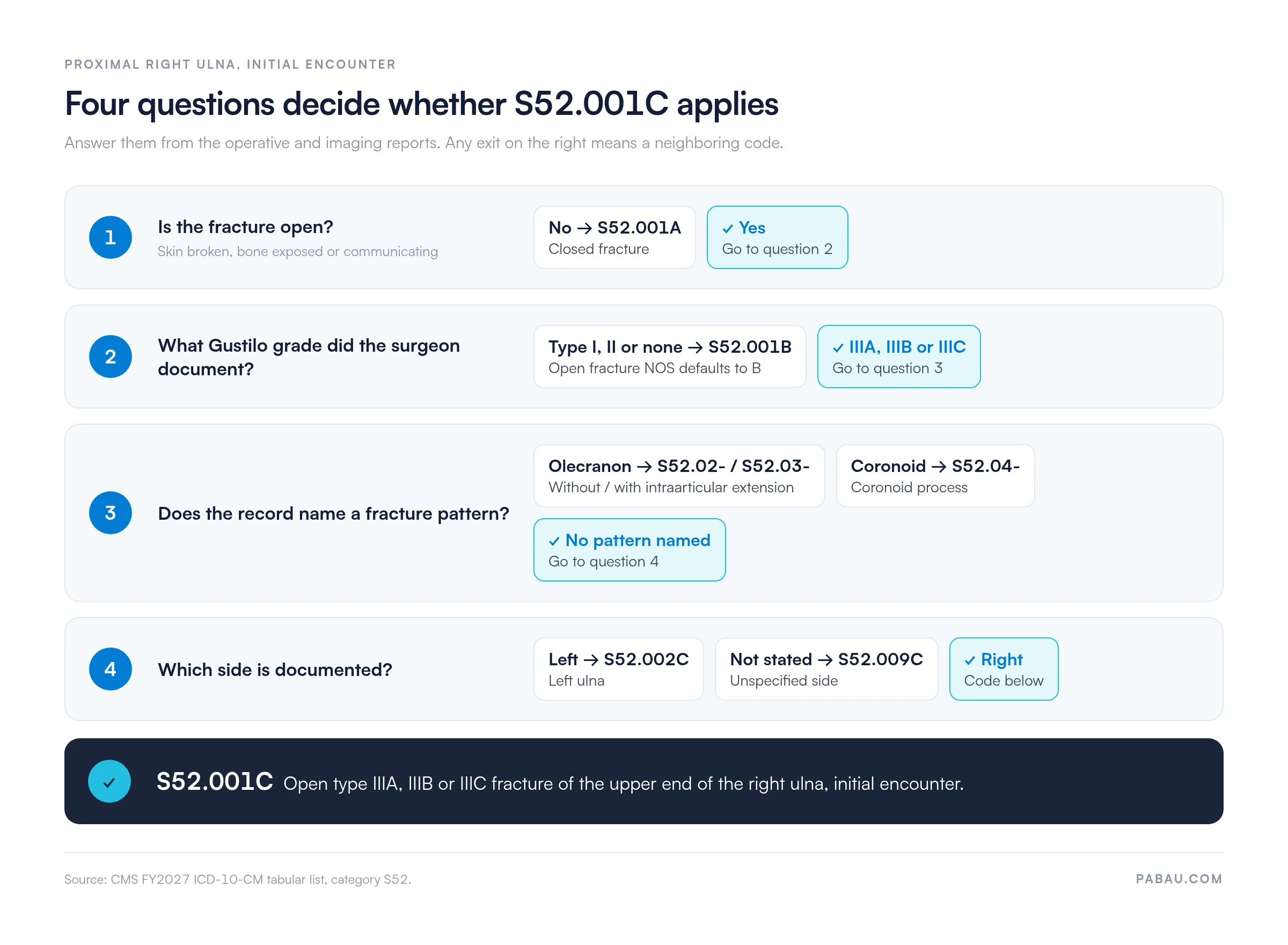
Before assigning S52.001C, run a three-question check against the operative report. Is the fracture open? Does the surgeon document Gustilo Type IIIA, IIIB, or IIIC? Is it the right ulna, with no named olecranon or coronoid pattern? If any answer is no, a different code applies, and auditors flag the mismatch.
S52.001C requires a specific documentation set. Missing any element leaves the coder without the clinical basis to assign the code, and leaves the practice exposed to a post-payment audit reversal.
Many orthopedic practices build their operative note templates to prompt for the Gustilo grade, side and fracture pattern at the time of documentation. That shortens the coding review cycle, because a structured field prompts the surgeon and a free-text field does not.
The ICD-10-CM Official Guidelines, Section I.C.20, call for external cause codes alongside fracture codes whenever the cause of injury is known. These codes are secondary diagnoses and do not affect principal diagnosis selection, but many payers use them in medical necessity review.
Report the external cause codes at the same specificity level as the fracture code. A documented fall from a ladder at home maps to a specific W-code, Y92 place, Y93 activity, and Y99 status, not to W19 alone. Type III wounds usually follow high-energy injuries, so the mechanism code often carries weight in medical necessity review.
The CPT codes billed with ICD-10 code S52.001C depend on how the proximal ulna fracture is treated. Type III open fractures almost always need surgical debridement, and most go on to open treatment with fixation. Because the injury is in the ulna, radial head and neck codes (24650-24666) do not pair with it.
Wound debridement bills as 11011 when it reaches muscle, or 11012 when contaminated bone is removed. Check current CMS National Correct Coding Initiative (NCCI) edits before pairing any CPT code with S52.001C, because bundling rules are updated quarterly.
Claims software for billers, such as Pabau’s, carries the coded encounter through to electronic submission. The diagnosis and CPT pairing you confirmed against the operative note is then the pairing the payer receives.
Claims submitted with S52.001C are denied for a predictable set of reasons. Most trace back to a detail missing from the operative report, or to a wrong 7th character. Each denial returns with a reason code, so it helps to know the common medical billing denial codes.
A structured clean claim process removes most of these denial triggers. It checks the diagnosis code, external cause code, CPT pairing and modifier logic before transmission. For denials that still come back, the denial management workflow guide covers appeal and resubmission.
Open fracture repair of the proximal ulna is generally covered under Medicare and most commercial plans as medically necessary surgical treatment. Prior authorization requirements, however, vary significantly by payer and plan year.
Sound billing compliance requirements for fracture claims include keeping the operative report, imaging, and Gustilo documentation for the payer’s audit look-back period. Medical billing documentation standards require every diagnosis code on the claim to be supported by the record at the time of service. Adding a Gustilo grade to an operative report after the claim is submitted creates a compliance risk.
Once active treatment for the S52.001C fracture ends, the 7th character changes for every later visit. Because this is an open Type III fracture, the subsequent characters come from the Type IIIA-IIIC set. Using character C beyond the active treatment phase is a coding error that payers flag during claims review.
E, H, M and Q are the subsequent characters for open Type I or II fractures, so they never follow S52.001C. The closed-fracture characters D, G, K and P do not apply either. Nonunion (N) and malunion (R) need imaging or clinical findings that confirm the healing failure, not a delayed healing assumption. The distinction matters because revision surgery for nonunion or malunion may trigger a separate authorization review.
For sequela encounters, the sequela condition (for example, post-fracture elbow stiffness) becomes the primary diagnosis, and S52.001S is sequenced as an additional code. Do not use S52.001C for a sequela visit, because character C is limited to the initial active treatment phase.
Coding S52.001C correctly depends on three details that often sit in different documents: The bone, the side and the Gustilo grade. Many orthopedic practices still pull them by hand from imaging reports and operative notes before building the claim.
Pabau keeps the encounter note, the diagnosis code and the claim in one patient record. Structured note templates can prompt the surgeon for the Gustilo grade and fracture pattern at the point of care. Claims management then carries the coded encounter through to electronic submission.
With the grade captured in a structured field, fewer claims go out with a wrong 7th character or a radius code on an ulna injury. That leaves billing teams less rework once the payer responds.

Pabau keeps the operative note, the ICD-10 code and the claim in one patient record. Its claims management supports electronic submission, so the code built from the surgeon’s note is the code the payer receives.

S52.001C is a narrow code, and most errors come from treating it as a broader one. It fits only a right proximal ulna fracture with an open Type IIIA, IIIB, or IIIC wound and no named olecranon or coronoid pattern. If any of those details is missing, one of its neighbors in S52.0 is the correct code.
The fix sits upstream of the coder. When surgeons document the Gustilo grade, the side and the fracture pattern in the operative report, the code follows from the note.
Pabau’s claims management supports electronic claim submission, so billing teams can see which claims the payer returned. Book a demo to see how Pabau supports ICD-10 coding for orthopedic and fracture-care practices.

Need a framework for reducing claim denials across your practice? Denial codes in medical billing covers the most common CARC denial codes and how to address them in your billing workflow.
Submitting claims electronically for the first time? 837 file format guide explains how electronic claim files are structured for payer submission and what coders need to verify before sending.
Verifying patient coverage before fracture treatment? Insurance eligibility verification outlines the steps to confirm active coverage and authorization status before surgical encounters.
Tracking which claims the payer paid or denied? Electronic remittance advice explains how payers report paid, adjusted and denied claims back to the practice.
ICD-10 code S52.001C is the billable diagnosis code for an unspecified fracture of the upper end of the right ulna. The 7th character C marks the initial encounter for an open fracture, Gustilo-Anderson Type IIIA, IIIB, or IIIC. It is valid for FY2027 and belongs to category S52 (fracture of forearm).
S52.001A is the initial encounter for a closed fracture of the upper end of the right ulna, where the skin is intact. S52.001C is the initial encounter for an open fracture of the same site, graded Gustilo Type IIIA, IIIB, or IIIC. An open Type I or II fracture takes S52.001B instead.
Category S52 covers fractures of both forearm bones. S52.0- is the upper end of the ulna, where S52.001C sits, and S52.1- is the upper end of the radius (head and neck). S52.2- covers the ulna shaft, S52.3- the radius shaft, S52.5- the lower end of the radius, and S52.6- the lower end of the ulna. The CDC/NCHS ICD-10-CM browser lists the complete S52 tabular.
Yes, S52.001C is a billable, specific code and may be used as the principal diagnosis on a claim for the initial fracture encounter. External cause codes (W/V/Y series) are reported as secondary codes alongside it, not before it.
The 7th character moves from C to a subsequent character once active treatment ends. Use F for routine healing, J for delayed healing, N for nonunion, and R for malunion. Active treatment includes the initial surgery and any staged procedures in the same course, and the provider’s documentation of the treatment phase decides the character.
The most common triggers are a wrong 7th character, a missing external cause code, and a wrong bone or side. Coding a Type I or II wound as C, or pairing a radial head CPT code with this ulna diagnosis, also causes denials. Checking the operative report for the Gustilo grade, bone and side resolves most of these before submission.