ICD-10 Code S42.361G: Displaced segmental fracture of right humeral shaft, delayed healing
What is ICD-10 code S42.361G? ICD-10 code S42.361G is the billable code for a di...

Last Updated: Oct 15, 2026
Billable Code Specific Code
S49.011P is the billable ICD-10-CM code for Salter-Harris Type I physeal fracture of upper end of humerus, right arm, subsequent encounter for fracture with malunion. It applies at follow-up visits once the growth plate fracture has healed out of alignment.
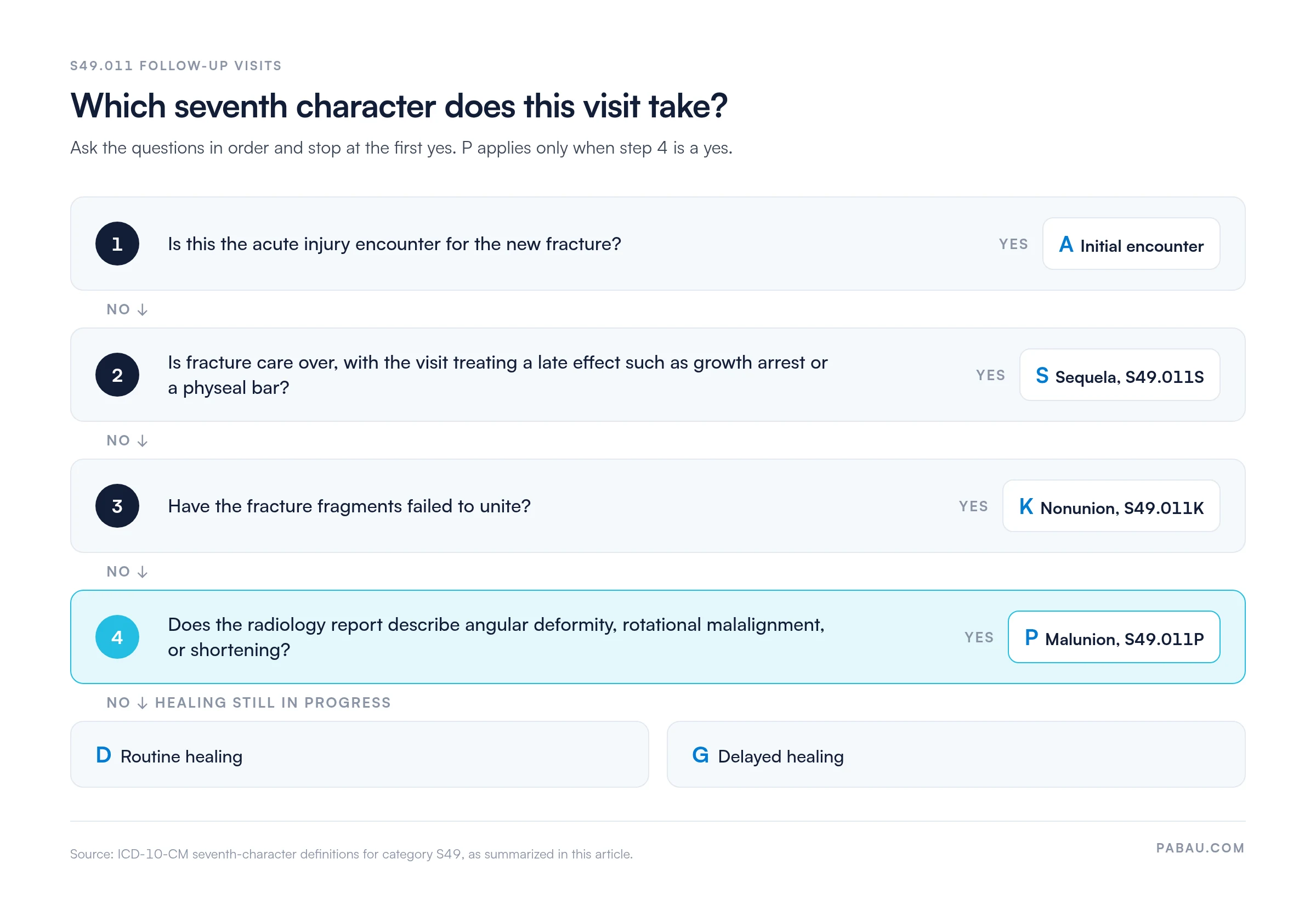
The P suffix needs a radiology report that describes angular deformity, rotational malalignment, or shortening. A fracture that has not united takes K instead, and a late effect treated after fracture care ends takes S.
Let Pabau's smart automation suggest the right codes, reduce claim denials, and keep your practice compliant—effortlessly.
Automate repetitive tasks and focus on what matters most—your patients.
Reduce coding errors and ensure compliance with the latest regulations.
Clean claims, fewer denials, and faster reimbursements.
Powerful insights and reporting to help your practice thrive.
HIPAA compliant SOC 2 certified GDPR-compliant Trusted by 4,000+ clinics worldwide

S49.011P designates a follow-up visit for a Salter-Harris Type I growth plate fracture of the proximal right humerus that healed in malalignment (malunion). It does not cover nonunion or sequela.
The P suffix requires radiographic confirmation of malunion in the radiology report. Without it, payers deny the claim or downcode it from P to D.
Confusing P (malunion) with K (nonunion) or S (sequela) is a common denial trigger for this code. Each suffix maps to a distinct clinical and billing scenario.
Claims management software such as Pabau helps practices submit cleaner claims and cut rework on physeal fracture follow-ups.
ICD-10 Code S49.011P is the billable code for a follow-up visit for a Salter-Harris Type I physeal fracture of the upper right humerus with malunion. Use it once imaging shows the growth plate fracture has healed out of alignment and the malunion is still under active care.
Each alphanumeric segment of S49.011P carries a distinct clinical meaning. Misreading any one position sends the claim to the wrong code.
Per the CMS ICD-10-CM coding guidelines, every fracture code requires a seventh character. That character must reflect the current episode of care, not the initial injury encounter. Understanding medical billing workflows for fracture follow-up helps practices apply this rule consistently across the S49 family.
A Salter-Harris Type I physeal fracture of the proximal humerus is a transverse fracture running entirely through the growth plate. It does not extend into the metaphysis or epiphysis. Because the fracture line stays within the physis, plain radiographs may show only subtle physeal widening rather than a visible fracture fragment. This is a known diagnostic pitfall.
This injury occurs almost exclusively in skeletally immature patients. The proximal humeral physis is among the last to close, typically in the mid-to-late teens, which extends the vulnerable window well into adolescence. Mechanisms include falls onto an outstretched arm, direct shoulder impact in contact sports, and birth-related trauma in neonates.
Growth plate integrity makes early reduction critical. Displaced fractures left in angular malalignment risk remodeling into a fixed deformity, precisely the scenario that produces a malunion requiring the P suffix at follow-up. The AAPC’s ICD-10-CM code lookup confirms S49.011P as distinct from both unspecified physeal fracture (S49.001-) and the higher Salter-Harris types (S49.021- through S49.041-).
The three outcome-based seventh characters — K, P, and S — are mutually exclusive. Each one names a separate diagnosis, with its own medical necessity case and its own treatment pathway.
Malunion (P): the fracture has consolidated, but imaging shows angular deformity, rotational malalignment, or shortening. The patient is still receiving active fracture-related care.
Sequela (S): the fracture episode is complete. Any residual condition being treated — growth arrest, shoulder stiffness, physeal bar formation — is coded as the sequela condition with S49.011S as an additional code. Do not use S49.011P when the fracture itself is no longer being actively managed.
Check each follow-up encounter in the order below, since a sequela or nonunion visit can still show a deformity on imaging. Stop at the first yes.
Three dimensions change the code: Salter-Harris type, laterality, and outcome suffix. Getting any one wrong routes the claim incorrectly. Use the table below to confirm each dimension independently before building the code.
Cross-check the fifth-character Salter-Harris type and its adjacent codes against the current tabular list before submitting. When the treating clinician or radiologist documents only “physeal fracture” without specifying a Salter-Harris type, default to S49.001P (unspecified) rather than assuming Type I.
Payers validate S49.011P against the claim record during medical necessity review. Each of the following documentation elements must be present before submission. Missing any one is a common denial trigger.
Run a pre-submission audit on all S49.011P claims: pull the radiology report and confirm the word ‘malunion’, ‘malalignment’, or equivalent language appears explicitly. A generic ‘fracture healing’ notation will not satisfy payer medical necessity review and will trigger a P-to-D downcode on remittance.
Complete, consistent documentation is the most reliable way to prevent these denials. With denial-reducing claims software, practices can build a documentation checklist into the fracture follow-up workflow. The checklist prompts providers to confirm laterality and alignment status before the encounter closes.
The procedure codes billed alongside ICD-10 Code S49.011P depend on whether the visit is a management-only encounter or involves corrective intervention. Confirming each CPT-to-ICD pairing before submission reduces front-end edits at the clearinghouse.
Corrective osteotomy (CPT 24400) requires separate prior authorization from most commercial payers. The ICD-10 Code S49.011P on the authorization request must exactly match the claim code. Therapy claims billed under 97110 or 97161 should list S49.011P as the linked diagnosis. A generic shoulder pain code leaves the payer without the malunion that justifies the therapy.
Medicare covers fracture follow-up care under the Global Surgery Package rules. Some S49.011P encounters fall within the postoperative global period of the original fracture surgery. Separate E&M visits billed as 99213 or 99214 may be denied. The exceptions are a visit unrelated to the surgery and a significant, separately identifiable service.
For corrective procedures, commercial payers including major health plan carriers typically require prior authorization when surgical correction of a malunion is planned. The authorization package should include the malunion-confirming radiology report, functional impairment documentation, and the proposed CPT code alongside the S49.011P diagnosis. Submitting through a medical claims clearinghouse that supports real-time eligibility checks reduces authorization lag for these cases.
State Medicaid programs vary in their prior authorization requirements for corrective osteotomy in pediatric patients. Verify the specific state Medicaid addendum before assuming standard commercial rules apply. The CMS guidance on fracture care — available via CMS ICD-10 coding resources — provides the federal baseline, but state programs may add requirements.
Physeal fracture codes generate a predictable denial pattern. Each item below identifies the denial cause and the corrective action to take before resubmission.
Systematic denial management workflows route S49.011P claim failures to a coder review queue instead of a general denied-claims bucket. That shortens resolution time for practices handling high volumes of pediatric orthopedic cases. Cross-referencing against medical billing denial codes helps coders trace each CARC denial reason back to the record that was missing.
Build a laterality verification step into every S49.011P encounter template. Require the provider to confirm right vs. left arm before the visit note can be finalized. A single checkbox prevents the most common mismatch denial on this code family.
External cause codes document the mechanism of injury that produced the original physeal fracture. For subsequent encounter codes — including S49.011P — Medicare and most commercial payers do not require external cause codes on follow-up claims. However, some state Medicaid programs require them on subsequent-encounter claims, so verify the payer’s addendum before omitting.
When external cause codes are required, append them as secondary codes. S49.011P remains the principal diagnosis. The mechanism code does not drive reimbursement for subsequent encounters, but its absence can trigger a Medicaid edit in mandating states. Consult the CDC/NCHS ICD-10-CM tool for the current year’s external cause code index when selecting the most specific mechanism code available.
The denials above trace back to three checks: alignment language in the radiology report, the arm named on every note, and the documented Salter-Harris type. When coders run those checks after the claim is built, a mismatch only surfaces as a denial on the remittance.
Pabau, the practice management platform we build, keeps the appointment, the treatment note, and the claim in the same patient record. Coders can read the radiology finding and the documented arm next to the diagnosis before the claim goes out.
Claims leave the practice with the code, the arm, and the suffix already agreeing with the record. Fewer S49.011P follow-ups come back for rework or appeal.

Pabau’s claims management software helps practices submit cleaner claims on fracture follow-up encounters. See how it works for orthopedic and physical therapy workflows.

S49.011P is earned in the radiology report, so start every follow-up claim there. If the report names the deformity, the arm matches across every note, and Type I is documented, the code holds. If any one is missing, code what the record supports instead, whether that is D, K, or S49.001P.
The trade-off is a few minutes at the front of the claim. A check of the report and the notes before submission costs less than an appeal that waits on an amended radiology addendum.
Book a demo to see how Pabau helps your coders catch suffix and laterality errors before a fracture follow-up claim goes out.

Need to understand how clean claims are built? Clean claim submission guide covers the elements that keep fracture follow-up claims from triggering front-end edits.
Dealing with repeated denials on orthopedic codes? Revenue cycle management overview explains how to structure the denial appeal and prevention process across specialties.
Want to understand how clearinghouse submission works? 837 file guide details how EDI claims are transmitted and where S49.011P mapping errors appear in the transaction set.
ICD-10 Code S49.011P is the billable code for a follow-up visit for a Salter-Harris Type I physeal fracture of the upper right humerus with malunion. Each character specifies the injury site, Salter-Harris fracture type, laterality, and outcome: the fracture has healed but in malalignment rather than anatomic position.
Malunion (seventh character P) means the fracture fragments have united but in malalignment — angular deformity, rotational offset, or shortening. Nonunion (seventh character K) means the fragments failed to unite at all, leaving persistent mobility at the fracture site. The two are distinct clinical diagnoses with different treatment pathways and cannot be used interchangeably.
Use P when the malunion itself is the active condition being treated — for example, a follow-up visit to evaluate deformity or plan corrective osteotomy. Use S (sequela) when the fracture episode is fully closed. The visit then addresses a downstream effect such as growth arrest, physeal bar, or chronic stiffness. Active malunion management always uses P, not S.
Physeal (growth plate) fractures occur almost exclusively in skeletally immature patients because the physis closes in adulthood. Applying S49.011P to an adult patient requires documented clinical justification confirming an open physis at the time of the original injury. Without that justification, the code carries a compliance risk.
The top denial triggers for S49.011P start with the initial encounter suffix (A) on a follow-up visit and missing malunion language in the radiology report. A laterality mismatch between the claim and clinical notes, or an undocumented Salter-Harris type, also triggers denials. Each requires a distinct corrective action before resubmission, and the denial reasons section above lists each fix.
S49.001P covers an unspecified physeal fracture of the upper end of the right humerus with malunion. Coders use it when the treating clinician has not documented a Salter-Harris type. S49.011P specifies Salter-Harris Type I. When the type is documented, specificity rules require the typed code. S49.001P is only appropriate when the record does not specify the Salter-Harris type.