ICD-10 code S49.199G: Physeal fracture of the lower humerus
ICD-10 code S49.199G: Full description and billability ICD-10 code S49.199G is a...

Last Updated: Oct 27, 2026
Billable Code Specific Code
S46.999A is the billable ICD-10-CM code for other injury of unspecified muscle, fascia and tendon at shoulder and upper arm level, unspecified arm, initial encounter. It covers contusions, blunt trauma and other injuries that are not strains or lacerations, when the note names neither the injured structure nor the arm.
A documented strain moves the code to S46.91-, a laceration to S46.92-, and a named right or left arm to S46.991A or S46.992A. The 7th character A applies while the injury is under active treatment.
Let Pabau's smart automation suggest the right codes, reduce claim denials, and keep your practice compliant—effortlessly.
Automate repetitive tasks and focus on what matters most—your patients.
Reduce coding errors and ensure compliance with the latest regulations.
Clean claims, fewer denials, and faster reimbursements.
Powerful insights and reporting to help your practice thrive.
HIPAA compliant SOC 2 certified GDPR-compliant Trusted by 4,000+ clinics worldwide

S46.999A is a billable ICD-10-CM code for other soft-tissue injuries of an unspecified arm at shoulder and upper arm level, excluding strains and lacerations.
The 7th character A marks the initial encounter during active treatment, while follow-up care uses D and late effects use S.
Use S46.999A only when the record can’t support laterality or injury type. If the chart names the arm, S46.991A or S46.992A avoids a specificity denial.
Pabau’s claims management software works with Claim.MD to check eligibility in real time and scrubs every claim for missing or invalid details before submission.
ICD-10 code S46.999A is the billable code for other injury of an unspecified shoulder or upper arm muscle, fascia or tendon. It applies to the initial encounter when the arm is not documented. The table below holds the facts coders and billers check before the claim goes out.
S46.999A covers shoulder and upper arm soft-tissue injuries that are neither strains nor lacerations. It applies when the documentation names neither the injured structure nor the arm side. Each word in the descriptor carries a coding decision.
According to the CMS ICD-10-CM code files, S46.999A sits within the S40-S49 block, injuries of the shoulder and upper arm. It is a valid leaf-node code on both professional (CMS-1500) and facility (UB-04) claim forms.
S46.999A is a billable ICD-10-CM code and is accepted by Medicare, Medicaid, and most commercial payers as a valid diagnosis. Before sending a clean claim, check three payer-side rules that apply regardless of CMS acceptance.
The ICD-10-CM Official Guidelines for Coding and Reporting state that codes should be reported to the highest degree of specificity supported by documentation. When the chart clearly identifies the arm side, S46.999A no longer meets that standard, and payers deny it.
The 7th character in S46.999A designates the episode of care, not the visit count. The base code S46.999 requires a 7th character to be billable; without it, the code is a non-billable header.
A common error: Coders switch from A to D after the patient’s second visit. The character is determined by what treatment is being rendered, not by the visit number. Take a patient who has surgical repair of a shoulder muscle three weeks after injury. The operative encounter still takes “A”, because active surgical treatment is occurring.
Three dimensions separate the codes most often confused in this group. They are injury type (strain vs. other), laterality (right/left/unspecified), and anatomical level (shoulder vs. wrist/hand). The table below covers the codes coders most commonly confuse with S46.999A, per the AAPC ICD-10-CM code lookup.
The critical split: If the provider writes “strain,” use the S46.91x block. If the provider writes “contusion,” “tear,” “partial disruption,” or simply “injury” without specifying mechanism, S46.99x is correct. Never substitute “other injury” for a documented strain. The four questions below run the whole selection in order, from anatomical level to the 7th character.
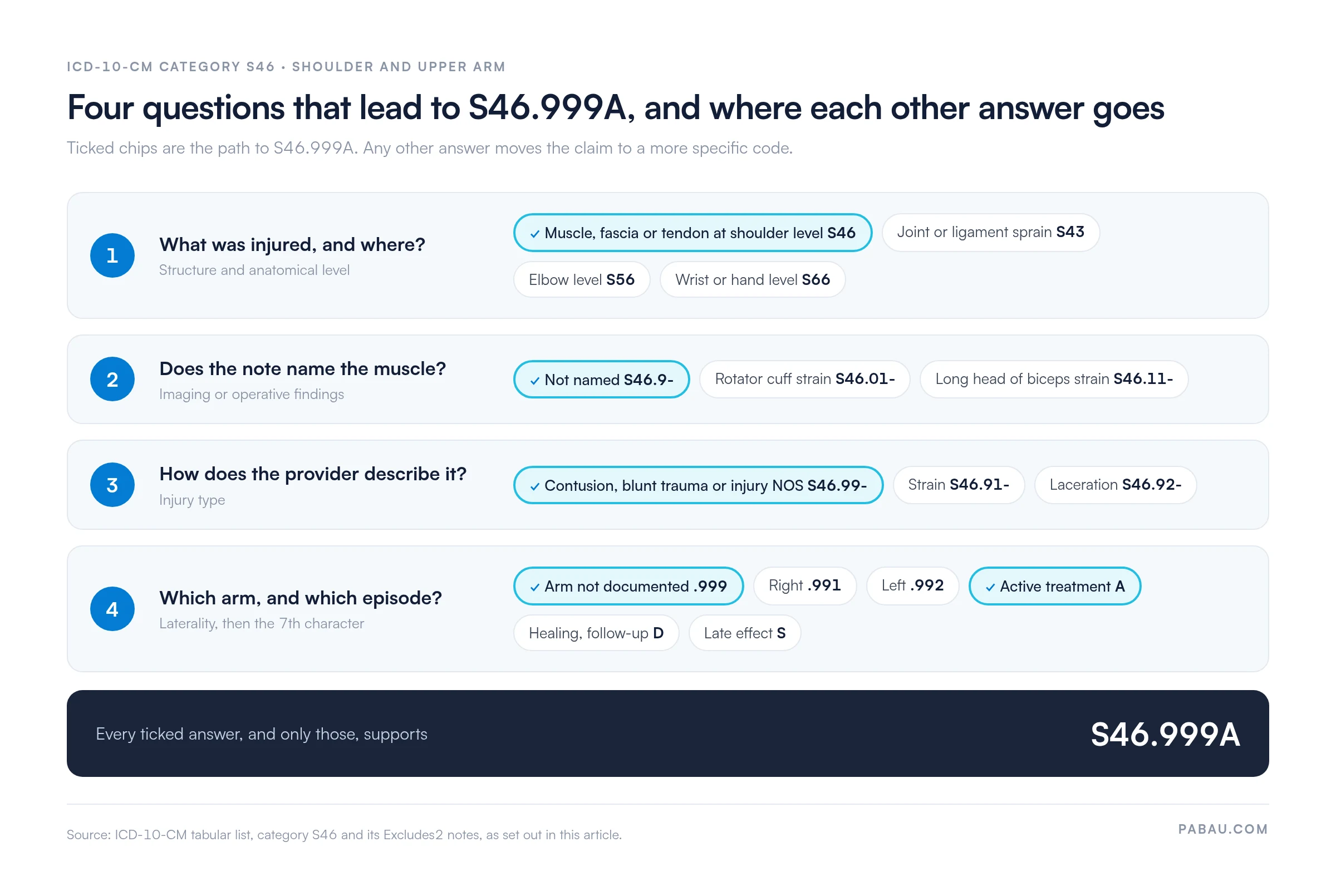
Run a quick chart audit before coding: Search the note for the words ‘strain,’ ‘sprain,’ ‘right,’ and ‘left.’ If any appear, you have more specific codes available. S46.999A should be a last resort after confirming none of those qualifiers appear anywhere in the documentation.
S46.999A inherits instructional notes from the levels above it in the hierarchy. They tell you which codes can share a claim with it and which injuries belong in another category.
S46 carries two Excludes2 notes. One covers injury of muscle, fascia and tendon at the elbow (S56.-). The other covers sprain of joints and ligaments of the shoulder girdle (S43.9). Both codes can be reported when both injuries are present.
S46 is strictly for muscle, fascia, and tendon injuries. A shoulder or acromioclavicular joint sprain codes to S43, while a documented rotator cuff muscle or tendon strain codes to S46.01-. A documented rotator cuff contusion stays in S46 as well. When documentation is ambiguous, query the provider before coding.
The ICD-10-CM Official Guidelines permit unspecified codes only when the documentation can’t support a more detailed code. For S46.999A, the record itself must leave the arm and the injury type undocumented. A coder’s preference is not enough. A well-structured medical billing workflow includes a documentation checklist that catches these omissions before the claim goes out.
The CPT codes below are the ones most often paired with shoulder muscle injury diagnoses on professional claims. Physical therapy and sports medicine practices should check current NCCI edits before submitting, because CMS updates them quarterly. Pabau’s claims management software sends claims through Claim.MD, running claim validation that scrubs every claim for missing or invalid details before it leaves the practice.
CPT codes 97110 and 97530 are often billed in the same session, so check NCCI edits for that pair each quarter. The S46.999A diagnosis must support medical necessity for each procedure billed. Payers may request the progress note that records the functional limitation being treated.
Payers deny S46.999A claims for predictable, fixable reasons. A structured denial management workflow and a working knowledge of denial codes turn most of them into one-pass corrections.
Before resubmitting a denied S46.999A claim, confirm whether the denial reason code indicates specificity (CARC 16) or medical necessity (CARC 50). The fix differs. A specificity denial needs a code change, while a medical necessity denial needs documentation attached. Mixing up the two causes a second denial.
Without a check before submission, an S46.999A specificity problem only surfaces when the remittance comes back. The biller then reads the CARC code, reopens the note to find the arm side, and resubmits.
Pabau checks patient eligibility through Claim.MD before the visit and opens each CMS-1500 claim pre-filled from the invoice. Its claim validation flags missing or invalid details before the claim leaves the practice, so each fix takes seconds.
Once the payer responds, electronic remittance advice (ERA) files come back into Pabau and settle payments against the invoice. Claims that need attention are flagged Needs action, so your team works S46.999A denials from one list.

Pabau integrates with Claim.MD to run real-time eligibility checks, claim validation that catches missing or invalid details before submission, and ERA-based denial tracking. That way, S46.999A claims leave your practice clean.

Treat S46.999A as a last resort, used only after the chart has been checked for an arm side and an injury type. If either turns up, the specific code is the one payers expect. Recoding before submission costs less than appealing afterward.
The trade-off is a little time at the front end. A quick chart search before submission saves a denial, a resubmission and the wait in between.
Pabau’s claims management software scrubs every claim for missing or invalid details before it leaves the practice, so fewer claims bounce back from the payer. To see how it works in a live claims workflow, book a demo.

Need to understand how claims clearinghouses work? Medical claims clearinghouse guide explains the end-to-end claim submission and adjudication process.
Working through an ERA after a denial? Electronic remittance advice explained covers how to read 835 remittance files and act on CARC denial codes.
Need to capture mechanism and laterality at the visit? Encounter form template gives clinicians one page with ICD-10 and CPT fields for the details coders need.
Billing 97110 and 97530 in the same session? The Medicare 8-minute rule explains how timed therapy minutes convert into billable units.
S46.999A is the ICD-10-CM code for other injury of an unspecified shoulder or upper arm muscle, fascia or tendon, unspecified arm, initial encounter. It covers shoulder soft-tissue injuries that are not strains or lacerations. It applies when the provider documents neither the specific structure nor the arm.
Yes, S46.999A is a valid billable leaf-node code accepted on both professional (CMS-1500) and facility (UB-04) claims. S46.999A is valid in the current ICD-10-CM code set; confirm the current fiscal year in the CDC/NCHS ICD-10-CM files before submitting.
The 7th character “A” designates the initial encounter, meaning the patient is under active treatment for the injury. It applies regardless of visit number. What matters is whether active treatment, such as surgery, acute management or initial evaluation, happens at that encounter. Subsequent-care visits use “D” and late effects use “S.”
S46.912A reports a strain of an unspecified shoulder muscle or tendon on the left arm. S46.999A reports “other injury” on an unspecified arm. Use S46.912A when the provider explicitly documents a strain mechanism on the left arm. S46.999A applies only when the injury is not a strain and the arm is undocumented.
Claims with S46.999A are usually denied for one of five reasons. The chart names the arm but the unspecified code was used, or the notes don’t establish medical necessity. The 7th character may not match the visit type, two CPT codes may trigger an NCCI edit, or the external cause code is missing. Identify the CARC denial reason code before resubmitting, because each one has its own fix.
Not always. Section I.C.20 of the ICD-10-CM Official Guidelines encourages an external cause code from the W, X or Y series alongside injury codes. There is no national requirement, but some payers and state reporting rules ask for one. Document the mechanism in the clinical note and add the matching external cause code to avoid claim edits.