ICD-10 Code S49.011P: Salter-Harris physeal fracture, right humerus, malunion
ICD-10 Code S49.011P: Quick reference ICD-10 Code S49.011P is the billable code ...

Last Updated: Oct 15, 2026
Billable Code Specific Code
S42.361G is the billable ICD-10-CM code for displaced segmental fracture of shaft of humerus, right arm, subsequent encounter for fracture with delayed healing. It applies at follow-up visits after active treatment, when the provider documents that the right humeral shaft is healing more slowly than expected.
The 7th character G separates delayed healing from routine healing (D), nonunion (K), malunion (P) and sequela (S). Choosing the wrong one is a frequent cause of denied claims for this code family.
Let Pabau's smart automation suggest the right codes, reduce claim denials, and keep your practice compliant—effortlessly.
Automate repetitive tasks and focus on what matters most—your patients.
Reduce coding errors and ensure compliance with the latest regulations.
Clean claims, fewer denials, and faster reimbursements.
Powerful insights and reporting to help your practice thrive.
HIPAA compliant SOC 2 certified GDPR-compliant Trusted by 4,000+ clinics worldwide

S42.361G codes a displaced segmental fracture of the right humeral shaft at a follow-up visit where the provider documents delayed healing.
The 7th character G means subsequent encounter with delayed healing. It is not a sequela character, and the sequela code for this fracture is S42.361S.
Aftercare Z codes such as Z47.89 are not used for a healing fracture. Guideline I.C.21.c.7 points you to the injury code with a subsequent-encounter character.
Once the provider documents nonunion or malunion, switch to S42.361K or S42.361P, and bill the repair procedure against that code.
Delayed-healing visits inside a 90-day global surgical period are usually bundled, so check the fixation date before you bill an E/M visit.
ICD-10 code S42.361G is the billable code for a displaced segmental fracture of the right humeral shaft, at a follow-up visit with delayed healing. You use it after active treatment, when the provider documents that the fracture is uniting more slowly than expected.
A segmental fracture breaks the shaft in two places and leaves a separate middle segment of bone. That segment can lose part of its blood supply, which is one reason these fractures are prone to slow healing. “Displaced” means the fragments have moved out of alignment, and “right arm” sets the laterality.
The code sits in Chapter 19 of ICD-10-CM and is valid in the FY2027 code set, effective October 1, 2026, per the CMS ICD-10-CM files.
The 7th character G means subsequent encounter for fracture with delayed healing. It tells the payer two facts at once. The patient has already had active treatment, and the fracture is behind its expected healing timeline.
G is not a sequela character. A coder who reads it as “late effect” bills the wrong phase of care. The sequela code for this fracture is S42.361S, which reports a condition left behind after the fracture has healed.
Delayed healing also differs from nonunion. With delayed healing, union is still expected but is coming slowly. Nonunion, coded with K, means the provider has documented that the fracture has failed to unite. The flow below shows where G sits in one fracture’s care, from fixation to sequela.
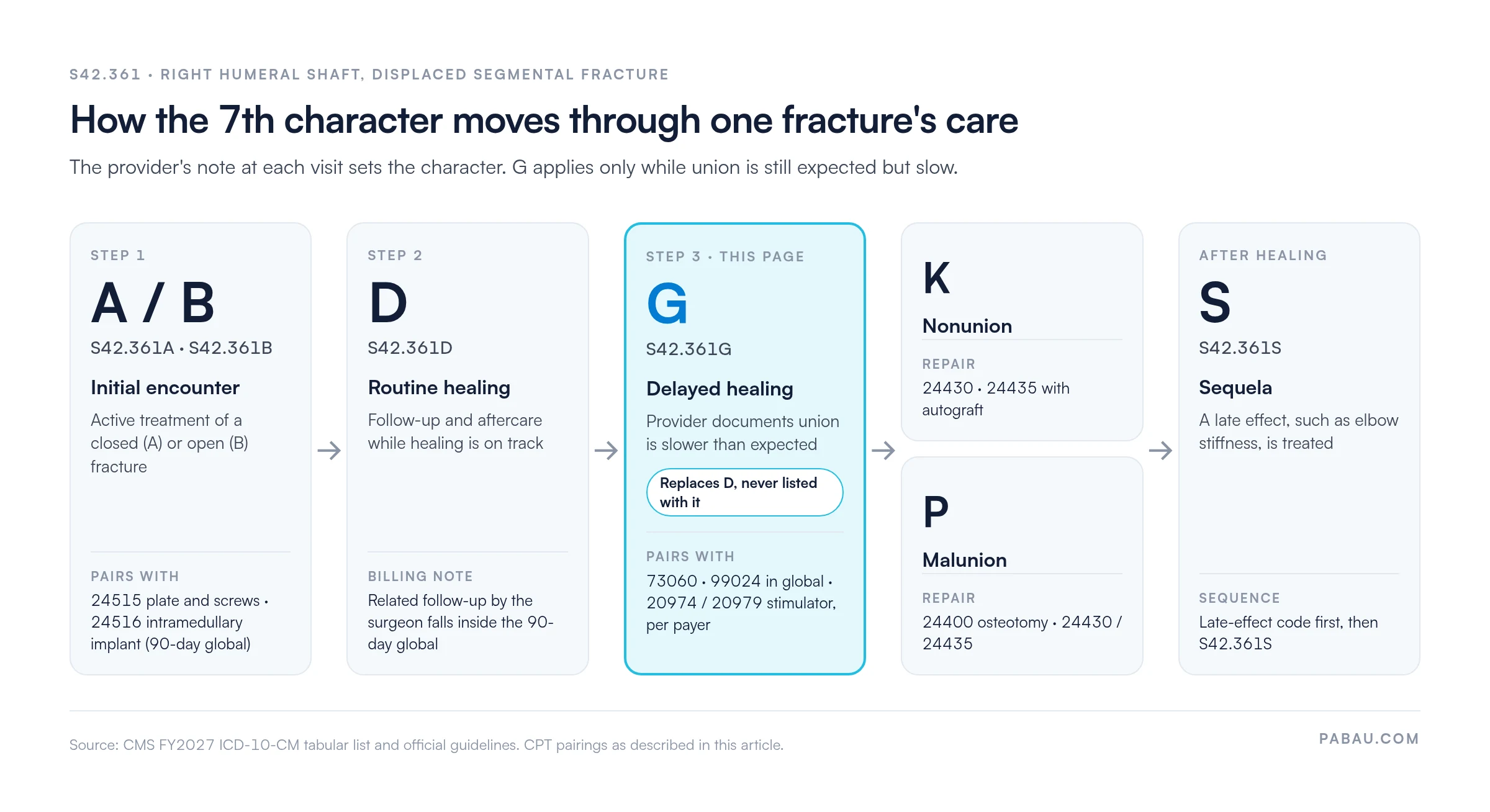
Category S42 uses seven 7th characters. Unlike the forearm, femur and lower leg categories, it has no separate open-fracture characters for subsequent care. Codes such as S42.361M or S42.361R therefore do not exist.
The open or closed distinction only matters at the initial encounter. A fracture that was open at injury still takes G at a delayed-healing follow-up.
The choice turns on what the provider writes about union at this visit. A coder cannot assign delayed healing from the calendar or from their own reading of an X-ray.
Sequela coding follows its own rule. The code for the late effect, such as stiffness, is listed first, and S42.361S is added to show its cause.
When the note is silent or contradictory, query the provider before you pick a character. A one-line query costs less than a denied claim and a corrected resubmission.
A note that supports G shows an earlier active-treatment encounter, today’s follow-up, and the provider’s statement that healing is delayed. Payers reviewing these claims look for the following elements.
Where they apply, record the factors that explain the delay, such as smoking or diabetes. They support medical necessity for extra imaging, therapy or a bone stimulator.
Aftercare Z codes are not used for injuries. ICD-10-CM guideline I.C.21.c.7 tells you to assign the acute injury code with the 7th character D for aftercare of an injury. Z47.89 therefore does not belong on a claim for this healing fracture.
When healing is delayed, the subsequent-care character changes from D to G for that visit. The new character replaces D, so never list S42.361D and S42.361G together on the same claim.
The fracture guidelines in ICD-10-CM guideline section I.C.19.c.1 handle complications the same way. Nonunion takes K and malunion takes P, rather than a separate complication code.
External cause codes are optional unless your payer or state requires them. If you report one, it takes the 7th character D, because external cause codes only take A, D or S as their 7th character. Keeping these rules in your medical billing compliance checks prevents repeat errors.
The procedures billed at a delayed-healing visit follow the plan for a slow-healing fracture. Monitoring, imaging, therapy and bone stimulation are the usual pairings. Most of these visits include serial humerus X-rays under 73060, so the provider can compare callus at both fracture sites.
Check bone stimulator coverage before you order one. Many payers, including Medicare’s national coverage determination for osteogenic stimulators, cover them for documented nonunion rather than delayed healing.
Surgical procedures change the diagnosis. Repair of a humeral nonunion or malunion (24430, or 24435 with autograft) pairs with S42.361K or S42.361P. A humeral osteotomy (24400) to correct malunion pairs with S42.361P, not G.
Physical therapists bill 97110 and their evaluation codes under the diagnosis the referring provider documented. If the referral still says routine healing, ask for the updated note before you switch to G.
Many displaced segmental shaft fractures are fixed surgically, with CPT 24515 (plate and screws) or 24516 (intramedullary implant). Both carry a 90-day global period, which covers related follow-up care by the operating surgeon.
A delayed-healing check inside that window counts as related care, so a separate E/M visit is usually bundled and denied with CO-97. Report 99024 for tracking instead, still with S42.361G as the diagnosis.
The picture changes when the surgeon returns the patient to the operating room for a related procedure, such as revision fixation. That claim needs modifier 78, and a missing modifier draws a CO-4 denial.
When a claim with S42.361G is denied, the claim adjustment reason code names the objection. A steady denial management workflow stops the same error repeating across claims.
For an appeal, attach the imaging report that shows slow progress and the note that names delayed healing. Add the date of the original fixation, so the reviewer can see whether a global period applies.
Tracking these medical billing denial codes by code family shows where documentation breaks down. Your revenue cycle management reports can flag S42.361 denials separately.
Add a healing-status field to your fracture follow-up template. The provider picks routine, delayed, nonunion or malunion at every visit, so the coder never has to guess between D, G, K and P.
These neighboring codes are the ones most often confused with S42.361G. Check laterality, displacement and healing status before you submit.
Avoid S42.363G when the note names the side, because payers often question unspecified laterality on fracture claims. Confirm each descriptor in the AAPC ICD-10-CM code lookup before submission.
Delayed-healing claims fail when the visit note and the claim tell different stories. A coder reads a free-text note, guesses the healing status, and learns from the remittance that the guess was wrong.
Pabau, the practice management platform we build, keeps the clinical note, the diagnosis and the invoice in one patient record. A structured follow-up form captures healing status at every visit, so the coder picks D, G, K or P from what the provider recorded.
Pabau’s Claim.MD integration then submits the claim electronically to US payers and brings remittance data back to the record. Denials such as CO-97 or CO-11 appear against the visit that caused them. The claims software for practices then shows which follow-up notes keep producing the same denial.

Pabau links each visit note to its diagnosis and claim. Delayed-healing encounters go out with the right 7th character and the documentation to support it.

S42.361G fits one visit type only. It is a follow-up for a displaced segmental fracture of the right humeral shaft whose healing the provider has called delayed. Treat the provider’s words about union as the deciding fact, and the 7th character follows from them.
The costly mistakes sit at the edges of that definition. Reading G as sequela turns a valid visit into a denial. So does billing Z47.89 for aftercare, or an E/M visit inside a surgical global period.
Practices that capture healing status in a structured field at every follow-up stop relying on coder judgment for these claims. Book a demo to see how Pabau keeps fracture notes, codes and claims aligned for orthopedic practices.

Want to reduce ICD-10 claim denials across your practice? Denial management in healthcare walks through systematic approaches to identifying and resolving recurring denial patterns.
Looking for guidance on clean claim standards? Clean claim submission covers the documentation and coding elements payers check before processing any musculoskeletal claim.
Need to understand how clearinghouses validate ICD-10 codes? Medical claims clearinghouse explains how electronic claim validation works before codes reach the payer.
Coding a delayed-healing shaft fracture on the left arm? ICD-10 code S42.332G covers a displaced oblique humeral shaft fracture with delayed healing.
Has the provider now documented nonunion? ICD-10 code S42.309K walks through coding and billing a humeral shaft nonunion.
ICD-10 code S42.361G means displaced segmental fracture of shaft of humerus, right arm, subsequent encounter for fracture with delayed healing. It is used at a follow-up visit when the provider documents that the fracture is healing more slowly than expected.
No. The 7th character G means subsequent encounter with delayed healing. The sequela code for this fracture is S42.361S, used for late effects once the fracture has healed.
S42.361D is a follow-up where healing is routine. S42.361G is a follow-up where the provider documents delayed healing. The choice depends on what the provider writes about union at that visit.
Use S42.361K once the provider documents nonunion, meaning the fracture has failed to unite. Use S42.361P when it has healed in poor alignment. Surgical repair of either is billed with that matching code, not G.
No. ICD-10-CM guideline I.C.21.c.7 says aftercare Z codes are not used for injuries. Assign the injury code with the subsequent-encounter character instead, which is G when healing is delayed.
The usual causes are CO-11 for a procedure that does not match delayed healing and CO-97 for a visit inside a 90-day global period. CO-4 follows a missing modifier such as 78. Matching the 7th character, procedure and modifier to the note prevents all three.