ICD-10 Code S82.299K: Other tibial shaft fracture nonunion, unspecified leg
ICD-10 Code S82.299K: Official description and quick reference ICD-10 Code S82.2...

Last Updated: Oct 21, 2026
Billable Code Specific Code
S42.152A is the billable ICD-10-CM code for displaced fracture of neck of scapula, left shoulder, initial encounter for closed fracture. It covers a closed break through the narrow neck between the scapular body and the glenoid while the patient is in active treatment.
Correct assignment turns on four elements in the record: The fracture site, displacement, left laterality and the stage of care. A fracture not documented as displaced or nondisplaced is coded as displaced.
Let Pabau's smart automation suggest the right codes, reduce claim denials, and keep your practice compliant—effortlessly.
Automate repetitive tasks and focus on what matters most—your patients.
Reduce coding errors and ensure compliance with the latest regulations.
Clean claims, fewer denials, and faster reimbursements.
Powerful insights and reporting to help your practice thrive.
HIPAA compliant SOC 2 certified GDPR-compliant Trusted by 4,000+ clinics worldwide

S42.152A codes a displaced fracture of the neck of the left scapula at the initial encounter for a closed fracture.
When the record does not say whether the fracture is displaced, ICD-10-CM codes it as displaced. S42.152A is therefore the default, and S42.155A needs explicit nondisplacement language.
The 6th character sets laterality. S42.151A is the right shoulder, S42.152A is the left, and S42.153A is the unspecified shoulder.
The 7th character A covers active treatment of a closed fracture only. Use B for an open fracture, D, G, K or P for later care, and S for sequelae.
Displaced neck fractures are treated closed or open, so CPT 23570, 23575 and 23585 can all pair with S42.152A.
Pabau’s claims management software scrubs every claim for missing or invalid details before it goes to Claim.MD, Pabau’s US clearinghouse partner.
ICD-10 code S42.152A identifies a displaced fracture of the neck of the left scapula at the initial encounter for a closed fracture. It is a billable ICD-10-CM code, valid for the current fiscal year. Use the table below to confirm the descriptor, classification and 7th character options before you assign it. Its neighbors in category S42 are listed in our searchable ICD-10-CM library.
The neck of the scapula is the narrowed region connecting the scapular body to the glenoid cavity, the socket of the shoulder joint. ICD-10-CM gives each scapula site its own subcategory, so the location named in the radiology report decides which code family applies.
“Displaced” means the fracture fragments have shifted out of their anatomical alignment. The treating physician or radiologist makes that call, never the coder. The ICD-10-CM Official Guidelines add a default that matters here. A fracture not documented as displaced or nondisplaced is coded as displaced, so S42.152A also covers a left scapular neck fracture with no displacement qualifier.
A sports medicine practice seeing high-energy shoulder injuries will meet this code most often after falls, direct blows to the shoulder, or motor vehicle accidents.
Knowing what falls inside and outside the S42 category prevents miscoding adjacent shoulder injuries.
S42.152A captures closed, displaced fractures of the left scapular neck during active treatment. It also covers a left scapular neck fracture whose displacement the record leaves unstated. A fracture not documented as open or closed is coded as closed. If the documentation states “open”, the initial encounter takes 7th character B instead (S42.152B).
ICD-10-CM also carries a “use additional code” instruction for this chapter. Report an external cause code alongside S42.152A to identify the mechanism, activity and place of occurrence. The CMS ICD-10-CM coding and reporting guidelines encourage this reporting. There is no national mandate, so whether it is required depends on state reporting rules and payer policy.
The 7th character reflects the stage of care, not the number of visits. A patient seen ten times during active treatment of the same fracture still takes character A every time.
The move from A to D is a frequent 7th character error in orthopedic coding. Active treatment ends when the provider moves from fracture management to routine monitoring of healing. From that visit on, use D for uncomplicated healing, G if healing is lagging, or K or P if imaging confirms a union problem.
All three codes describe a displaced fracture of the neck of the scapula at the initial encounter for a closed fracture. They differ only in the 6th character, which records the side. Payer edits often flag unspecified laterality, so explicit side documentation protects the claim.
When documentation says “left shoulder” but does not name the scapula, review the imaging and operative reports. An X-ray or CT report stating “displaced fracture of the left scapular neck” supports S42.152A. So does “left scapular neck fracture” with no displacement qualifier.
S42.152A (displaced) and S42.155A (nondisplaced fracture of neck of scapula, left shoulder, initial encounter) differ by one clinical variable. That variable is whether the fragments have shifted from their anatomical position. The answer comes from the radiology report or the operative note, never from the coder’s judgment.
The nondisplaced family mirrors the displaced one. S42.154A is the right shoulder, S42.155A the left, and S42.156A the unspecified shoulder. A claim carrying S42.155A against a report that says only “scapular neck fracture” is the mismatch an imaging-based audit will flag. In that case, the defensible code is S42.152A. The grid below sets all six initial-encounter codes side by side.
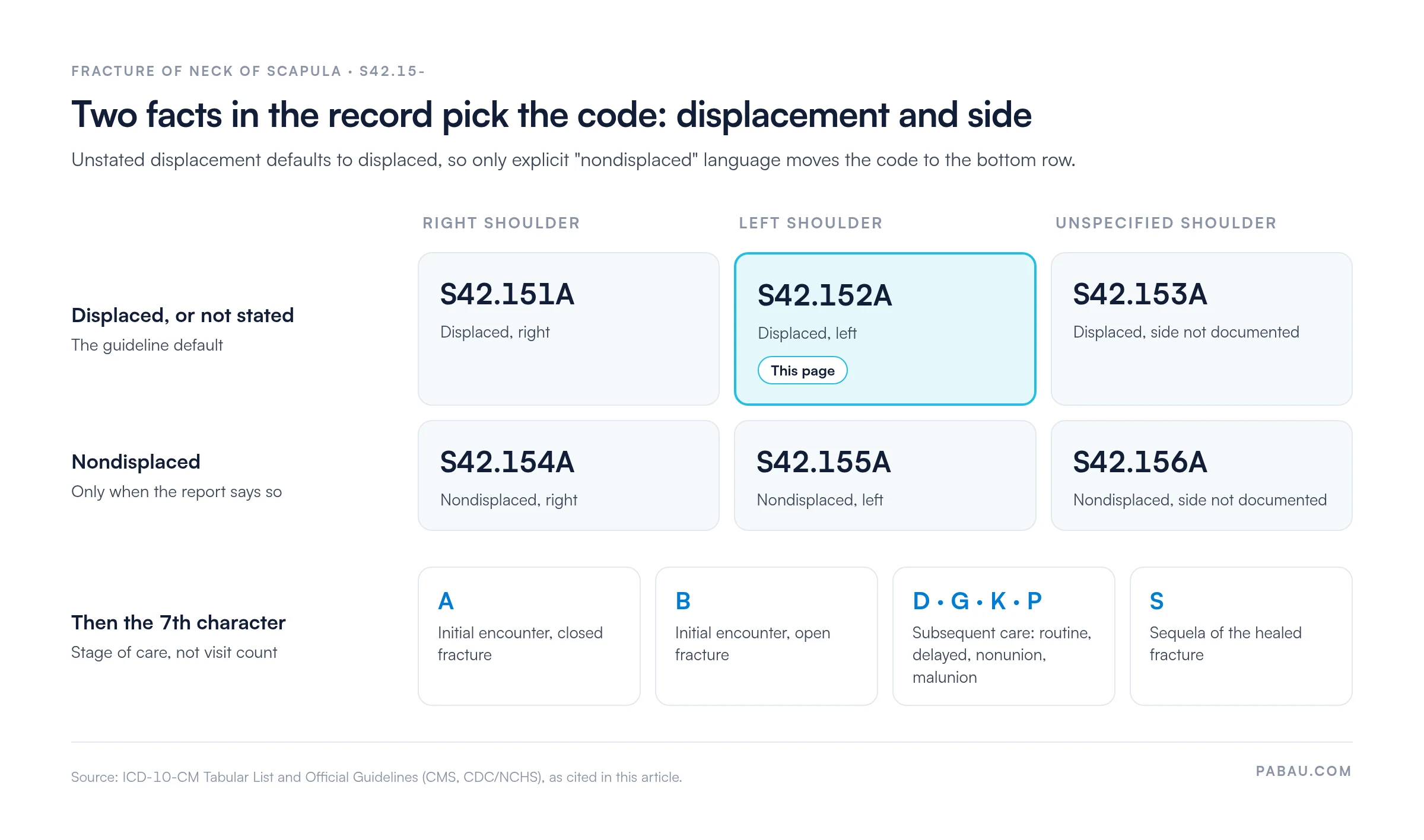
Before switching from S42.152A to S42.155A, search the radiology report for ‘nondisplaced,’ ‘non-displaced’ or ‘no displacement.’ If none of those phrases appears, S42.152A stands. A query takes two minutes, while a denial appeal can take weeks.
A coder needs five elements in the medical record before assigning ICD-10 code S42.152A. Missing any one of them creates grounds for denial on audit.
Three CPT codes cover the treatment of scapula fractures, and all three are plausible with a displaced neck fracture. The right one depends on what the treating physician documented doing, not on the displacement alone. Link the procedure code to ICD-10 code S42.152A through the claim’s diagnosis pointer.
Many displaced scapular neck fractures still heal well without surgery, so 23570 remains a frequent pairing. CPT 23585 with S42.152A is not unusual, because significant displacement is a recognized indication for fixation. Have the operative note record the degree of displacement and the surgical rationale, so the pairing is easy to support if a payer asks.
Common external cause pairings with S42.152A include the following codes.
Per AAPC’s ICD-10-CM code database, external cause codes follow the injury code and are never the first-listed diagnosis. Add a place of occurrence code (Y92.-) when documentation supports it.
Pabau’s orthopedic claims management toolset supports multi-code claim construction and checks each claim for missing or invalid details before submission.
This six-step workflow turns the code definition into an assignment routine you can run against a patient record. Follow the steps in order, because each one narrows the code the next step confirms.
For coding compliance guidance, the CMS ICD-10-CM Official Guidelines remain the authoritative reference. The CDC/NCHS ICD-10-CM web tool confirms current-year code status and tabular notes. The AAPC ICD-10-CM lookup shows the full S42 hierarchy. Practices with billing compliance workflows built around these steps can record the coding rationale in the patient record, which supports appeals.
The documentation rules above create five predictable denial patterns for this code. The table maps each one to its root cause, prevention step and appeal argument.
Tracking denials across all S42.15- claims, not just S42.152A, shows whether a problem is systematic. One example is a radiology template that never states displacement or laterality.
In many practices, the coder checks the radiology report by hand and the claim goes out. An error on the side, the displacement or the 7th character then returns weeks later as a denial. Each one costs a resubmission and delays payment.
Pabau’s claim validation scrubs every claim for missing or invalid details before it leaves Pabau. If a claim still comes back rejected, Pabau flags it as needing action and links straight to the field to fix. The Claim.MD clearinghouse integration then submits claims, checks eligibility and tracks each claim through to payment or denial.
Electronic remittance advice comes back into Pabau, so payments and denials sit next to the claim that produced them. That makes it easier to run a denial management workflow that fixes recurring patterns rather than single claims.

Pabau scrubs every claim for missing or invalid details before it leaves your practice, then submits it through Claim.MD. See how orthopedic and sports medicine practices fix errors before the payer sees them.

S42.152A is the default code for a closed left scapular neck fracture in active treatment. It applies whether the report says “displaced” or says nothing about displacement. That default is what makes it defensible. The riskier move is reaching for S42.155A without the word “nondisplaced” in the imaging report.
Build the check into your routine: Site, displacement, side, stage of care, then the procedure. Do it before the claim leaves, and most S42.152A denials never happen. Book a demo to see how Pabau validates fracture claims before they reach the payer.

Need a framework for managing claim denials systematically? Denial codes in medical billing covers the most common CARC codes and how to build a denial tracking workflow.
Want to understand how clearinghouse edits catch errors before submission? How a medical claims clearinghouse works explains the validation layer between your practice and the payer.
Looking for guidance on insurance eligibility verification before the encounter? Insurance eligibility verification walks through the pre-visit workflow that reduces downstream claim issues.
ICD-10 code S42.152A is the billable diagnosis code for a displaced fracture of the neck of the left scapula, initial encounter for closed fracture. It sits in ICD-10-CM Chapter 19 (Injury, poisoning and certain other consequences of external causes), under category S42 (Fracture of shoulder and upper arm).
Yes, S42.152A is a billable ICD-10-CM code valid for the current fiscal year. It is a complete code at its full specificity level and can be submitted on both professional and facility claims.
S42.151A codes a displaced fracture of the neck of the right scapula, and S42.152A codes the same fracture on the left side. Both carry the initial encounter 7th character A. Imaging or clinical documentation must confirm the side before you select either code.
S42.152A codes a displaced fracture of the neck of the left scapula, and S42.155A codes the nondisplaced equivalent. ICD-10-CM codes a fracture as displaced when displacement is not documented. S42.152A is therefore correct unless the radiology report explicitly states nondisplaced.
Switch from A to D when active fracture management is complete and the patient is in routine follow-up with normal healing. Use S for a later encounter treating a late effect of the healed fracture, such as chronic shoulder pain or stiffness. Sequence the sequela condition first, then S42.152S.
There is no national requirement to report external cause codes, so Medicare does not mandate one with S42.152A. The ICD-10-CM guidelines still encourage them for injuries, and some state reporting rules and payer policies require them. Reporting one alongside S42.152A documents how the injury happened.
CPT 23570 covers closed treatment without manipulation, and 23575 covers closed treatment with manipulation. CPT 23585 covers open treatment with internal fixation, which is a common choice for significantly displaced neck fractures. Choose the code that matches the documented procedure.