ICD-10 code S43.223D: Posterior sternoclavicular joint subluxation, subsequent encounter
ICD-10 code S43.223D: Quick reference summary ICD-10 code S43.223D is the billab...

Last Updated: Nov 3, 2026
Billable Code Specific Code
S42.134B is the billable ICD-10-CM code for nondisplaced fracture of coracoid process, right shoulder, initial encounter for open fracture. It applies while the patient is in active treatment for a break in the hook-shaped coracoid process of the right scapula. The fragments stay aligned, and a wound communicates with the fracture.
An open coracoid fracture is uncommon, because the process lies deep beneath the deltoid and pectoralis major. It usually follows high-energy trauma. Coding turns on four documented facts: The coracoid site, nondisplaced alignment, the right side and an open wound during active treatment.
Let Pabau's smart automation suggest the right codes, reduce claim denials, and keep your practice compliant—effortlessly.
Automate repetitive tasks and focus on what matters most—your patients.
Reduce coding errors and ensure compliance with the latest regulations.
Clean claims, fewer denials, and faster reimbursements.
Powerful insights and reporting to help your practice thrive.
HIPAA compliant SOC 2 certified GDPR-compliant Trusted by 4,000+ clinics worldwide

S42.134B is a billable ICD-10-CM code for an open, nondisplaced fracture of the right coracoid process at the initial encounter.
The coracoid process belongs to the scapula, not the humerus, so this code sits in the S42.1 scapula subcategory.
The 7th character B covers active treatment of an open fracture only, and later visits move to D, G, K, P or S.
Documentation must name the coracoid process, the right side, nondisplaced alignment, and a wound that communicates with the fracture.
No CPT code names open treatment of the coracoid, so confirm with the payer whether 23585 or unlisted 23929 fits the procedure.
ICD-10 code S42.134B describes a nondisplaced fracture of the coracoid process of the right shoulder, initial encounter for an open fracture. It is a billable code with no further subdivisions. In medical billing, payers match each character of the code against the clinical record. One wrong character is enough to deny the claim.
Verify the current code descriptor and tabular notes via the CDC/NCHS ICD-10-CM web tool, which publishes the official annual release.
A coracoid process fracture is a break in the hook-shaped projection that curves forward from the top of the scapula. It sits just below the outer end of the clavicle and in front of the shoulder joint.
Several structures anchor to the coracoid. The pectoralis minor, the coracobrachialis and the short head of the biceps attach to it. So do the coracoclavicular, coracoacromial and coracohumeral ligaments.
Those attachments explain the two usual mechanisms. A direct blow to the front of the shoulder can break the process outright. A strong pull through the muscles or the coracoclavicular ligaments can avulse it, often alongside an acromioclavicular (AC) joint injury or a shoulder dislocation.
An open coracoid fracture is uncommon because the process lies deep beneath the deltoid and pectoralis major. A wound that reaches it usually means high-energy trauma, so expect other shoulder injuries in the same record. A nondisplaced fracture is often managed without surgery, but the open wound still needs urgent care.
Each character in S42.134B carries a distinct clinical meaning. Misreading any one of them produces a code that describes a different patient.
“Nondisplaced” means the fragments remain in anatomical alignment. The coder assigns it from the physician’s documented description, not from an independent reading of the imaging.
Two default rules in the S42 category apply here. A fracture not documented as displaced or nondisplaced is coded as displaced. A fracture not documented as open or closed is coded as closed. Either default moves the claim off S42.134B.
The 7th character B designates an initial encounter for an open fracture. The patient is receiving active treatment, and the wound communicates with the fracture. Active treatment includes surgery, emergency care and evaluation by a new physician, and it ends when care moves to routine follow-up.
The most common error is continuing to bill S42.134B after active treatment ends. Once the provider documents routine follow-up, the 7th character changes to D, G, K or P, depending on the documented healing. Per the CMS ICD-10 coding guidelines, the character follows the nature of the encounter, not the date of the injury.
Sequela encounters use S42.134S, sequenced after the code for the late effect itself. If chronic shoulder pain is the reason for the visit, for example, report M25.511 (pain in right shoulder) first.
Run a charge-capture check on every S42.134B claim at 30 days after the first encounter. A claim still carrying B at that point needs a documentation review against the encounter notes.
S42.134B records an open fracture without specifying its Gustilo-Anderson type. That system grades open fractures by wound size, contamination and soft-tissue damage, from Type I to Type IIIC. ICD-10-CM has no separate S42 codes for each type, so S42.134B applies to any documented open coracoid fracture.
The Gustilo type still matters operationally. Surgical teams and payers use it to judge the need for staged debridement and antibiotic cover. Capture it from the operative note in the supporting record, even though it does not change the diagnosis code.
The coracoid process family, S42.13-, has six fifth- and sixth-character codes. Each takes seven 7th characters, so the family holds 42 billable codes. The table shows the initial open-fracture code for each one.
Three errors account for most wrong-code selections in this family:
One more mix-up deserves a check, because the shoulder has two bony prominences that sound alike. A nondisplaced open fracture of the greater tuberosity of the right humerus is S42.254B, not S42.134B. Confirm that the record names the coracoid before you submit. Cross-reference the AAPC ICD-10-CM code lookup for the descriptor text.
The five checks below follow the order a coder reads the record, and each one shows the code a failed check leads to.
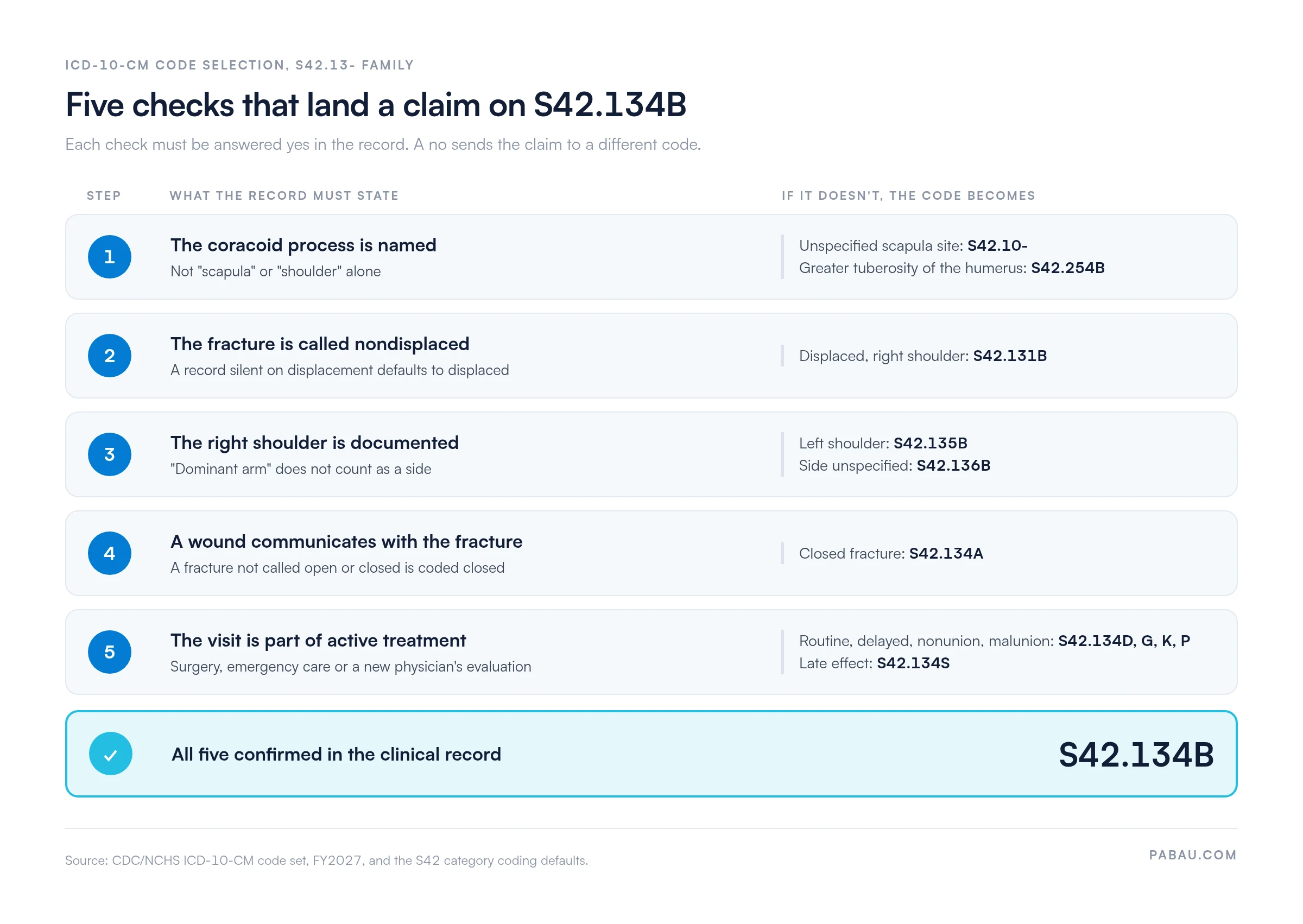
Every character in S42.134B must be supported in the clinical record. Coders cannot infer displacement from the fracture pattern or assume the side from the operative field. Submitting a clean claim for this code requires the following documentation:
Getting medical billing compliance right at the documentation stage keeps retroactive audits from turning into overpayment demands on paid claims.
Flag operative notes that mention an ‘open wound’ without linking it to the fracture. Payers want the note to tie the wound to the fracture itself. Ask the surgeon to document ‘open fracture with wound communication’ before signing the note.
CPT has no procedure code that names the coracoid process. Scapular fracture treatment falls in the 23570-23585 range, and open-wound care uses the open-fracture debridement codes, starting at 11010. An open fracture does not automatically mean open treatment, so code the procedure the surgeon documents.
Apply the RT modifier to shoulder procedure codes where the payer requires it. Medicare and many commercial payers expect RT or LT on codes in the 23000 range. A missing modifier can trigger a CO-4 denial, so confirm each payer’s rule before submission.
ICD-10-CM guideline Section I.C.20 encourages external cause codes with injury codes, though no national rule makes them mandatory. Many state reporting systems and payers do require them. For S42.134B, the external cause code records how the coracoid broke.
External cause codes carry their own 7th character set, which has no open or closed distinction. A primary code ending in B therefore pairs with an external cause code that uses A for the initial encounter. Use the WHO ICD-10 browser to check the international hierarchy when confirming external cause categories.
Code associated injuries separately when the record documents them. An AC joint dislocation, a clavicle fracture or a shoulder dislocation each takes its own S42 or S43 code alongside S42.134B.
Six patterns account for most rejections on S42.134B claims. Strong denial management workflows catch them before submission. The table maps each pattern to its usual denial code and the fix.
Review denial explanations against the full list of medical billing denial codes to map each CO and OA adjustment reason code to its appeal route. Electronic remittance advice (ERA) shows which claim line carried the wrong 7th character.
Most S42.134B denials start with a note that never stated the coracoid, the side or the open wound. The coder then has to chase the surgeon after the claim has already bounced.
Pabau, the practice management and billing platform we build, keeps the clinical note, the diagnosis code and the claim on one patient record. Its claims management software lets the coder see the documentation behind each code before submission. Claims then go out through Claim.MD, the US clearinghouse Pabau integrates with, which checks them against payer edits.
The result is fewer resubmissions for a code where one wrong character changes the bone, the side or the encounter.

Pabau keeps the fracture note, the diagnosis code and the claim in one patient record, and sends claims through Claim.MD for payer checks. See how orthopedic and injury practices use Pabau to cut claim rework.

S42.134B only fits when four facts line up in the record. It needs the coracoid process, the right side, nondisplaced alignment and an open wound during active treatment. When any one of them is missing, ask for an addendum rather than coding around it.
The procedure side needs the same care. With no coracoid-specific CPT code, agree the open-treatment code with each payer before the first claim, not after a denial. Book a demo to see how Pabau helps orthopedic and injury practices submit fracture claims that pass on the first attempt.

Need to understand how claim denials are classified? Medical billing denial codes maps the most common CO and OA adjustment reason codes to their root causes and appeals pathways.
Working on building a cleaner claims submission process? Submitting a clean claim covers the documentation, coding, and payer-edit checks that reduce first-pass rejection rates.
Exploring how electronic remittance works after submission? Electronic remittance advice (ERA) explains how 835 transactions map denial codes back to specific claim lines.
ICD-10 code S42.134B means nondisplaced fracture of coracoid process, right shoulder, initial encounter for open fracture. The coracoid process is part of the scapula. The record must document the coracoid site, the right side, nondisplaced alignment, an open wound and active treatment.
Yes, S42.134B is a billable ICD-10-CM code with no further subdivisions. It is valid in the FY2027 code set. Confirm its status each October in the CDC/NCHS ICD-10-CM release.
No, S42.134B is a scapula code, because the coracoid process is part of the shoulder blade. A nondisplaced open fracture of the greater tuberosity of the right humerus is coded S42.254B.
S42.134A is the initial encounter for a closed fracture, and S42.134B is the initial encounter for an open fracture. Use S42.134B only when the physician documents a wound that communicates with the fracture. A fracture not documented as open or closed is coded as closed.
Closed management pairs with CPT 23570, or 23575 when manipulation is performed. Wound care at the open fracture site uses 11010-11012, chosen by depth. No CPT code names open coracoid fixation, so confirm with the payer whether 23585 or unlisted 23929 applies.
Follow-up visits use S42.134D for routine healing, S42.134G for delayed healing, S42.134K for nonunion and S42.134P for malunion. Late effects use S42.134S. The change applies once the provider documents that active treatment has ended.