ICD-10 Code S82.299K: Other tibial shaft fracture nonunion, unspecified leg
ICD-10 Code S82.299K: Official description and quick reference ICD-10 Code S82.2...

Last Updated: Oct 21, 2026
Billable Code Specific Code
S42.114G is the billable ICD-10-CM code for nondisplaced fracture of body of scapula, right shoulder, subsequent encounter for fracture with delayed healing. It applies at a follow-up visit where the clinician documents that the right scapular body fracture is healing more slowly than expected.
Routine follow-up visits use S42.114D instead, and a fracture that fails to unite moves to S42.114K. The right side is already set by the 6th character, so S42.114G needs no extra laterality digit.
Let Pabau's smart automation suggest the right codes, reduce claim denials, and keep your practice compliant—effortlessly.
Automate repetitive tasks and focus on what matters most—your patients.
Reduce coding errors and ensure compliance with the latest regulations.
Clean claims, fewer denials, and faster reimbursements.
Powerful insights and reporting to help your practice thrive.
HIPAA compliant SOC 2 certified GDPR-compliant Trusted by 4,000+ clinics worldwide

S42.114G is a billable ICD-10-CM code for a nondisplaced fracture of the right scapular body at a follow-up visit where healing is delayed.
The 7th character G means delayed healing. A routine follow-up visit takes S42.114D, so coding G without a documented delay invites a denial.
Laterality already sits in the 6th character, where S42.114 is the right shoulder. The left side is S42.115G and an unspecified side is S42.116G.
The note must state the delay in the clinician’s words, such as delayed union or slower healing than expected, before G is assigned.
Pabau’s claims management scrubs each claim for missing or invalid details before it leaves, then tracks it from submission to payment.
ICD-10 code S42.114G is the billable code for a nondisplaced right scapular body fracture at a follow-up visit where healing is delayed. Each part of that descriptor changes the code, so all four must be in the record.
The scapular body is the most commonly fractured part of the scapula, and these fractures are usually managed without surgery. The bone sits inside a thick muscle envelope, so it tends to heal on schedule. That makes G the exception at follow-up, and S42.114D the code most visits will use.
The side of the injury is set by the 6th character, not by an extra digit. Each code below is a complete, billable 7-character code at the delayed-healing stage.
Always code to the highest level of specificity. Billing S42.116G when the record says “right shoulder” is a documentation mismatch and a common payer audit flag.
The parent codes carry the instructional notes that apply to S42.114G, so it helps to know the path. The CDC/NCHS ICD-10-CM web tool shows the full hierarchy with active-code flags for each fiscal year.
S42 codes describe traumatic fractures. A scapular fracture caused by bone disease is coded in chapter 13 instead. Osteoporotic fractures go to M80.-, fractures in neoplastic disease go to M84.5-, and other pathological fractures go to M84.4-.
The 7th character in an S42 fracture code shows where the patient is in the episode of care. Seven values apply to this family. G is correct when active treatment has ended and the clinician documents that healing is delayed.
The routine-healing trap: A follow-up visit alone does not justify the G character. Under Section I.C.19 of the ICD-10-CM Official Guidelines, routine care during healing takes D, such as an X-ray to check progress. G applies only when the record states that healing is delayed.
The active-treatment trap: A post-surgical check where the surgeon reviews imaging is a subsequent encounter, not an initial one. Billing A at that visit is one of the most frequent 7th character errors in orthopedic claims.
Two questions settle the 7th character at any S42.114 visit, as the chart below shows. First, is active treatment still underway? If not, what does the note say about healing?
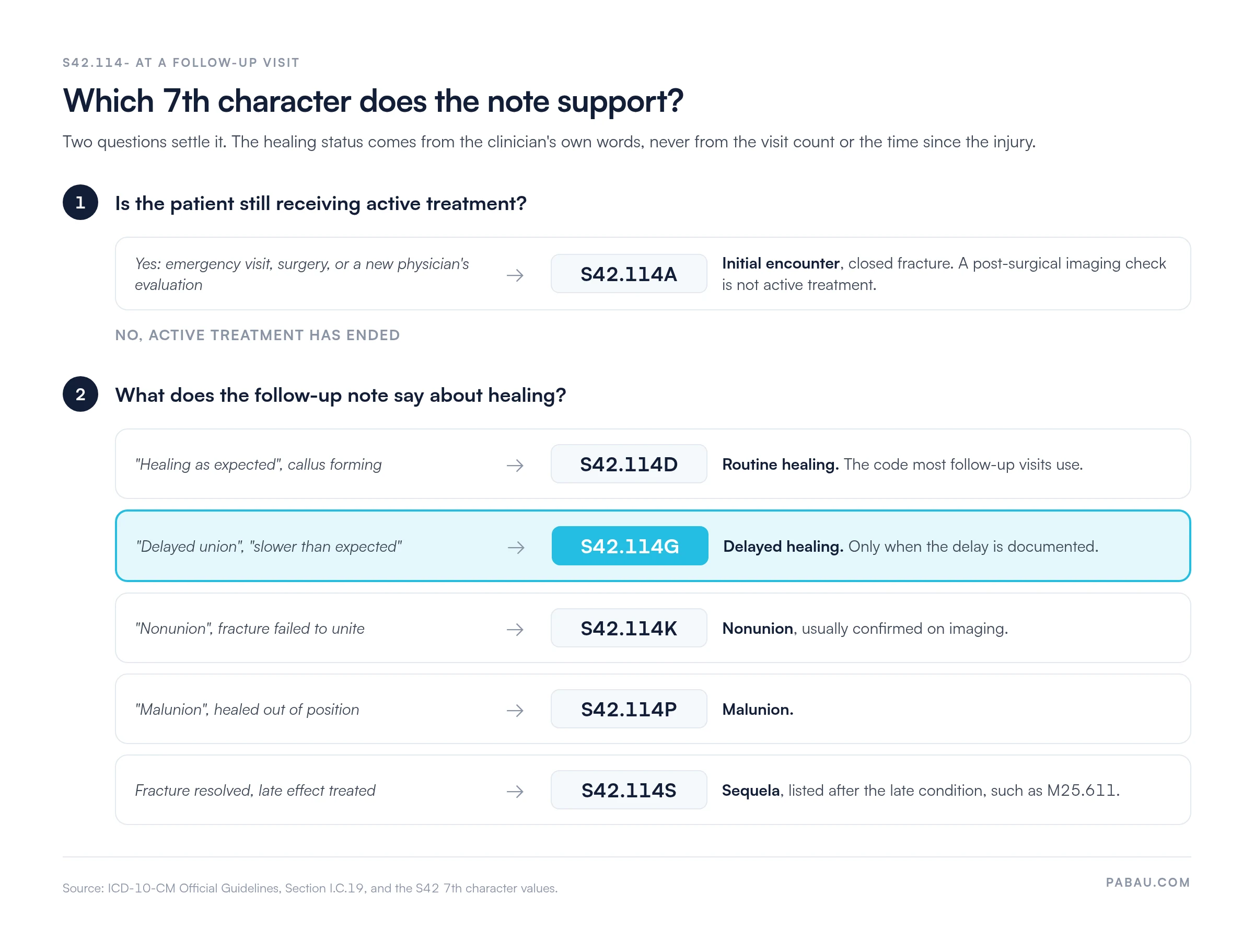
Three subsequent-encounter characters cause most of the confusion for this code. Each matches a different healing status, and the physician note decides which one applies.
A sequela encounter uses S42.114S instead, once the fracture itself has resolved. The code for the late condition comes first. For example, stiffness of the right shoulder (M25.611) is listed first, with S42.114S added second.
Displacement and fracture site are clinical findings from imaging. The treating physician documents them, and the coder selects the code that matches.
The displaced body codes run S42.111 (right), S42.112 (left), and S42.113 (unspecified side). If the record does not say displaced or nondisplaced, ICD-10-CM defaults to displaced, which moves the claim to S42.111G. Query the physician first, because a clarification is faster than reworking a denial.
Every element of ICD-10 code S42.114G must be supported by the medical record. A good medical billing workflow builds a documentation check into each encounter type. For a delayed-healing scapula visit, the record must show all five of the following:
If the record describes normal healing, use S42.114D. If it documents nonunion, use S42.114K, and if it documents malunion, use S42.114P. Coders may not infer delayed healing from the number of visits or the time since the injury.
Query the physician if a follow-up note gives no healing status. “Healing as expected” supports D, not G. “Delayed union on today’s X-ray” supports G, and one sentence from the provider prevents a slow denial.
The CPT code billed with S42.114G reflects what the clinician did at the visit. Orthopedic and sports medicine practices should map these pairings into their billing templates. Check each pairing against current payer policy, because coverage at follow-up visits varies by plan and MAC.
CPT 23570 and 23575 cover the closed treatment of a scapular fracture (without and with manipulation) and carry a 90-day global period. Follow-up visits for the fracture inside that period are part of the surgical package, delayed healing included. Bill separate E/M visits only once the global period has ended, unless the payer says otherwise.
Most payers do not require prior authorization for an orthopedic follow-up visit billed with S42.114G. Local coverage determinations from Medicare Administrative Contractors can still add medical necessity criteria for services like CT. Running insurance eligibility verification before each follow-up catches plan-specific rules early. Review the CMS ICD-10 coding and billing guidance for the current fiscal year.
Scrubbing each claim before it leaves your system prevents many avoidable denials. Pabau’s claims management software checks every claim for missing or invalid details, and its Claim.MD integration sends CMS-1500 claims to thousands of US payers.
When a payer denies a claim, electronic remittance advice (ERA) files show the reason code. A denial code lookup matches each one to its fix. The table below maps the common denial patterns for S42.114G.
Structured denial management workflows group denials by root cause instead of working each one alone. That view surfaces repeat errors, such as G used for routine visits, across a provider or service line. Checking clean claim submission requirements before transmission stops most of these issues at the source.
Run a code validity check each October, when the new ICD-10-CM fiscal year takes effect. Use the CDC/NCHS ICD-10-CM tool to confirm S42.114G is still active before billing visits on or after October 1.
Before finalizing S42.114G, confirm the visit does not point to an adjacent code. The AAPC ICD-10-CM code lookup and the CMS ICD code validity lists both confirm active status and descriptors. The adjacent codes to review are listed below.
Delayed-healing claims fail when the note and the claim disagree. A follow-up gets coded G from habit, or the side on the claim drifts from the side in the chart. Tracing that back after a denial costs more time than the visit earned.
Pabau, the practice management platform we build, keeps the clinical note, the invoice, and the insurance claim on one patient record. Claim validation flags missing or invalid details before a claim leaves, with a link to the field that needs fixing. Eligibility checks run from the patient record before the visit.
Once a claim is sent through Claim.MD, its status updates from the payer and ERA payments match back to the claim. Your team sees a denial on a delayed-healing claim the day it arrives and can fix it while the visit is still recent.

Pabau scrubs each claim for missing or invalid details, sends CMS-1500 claims through Claim.MD, and matches ERA payments back to every claim. See how it fits your orthopedic billing workflow.

S42.114G is a narrow code. It belongs only to the right-sided, nondisplaced scapular body fracture whose healing the physician has called delayed. Most follow-up visits for this fracture belong to S42.114D, and treating G as the default follow-up code is the error payers catch.
Make the healing status a required line in every fracture follow-up note, and let that line choose the 7th character. The trade-off is one more query to the physician now and far fewer recoded claims later.
Book a demo to see how Pabau links the follow-up note to a scrubbed, tracked claim for orthopedic practices.

Need to understand clearinghouse claim validation? Pabau’s Claim.MD clearinghouse guide explains how 837P claim transmission and real-time eligibility checks work end to end.
Working through a claim denial on a fracture code? Denial codes in medical billing maps CARC adjustment reason codes to corrective actions for common orthopedic claim rejections.
Want a framework for fracture billing compliance? Medical billing compliance covers documentation standards, audit risk, and payer policy verification for musculoskeletal practices.
ICD-10 code S42.114G means a nondisplaced fracture of the body of the right scapula, at a subsequent encounter with delayed healing. It is used at a follow-up visit where the physician documents that the fracture is healing more slowly than expected.
Yes, S42.114G is a complete, billable 7-character ICD-10-CM code. The 6th character already sets the right shoulder, so no extra laterality digit is added. The left side is S42.115G and an unspecified side is S42.116G.
The 7th character G means a subsequent encounter for a fracture with delayed healing. It contrasts with A and B (initial encounter), D (routine healing), K (nonunion), P (malunion), and S (sequela).
S42.114D is for a follow-up visit where the fracture is healing normally, while S42.114G is for one where healing is delayed. The physician note decides which applies. Without a documented delay, the follow-up is coded D.
The most common reason is G billed when the note describes routine healing, which should be S42.114D. Other causes include A billed at a follow-up, a side that does not match the record, and visits billed inside a 90-day global period.
Query the treating physician before billing. S42.116G (unspecified shoulder) is valid, but payers often flag unspecified laterality. A note confirming the right side supports S42.114G, and a left-sided fracture takes S42.115G.