

ICD-10 code S61.201A: Open wound of left index finger without nail damage
ICD-10 code S61.201A covers a left index finger wound of unstated type ICD-10 co...

Last Updated: Oct 16, 2026
Billable Code Specific Code
S36.592A is the billable ICD-10-CM code for other injury of descending [left] colon, initial encounter.
Coders often confuse it with S36.591A (transverse colon), S36.593A (sigmoid colon), or S36.599A (unspecified part of colon). In this subcategory, the last digit names the colon segment, not the injury type. A wrong segment means a wrong code and a likely denial.
Let Pabau's smart automation suggest the right codes, reduce claim denials, and keep your practice compliant—effortlessly.
Automate repetitive tasks and focus on what matters most—your patients.
Reduce coding errors and ensure compliance with the latest regulations.
Clean claims, fewer denials, and faster reimbursements.
Powerful insights and reporting to help your practice thrive.
HIPAA compliant SOC 2 certified GDPR-compliant Trusted by 4,000+ clinics worldwide

S36.592A is the billable ICD-10-CM code for other injury of the descending [left] colon at the initial encounter.
In the S36.59x subcategory, the sixth character names the colon segment, so S36.590A is the ascending colon and S36.593A is the sigmoid colon.
Code a documented contusion of the descending colon as S36.522A and a laceration as S36.532A; S36.592A covers other injury types.
Use the 7th character A during active treatment, D for routine healing-phase care, and S for late effects of the injury.
Billing software such as Pabau submits CMS-1500 claims through Claim.MD and tracks their status, using the codes your team assigns.
ICD-10 Code S36.592A is the billable, specific ICD-10-CM code for other injury of the descending [left] colon at the initial encounter. Use it when the record names the descending colon and an injury type other than contusion, laceration, or primary blast injury. The table below captures the fields a coder needs before submitting a claim.
The code S36.592A is built in layers, and each character narrows the classification. Two characters do most of the work: the fifth names the injury type and the sixth names the colon segment.
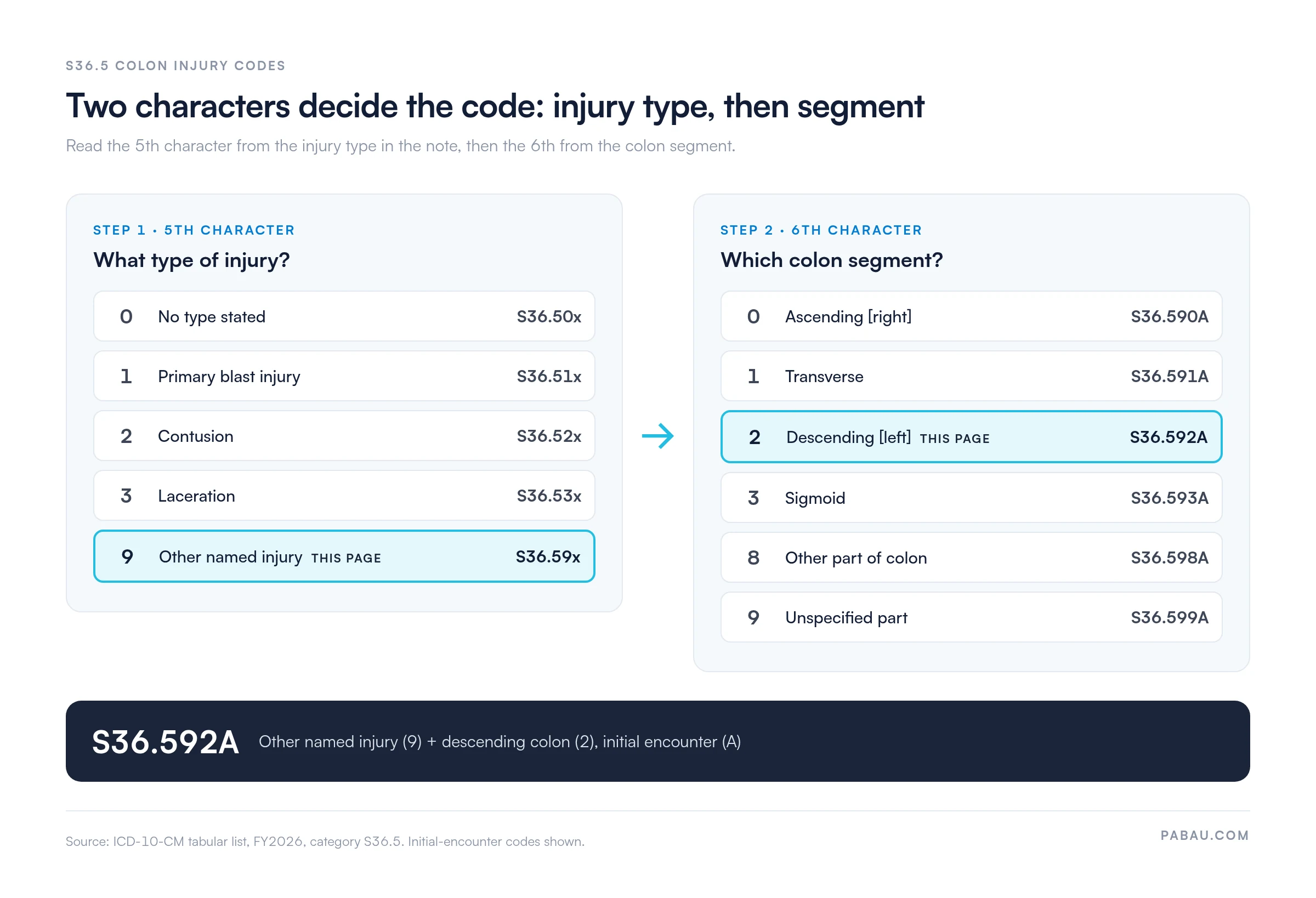
The word “other” sits at the fifth-character level. It means the note names an injury type that has no dedicated code in the S36.5 subcategory. An injury with no stated type goes to the unspecified codes instead, so a descending colon injury with no type is S36.502A. The last digit then picks the segment, and 2 always means the descending colon.
The 7th character is required for every code in the S36 block. Submitting a claim without it, or with the wrong qualifier, results in an automatic edit rejection by most payers.
Under ICD-10-CM Official Guidelines Section I.C.19.a, “initial encounter” does not simply mean the first visit. It means any visit during which active treatment is still being rendered. A patient transferred to another facility for definitive surgical repair is still in the initial encounter phase. That holds even if another facility has already seen them.
Two choices decide the code: the injury type and the colon segment. S36.59x covers other injury across six segments, and S36.590A is the ascending colon, not an unspecified injury. The table sets the S36.59x codes beside the descending colon contusion and laceration codes.
Decision rule: Read the surgeon’s note in two steps. First, find the injury type: contusion points to S36.52x, laceration to S36.53x, primary blast injury to S36.51x, and no stated type to S36.50x. Only another named injury type belongs in S36.59x. Second, find the segment, because the last digit must match it. A descending colon injury always ends in 2, so the other-injury code is S36.592A. The chart below maps both steps.
Category S36 carries a code-also note: report any associated open wound of the abdominal wall (S31.-) as well. Notes can sit at the category and subcategory levels, so check the current tabular list before you finalize the claim. The CMS ICD-10 coding resources publish the current code files and guidelines each year.
Injuries to other organs from the same event get their own codes. A small intestine injury is coded from S36.4- and a rectal injury from S36.6-. Each one needs separate documentation in the operative report.
S36.592A applies when the record names the descending colon and an injury type other than contusion, laceration, or primary blast injury. Three common presentations in trauma surgery follow.
Each scenario depends on the note naming both the injury type and the colon segment. A note that says only “colon injury” supports S36.509A, not S36.592A.
S36.592A is defined by both an injury type and a colon segment, so the record must support each one. The CDC/NCHS ICD-10-CM coding tool lets you confirm the code and its neighbors in the tabular list before you submit.
Absent any of these elements, a post-payment audit could reclassify the claim as miscoded or unsupported, triggering a recoupment request.
ICD-10-CM Official Guidelines Section I.C.20 sets no national mandate for external cause codes, but many payers and state reporting programs require them. They never serve as the principal diagnosis. They follow S36.592A on the claim and explain how the injury happened.
Trauma surgery billing pairs S36.592A with the procedure code that matches the surgical repair performed. The table below shows common pairings. Verify each one against current NCCI edits before submitting. Practices using claims management software keep each claim, its status, and payer responses in one place.
Claim denials on S36.592A-coded claims cluster around a small set of recurring errors. Each one is preventable with pre-submission checks. A denial management workflow starts by finding which of these patterns your team hits most often.
Reviewing medical billing denial codes alongside the CARC reason codes on each EOB shows which pattern is active in your practice’s claim data.
Run a monthly audit on S36.592A claims returned with CARC 197 (precertification or authorization absent) or CARC 96 (non-covered charge). Emergency trauma care rarely needs prior authorization, so check these denials for a missed emergency exception or a coding error. Fix the edit, resubmit within the payer’s timely filing window, and log the correction in your denial log.
The S36.5 codes are easy to miscode because two neighboring characters carry different meanings. The tips below cover the patterns that cause the most rework.
Many trauma billing teams key the same S36.592A claim twice, once in the practice system and again in a payer portal. Each re-keyed field is another chance to drop the 7th character or swap the segment digit.
Pabau’s Claim.MD integration submits CMS-1500 claims to thousands of US payers and tracks each claim’s status. It sends the ICD-10 and CPT codes your coders have already assigned, so code selection stays with your team.
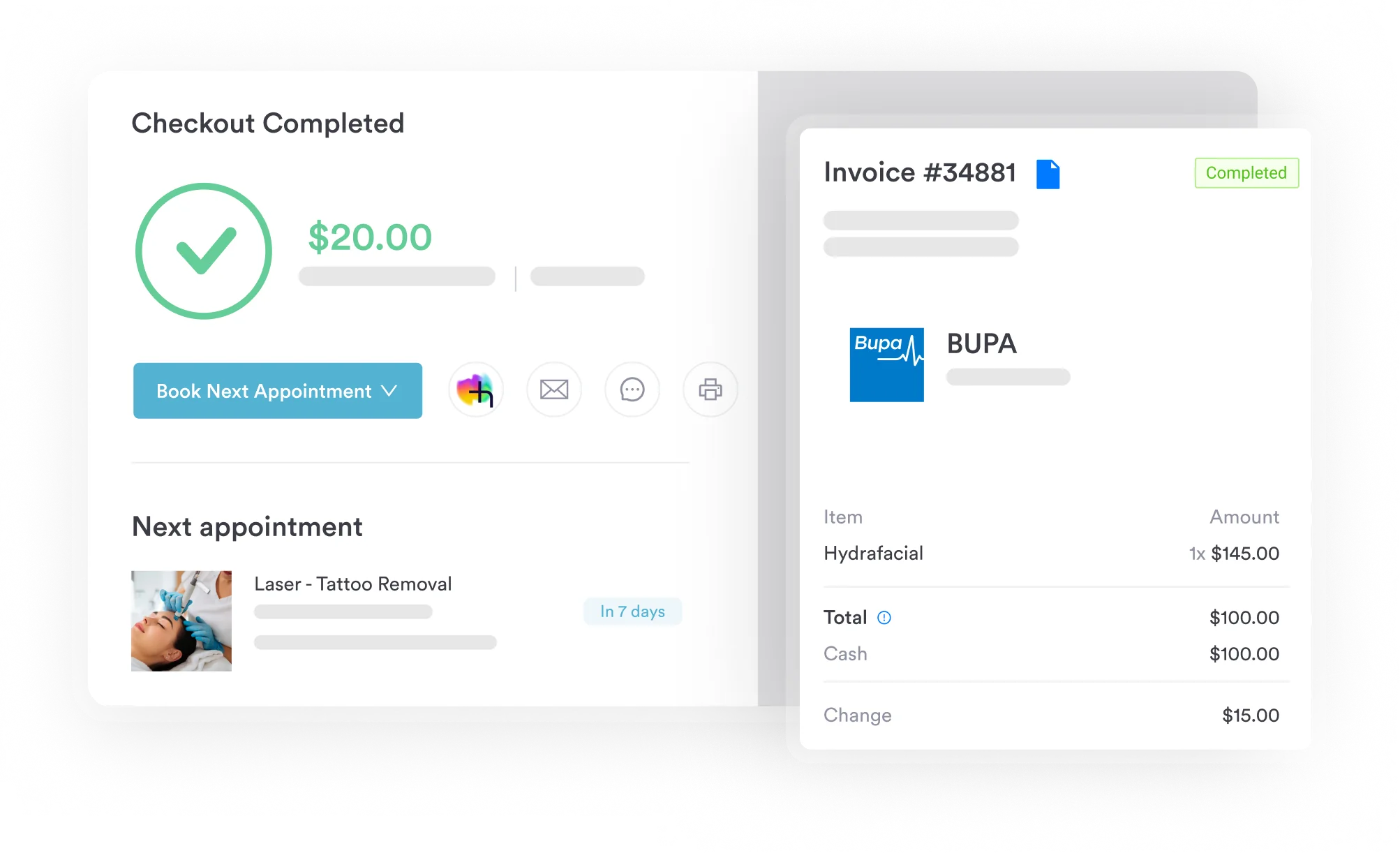
For teams handling S36.592A claims, that means less time re-keying claims and chasing payer responses. It also gives coders one place to check where each claim stands.

Pabau sends CMS-1500 claims through Claim.MD and tracks their status, so billing teams can follow S36.592A claims from submission to payment posting.

S36.592A rests on two facts in the record: an injury type other than contusion, laceration, or blast, and the descending colon as the site. Get either one wrong and the code is wrong, whatever the rest of the claim says. That is why the segment and injury-type checks belong at the start of coding, before an auditor finds the mismatch.
Trauma billing teams that build these checks, the 7th character review, and payer external cause rules into pre-submission work will stop most errors early. To see how Pabau supports claims submission and tracking for trauma and surgical practices, book a demo.

Need guidance on handling medical billing denials? Denial management in healthcare covers the full workflow for tracking, appealing, and preventing payer rejections.
Submitting electronic claims for the first time? What is medical billing explains the end-to-end process from code assignment through payment posting.
Want to understand the clearinghouse submission process? The 837 file format covers how ICD-10 and CPT data flows from the practice to the payer through an EDI transaction.
ICD-10 Code S36.592A is the billable code for other injury of the descending [left] colon, initial encounter. It applies when the note names an injury type other than contusion, laceration, or primary blast injury. The 7th character A means active treatment is ongoing.
Yes. S36.592A is a valid, billable, and fully specific ICD-10-CM code confirmed in the current FY tabular list. It needs the 7th character A to be complete. The base code S36.592 without a 7th character is not billable.
Both codes describe other injury of the colon, but the last digit names a different segment. S36.590A is the ascending [right] colon and S36.592A is the descending [left] colon. Neither one means unspecified injury, which is coded in S36.50x.
Use A (S36.592A) for any visit during which active treatment is still being delivered, including the initial ED visit, surgery, and inpatient ICU care. Switch to D (S36.592D) only after active treatment is complete and the patient is receiving routine healing care such as wound checks or ostomy follow-up.
Common triggers are a segment that does not match the note, a contusion or laceration coded as other injury, and the wrong 7th character. A missing external cause code can also cause a denial with payers that require one.
Common pairings are 44604 (colorrhaphy without colostomy), 44605 (colorrhaphy with colostomy), 44320 (colostomy), and 49000 (exploratory laparotomy). Verify each pairing against current NCCI edits before submission, as bundling rules change each year.



