HCPCS Code G0163: Skilled nursing observation and assessment
What is HCPCS Code G0163? HCPCS Code G0163 is a deleted Level II code for skille...

Last Updated: Oct 15, 2026
Billable Code Specific Code
S37.049D is the billable ICD-10-CM code for minor laceration of unspecified kidney, subsequent encounter.
It applies once the patient has moved past active treatment and into routine care while the injury heals. The 7th character D carries that distinction on its own.
Reach for S37.049A at a two-week wound check and the claim goes out with the wrong encounter phase.
Let Pabau's smart automation suggest the right codes, reduce claim denials, and keep your practice compliant—effortlessly.
Automate repetitive tasks and focus on what matters most—your patients.
Reduce coding errors and ensure compliance with the latest regulations.
Clean claims, fewer denials, and faster reimbursements.
Powerful insights and reporting to help your practice thrive.
HIPAA compliant SOC 2 certified GDPR-compliant Trusted by 4,000+ clinics worldwide

S37.049D is the billable ICD-10-CM code for minor laceration of unspecified kidney, subsequent encounter. It has been valid since ICD-10-CM took effect on October 1, 2015.
The 7th character D applies only during routine care while the kidney laceration heals, not at the initial injury visit.
A minor laceration maps clinically to AAST Grade II, not Grade I. Grade I is a contusion or subcapsular hematoma with no laceration at all.
Using S37.049A when the patient returns for follow-up care is one of the most common coding errors on renal trauma claims.
Practice management software like Pabau supports ICD-10 code selection inside clinical documentation, which cuts the keying errors that trigger denials.
ICD-10 Code S37.049D is a billable, specific ICD-10-CM diagnosis code. It describes a minor laceration of an unspecified kidney seen at a subsequent visit.
The code has been in the ICD-10-CM Tabular List since the US adopted ICD-10-CM on October 1, 2015. FY2026 is the current annual cycle of the code set, which CMS and NCHS maintain jointly. It is not the code’s origin date.
Because S37.049D is fully specified, it can be submitted directly on a claim without a placeholder or an additional qualifier. Coders do not need a secondary code to indicate the encounter type. The 7th character D does that job inside the code itself.
The official ICD-10-CM description for S37.049D is “Minor laceration of unspecified kidney, subsequent encounter.” Each word carries coding weight. “Minor laceration” separates this code from the major laceration codes in the S37.06 family. “Unspecified kidney” signals that laterality was not documented. “Subsequent encounter” is carried by the 7th character D.
The following approximate synonyms and applicable-to notes appear in the ICD-10-CM Tabular List. These alternate phrasings are acceptable in clinical documentation and will map correctly to S37.049D during coding review.
Documentation using any of these equivalent phrases, paired with the correct encounter type, supports ICD-10 Code S37.049D on the claim. Coders should still confirm laterality. If the operative or imaging report specifies the right or left kidney, move to S37.041D or S37.042D respectively.
The base code S37.049 requires a 7th character to be billable. The CDC/NCHS ICD-10-CM coding tool lists three valid options. Each one represents a distinct phase in the patient’s clinical course, and picking the wrong one is a coding error rather than a judgment call.
The ICD-10-CM Official Guidelines for Coding and Reporting define a subsequent encounter as a visit after the patient has received active or definitive treatment. The patient is now receiving routine care during recovery. So the number of visits does not decide the encounter type.
A patient could have three ED visits all coded with 7th character A, if active treatment is still ongoing at each one. The switch to D happens when the clinical picture shifts from treating the injury to monitoring it.
Sequela (S) follows a different logic. The original injury must be fully resolved, and the current condition must be a direct late effect of it.
Chronic kidney function changes from healed laceration scarring would use S37.049S, paired with a secondary code for the current condition. Do not use S while the laceration is still healing.
A renal finding at follow-up does not always belong to the injury chapter. Isolated proteinuria with a documented minor glomerular lesion is coded as N06.0, from the genitourinary chapter rather than Chapter 19.
Before assigning 7th character D, check the operative note or discharge summary from the initial encounter. Documentation showing the patient still admitted for observation, or under active nephrology management, may still point to the initial encounter code. The transition to D is clinical, not calendar-based.
S37.049D sits inside a structured ICD-10-CM hierarchy. Knowing the parent codes helps you navigate laterality decisions and pick an adjacent code when the clinical picture changes.
S37.049D belongs to a family of kidney laceration codes split by severity and laterality. The right sibling code depends on what the record states about injury grade and which kidney is affected. The AAPC ICD-10-CM code lookup lists the full S37 family with official descriptions.
Documentation discipline at the initial visit makes severity and laterality straightforward at every subsequent encounter. It also keeps the claim off the ambiguous-code review pile.
The American Association for the Surgery of Trauma (AAST) Organ Injury Severity Scale is the framework surgeons and emergency physicians use to grade renal trauma. ICD-10-CM does not officially map to AAST grades.
The correlation still helps you check that the code you picked matches the clinical record. Use it as supporting context, never as a rule that overrides the Tabular List.
A Grade II injury is the closest clinical match to what ICD-10-CM calls a minor laceration. Grade I carries no laceration at all, so a Grade I record does not support S37.049D. When imaging describes a cortical laceration of 1 cm or less, with no urinary extravasation, S37.049D is the right subsequent encounter code.
If the report uses Grade III language, check for collecting system involvement before you default to the minor laceration family.
The ICD-9-CM equivalent for S37.049D is 866.02, injury to kidney, without mention of open wound into cavity, laceration. In plain terms, that is a closed kidney laceration. The crosswalk is approximate rather than a precise one-to-one mapping.
ICD-9-CM had less granular laterality and encounter-phase specificity than ICD-10-CM, so the conversion loses some clinical detail. The crosswalk is useful for legacy record lookups, research pulls against older Medicare claims data, and payer policies that reference earlier coding periods.
For forward mapping from ICD-9 to ICD-10, 866.02 maps to several S37 codes depending on severity and laterality. Always check the clinical record rather than relying on the crosswalk alone.
The ICD-10-CM Official Guidelines for Coding and Reporting, Chapter 19, carry the authoritative rules for applying 7th characters to trauma codes. Review them each year, since the phrasing and the examples change with every fiscal year release.
Key documentation elements required to support S37.049D on a claim:
Those two tests run in order. Encounter phase settles the 7th character, and laterality settles the digit in front of it.
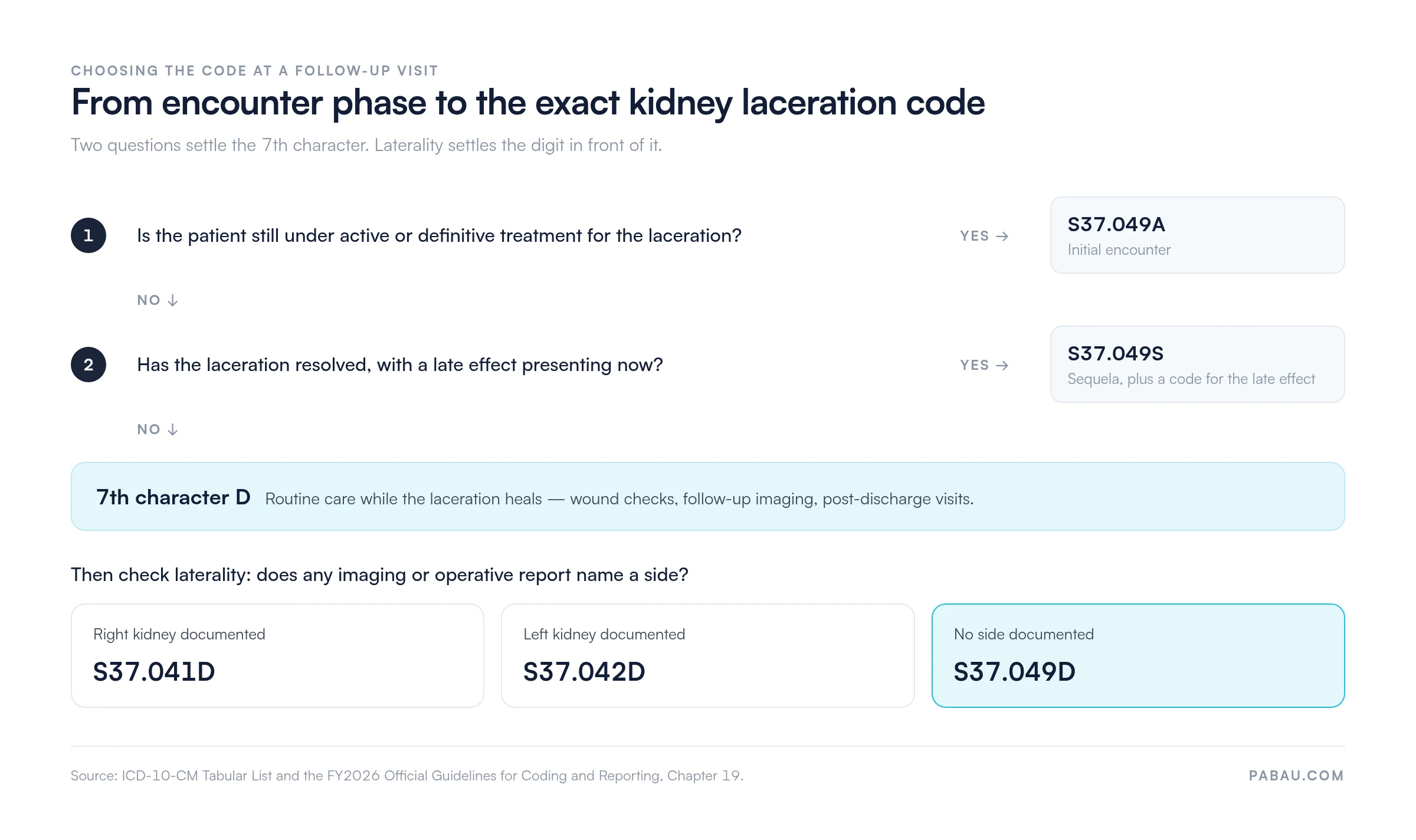
Subsequent encounter (D) and sequela (S) are not interchangeable, and misapplying them is a common audit finding. The table below sets out when each applies to kidney laceration coding.
S37.049D is accepted for claims submission under HIPAA-compliant electronic transactions. On a CMS-1500 or 837P claim, it has to be linked to a procedure code for the service performed. That is usually an evaluation and management (E/M) code.
Getting both halves right on the first pass is what makes a clean claim submission. A subsequent encounter code paired with a mismatched service type will fail a payer edit.
Practices on electronic clearinghouse submissions can validate S37.049D before final submission. Electronic remittance advice (ERA) then returns the payer’s adjudication result, including any denial reason codes.
Most billing errors on S37.049D fall into three categories. Fixing each one at the point of documentation prevents the rework downstream. Reviewing denial codes after each remittance cycle shows which category your practice hits most.
Payers may request records to validate subsequent encounter coding, particularly when the visit volume for an injury looks inconsistent with typical healing timelines. The note has to support the code on its own, without relying on the coder’s knowledge of the case.
A practice without a coding crosscheck relies on the coder remembering that this patient was here two weeks ago. The initial-encounter code sits in the chart, so it gets copied forward, and the claim goes out with an A where it needed a D.
Practice management software like Pabau puts the diagnosis code inside the clinical note. The visit type and the previous encounter for the same injury sit right beside it. The coder can see that this is a wound check before they pick the 7th character.

Because the invoice comes off the same record, nobody re-keys the code on the way to the clearinghouse. Pabau also connects to the Claim.MD clearinghouse for US claims, which supports eligibility checks and 837P submission.
A practice that sees renal trauma follow-ups regularly needs claims software for coders, not a reminder taped to a monitor. Every Pabau subscription includes it, so there is no tier to upgrade to.

Pabau supports ICD-10 diagnosis code selection within clinical documentation, helping your team reduce coding errors and submit cleaner claims. See how it works in a live demo.

The injury does not change between the ED visit and the wound check two weeks later. The encounter phase does, and that is the only thing S37.049D is there to record.
So build the check into the visit, not into the coder’s memory. Any injury code on a follow-up appointment gets its 7th character confirmed against the previous encounter before the claim leaves. That one step removes the most common renal trauma denial from your remittance file.
Book a demo to see how Pabau ties diagnosis coding to the clinical note, so follow-up claims go out with the right 7th character.

Need to work the denials this code generates? Denial codes in medical billing explains the remittance advice codes behind a rejected trauma claim.
Want a process for chasing rejections? Denial management in healthcare sets out how to triage, appeal, and prevent repeat denials.
Not sure how a claim reaches the payer? Medical claims clearinghouse walks the 837P pathway from the practice through to adjudication.
Reading a remittance file for the first time? Electronic remittance advice explains what each adjustment code on an ERA is telling you.
S37.049D is a billable ICD-10-CM diagnosis code for minor laceration of unspecified kidney, subsequent encounter. It applies when a patient with a previously diagnosed minor kidney laceration receives routine follow-up care during the healing phase. A wound check or a repeat imaging visit both qualify.
Yes. S37.049D is a specific, billable ICD-10-CM code, and it appears in the current FY2026 Tabular List. It has been valid since ICD-10-CM took effect on October 1, 2015, and needs no additional qualifier on a claim.
S37.049A applies at the initial encounter when the patient is receiving active treatment for the kidney laceration. S37.049D applies at subsequent visits when the patient is receiving routine care during the healing phase. The transition from A to D is determined by the clinical encounter type, not by the number of visits or elapsed time.
The approximate ICD-9-CM crosswalk for S37.049D is 866.02, injury to kidney, without mention of open wound into cavity, laceration. That describes a closed kidney laceration. The equivalence is approximate, because ICD-9-CM did not carry laterality or encounter phase at the same level of detail.
Subsequent encounter (7th character D) is used while the original injury is still healing and the patient is receiving routine care. Sequela (7th character S) is used after the acute phase has fully resolved. It covers a late effect caused by the original injury, such as chronic pain from renal scarring.
A minor kidney laceration corresponds clinically to AAST Grade II, which is a laceration 1 cm deep or less with no urinary extravasation. AAST Grade I has no laceration at all, only a contusion or a nonexpanding subcapsular hematoma. This is a clinical correlation, since ICD-10-CM does not adopt AAST grade terminology.