ICD-10 Code T31.77: Burns involving 70-79% of body surface
ICD-10 code T31.77: Quick reference and code details ICD-10 code T31.77 is the b...

Last Updated: Nov 5, 2026
Billable Code Specific Code
S37.099A is the billable ICD-10-CM code for other injury of unspecified kidney, initial encounter. It covers a documented kidney injury that is neither a contusion nor a laceration, when the record does not say which kidney was hurt.
The code is valid in the FY2027 ICD-10-CM code set, effective October 1, 2026. If imaging or the operative note names a side, S37.091A (right) or S37.092A (left) applies instead.
Let Pabau's smart automation suggest the right codes, reduce claim denials, and keep your practice compliant—effortlessly.
Automate repetitive tasks and focus on what matters most—your patients.
Reduce coding errors and ensure compliance with the latest regulations.
Clean claims, fewer denials, and faster reimbursements.
Powerful insights and reporting to help your practice thrive.
HIPAA compliant SOC 2 certified GDPR-compliant Trusted by 4,000+ clinics worldwide

S37.099A is the billable ICD-10-CM code for other injury of unspecified kidney, initial encounter. The kidney is confirmed, and only the side is missing.
Use S37.091A for the right kidney and S37.092A for the left. S37.099A fits only when the record does not state which kidney was injured.
“Other” means a documented kidney injury that is not a contusion or a laceration. Those injury types have their own subcodes, S37.01- to S37.06-.
When the injured organ is not identified at all, the code is S37.99XA, not S37.099A.
The 7th character A covers active treatment. Pair the code with an external cause code to describe how the injury happened.
ICD-10 Code S37.099A is the billable code for other injury of unspecified kidney, initial encounter. It applies when the record confirms a kidney injury that is neither a contusion nor a laceration, but does not name the side.
The code sits in chapter 19 of ICD-10-CM, which covers injuries, poisonings, and certain other consequences of external causes. The table below gives the key facts to check before claim submission.
S37.099A means a confirmed kidney injury of an “other” type, on a side the record does not name, at the initial encounter. Each character narrows the diagnosis one step.
So the descriptor “other injury of unspecified kidney” is precise about two things. The injured organ is the kidney, and the injury is a documented type outside contusion and laceration. The one open question is laterality, because the record does not say whether the right or left kidney was hurt.
“Other injury” and “unspecified injury” are not interchangeable in ICD-10-CM. Unspecified injury of kidney (S37.00-) applies when the record names no injury type at all. “Other” means a specific injury type is documented, but it has no dedicated kidney subcode.
Per ICD-10-CM Official Guidelines Section I.C.19.a, the 7th character on an injury code defines the phase of care, not the severity. A wrong 7th character is a frequent denial trigger on trauma claims.
A patient transferred to another facility during active treatment keeps A as the 7th character. It shifts to D once active treatment ends and the patient moves into routine monitoring or recovery care.
S37.099A applies when the record confirms a kidney injury of an “other” type but does not say which kidney. These presentations map correctly to the code.
“Unspecified” here can be an accurate picture of the record at the time of coding. Still, laterality is usually knowable for a kidney injury, because CT imaging shows which side is affected. If the imaging report or operative note names a side, use S37.091A or S37.092A instead.
Code each encounter from the documentation available for that encounter. If a later workup names the side, the next encounter takes the lateral code. Do not retroactively change a correctly coded initial claim.
The ICD-10-CM tabular list carries instructional notes at the S37 category level that affect how S37.099A is assigned and sequenced.
Within S37.0, one character changes either the injury type or the side. One step up, S37.99XA covers an injury where the organ itself is unknown. The table sets the six codes side by side.
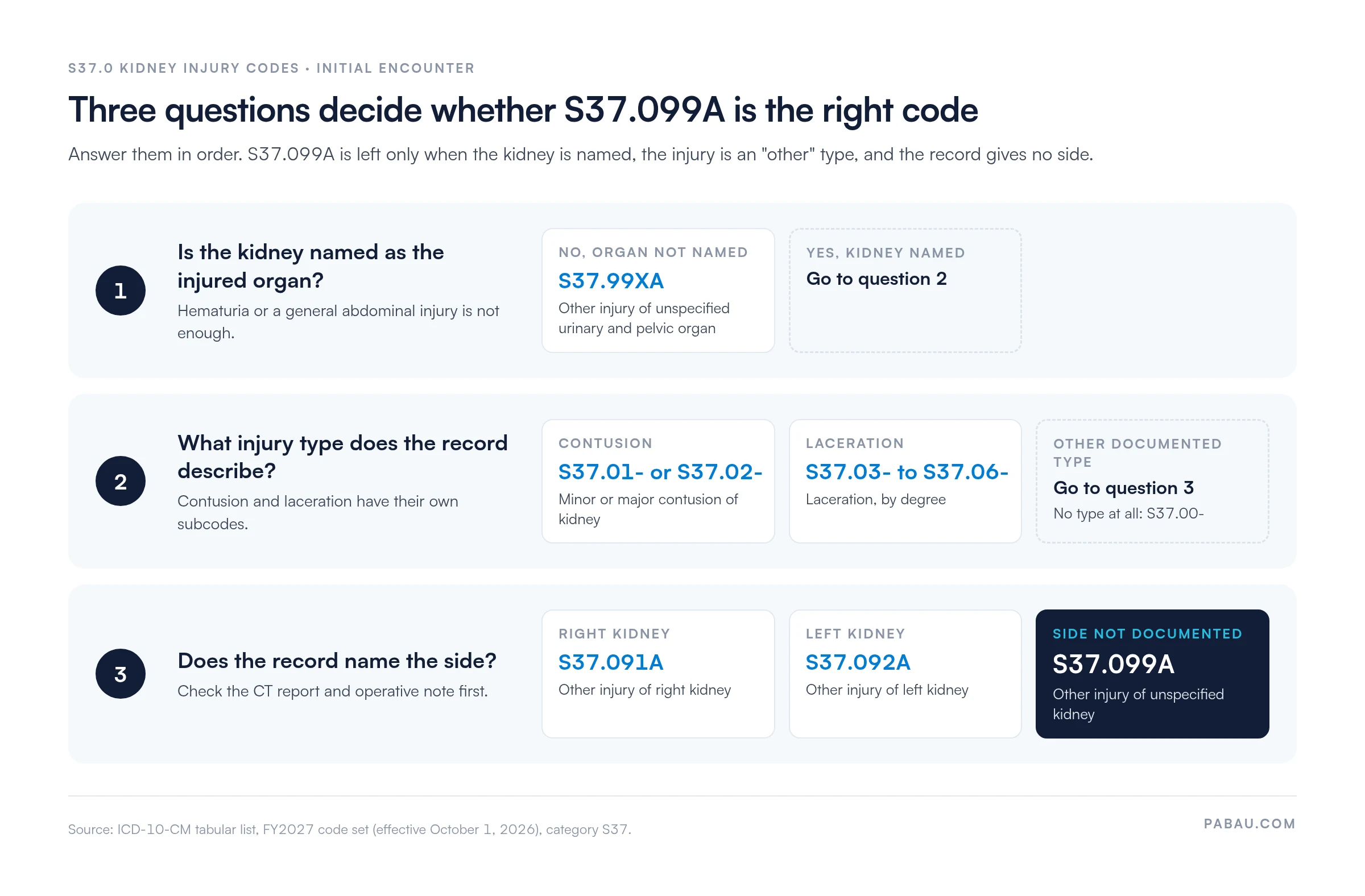
Work through three questions in order. First, is the kidney named as the injured organ? If not, look at S37.99XA or the other S37 subcategories. Second, is the injury a contusion or laceration? If so, a more specific kidney subcode applies.
Third, does the record name the side? If yes, use S37.091A or S37.092A. S37.099A is correct only when the kidney is confirmed, the injury type is “other”, and the side is missing. The chart below walks the same three questions in order.
The ICD-10-CM Official Guidelines encourage pairing injury codes with external cause codes from the V, W, X, and Y chapters.
There is no national mandate, but many payers and state reporting programs expect them on trauma claims. Building external cause coding into trauma charge capture is part of sound revenue cycle management.
Under UHDDS guidelines for inpatient coding, the principal diagnosis is the condition found after study to be chiefly responsible for the admission.
When the kidney injury is the reason for admission, S37.099A sequences first. External cause codes and any associated injuries, such as an open wound or rib fracture, follow as additional diagnoses.
For outpatient encounters, list first the injury that drove the visit. If the patient presents for evaluation of the kidney injury, S37.099A goes first. When the kidney injury is secondary to the main reason for the encounter, it follows as an additional code.
An external cause code is never the principal or first-listed diagnosis.
Documentation must support three things: a kidney injury, an “other” injury type, and the missing side. A clean claim submission for S37.099A depends on these elements being in the record before the claim goes out.
Meeting medical billing compliance requirements means keeping imaging reports, operative notes, and physician attestation in the chart before any S37.099A claim is submitted.
Before you submit S37.099A, check the CT report for a side. Kidney imaging almost always names the right or left kidney. If it does, or a physician query confirms the side, code S37.091A or S37.092A instead. A lateral code gives payers a clearer clinical picture and holds up better in an audit.
Kidney trauma claims draw more scrutiny than routine outpatient claims, and unspecified laterality adds to it. These are the main denial triggers for S37.099A, each paired with a prevention step.
Proactive denial management workflows catch these errors before submission rather than at appeal. For the meaning of each denial code, our denial codes guide covers the CARC and RARC explanations most clearinghouses return.
Payers judge medical necessity on the pairing of a diagnosis code with a procedure code. These CPT codes often appear alongside a kidney injury code in trauma encounters.
Payers audit CPT-to-ICD linkage on trauma claims, so document the clinical reason that ties each procedure to the kidney injury. A linked procedure also tends to undercut “unspecified”. The CT report billed under 74177 usually names the injured side.
An embolization report under 37244 names the renal vessel treated, and an operative note for kidney surgery almost always names the side. Recheck S37.099A against those reports before you submit.
An S37.099A claim usually goes wrong when the chart and the claim form are handled in different places. The imaging report names a side, but the claim still carries the unspecified code. Or the external cause code never makes it across.
Pabau, the practice management platform we build, keeps the clinical record and the claim in one system. Your billing team codes straight from the ED note, imaging report, and operative note, with no re-keyed summary in between. Pabau’s claims management software handles submission, eligibility checks, claim status, and remittance posting in the same place.
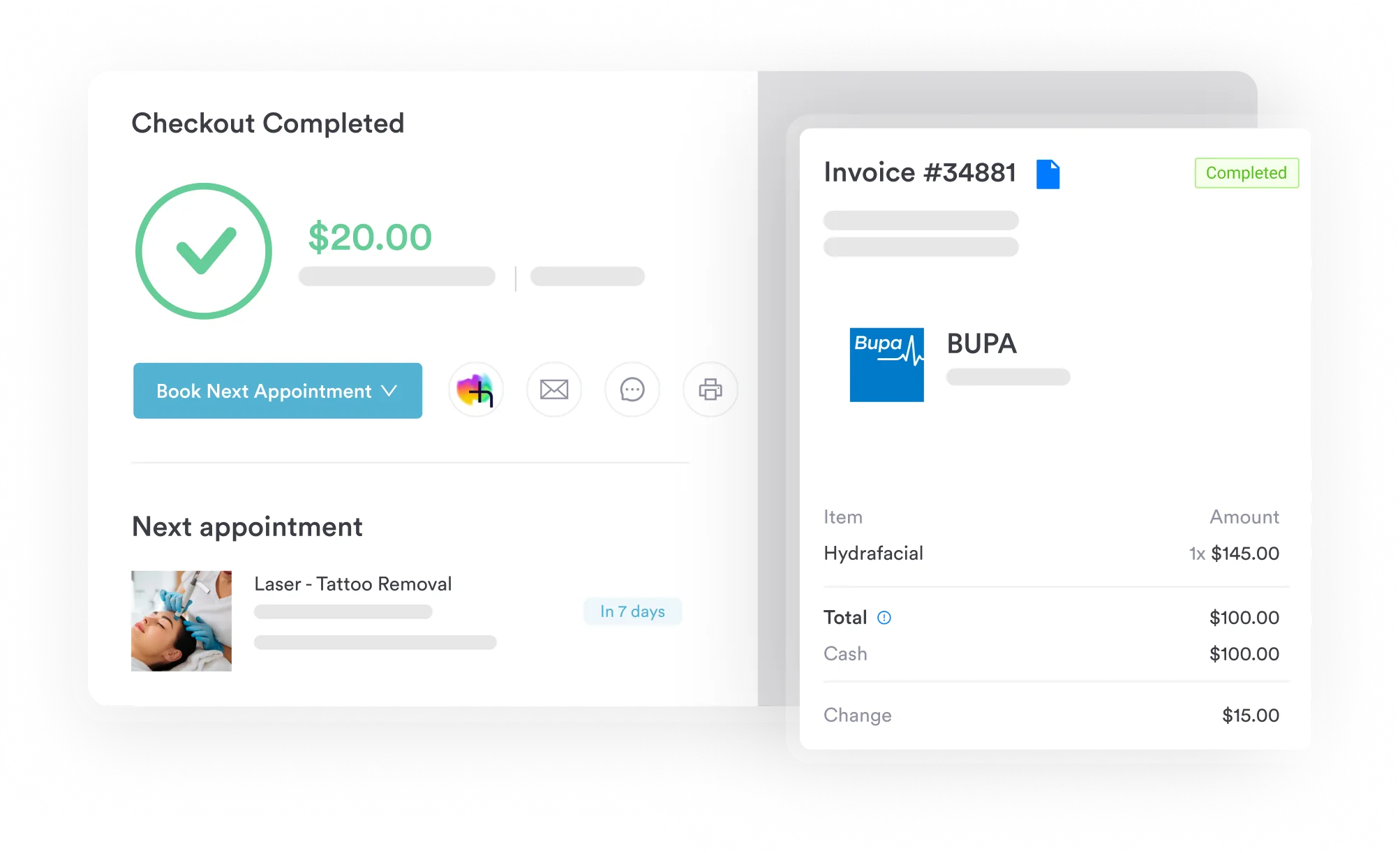
Claims route out through the Claim.MD clearinghouse, and status updates and electronic remittance advice come back against the same patient record. A rejection for a missing side or external cause code shows up the day the payer returns it, while the chart is still fresh.

Pabau keeps the clinical record and the claim in one system and submits claims through the Claim.MD clearinghouse. Eligibility checks, claim status, and remittances come back against the same patient record.

S37.099A confirms two facts and leaves one open. The kidney was injured, and the injury was neither a contusion nor a laceration. Which kidney stays unrecorded, and that is acceptable only while no imaging report or operative note names a side.
For kidney trauma, that window is usually short, because CT and operative reports name the side. Check the chart for a side before every S37.099A claim goes out, and query the physician when the side is clinically clear but undocumented. Book a demo to see how Pabau puts the imaging report and the claim side by side for your billing team.

Want to understand the clearinghouse layer? Medical claims clearinghouse guide explains how claims route from practice to payer and where validation failures occur.
Looking to strengthen your overall billing compliance posture? What is revenue cycle management maps the full cycle from patient encounter to payment posting.
Confirmed a right-kidney contusion instead? ICD-10 code S37.011A covers a minor contusion of the right kidney at the initial encounter.
Coding a kidney laceration with no side recorded? ICD-10 code S37.049D covers a minor laceration of an unspecified kidney at a subsequent encounter.
ICD-10 Code S37.099A means “other injury of unspecified kidney, initial encounter.” It covers a documented kidney injury that is neither a contusion nor a laceration, where the record does not say which kidney. It sits in category S37 (Injury of urinary and pelvic organs) in chapter 19 of ICD-10-CM.
Yes. S37.099A is a valid, billable 7-character ICD-10-CM code. Use it on claims for the initial encounter when a kidney injury of an “other” type is confirmed but the side is not documented.
S37.091A is other injury of the right kidney, so the side is confirmed. S37.099A is the same injury type when the record does not say which kidney. If imaging or the operative note names the right kidney, use S37.091A. For the left kidney, use S37.092A.
S37.099A confirms the organ is the kidney and leaves only the side open. S37.99XA is other injury of unspecified urinary and pelvic organ, used when the record does not identify the injured organ at all. If the kidney is named, S37.99XA is the wrong code.
Use A while the patient receives active treatment, such as an ED visit, surgery, or an admission for the acute injury. Switch to D for follow-up visits once active treatment ends. Use S for sequela, a late effect such as post-traumatic hypertension after a kidney injury.
Pair S37.099A with a V, W, X, or Y code that describes the mechanism of injury. Examples include a V code for a motor vehicle collision, a W code for a fall, or an assault code. Many payers expect an external cause code on trauma claims.
The most common triggers are an unspecified side when imaging names one, a missing external cause code, and character A on a follow-up visit. Others include a contusion or laceration coded as “other” and a weak link between the CPT code and the kidney injury. A pre-submission check prevents most of them.