

ICD-10 Code S42.444P: Medial epicondyle fracture, right humerus
ICD-10 Code S42.444P: full descriptor and code validity ICD-10 Code S42.444P car...

Last Updated: Oct 13, 2026
Billable Code Specific Code
S34.21XD is the billable ICD-10-CM code for injury of nerve root of lumbar spine, subsequent encounter.
Two things trip coders up here. The first is the cauda equina, which carries its own code, S34.3XXD. The second is the 7th character, where a wrong letter or a missing placeholder X sends the claim straight back.
Lumbar nerve root injuries are routine work for practices running physical therapy EMR workflows. They are also documentation-sensitive, so the code has to match what the note actually says.
Let Pabau's smart automation suggest the right codes, reduce claim denials, and keep your practice compliant—effortlessly.
Automate repetitive tasks and focus on what matters most—your patients.
Reduce coding errors and ensure compliance with the latest regulations.
Clean claims, fewer denials, and faster reimbursements.
Powerful insights and reporting to help your practice thrive.
HIPAA compliant SOC 2 certified GDPR-compliant Trusted by 4,000+ clinics worldwide

S34.21XD is the billable ICD-10-CM code for injury of a nerve root of the lumbar spine, subsequent encounter.
S34.21XD is not the cauda equina code. Traumatic injury of the cauda equina has its own code, S34.3XXD.
The 7th character D covers routine care during healing or recovery, after the initial encounter has already been billed.
The placeholder X has to fill the 6th position, so S34.21D is an invalid code that payers reject.
Practice management software like Pabau keeps every encounter note on one record and validates insurer details before claims go out.
The table below has the facts at a glance.
Each position in an ICD-10-CM code carries a specific meaning, and S34.21XD follows the standard injury code structure. Read it position by position and the ambiguity disappears, whether you are picking the code or auditing it later.
The placeholder X in the 6th position is not optional. On this point, the CMS ICD-10-CM coding guidelines leave no room to interpret. A code that needs a 7th character, but has fewer than six characters before it, takes placeholder X in every empty position.
Omitting it produces an invalid code that gets rejected at submission. The same rule runs through the injury and external cause chapters. A code like W25.XXXD carries three placeholders before its 7th character.
The lumbar nerve roots are the five pairs of spinal nerves, L1 through L5, that leave the spinal canal at each lumbar level.
Each root exits through its own intervertebral foramen. Because the spinal cord itself ends around L1 to L2, these roots travel some distance inside the canal before they exit.
Documentation decides between three neighboring code families. A named lumbar nerve root injury codes to S34.21X. Injury described as involving the cauda equina, the bundle of roots below the end of the cord, codes to S34.3XX instead. Damage to the lumbar spinal cord itself codes to the S34.0 or S34.1 families.
S34.21XD is the code you reach for once the initial encounter is behind you. The patient has been assessed and treated for the acute injury, and now returns for routine care while the nerve root heals.
Physical therapy sessions, rehabilitation visits, follow-up imaging reviews, and post-surgical checks all belong in that phase.
The same code carries the injury forward through a long recovery. Lumbar nerve root injuries can take months to settle, and each visit still describes the same injury episode.
Every injury code with a 7th character works this way, from a puncture wound like puncture wound like S21.439D to a spinal fracture. Only once the acute injury has resolved and a residual condition remains does the sequela character take over.
Knowing which level you are coding at helps you apply the right specificity. It also shows which parent codes are headers rather than billable options.
The WHO ICD-10 classification provides the international framework, and the US ICD-10-CM system extends it with additional clinical detail.
Only the 7th character variants are billable: S34.21XA, S34.21XD, and S34.21XS. A claim submitted as S34.21 or S34.21X will be rejected.
Confirm the encounter type before you pick the code, and check billability against the CDC/NCHS ICD-10-CM web tool for the current fiscal year.
The S34 block also carries a code also instruction that is easy to skip. Report any associated vertebral fracture (S22.0- or S32.0-) alongside the nerve root injury code.
The same applies to an open wound of the abdomen, lower back and pelvis (S31.-), and to transient paralysis (R29.5). Fracture-related nerve root injuries almost always need that second code.
The 7th character is the biggest decision on an S34.21X claim. Pick the wrong one and payers flag the claim for review.
Each option describes a different clinical moment, and the ICD-10-CM Official Guidelines for Coding and Reporting set out when each applies.
The line between D (subsequent encounter) and S (sequela) is where most coders slip. Both apply after the initial encounter, but they describe different clinical situations.
When sequela coding applies, code the residual condition first, then add S34.21XS as a secondary code to show the causal injury. That sequencing requirement sits in the ICD-10-CM Official Guidelines, Section I.C.19.
A warehouse worker falls from a ladder and lands on his lower back. Imaging in the emergency department shows an L5 root injury from a burst fracture. That first visit is S34.21XA, with the fracture code reported alongside it.
Six weeks later he starts outpatient physical therapy. Every one of those visits is S34.21XD, because the same injury is still healing. The therapist names the root and the side in each note.
A year on, the fracture has healed but the foot drop has not. Now the residual condition leads the claim, and S34.21XS follows it as the cause. Same patient, same injury, three different codes.
S34.21XD sits inside a tight family of lumbar and sacral nerve codes, and several of its neighbors look almost identical on a claim form.
Sympathetic nerve injuries such as S34.5XXA sit in the same block. Billing teams need to know each one well enough to rule it out.
The cauda equina codes deserve extra attention, because they cause the single most common mix-up here. S34.3XXD covers injury to the cauda equina as a structure, and it has no anatomical subdivision before the 7th character.
S34.21XD is narrower and applies when the record names a lumbar nerve root. The AAPC Codify ICD-10-CM lookup is a quick way to confirm either descriptor before you submit.
The S34 block also has a distal limit. Beyond the lumbosacral plexus the nerve continues as the sciatic trunk, so a traumatic right-leg injury there takes S74.01XA at the initial encounter.
Etiology matters just as much as anatomy. When a lumbar nerve root is compressed by degenerative disease rather than trauma, the claim belongs on M54.16 rather than anywhere in S34. Reserve the S34 family for documented traumatic injury.
Pull every S34.21X claim from the last quarter and read the clinical note behind it. If the note describes the cauda equina rather than a named lumbar nerve root, that claim belongs on S34.3XX. This one crosswalk check catches the most expensive error in the S34 family, and it usually turns up a batch of claims at once.
S34.21XD is a billable code, but payer acceptance depends on what the clinical documentation supports. Rehabilitation, orthopedic, and sports medicine teams all bill it, and reviewers ask the same questions of each.
The subsequent encounter designation also sets expectations that an initial encounter claim does not. Here is what a reviewer looks for, and what tends to go missing.

Medicare, Medicaid, and commercial payers each add coverage criteria beyond ICD-10-CM validity. Medicare covers outpatient therapy when the record shows the service is reasonable and necessary, with clear, measurable treatment goals.
Skilled maintenance therapy can qualify too, so the note should justify skilled care rather than promise steady improvement. Check the Local Coverage Determination for your Medicare Administrative Contractor, known as your MAC, before billing rehabilitation under S34.21XD.
Every visit in the injury episode belongs in one chart. When initial, subsequent, and sequela visits are easy to tell apart, an audit response takes minutes instead of days. The CPT codes and unit rules that pair with this diagnosis sit in physical therapy billing.
Lumbar nerve root injury codes produce a predictable set of errors, and a handful of patterns account for most of the rework. Each one below has a fix that takes seconds at the point of coding.
Five questions catch almost every S34.21XD rejection, and none of them take longer than a glance at the note:
The fourth question is the one that catches teams out. If the initial encounter happened at another facility, record the transfer of care and file the notes you received.
Payers cross-reference encounter histories, and a subsequent encounter claim with no traceable start draws an automatic review flag.
The coding decision on an S34.21XD claim takes seconds. Producing the encounter history behind it, months later and under review, is the part that costs practices time.
Practice management software like Pabau keeps every visit from one injury episode on a single patient record. The initial encounter note, each therapy note after it, and any imaging attached to them stay together. An audit request turns into a few clicks instead of a file hunt.
Pabau’s claims management software also checks insurer details before the claim goes out, so a clean code is not undone by a stale policy number. Claims that do come back are tracked on the same record, so the rebill starts from the full history.
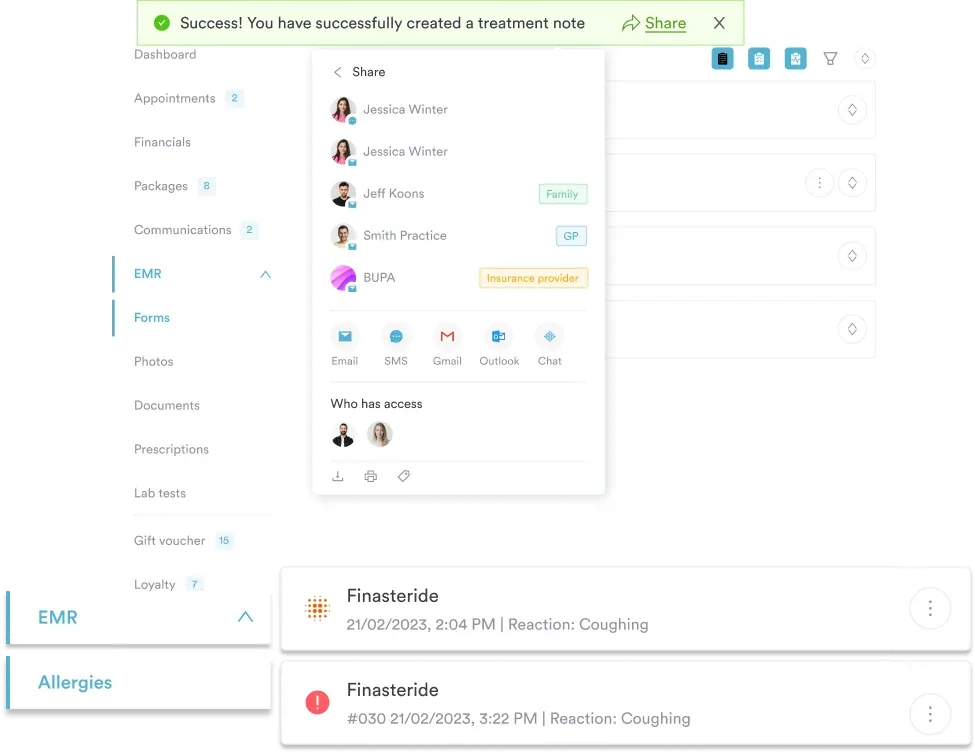

Pabau gives rehabilitation and spine practices one record per patient, so every encounter note sits with the claim it supports. Insurer details are checked before the claim is submitted, which keeps clean coding from being undone by bad data.

Most S34.21XD denials come down to two decisions. The first is whether the record describes a lumbar nerve root or the cauda equina, which sends the claim to S34.3XXD instead. The second is which 7th character the encounter calls for. Get both right, and the placeholder X is the only mechanical detail left to watch. Claim accuracy is cheaper to build at entry than to repair in an appeal. A coding error surfaces as a cash flow problem weeks later, which is why the healthcare revenue cycle is measured end to end. Claim accuracy is cheaper to build at entry than to repair in an appeal. A coding error surfaces as a cash flow problem weeks later, which is why the healthcare revenue cycle is measured end to end.
Set the pattern once and it holds for the whole episode. The coder stops re-deciding the same question at every visit, and the practice stops absorbing rework it was never paid for. Book a demo to see how Pabau keeps injury records and claims in one place.

Billing anesthesia for a lower leg procedure? CPT code 01522 covers anesthesia billing for a venous thrombectomy performed below the knee.
Is the injury being managed surgically? 20938 sets out the billing rules for structural autograft in spine surgery.
Need a worked sequela example? S62.032S shows how the S character works once an injury has healed.
Seeing 7th characters beyond A, D and S? S52.262K explains the nonunion characters that fracture codes add.
Billing anesthesia with a units-based formula? CPT Code 01620 explains the units-based formula behind anesthesia billing for shoulder and axilla procedures.
Not as a national requirement. ICD-10-CM does not mandate Chapter 20 external cause codes, though many states and payers ask for them. If you report one, match its 7th character to the encounter, so a follow-up visit takes D.
No. Aftercare Z codes are not used for injuries. The official guidelines tell you to report the injury code with the 7th character for a subsequent encounter, which is exactly what S34.21XD does.
No. D applies for as long as the patient gets routine care while the injury heals, whether that runs six weeks or a year. The switch to S is triggered by a healed injury with a lasting problem, not by the calendar.
Yes. The injury that is the focus of treatment is sequenced first, so a therapy visit for the nerve root injury leads with S34.21XD. Report any associated fracture or open wound as an additional code.
You still bill S34.21XD. The D character reflects where the patient is in the injury episode, not who treated it first. Record the transfer of care and file the notes you received, so the claim has a traceable start.




