

ICD-10 Code S53.013D: Anterior subluxation of unspecified radial head
ICD-10 Code S53.013D: Quick reference summary Use the table below as your first ...

Last Updated: Nov 6, 2026
Billable Code Specific Code
S34.115S is the billable ICD-10-CM code for complete lesion of L5 level of lumbar spinal cord, sequela. It applies when a visit treats a late effect of that injury, such as neurogenic bladder, after the acute phase has ended. The condition treated is coded first, and S34.115S follows as its cause.
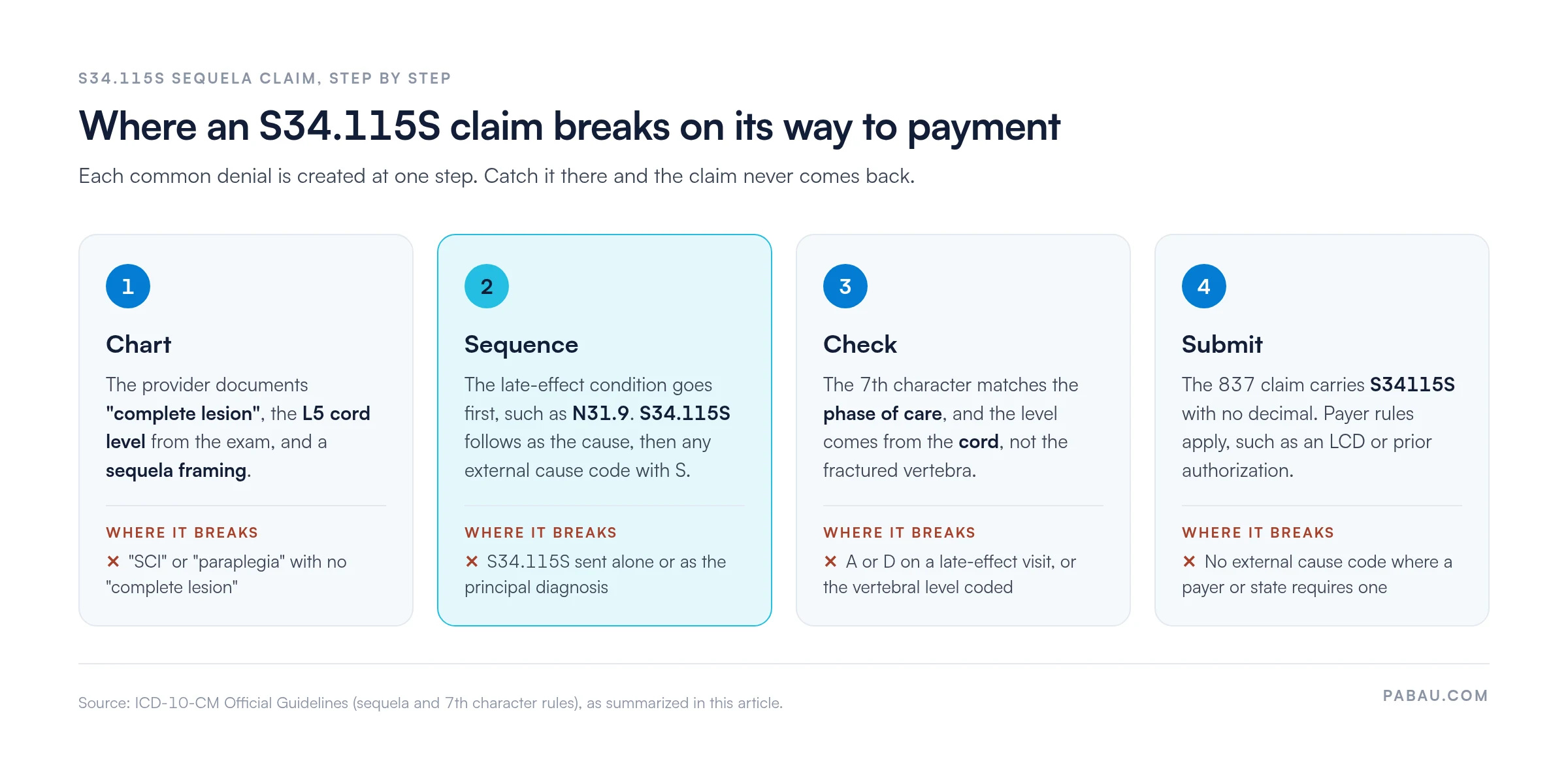
The 7th character S marks care for a late effect, while D marks routine care during healing. Using D on a late-effect visit is a common cause of denials.
Let Pabau's smart automation suggest the right codes, reduce claim denials, and keep your practice compliant—effortlessly.
Automate repetitive tasks and focus on what matters most—your patients.
Reduce coding errors and ensure compliance with the latest regulations.
Clean claims, fewer denials, and faster reimbursements.
Powerful insights and reporting to help your practice thrive.
HIPAA compliant SOC 2 certified GDPR-compliant Trusted by 4,000+ clinics worldwide

S34.115S reports a complete lesion of the L5 lumbar cord segment at a sequela visit, when the condition treated stems from the old injury.
L5 here is a spinal cord segment, not the fifth lumbar vertebra. Take the level from the neurological exam, not from the fracture.
Sequence the late-effect condition first, such as neurogenic bladder, and report S34.115S after it as the cause.
The record needs the words “complete lesion”, the L5 level and a sequela framing. ASIA grade A and imaging make it easier to defend.
Pabau, the practice management platform we build, pre-fills claims from the invoice and submits them through Claim.MD in the US. Your coder still chooses and sequences the codes.
ICD-10 code S34.115S is the billable ICD-10-CM code for a complete lesion of the L5 level of the lumbar spinal cord, sequela. Use it when a patient is treated for a late effect of that injury after the acute phase has ended. The condition being treated goes first on the claim, and S34.115S follows as its cause.
It sits in Chapter 19 of the ICD-10-CM Tabular List, which covers injury, poisoning and certain other consequences of external causes. The Centers for Medicare & Medicaid Services (CMS) and the National Center for Health Statistics (NCHS) maintain the code set.
If the injury itself is still in active treatment or healing, a different 7th character applies. That choice shapes the rest of the medical billing process, from claim to remittance.
Read the code left to right and it moves from chapter to cord segment to phase of care. Misreading the subcategory digits or the 7th character gives you a valid code for the wrong level or the wrong phase of care.
The decimal point is used in clinical documentation and whenever the code is displayed, as in S34.115S. Electronic claims in the 837 format omit it, so the code is transmitted as S34115S. The CDC/NCHS ICD-10-CM browser lists the code in its displayed form.
A complete lesion means no motor or sensory function below the injured cord segment, with no sacral sparing.
Clinically, that matches ASIA Impairment Scale (AIS) grade A, although the ICD-10-CM code does not name the ASIA scale. The provider must document “complete lesion” for the code to be supported, so query the provider rather than infer it from an ASIA grade.
L5 in this code names a spinal cord segment, not the fifth lumbar vertebra. The tabular note for S34.0 and S34.1 says these codes refer to the cord level, not the bone level. The L1 to L5 cord segments sit behind roughly the T9 to T12 vertebrae. A thoracolumbar fracture can therefore produce an L5 cord lesion. Cord segments above L1 are coded from category S24 instead, such as S24.114D for a complete T11-T12 lesion at a subsequent encounter.
A complete lesion at L5 spares the segments above it, so hip flexion and knee extension (L2 to L4) are usually preserved. Ankle plantar flexion (S1) is lost, and great toe extension (L5) is weak or absent. Loss of the S2 to S4 segments affects bladder, bowel and sexual function.
The result is partial paralysis of both legs rather than total lower-limb paralysis. Patients often keep enough hip and knee control to stand or walk with ankle-foot orthoses.
Document more than the code level. Payers reviewing S34.115S rehabilitation claims look for three things in the chart. They want the phrase ‘complete lesion’, an ASIA classification, and an exam that places the neurological level at L5. Missing one of them can turn a clean claim into a documentation request.
The 7th character S marks a sequela encounter. The ICD-10-CM Official Guidelines define a sequela as a residual effect that remains after the acute phase of an injury has ended. Code the residual condition first, then report the injury code with S after it.
All three 7th characters attach to the same base code, S34.115. The choice depends on the phase of care and on what the visit treats.
When a patient with a prior complete L5 lesion returns for bladder care, code the bladder condition first. S34.115S follows as the additional code that explains its cause.
The S34.1 subcategory splits lumbar cord injuries by completeness and by level, from L1 to L5. Picking the wrong level or completeness gives you a valid code for the wrong injury, which an audit can flag.
Check the level against the neurological exam and imaging report before you assign it. When more than one lumbar segment is injured, the tabular instructs you to code the highest level.
If the record names L5 but not whether the lesion is complete, S34.105S applies until the provider answers a query. The AAPC Codify ICD-10-CM lookup lets you browse the full S34.1 range with its notes.
Category S34 carries a code-also note for any associated fracture of a vertebra (S22.0- or S32.0-). The L5 cord segment sits behind the lower thoracic spine, so that fracture code may come from S22.0-, not S32.0-. Report it only when the fracture or its effects are part of the visit, with the matching 7th character.
At a sequela visit, the principal diagnosis is the condition being treated, and S34.115S follows it. These codes commonly appear alongside it in rehabilitation and outpatient settings.
Cauda equina syndrome (G83.4) does not fit an L5 cord lesion. The L5 segment is part of the spinal cord, while the cauda equina is the bundle of nerve roots below the cord. A traumatic cauda equina injury has its own code, S34.3XXS at a sequela visit, and needs its own documentation.
Section I.C.20 of the ICD-10-CM Official Guidelines covers external cause codes. There is no national requirement to report them, and the guidelines encourage voluntary reporting. Report one whenever a payer or a state mandate requires it. At a sequela visit, the external cause code also takes 7th character S.
Strong documentation for a spinal cord injury sequela shows more than the treatment given. It ties the condition treated to a prior complete lesion at L5 and shows that the acute phase has ended. Payers audit these claims because the 7th character changes how the visit is read.
Take a patient who had a complete L5 cord injury in a fall several years ago. They now visit a urology practice to manage neurogenic bladder. The note names the bladder condition as secondary to the prior complete L5 lesion.
The first diagnosis on the claim is N31.9, the bladder condition the visit treats. S34.115S sits second and explains the cause. If the payer or state requires external cause reporting, W19.XXXS follows with the same S character.
Each of the four steps below is where one of the common denials starts.
Under HIPAA, ICD-10-CM is the required diagnosis code set for covered entities. Individual payers then add their own coverage and authorization rules on top.
Medicare Part A claims for an inpatient rehabilitation facility (IRF) stay must meet the IRF coverage criteria. The patient needs physician supervision and intensive therapy, generally three hours a day on at least five days a week. The admission must also be reasonable and necessary.
Medicare Part B claims list the sequela condition first, and that diagnosis must support the service under any applicable Local Coverage Determination (LCD). Medicare does not cover every service for spinal cord injury sequelae, so check the LCD for the procedure you bill.
Workers’ compensation carriers set their own rules, and those rules vary by state. Some require prior authorization for rehabilitation whatever the diagnosis code. The S suffix can affect whether a carrier treats the visit as part of the original claim, so confirm with the carrier before billing.
A clean claim submission process matters here, because documentation problems often delay these payments.
Medicaid programs are run by each state and set their own prior authorization rules for SCI rehabilitation and long-term sequela care. Coverage for services billed with S34.115S as the cause code varies by state. Check the state Medicaid fee schedule and any managed care organization (MCO) contract before assuming coverage.
Most S34.115S denials trace back to the 7th character, the level, or a missing companion code. The base code itself is rarely the problem. The remittance’s reason code tells you which one it was, and this list of denial codes for billers explains how to act on each.
Practices running SCI rehabilitation programs benefit from denial management workflows that review these patterns before submission. Pabau submits claims through Claim.MD in the US, with eligibility checks and remittance tracking. Your coder still checks the 7th character and the level against the note.
Run a monthly audit of S34.1 sequela claims. Pull every claim with an S34 code ending in S, then compare its 7th character with the phase of care in the note. The same review catches claims where the fracture level was coded in place of the cord level.
S34.115S has been a valid, billable ICD-10-CM code since ICD-10-CM took effect in the US on October 1, 2015. ICD-10-CM is the US clinical modification, maintained by NCHS at the CDC and by CMS. S34.115S is a US-only code, so check its status against US sources.
Check the code against the current fiscal year’s tabular list in the CDC/NCHS ICD-10-CM browser or the CMS ICD-10 files. Updates take effect each year on October 1. Build an annual code review into your medical billing compliance program so any S34 change reaches your billing team.
Billing a sequela visit often means copying diagnoses from the clinical note into a separate billing tool. Each handoff is a chance for the late-effect condition and S34.115S to land in the wrong order.
Pabau’s claims software for practices pre-fills claims from the invoice and the insurer details on the patient’s record. It checks that required claim fields are complete before submission. In the US, claims go through the Claim.MD clearinghouse, with eligibility checks, claim-status tracking and ERA posting.
Your coder still chooses and sequences the codes. The diagnoses are entered once, and the claim and its remittance stay attached to the patient record if you need to appeal.

Pabau pre-fills claims from the invoice and scrubs them for missing details. It submits them through the Claim.MD clearinghouse in the US, tracks claim status and posts ERAs. Your billing team spends less time rekeying codes and chasing denials.

S34.115S holds up when the record carries three facts. The provider documents a complete lesion, the exam places it at the L5 cord segment, and the note frames the visit as late-effect care. If one is missing, query the provider before the claim goes out, because fixing the chart costs less than an appeal.
Give the level the most scrutiny on this code, since the L5 cord segment sits several vertebrae above the L5 vertebra. Book a demo to see how Pabau keeps diagnoses, claims and remittances together for your SCI rehabilitation patients.

Need a primer on clearinghouse claim validation? Pabau’s Claim.MD clearinghouse guide explains how real-time eligibility and claim scrubbing reduce denial rates for ICD-10-CM submissions.
Struggling with denial codes on rejected SCI claims? Denial codes in medical billing breaks down CARC reason codes and how to action each one in your appeal workflow.
Want to understand the ERA process after a claim is adjudicated? Electronic remittance advice (ERA) explained covers 835 transaction reading, payment posting, and reconciliation for rehabilitation practices.
ICD-9-CM used 907.2, late effect of spinal cord injury, with no level or completeness built in. It only applies to records dated before October 1, 2015. Later dates of service use ICD-10-CM codes such as S34.115S.
No. The ICD-10-CM Official Guidelines set no time limit on reporting a sequela. A late effect can show up months or decades after the injury, and S34.115S applies whenever a visit treats one.
A sequela is a condition that remains after the acute phase of an injury has ended. Neurogenic bladder after a cord injury is one example. The 7th character S tells the payer the visit treats that result, not the injury.
Use S34.115A while the new injury is in active treatment, such as emergency care or surgery. Switch to S34.115D for routine healing visits, and to S34.115S once a visit treats a late effect.
Usually not. At a sequela visit, the condition being treated is listed first, such as N31.9 for neurogenic bladder. S34.115S follows as the code that explains its cause.



