ICD-10 Code R34: Anuria and oliguria
ICD-10 Code R34 is the billable ICD-10-CM diagnosis code for anuria and oliguria...

Last Updated: Oct 6, 2026
Billable Code Specific Code
S34.105S is the billable ICD-10-CM code for unspecified injury to L5 level of lumbar spinal cord, sequela. It applies when the visit treats a residual condition of a traumatic L5 cord injury that has stabilized. The record does not state whether the injury was complete or incomplete.
The code appears most often on rehabilitation, physical therapy and workers compensation claims. It is reported after the residual condition it caused, such as muscle weakness or neurogenic bladder.
Let Pabau's smart automation suggest the right codes, reduce claim denials, and keep your practice compliant—effortlessly.
Automate repetitive tasks and focus on what matters most—your patients.
Reduce coding errors and ensure compliance with the latest regulations.
Clean claims, fewer denials, and faster reimbursements.
Powerful insights and reporting to help your practice thrive.
HIPAA compliant SOC 2 certified GDPR-compliant Trusted by 4,000+ clinics worldwide

S34.105S codes an unspecified traumatic injury at the L5 lumbar cord level in the sequela (late effects) phase of care.
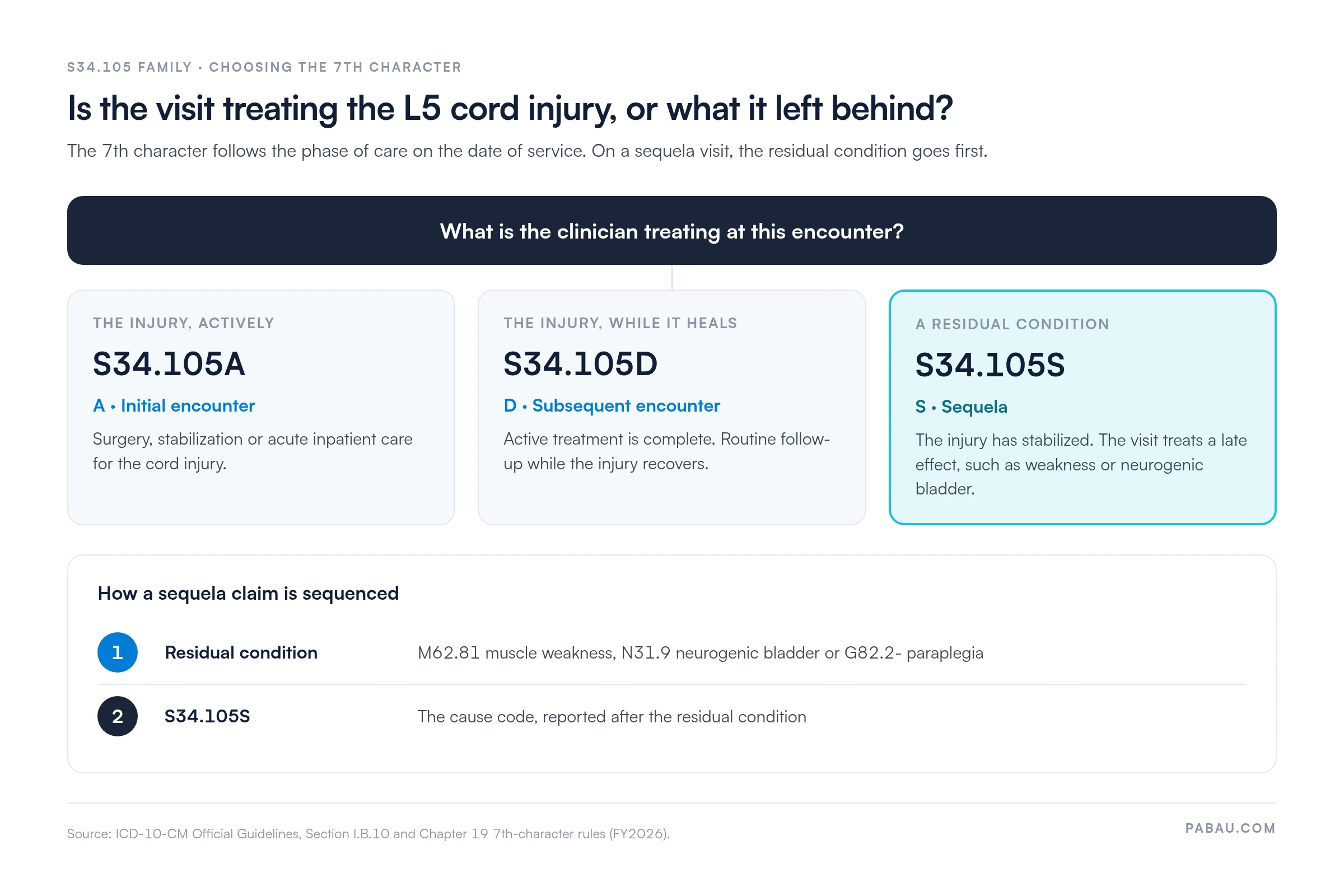
The S 7th character applies only when the visit treats a residual condition, not while the original injury is still actively healing.
Unspecified means the record does not document complete vs incomplete cord injury status, which carries higher audit risk.
On a sequela claim, report the residual condition first and S34.105S second as the cause code, because a reversed order is a common denial trigger.
Pabau’s claims management software pulls existing patient-record data into pre-filled claims, submits them through Claim.MD, tracks claim status and posts ERAs.
ICD-10 Code S34.105S is the billable ICD-10-CM code for an unspecified injury to the L5 level of the lumbar spinal cord, sequela. It covers visits that treat a residual condition after the cord injury has stabilized. The code has been valid since FY2016 (October 1, 2015), so verify it for the date of service in the CMS ICD-10-CM annual code files. The table below summarizes its key attributes.
Each alphanumeric position in S34.105S encodes a specific clinical fact. Misreading any one position is enough to generate a denial or an audit flag.
Why “unspecified” applies here: The 5th character “0” means the documentation does not say whether the cord injury was complete or incomplete. Complete means total loss of function below the level, and incomplete means partial preservation. This is common in sequela-phase records, where the acute imaging was done elsewhere or years earlier.
Use the unspecified code only when the record does not support greater specificity. It carries higher audit risk than a complete or incomplete code.
The 7th character is a frequent source of claim denials in the S34.105 family. It must reflect the phase of care on the date of service, not the phase when the original injury occurred.
Use S34.105S when the clinician is treating a condition that resulted from the original L5 cord injury, not the injury itself. The original injury has recovered as far as it will, and the visit is for the downstream consequence.
Use S34.105D when the injury is still healing and the visit is part of routine recovery management. The cord injury is still the active clinical issue, just past the acute treatment phase.
Practical decision rule: Ask what the clinician is treating today. If it is a residual condition left behind after the injury stabilized, use S34.105S. If the healing injury itself is still the reason for the encounter, use S34.105D.
Sequela coding order (mandatory): Per the FY2026 ICD-10-CM Official Guidelines (Section I.B.10), report the residual condition first, then S34.105S as the cause. Reversing this order is a common denial trigger. The diagram below puts the phase-of-care choice and the claim order side by side.
These neighboring codes cause most of the confusion when coders select within the S34.10x family.
Key rule: Use the most specific anatomical level the documentation supports. If imaging or the treating physician’s notes state L5, use S34.105S, not S34.109S. Defaulting to the unspecified-level code when a level is documented is a specificity error that can trigger payer queries.
The S34 category carries no Excludes notes that apply to S34.105S. It carries two instructions instead, and a third rule separates cord injury from cauda equina injury. Coders using lookup tools such as the AAPC ICD-10-CM lookup will see the instructions at the category level.
Five documentation elements determine whether S34.105S will withstand payer review. Missing any one of them converts a defensible claim into an audit liability. Capture them at the point of care rather than reconstructing them at billing, and claims management software can carry them straight onto the claim.
Run a specificity check before submitting any S34.10x claim. If the original MRI or operative report is accessible, verify whether it documents complete vs incomplete cord injury status. Upgrading from S34.105S to S34.115S (complete) or S34.125S (incomplete) eliminates the ‘unspecified’ audit flag and reduces denial risk.
Payers often scrutinize long-term sequela claims, and requirements vary by carrier. S34.105S describes a chronic, ongoing condition rather than an episode of care, so its medical billing needs more supporting paperwork than an acute injury claim.
Common payer requirements before accepting S34.105S include:
Payer requirements change with each annual coverage determination cycle. Verify individual payer policies before each claim submission rather than relying on prior-year approval patterns.
S34.105S is valid on PT, OT and physiatry claims as the cause code when the visit treats residual effects of the L5 cord injury. The residual condition is the primary diagnosis, and S34.105S follows it as the secondary cause code.
On a physical therapy claim, list the residual condition first and report S34.105S after it. For lower extremity weakness, that first code is usually M62.81. Common residual-condition codes include:
On the procedure side, therapeutic exercise is billed under 97110, therapeutic activities under 97530 and mechanical traction under 97012. S34.105S sits in the diagnosis fields after the residual condition, and the CPT codes describe the services rendered during that visit.
Workers compensation claims for lumbar cord injury sequela carry documentation and billing requirements that differ from commercial payer rules. Medical billing compliance for work-related injuries requires a clear causal chain from the workplace incident to the current residual condition.
Workers comp carriers typically require these additional elements alongside the standard documentation for S34.105S:
Workers compensation rules differ by state and carrier. The guidance above reflects common practice, so confirm requirements with the specific insurer handling the claim.
The five denial patterns below are the ones to rule out first when an S34.105S claim comes back rejected. Denial management for spinal cord injury codes starts with identifying which pattern triggered the rejection. Only then can you choose between a corrected claim and an appeal.
Start by matching the claim adjustment reason code (CARC) on the remittance against a reference list of denial codes. When you appeal, three documents carry the most weight:
Submitting a clean claim the first time requires all five documentation elements to be in place before the claim is created.
Billing a sequela visit often means retyping diagnosis codes from the clinical note into a separate billing tool, then chasing the claim through payer portals. Each handoff is another chance for the residual condition and S34.105S to land in the wrong order.
In Pabau, the practice management platform we build, claims management pulls existing patient-record data into pre-filled claims. It submits them through the Claim.MD clearinghouse, tracks claim status and posts ERAs. It also supports eligibility checks for US payers through Claim.MD.
Your coder still chooses and sequences the codes. The difference is that diagnoses are entered once, in the record. The claim and its remittance then stay attached to the patient if you need to appeal later.

Pabau pulls existing patient-record data into pre-filled claims, submits them through the Claim.MD clearinghouse, tracks claim status and posts ERAs. Your billing team spends less time rekeying codes and chasing denials.

S34.105S holds up when the record does three jobs. It documents the L5 level, it declares the sequela phase in a dated note, and it names the residual condition that leads the claim. If one of those is missing, query the clinician before the claim goes out rather than defending it on appeal.
The trade-off worth weighing is specificity. If the acute imaging shows a complete or incomplete injury, S34.115S or S34.125S removes the unspecified flag. Chasing that old report is usually cheaper than a denial.
To see how Pabau carries documented diagnoses onto pre-filled claims and tracks them through Claim.MD, book a demo.

Need to understand clearinghouse submission for ICD-10 claims? Claim.MD clearinghouse guide explains how electronic claim validation works for diagnosis codes like S34.105S.
Handling a high volume of spinal injury denials? Denial codes in medical billing covers CARC denial reason codes and how to resolve the most common rejection patterns.
Want to verify electronic remittance for sequela claims? Electronic remittance advice (ERA) explains how 835 ERA files report payment decisions on ICD-10-coded claims.
Billing functional training after a cord injury? CPT code 97530 covers the documentation and time rules for therapeutic activities.
ICD-10 Code S34.105S is the billable ICD-10-CM diagnosis code for an unspecified injury to the L5 level of the lumbar spinal cord, sequela. The encounter addresses a residual condition (late effect) of a prior traumatic L5 cord injury, not the acute injury itself. Unspecified indicates the record does not document whether the injury was complete or incomplete.
Yes. S34.105S is a billable ICD-10-CM diagnosis code, valid since FY2016 (October 1, 2015). Verify that it is active for the date of service using the CMS annual code files.
Use S34.109S, the unspecified-level lumbar cord sequela code, when the record confirms a lumbar cord injury but not its level. Do not default to S34.105S when L5 is not explicitly documented. Coding a more specific level than the documentation supports is a specificity error.
Yes. S34.105S is valid on PT, OT and physiatry claims as the cause code, reported after the residual condition. Report the specific residual condition (e.g., muscle weakness M62.81) as the primary diagnosis and S34.105S as the cause code. Companion CPT codes commonly include 97110 (therapeutic exercise) and 97530 (therapeutic activities).
Common reasons are a wrong 7th character (A or D instead of S), a reversed coding order with S34.105S listed first, and missing causal-chain documentation. Payers also reject the unspecified code when imaging supports a more specific one. Billing S34.105S during the active healing phase rather than the sequela phase is another frequent cause.