ICD-10 Code S42.002G: Left clavicle fracture with delayed healing
ICD-10 Code S42.002G: Code details and quick reference ICD-10 Code S42.002G is a...

Last Updated: Oct 12, 2026
Billable Code Specific Code
S31.44XA is the billable ICD-10-CM code for puncture wound with foreign body of vagina and vulva, initial encounter. It applies when a pointed object pierces the vaginal wall or vulvar skin. A foreign body stays in the wound or was carried into it.
The A character marks active treatment, such as foreign body removal or wound repair. When the note documents a puncture but no retained or introduced object, the correct code is S31.43XA instead.
Let Pabau's smart automation suggest the right codes, reduce claim denials, and keep your practice compliant—effortlessly.
Automate repetitive tasks and focus on what matters most—your patients.
Reduce coding errors and ensure compliance with the latest regulations.
Clean claims, fewer denials, and faster reimbursements.
Powerful insights and reporting to help your practice thrive.
HIPAA compliant SOC 2 certified GDPR-compliant Trusted by 4,000+ clinics worldwide

S31.44XA reports a puncture wound with foreign body of the vagina or vulva at the initial encounter, while active treatment is under way.
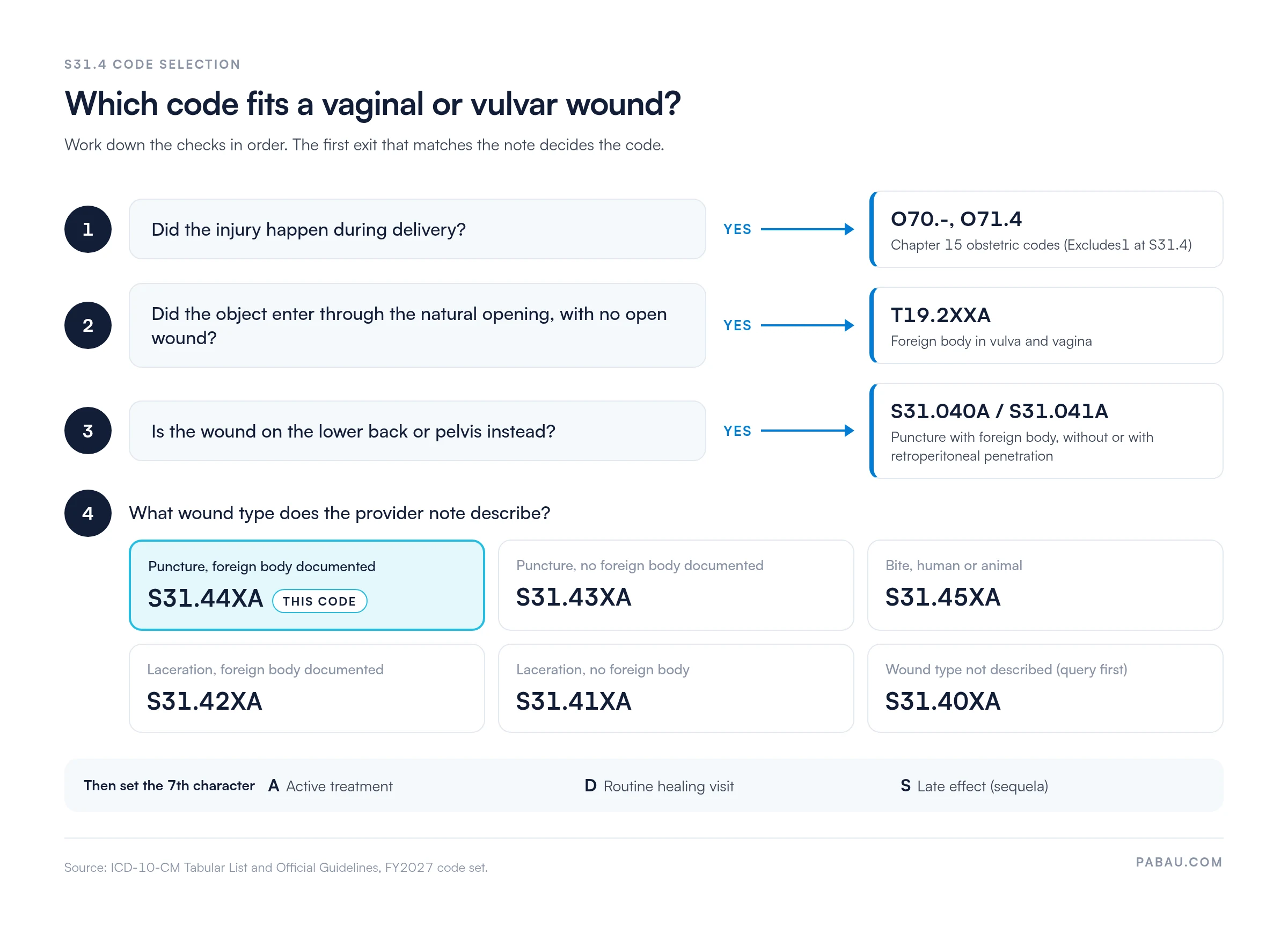
S31.4 is the vagina and vulva subcategory, so a lower back or pelvis puncture wound with foreign body is coded S31.040A or S31.041A instead.
The A character stays on every claim during active treatment, then D covers routine healing visits and S covers late effects.
An object that entered through the vaginal opening without an open wound is coded T19.2XXA, and a childbirth injury moves to Chapter 15.
Pabau’s claims software holds a claim until required insurer details are in place, then sends it to US payers through Claim.MD.
ICD-10 code S31.44XA is the billable ICD-10-CM code for a puncture wound with foreign body of the vagina and vulva, initial encounter. It applies when a pointed object pierces the vaginal wall or vulvar skin. A foreign body stays in the wound or was carried into it.
Its full official descriptor is Puncture wound with foreign body of vagina and vulva, initial encounter. The code has been valid since ICD-10-CM took effect on October 1, 2015, with no change in any annual update through FY2027.
Code edits list S31.44XA as applicable to female patients only. A claim fails the sex edit when the patient record does not match, so registration data matters as much as the note.
The table below sets out each element of the code and what it tells a payer.
The parent-to-child hierarchy confirms that you have reached the most specific valid code. The CMS ICD-10-CM code files publish it every year. For S31.44XA, it runs as follows:
The placeholder X carries no clinical meaning. Omitting it (S31.44A instead of S31.44XA) produces an invalid code that payers reject. For background on how these codes feed into claim processing, see our overview of medical billing fundamentals.
The 7th character on S31.44XA tracks the phase of care, so the same character can repeat across several visits.
The ICD-10-CM Official Guidelines (Section I.C.19.a) assign A to each encounter where the patient receives active treatment. Take a patient seen in the emergency department on day 1, then by a gynecologist on day 3 for removal under anesthesia. Both claims carry S31.44XA.
Check every claim that switches to S31.44XD on the second visit. If the note still shows active treatment, the claim needs S31.44XA, and the mismatch with the procedure code invites a medical necessity review.
Instructional notes at four levels apply to S31.44XA: the S00-T88 chapter, the S30-S39 block, the S31 category and the S31.4 subcategory.
The obstetric Excludes1 is the one to watch on this code. A vaginal or vulvar wound sustained during childbirth is coded from Chapter 15, never with S31.44XA.
The T19 Excludes2 works the other way. When an object inserted through the vaginal opening also punctures the vaginal wall, both T19.2XXA and S31.44XA may be reported.
These codes are the ones most often selected in place of S31.44XA, or the other way round. The AAPC ICD-10-CM code lookup and the ICD10Data entry for S31.44XA both show full descriptors, which helps coders confirm specificity before submission.
Two confusions cause most errors with this code. The first is the foreign body call: with no object documented, code S31.43XA, because S31.44XA without that evidence is upcoding.
The second is site. S31.4 covers only the vagina and vulva, so a puncture wound with foreign body of the lower back or pelvis goes to S31.040A or S31.041A.
The path below runs those checks in order, starting with obstetric context and ending at the wound type the note describes.
Vaginal and vulvar puncture wounds are sometimes the result of assault, which changes how the codes are sequenced. ICD-10-CM guideline I.C.19.f sets the order:
The note decides the path. Code abuse as confirmed only when the provider documents it as confirmed, and as suspected when the note says suspected.
Chapter 19 instructs coders to add a secondary code from Chapter 20 to show how the injury happened. For S31.44XA, that means a W- or X-series mechanism code plus supporting Y codes.
Add a place of occurrence code (Y92.-), an activity code (Y93.-) and an external cause status code (Y99.-) when the note supports them. Add Z18.- as well when the provider documents that a fragment of the object was left in place.
Section I.C.20 sets no national requirement to report external cause codes. A state mandate or payer policy can require them, and the guidelines encourage reporting them either way. They also give a reviewer the mechanism behind the wound.
Clear documentation is the most reliable defense against a denied or audited S31.44XA claim. Under medical billing compliance standards, the provider note must support every element of the code descriptor before submission.
The provider note must explicitly address each of these elements:
S31.44XA does not carry a payment rate of its own. Payment follows the procedure codes billed with it, and the diagnosis establishes medical necessity for them.
Common pairings include CPT 57415 for removal of an impacted vaginal foreign body under anesthesia other than local. CPT 57200 covers nonobstetrical suture of a vaginal injury. When the object is removed without anesthesia, CPT directs coders to an E/M code instead.
On inpatient claims, MS-DRG v44.0 groups S31.44XA into several DRGs, including 760-761 for female reproductive system disorders and 963-965 for multiple significant trauma.
The final DRG depends on the principal diagnosis, the procedures and the secondary codes. The CDC/NCHS ICD-10-CM browser tool confirms the code’s current status.
Prior authorization rules for follow-up wound care vary by payer and plan. Check the plan’s requirements before you schedule extra visits after the initial encounter.

Most S31.44XA denials trace back to a short list of errors. Knowing which pattern hits your practice tells you where to intervene. Denial management workflows start by sorting the reason codes on every returned claim. Our list of denial codes for coders explains what each one means.
Audit S31.44XA claims monthly for two reason codes. CARC 11 means the diagnosis is inconsistent with the procedure, and CARC 16 means the claim lacks information or has billing errors. Both point straight back to the documentation and companion-code problems above.
Many injury claim problems start before the claim leaves the practice. An insurer detail is missing, or a code does not match the visit. Pabau’s billing software for private practices catches the first kind at the point of sending.
Inside its claims software for billers, validation checks run whenever someone sends a claim. If insurer details such as a membership number or authorization code are missing, the Send button stays disabled until the field is fixed.
In the US, claims go out as electronic CMS-1500s through the Claim.MD integration. Your team can run real-time eligibility checks before treatment, track each claim’s status, and post electronic remittance advice back against the claim.
Denials that do come back land in the same claims dashboard. Your billing team starts the fix from the claim itself, not from a payer portal.

Pabau holds a claim until required insurer details are in place, submits it through Claim.MD, and posts ERA remittances back. Book a demo to see the workflow for injury codes like S31.44XA.

S31.44XA holds up on audit only when the note carries three facts: a puncture mechanism, a named foreign body, and a vaginal or vulvar site. If any one is missing, a different code fits better, whether S31.43XA, S31.42XA or T19.2XXA.
Confirm the site before you assign the code. S31.4 covers the vagina and vulva only, and lower back or pelvis wounds belong under S31.04- instead.
Context matters as much as anatomy. A childbirth injury moves to Chapter 15, and documented sexual abuse puts a T74 or T76 code ahead of S31.44XA.
Accurate codes still need clean claims behind them. Book a demo to see your team run claims, eligibility checks and remittances for injury codes from one dashboard.

Need to understand how claim clearinghouses work? Medical claims clearinghouse overview explains how payer validation works before a claim reaches adjudication.
Coding a vaginal or vulvar laceration at follow-up? ICD-10 code S31.41XD covers the subsequent-encounter code for a laceration without foreign body in the same subcategory.
Does a payer want approval before follow-up wound care? Prior authorization process guide walks through requesting and tracking approvals before extra visits.
Want to reduce denials across your entire ICD-10 code set? Revenue cycle management guide covers the end-to-end process from coding through payment posting.
S31.44XA is the billable ICD-10-CM code for a puncture wound with foreign body of the vagina and vulva, initial encounter. The A character means the patient is still receiving active treatment, such as foreign body removal or wound repair.
Yes. S31.44XA is a billable, specific code that has been unchanged since ICD-10-CM took effect in October 2015, and it remains valid in FY2027. Code edits apply it to female patients only.
No. S31.4 is the vagina and vulva subcategory. A puncture wound with foreign body of the lower back and pelvis is coded S31.040A without retroperitoneal penetration, or S31.041A with it.
Use S31.44XA while the patient receives active treatment, however many visits that takes. Switch to S31.44XD only when the wound is healing and the visit is a routine check or dressing change.
T19.2XXA reports a foreign body in the vulva and vagina that entered through the natural opening without an open wound. S31.44XA reports a puncture wound with a foreign body. When an inserted object also punctures the vaginal wall, the Excludes2 note allows both codes.
Sequence T74.21XA first for confirmed adult sexual abuse, or T76.21XA for suspected abuse, then S31.44XA. Confirmed cases also take an assault external cause code and, when known, a Y07 perpetrator code.