ICD-10 code S31.44XA: Vaginal and vulvar puncture wound with foreign body
ICD-10 code S31.44XA: Definition and billable status ICD-10 code S31.44XA is the...

Last Updated: Oct 12, 2026
Billable Code Specific Code
S12.54XA is the billable ICD-10-CM code for Type III traumatic spondylolisthesis of sixth cervical vertebra, initial encounter for closed fracture. It applies for the whole active treatment phase, surgery included, and stays valid in the FY2027 code set.
Denials on this code usually trace back to a wrong 7th character or a physician note that never classifies the injury as Type III.
Let Pabau's smart automation suggest the right codes, reduce claim denials, and keep your practice compliant—effortlessly.
Automate repetitive tasks and focus on what matters most—your patients.
Reduce coding errors and ensure compliance with the latest regulations.
Clean claims, fewer denials, and faster reimbursements.
Powerful insights and reporting to help your practice thrive.
HIPAA compliant SOC 2 certified GDPR-compliant Trusted by 4,000+ clinics worldwide

ICD-10 Code S12.54XA covers Type III traumatic spondylolisthesis of the sixth cervical vertebra (C6), initial encounter for closed fracture.
The 7th character A covers the whole active treatment phase of a closed fracture, not only the first visit.
Imaging must place the displacement at the C6 vertebral body, or the claim risks a wrong-level code such as S12.44XA or S12.64XA.
The physician has to document “Type III” in the note, or the code falls back to S12.530A or S12.531A.
Pabau’s claims management and Claim.MD integration help practices catch 7th character and placeholder errors before submission.
ICD-10 Code S12.54XA is the valid, billable ICD-10-CM code for Type III traumatic spondylolisthesis of the sixth cervical vertebra (C6), initial encounter for closed fracture. It remains active in the fiscal year 2027 code set, and the table below confirms its status and hierarchy.
ICD-10 Code S12.54XA carries a precise meaning in each character position. Reading it position by position shows exactly where a wrong level, subtype, or encounter character would change the code.
The placeholder X in position 6 is a common source of claim rejections. Per CMS ICD-10-CM coding guidelines, any empty position before a required 7th character is filled with an X placeholder. Without it, S12.54XA is invalid and the claim is rejected on submission.
Traumatic spondylolisthesis of the sixth cervical vertebra is an acute injury. The C6 vertebra fractures and slips out of alignment with the vertebra below it. It follows significant trauma, not gradual wear, which separates it from degenerative spondylolisthesis.
ICD-10-CM gives each vertebra from C2 to C7 the same three traumatic spondylolisthesis options: Type III, other, and unspecified. The code book does not define “Type III” itself. The code therefore rests on the type the treating physician documents, and it describes the most severe, typically unstable pattern that usually needs surgical stabilization.
C6 sits in the lower cervical spine, one of the most mobile segments of the neck and a frequent site of cervical trauma. Displacement at this level can compress the C6 and C7 nerve roots or the cervical spinal cord. Clinically, that may show as weakness in elbow flexion or wrist extension, or numbness over the thumb and radial forearm.
Common mechanisms of injury at C6 include:
The physician’s documentation must name the injury as traumatic spondylolisthesis at the C6 level and specify Type III. A radiology report confirming displacement at C6 is not enough on its own to support ICD-10 Code S12.54XA in a post-payment audit.
The 7th character for S12.54 tells the payer which phase of care the encounter represents. Category S12 offers six options, and choosing the wrong one is a leading reason for denials on cervical fracture codes.
Per the ICD-10-CM Official Guidelines for Coding and Reporting, the 7th character A applies throughout active treatment, not only to the first visit. A patient who returns two weeks after injury for surgical fusion is still in active treatment. Coding that encounter as S12.54XD is incorrect and may trigger a denial or an audit.
ICD-10 Code S12.54XA sits within the following tabular hierarchy. The parent levels carry the notes that decide when to add spinal cord injury codes and how to sequence them. A solid grasp of medical billing fundamentals helps before you submit S12 category claims.
Key coding instructions for S12.54XA include:
Four kinds of code cause most of the confusion with ICD-10 Code S12.54XA. They are other 7th character variants, adjacent vertebral levels, other injury subtypes at C6, and degenerative spondylolisthesis from the M chapter.
Level confusion is common in the lower cervical spine. Imaging reports often describe a segment, such as “C6-C7 listhesis”, rather than a single vertebra. Confirm which vertebral body is fractured and displaced before you choose between S12.44XA, S12.54XA, and S12.64XA.
Insufficient documentation is the most preventable cause of S12.54XA denials. The medical record must contain each of the following elements to withstand payer review. Good medical billing compliance means capturing them before the claim goes out, not adding them afterward.
Query the treating physician whenever the imaging report describes C6 displacement but the note gives no injury type. One clarification before billing keeps the claim on S12.54XA instead of an unspecified code such as S12.530A.
S12.54XA is a high-acuity trauma code, and payers often review it alongside the surgical procedures billed with it. Cervical fusion codes such as CPT 22551 and 22552 commonly need prior authorization.
Key payer considerations for S12.54XA claims:
S12.54XA denials cluster around five root causes. Each one is correctable before resubmission when the documentation is in place. Strong denial management workflows track these patterns by payer and code family to prevent repeats.
A clean claim submission checklist catches most of these causes before the claim is filed. When a denial still comes back, the remittance denial codes name the reason the payer gave.
These scenarios show how to apply ICD-10 Code S12.54XA across one patient’s episode of care. The 7th character follows the encounter type, so the chart below maps each visit to its code before the scenarios walk through the first three.
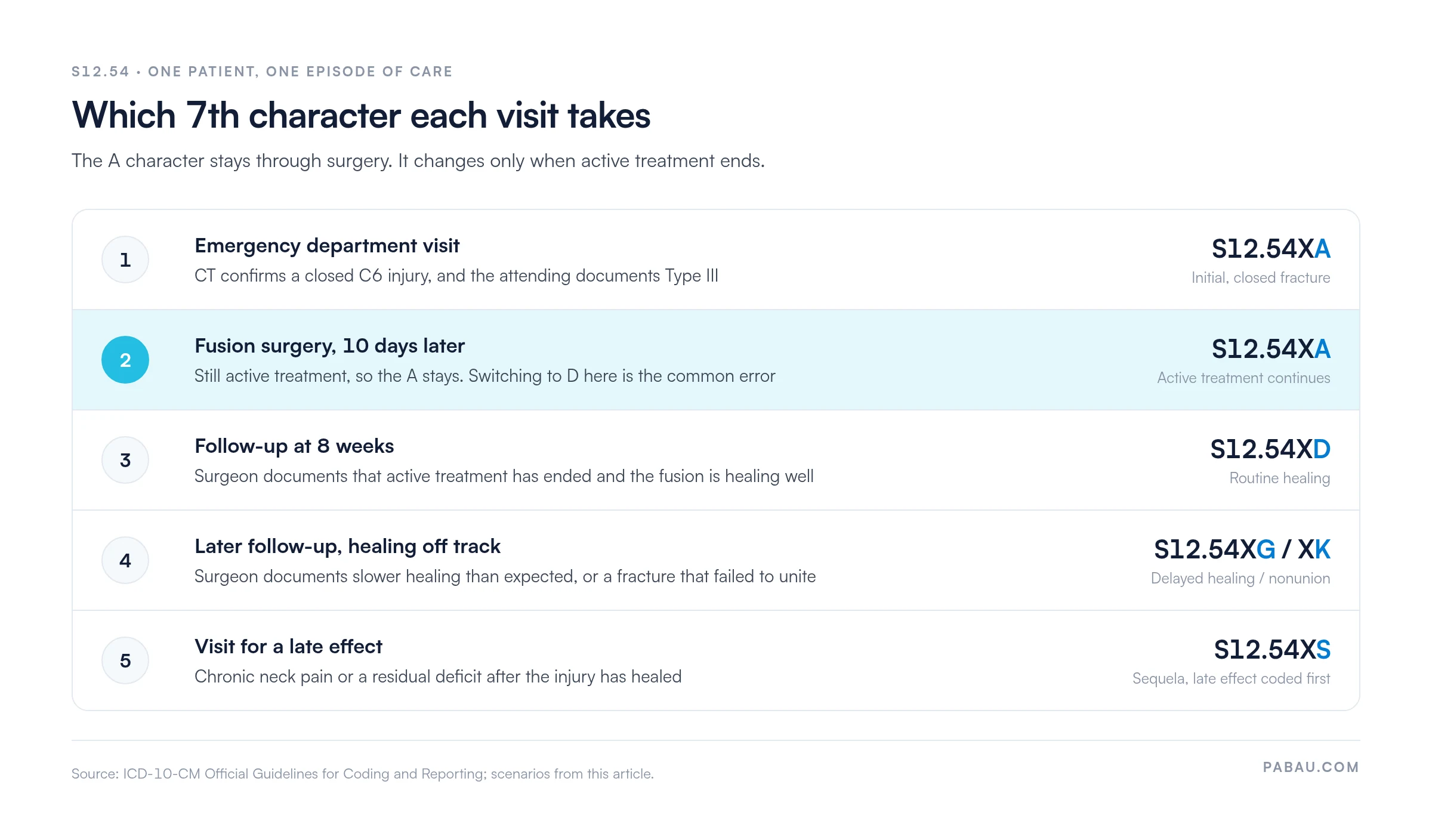
A 34-year-old presents to the ED after a high-speed motor vehicle collision. CT imaging confirms a closed traumatic spondylolisthesis of C6 on C7. The ED attending documents “Type III traumatic spondylolisthesis, C6” and admits the patient for spine surgery evaluation.
Correct code: S12.54XA (initial encounter for closed fracture, active treatment). If the physician documents a cord injury, add the matching S14 code, such as S14.106A. Add the external cause code for the collision as well.
The same patient returns 10 days later for planned fusion and stabilization of the C6-C7 segment. The spine surgeon’s pre-operative note confirms the Type III injury and the surgical plan.
Correct code: S12.54XA again, because active treatment has not ended. A common error is switching to S12.54XD because the visit feels like a follow-up. Active surgical management keeps the A character in place.
Eight weeks after surgery, the patient returns for a wound check and an X-ray. The surgeon documents that the fusion is progressing well and active treatment has ended. The visit is routine post-surgical monitoring.
Correct code: S12.54XD (subsequent encounter for fracture with routine healing). This is the first correct use of the D character in this episode of care. If the surgeon later documents delayed healing or nonunion, switch to S12.54XG or S12.54XK.
Most S12.54XA denials start in the chart. A missing “Type III” statement, an unclear vertebral level, or a stale 7th character slips through when notes and claims live in separate systems.
Pabau, the practice management platform we build, keeps clinical notes, diagnosis codes, and claims in one patient record. Its error-checking claims software lets billers check the documented type, level, and treatment status before they code the encounter.
Pabau’s Claim.MD clearinghouse integration sends coded claims through payer edit checks before submission. Errors such as an omitted placeholder X are flagged while they are still cheap to fix.

Pabau keeps notes, diagnosis codes, and claims in one place. Spine and orthopedic practices catch a missing Type III statement or a wrong 7th character before submission.

S12.54XA rewards coders who check three facts before they bill: the vertebral level, the documented type, and the treatment phase. Get the level wrong and the claim describes a different vertebra. Get the phase wrong and a valid code is still denied.
The cheapest fix is upstream. Query the physician before submission, not after the denial, and the claim usually goes through on the first pass.
Book a demo to see how Pabau helps spine and orthopedic practices code cervical fracture claims correctly the first time.

Need to understand how clearinghouse submission works? Medical claims clearinghouse guide explains how electronic claims move from practice to payer and where errors are caught.
Want to understand 837P claim structure for ICD-10-coded trauma claims? 837 file format guide breaks down how diagnosis codes are mapped in electronic claim submissions.
ICD-10 Code S12.54XA is the billable ICD-10-CM code for Type III traumatic spondylolisthesis of the sixth cervical vertebra (C6), initial encounter for closed fracture. It is valid for fiscal year 2027 and applies while the patient receives active treatment.
S12.54XA uses the 7th character A and applies during active treatment of a closed fracture. S12.54XD uses the 7th character D and applies once active treatment is complete and the fracture is healing routinely. Both codes describe the same C6 injury.
Yes. S12.54XA is a billable, specific ICD-10-CM code in the FY2027 code set published by CMS and NCHS. It can be reported on a CMS-1500 or 837P claim.
Yes, when the physician documents an associated cervical spinal cord injury. Category S12 instructs coders to code also any associated cord injury from S14.0 or S14.1-, such as S14.106A at the C6 level. Without documented neurological involvement, S12.54XA is reported without an S14 code.
The record must include CT or MRI confirming traumatic spondylolisthesis at C6 and a physician statement classifying the injury as Type III. It also needs the open or closed status, the traumatic mechanism, and a note showing active treatment.
The hangman fracture is a traumatic spondylolisthesis of the second cervical vertebra (C2), not C6. Its Type III initial encounter code for a closed fracture is S12.14XA. S12.54XA describes a Type III traumatic spondylolisthesis of the sixth cervical vertebra instead.