



HCPCS code E0198: Water pressure pad billing guide
HCPCS code E0198 is a water pad for a standard mattress HCPCS code E0198 is the ...

Last Updated: Oct 13, 2026

CPT code 22551 covers anterior interbody arthrodesis below C2, bundling disc space preparation, discectomy, osteophytectomy, and decompression of the cord or nerve roots.
Decompression is what separates 22551 from 22554, so read the operative note before you commit to either code.
Bone graft is billed separately, using 20930 or 20931 for allograft and 20936 through 20938 for autograft.
Add-on code 22552 covers each cervical interspace after the first, and it never carries modifier 51.
M50.12 and M50.22 are parent codes, so the claim needs the sixth character that names the treated level.
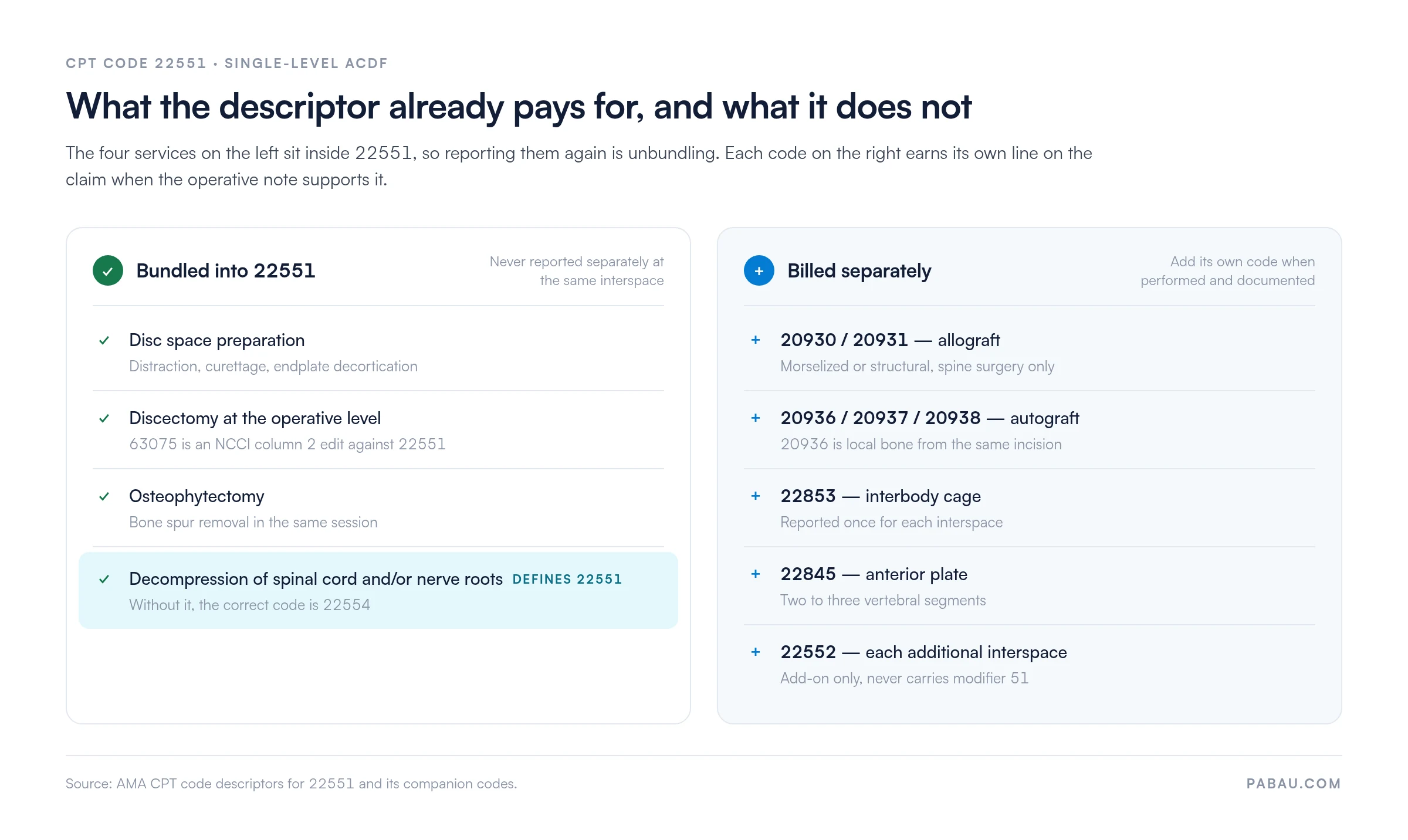
CPT code 22551 reports a single-level anterior cervical discectomy and fusion below C2. Its descriptor bundles four services: disc space preparation, discectomy, osteophytectomy, and decompression of the spinal cord or nerve roots. That fourth element is where ACDF claims go wrong.
Decompression is what separates 22551 from 22554, and it is why a separate discectomy code cannot ride alongside it. Bone graft is the mirror error. Graft sits outside the bundle, so a claim without a graft code underbills the case.
What follows covers Medicare rates, add-on codes, modifiers, diagnosis pairing, documentation, and the NCCI edits behind the most common denials.
CPT code 22551 describes arthrodesis, anterior interbody, including disc space preparation, discectomy, osteophytectomy, and decompression of spinal cord and/or nerve roots; cervical below C2.
In the American Medical Association’s CPT code set, it is the primary code for a single-level ACDF performed below C2.
Those four services are one billable unit. Reporting any of them separately at the same interspace is unbundling, and the NCCI edit file will catch it.
Bone graft is not on that list. The descriptor stops at decompression, so grafting earns its own code every time the surgeon performs it. That split is worth pinning above a coder’s desk, because it is where an ACDF claim either underbills or trips an edit.
Report 22551 when the surgeon reaches the cervical spine below C2 from the front, removes the disc, decompresses the neural structures, and fuses the interspace. Cervical disc herniation, cervical stenosis, and spondylosis with radiculopathy or myelopathy are the usual indications.
Three findings have to be legible in the operative report before anyone codes it.
Miss any one of the three and the payer has grounds to deny or downcode. CMS billing article A59668 sets out the same expectations for Medicare cervical fusion claims.
The two anterior cervical fusion codes look almost identical on a superbill, and they pay differently. 22551 includes decompression of the spinal cord or nerve roots. 22554 covers the same anterior interbody fusion with minimal discectomy only, done to prepare the interspace rather than to relieve pressure on anything.
So the deciding phrase sits in the operative note, not on the surgical schedule. If the surgeon documents cord or nerve root decompression, the case is 22551. If the note describes clearing just enough disc to seat the graft, it is 22554. Approach settles the first half of the question, and decompression settles the second.
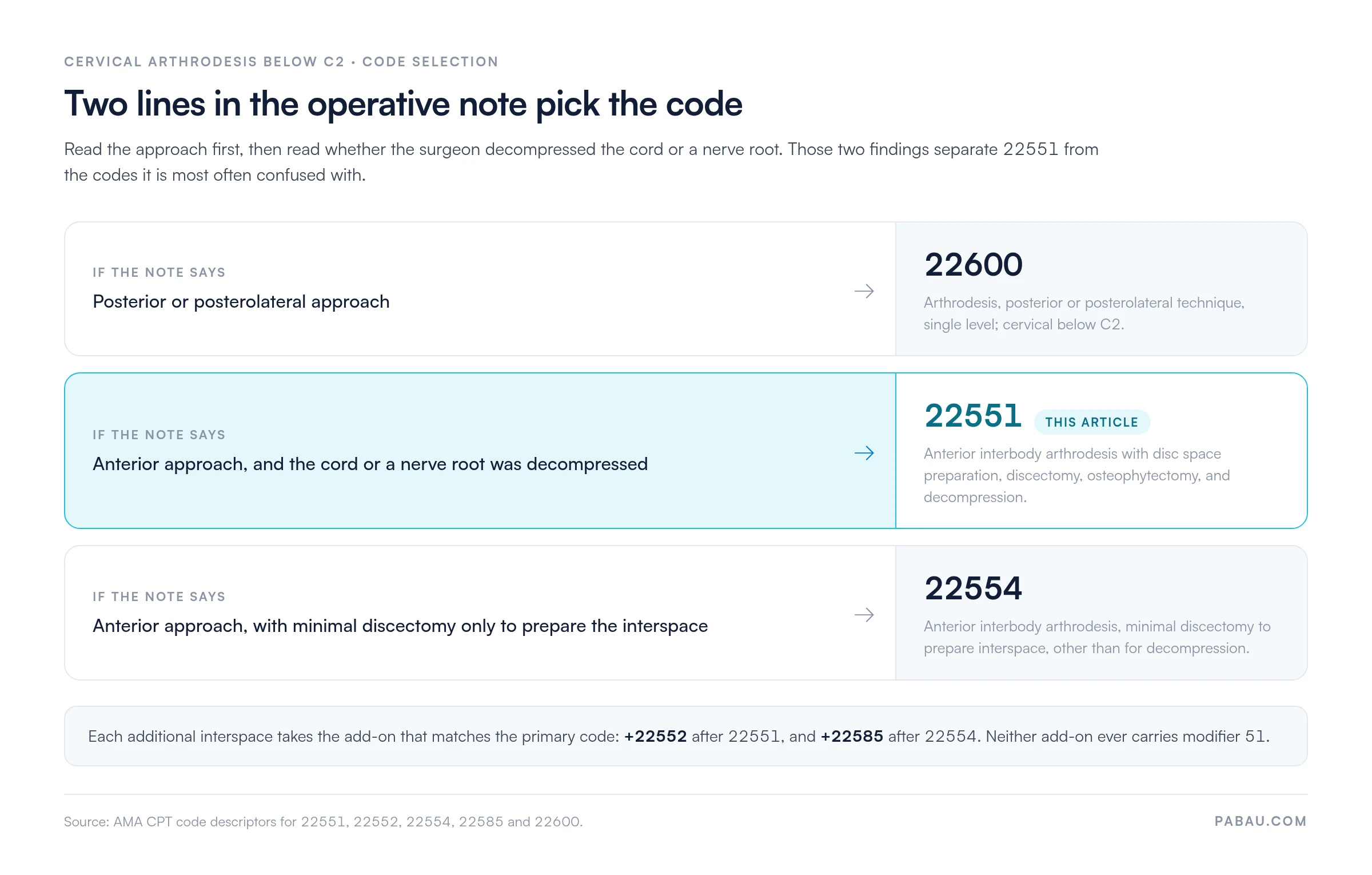
Add-on selection follows the primary code. 22552 pairs with 22551, and 22585 pairs with 22554. Mixing the two families is a rejection, because each add-on is only valid against its own parent code.
Payment for CPT code 22551 depends on the setting and the locality. Verify current figures with the CMS Physician Fee Schedule lookup before billing, because rates reset every January with the MPFS.
The table below shows 2025 national averages.
Geographic Practice Cost Index adjustments move the final allowed amount by locality, so treat a national average as a planning figure.
Practices that bill this code regularly should pull fresh RVU values each January, before the first case of the year is submitted.
CPT code 22551 rarely stands alone on a surgical claim. Working out which companion codes apply, and in what order, is the single biggest source of ACDF billing errors.
22552 is an add-on code and cannot stand alone on a claim. It needs 22551 beside it as the primary code. A two-level ACDF at C4-C5 and C5-C6 is billed as 22551 once and 22552 once. A three-level case is 22551 once and 22552 twice.
Because 22552 is an add-on, modifier 51 does not apply to it. Appending 51 to an add-on code is one of the most reliable ways to earn a manual review.
22853 covers insertion of an interbody biomechanical device, and its descriptor reads “each interspace”. A two-level ACDF with a cage at both levels therefore supports 22853 twice, not once.
22845 covers anterior instrumentation across two to three vertebral segments, which is the usual cervical plate. Both codes sit inside payer-specific bundling policy. Some commercial plans fold one or both into 22551, so read the policy before the claim goes out.
Bone graft is billed separately whenever it is performed. The 22551 descriptor never mentions grafting, so none of it is included in the primary code. Which graft code applies depends on the material and where it came from.
20936 is the one that gets misread. Local morselized bone taken from the exposure qualifies, and no second incision is required to report it. Only 20937 and 20938 depend on a distinct skin or fascial incision.
Modifier choice on 22551 comes down to two questions. Who operated, and what else happened on the same date of service?
Every 22551 claim needs an ICD-10-CM diagnosis that explains why the fusion was necessary. The qualifying codes sit in the M47, M48 and M50 ranges of the ICD-10-CM code library.
Your MAC’s Local Coverage Determination names which of them it will actually pay, so check the LCD for your jurisdiction.
Two of those families come with a trap. M50.12 and M50.22 are parent codes rather than billable ones, so a claim carrying either will reject for missing specificity. Add the sixth character that matches the level in the operative note.
M47.812 is the other code worth flagging. It reads “spondylosis without myelopathy or radiculopathy, cervical region”, which is the opposite of what a fusion usually documents. When the note describes radiculopathy, the correct code is M47.22.
Unspecified pain codes rarely clear medical necessity for a surgical fusion. M54.2 for cervicalgia, submitted on its own, will not support 22551.
CMS article A59668 and most MAC LCDs converge on the same short list. Run it before the claim leaves the office, rather than after the denial arrives.
Send the coded claim promptly after surgery. The longer the delay between the operative date and submission, the more likely a missing detail or a timely-filing limit ends the conversation.
Ask the circulating nurse for the implant sticker sheet before you leave the facility. Cage and plate lot numbers live on those stickers, and they have to match the implant record in the operative note. A mismatch between the two is a leading audit trigger in spine billing.
The National Correct Coding Initiative publishes column 1 and column 2 pairs that define what already sits inside CPT code 22551.
Those edits update quarterly, so check the current file in CMS’s NCCI edit tables before you unbundle anything.
Anterior cervical fusion generates more than its share of surgical denials. These six account for the bulk of them.
Most spine practices move codes by hand. The surgeon dictates, a coder reads the note, and the codes get retyped into a separate billing system. Every hop is a chance for 22552 to go missing or for an interspace to drift by one level.
Practice management software like Pabau keeps the codes on the record they came from. Its connected claims management attaches CPT and ICD-10 codes to the treatment note itself. The claim is then assembled from what the surgeon documented, not from a second transcription.
Submission runs electronically through Claim.MD in the US. Claims are scrubbed for missing or malformed data on the way out, which catches an absent diagnosis or an empty required field. Coding judgment still belongs to your coder, because scrubbing does not choose modifiers or code pairs for you.
After adjudication, remittance reconciliation and superbill generation sit in the same workflow. That matters most for a practice running several surgeons and expensive implants. Fewer hand-offs mean fewer places for an ACDF claim to drift from the operative record.

Pabau keeps CPT and ICD-10 codes on the treatment record. Each claim is scrubbed for missing or malformed data before submission, so complex spine cases leave the practice whole.

CPT code 22551 rewards careful reading of one document. The operative note names the approach, the level, whether the cord or nerve roots were decompressed, and what was grafted. Between them, those four facts pick the primary code, the add-ons, and the graft codes.
Two habits do most of the work. Confirm decompression before you commit to 22551 over 22554, and never let a documented graft leave without 20930 through 20938 beside it. Everything else on this page is detail hanging off those two checks.
The rest is process. When the codes already live on the clinical record, there is less to re-key and less to verify by hand. Book a demo to see how Pabau assembles and scrubs spine fusion claims straight from the operative note.

Fusion documented without decompression? CPT code 22554 walks through the anterior fusion code that applies when the surgeon only prepared the interspace.
Placing a cage at more than one level? CPT code 22853 explains the each-interspace rule and when payers fold the device into the fusion.
Billing the anterior plate as well? CPT code 22845 covers instrumentation across two to three vertebral segments and the policies that limit it.
Working a posterior cervical case instead? CPT code 22600 sets out the posterior arthrodesis code and how it differs from the anterior family.
Chasing a rejection on a fusion claim? Denial codes in medical billing maps the CARC and RARC codes billing teams see most, and what each one asks for.
Ninety days. CPT code 22551 carries a 090-day global period on the Medicare Physician Fee Schedule. Routine post-operative visits are already paid for inside the surgical fee. Unrelated care in those 90 days needs modifier 24 on the E/M service. An unrelated return to the operating room needs modifier 79.
On the commercial side, usually yes. Most commercial payers and Medicare Advantage plans require prior authorization for cervical fusion, often through a musculoskeletal review vendor. Traditional Medicare fee-for-service generally does not. Get the authorization number on file before the surgery date, because retroactive requests are rarely granted.
The decompression the surgeon actually performed, not 22551. Arthrodesis has to happen for a fusion code to apply. If the disc is removed and the nerve root decompressed but no fusion follows, report 63075 for a single cervical interspace instead. Document why the fusion was stopped.
The hospital or ASC does, on a claim of its own. Your 22551 covers the surgeon’s professional work only. The facility is paid separately under the MS-DRG, OPPS, or ASC payment system. That is why the fee schedule amount looks small next to the cost of the case.



