ICD-10 code S52.281Q: Bent bone of right ulna, open fracture with malunion
ICD-10 code S52.281Q: Definition and clinical description ICD-10 code S52.281Q i...

Last Updated: Nov 2, 2026
Billable Code Specific Code
S12.591B is the billable ICD-10-CM code for other nondisplaced fracture of sixth cervical vertebra, initial encounter for open fracture. It applies while the patient is in active treatment for an open C6 fracture whose type has no specific code of its own.
Two documentation points commonly cause problems on this code: Suffix selection (A vs B) and open-wound documentation. Before assigning suffix B, confirm the record shows the fracture is open, nondisplaced and still in active treatment.
Let Pabau's smart automation suggest the right codes, reduce claim denials, and keep your practice compliant—effortlessly.
Automate repetitive tasks and focus on what matters most—your patients.
Reduce coding errors and ensure compliance with the latest regulations.
Clean claims, fewer denials, and faster reimbursements.
Powerful insights and reporting to help your practice thrive.
HIPAA compliant SOC 2 certified GDPR-compliant Trusted by 4,000+ clinics worldwide

S12.591B codes an open, nondisplaced C6 fracture of the “other” type while the patient is in active treatment, unlike the closed-fracture code S12.591A.
The 9 in S12.591B marks an “other” fracture type, excluding the specifically named C6 types, such as traumatic spondylolisthesis (S12.53-S12.55) and unspecified fracture (S12.50-).
Reusing suffix B on follow-up visits after active treatment ends can lead to denials or audit queries. Switch to suffix D for routine healing-phase care.
Pabau’s claims management software generates CMS-1500 claims from invoices, submits them through Claim.MD and flags denied claims for rework.
ICD-10 code S12.591B is the billable ICD-10-CM code for an other nondisplaced fracture of the sixth cervical vertebra, initial encounter for open fracture. It is valid in the FY2026 and FY2027 ICD-10-CM code sets, as the CDC/NCHS ICD-10-CM web tool confirms.
The code sits in category S12 (fracture of cervical vertebra and other parts of neck), within subcategory S12.59 for other fractures of C6. Use it when the record documents an open C6 fracture of a type with no code of its own, with no displacement, during active treatment.
The official full descriptor is: Other nondisplaced fracture of sixth cervical vertebra, initial encounter for open fracture. Each part of that descriptor maps to one character of the code, as the next section shows.
Reading the ICD-10-CM code structure character by character stops most S12.591B errors before the claim reaches the payer. Each character carries a specific clinical meaning.
The 9 marks an “other” fracture type, excluding the specifically named C6 types, such as traumatic spondylolisthesis (S12.53-S12.55) and unspecified fracture (S12.50-). Use it when the record describes a C6 fracture type that has no code of its own. If the record identifies traumatic spondylolisthesis, code to S12.53-S12.55 instead. If it gives no fracture type at all, S12.50- applies.
C6 sits in the lower cervical spine, just above the cervicothoracic junction. That position makes it vulnerable in high-energy flexion-compression injuries, such as diving accidents, motor vehicle collisions and falls from height. A nondisplaced fracture at this level means the bone is broken but the fragments have not shifted out of alignment.
Open fractures at C6 are uncommon but clinically urgent. An open wound at the fracture site raises the infection risk and often needs prompt surgical debridement. It also needs explicit documentation to support suffix B, because payers may review open-fracture claims more closely than the closed equivalent.
Suffix A means initial encounter for a closed fracture, and suffix B means initial encounter for an open fracture. Section I.C.19 of the ICD-10-CM Official Guidelines for Coding and Reporting lists the terms that classify a fracture as open. They include compound, infected, with foreign body and puncture wound with foreign body. A fracture not specified as open or closed is coded as closed.
When the medical record is silent on wound status, assign suffix A (closed), as Section I.C.19 directs. Assigning suffix B without documentation of an open fracture is a coding error that payers can recover on audit.
ICD-10 code S12.591B sits in a tight group of C6 fracture codes from the ICD-10-CM tabular list. Choosing the right one depends on three facts in the record: The fracture type, whether it is displaced, and whether it is open or closed. The comparison below covers the codes most often confused with S12.591B.
Displacement is the only difference between S12.591B and S12.590B. Both code an open “other” C6 fracture at the initial encounter, but S12.590B applies when imaging shows the fragments have shifted. When the radiologist describes a “nondisplaced fracture of C6” without naming a type, S12.501B is the accurate open-fracture code.
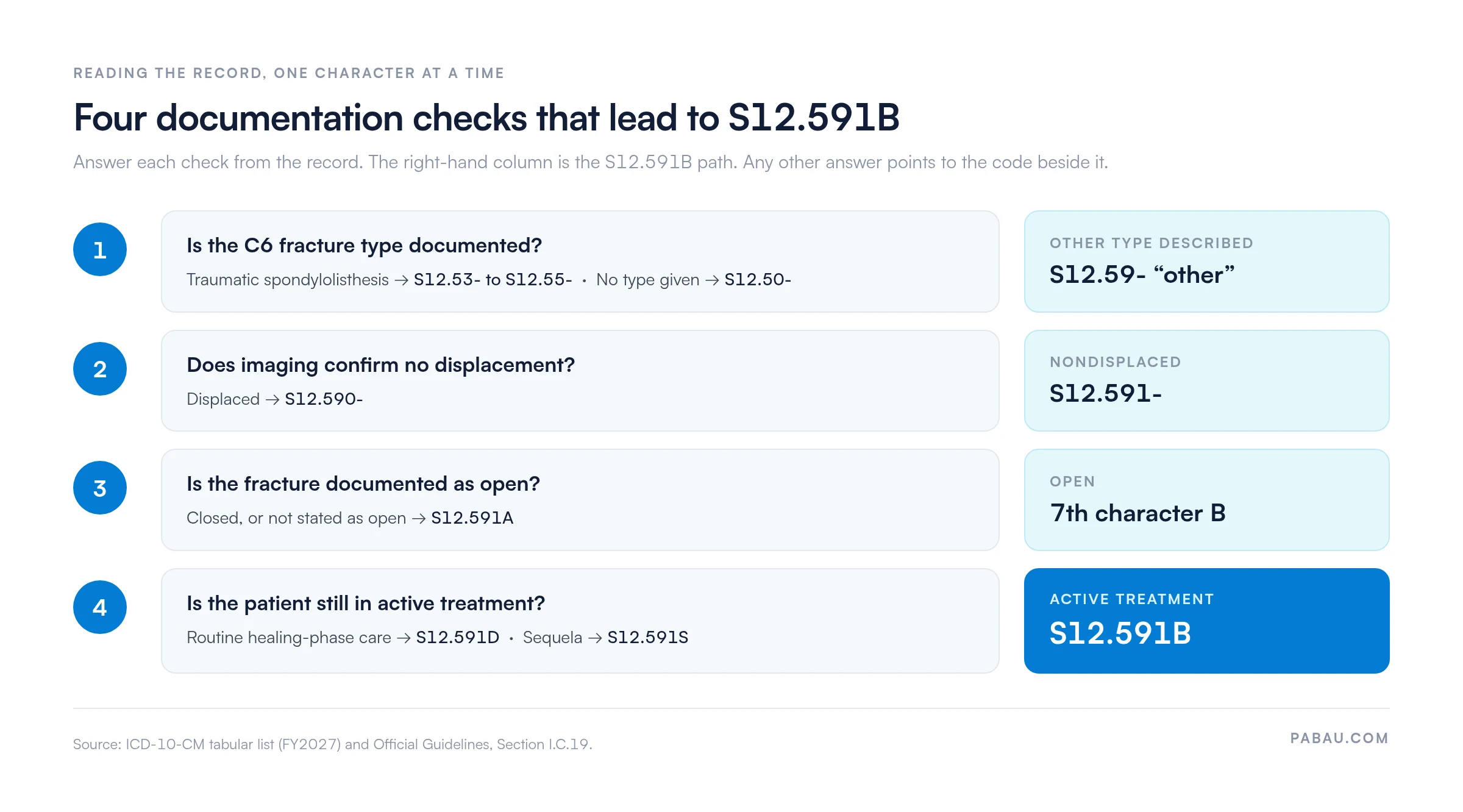
The four checks in the diagram below lead to S12.591B, and each other answer points to the code that fits instead.
The 7th character for S12.591B follows the standard trauma encounter rules in Section I.C.19 of the ICD-10-CM Official Guidelines published by CMS and NCHS.
Reusing suffix B after the active treatment phase ends can lead to denials or audit queries. Switch to suffix D as soon as the documentation shows routine follow-up care rather than active fracture management.
Query the treating physician when the medical record does not specify whether the fracture is open or closed. An unanswered query defaults the suffix to A (closed). Document the query and the response in the coding log so the record reflects how the coding decision was reached.
A complete medical record for S12.591B contains each of the five elements below. Missing any one of them creates a denial or audit risk. Confirm all five before the claim goes out to give yourself the best chance of a clean claim on the first pass.
The procedure codes below are the ones most often billed alongside S12.591B, from fusion at C6 to imaging and emergency evaluation. Anterior fusion below C2 is reported with 22551, and the first CT of the cervical spine with 72125. Each row notes the review trigger to flag before submission.
Bundling edits can apply when several radiology codes are submitted for the same session. Check the Medicare MAC’s LCD or the payer’s medical policy before submitting both 72125 and 72141 for the same encounter.
Payer policies differ by plan and plan year, so the guidance below reflects general industry practice. Verify current requirements with each payer before submitting. Insurance eligibility verification before the encounter surfaces prior-authorization requirements ahead of the procedure.
For practices handling many trauma claims, tying revenue cycle management to real-time eligibility checks gets urgent fracture claims submitted sooner.
Two documentation points commonly cause problems on this code: Suffix selection (A vs B) and open-wound documentation. A structured denial management workflow catches both before submission. When a claim is denied anyway, the remittance advice states the reason using standard denial codes in medical billing.
For a denied claim, record the CARC reason code from the remittance advice before you start an appeal. Denial patterns across a code family, such as all S12.5- codes, are easier to fix at the policy level than claim by claim.
Many practices still code the encounter in one place, re-key it into a billing system and upload the claim through a separate clearinghouse portal. Each hand-off is a chance for suffix B to become A, or for a denial to sit unnoticed in a payer portal.
Pabau, the practice management platform we build, keeps those steps in one system. Its claims management software generates CMS-1500 claims from invoices and submits them through Claim.MD. It also checks eligibility in real time, matches ERAs to claims and flags denied claims for rework.
The result is less re-keying between the chart and the claim. A denied trauma claim also reaches your team for rework instead of waiting to be found.
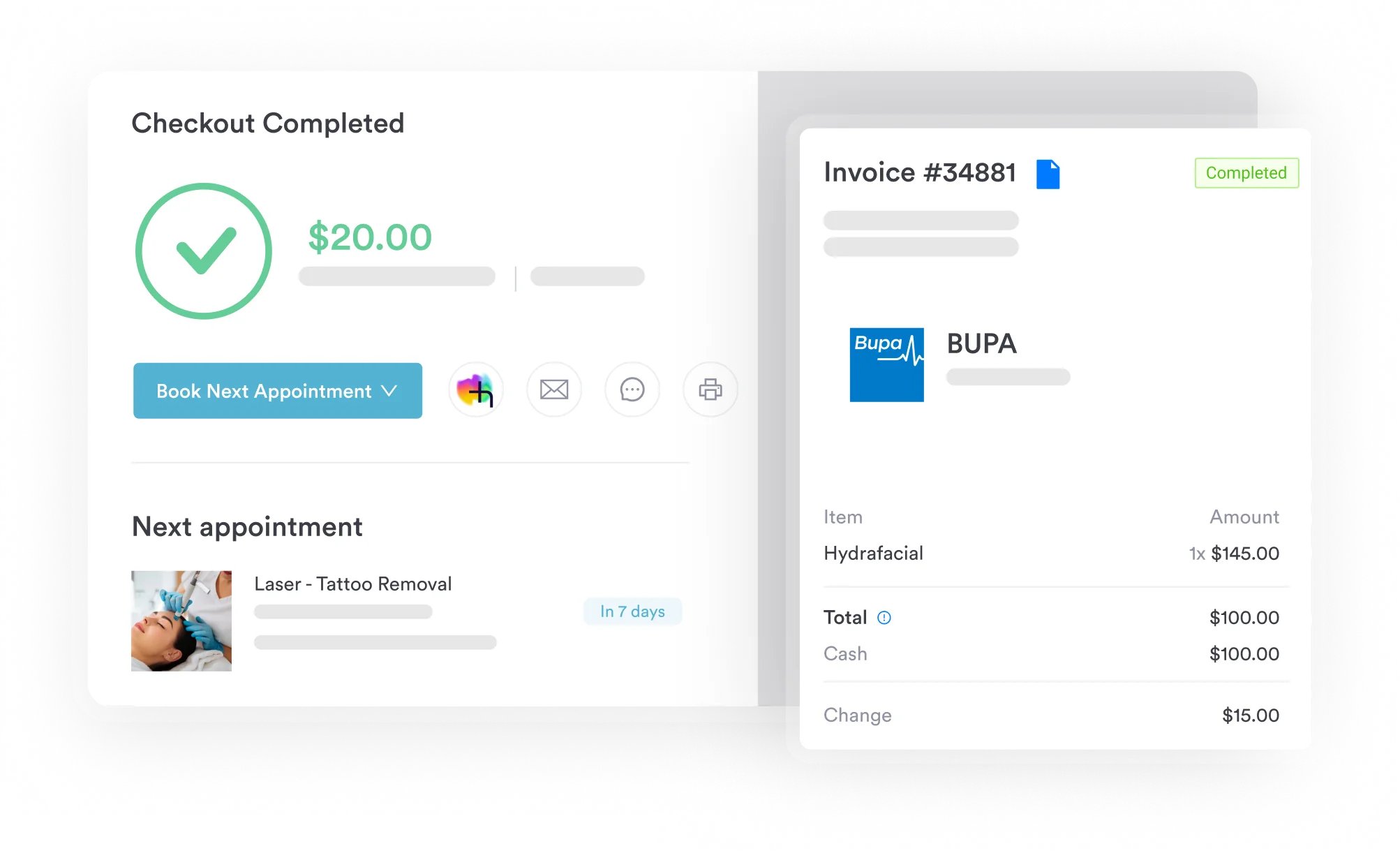

Pabau generates CMS-1500 claims from invoices, submits them through Claim.MD and checks eligibility in real time. Matched ERAs and flagged denials help your team rework a rejected S12.591B claim quickly.

Treat S12.591B as a documentation code first. Before you assign it, confirm three facts in the record: The fracture is open, it is nondisplaced, and the patient is still in active treatment. If one is missing, query the physician or code the closed, displaced or subsequent-encounter alternative instead.
A query delays the claim, but a suffix B claim without open-fracture documentation can be denied or recovered after payment. The extra step up front is the cheaper of the two.
To spend less time re-keying and reworking trauma claims, book a demo and see how Pabau submits CMS-1500 claims through Claim.MD.

Need to read the denial codes on a rejected S12.591B claim? Medical billing denial codes covers the CARC and RARC codes that appear on fracture claim rejections.
Want to streamline trauma claim submission across a multi-provider practice? Claim.MD clearinghouse guide explains how Pabau generates and submits CMS-1500 claims, checks eligibility in real time and matches ERAs.
Coding a named C6 fracture type instead? ICD-10 code S12.54XA covers type III traumatic spondylolisthesis of the sixth cervical vertebra, initial encounter for closed fracture.
Want to see where diagnosis coding fits in the billing cycle? Revenue cycle management guide explains how coding, claim submission and denial resolution connect across patient billing.
ICD-10 code S12.591B is the billable diagnosis code for an other nondisplaced fracture of the sixth cervical vertebra (C6), initial encounter for open fracture. It is valid in the FY2026 and FY2027 ICD-10-CM code sets and belongs to category S12.
S12.591A codes the same fracture when it is closed or not documented as open. S12.591B requires the medical record to document the fracture as open. Use A when the record is silent on wound status, and never assign B without supporting documentation.
Yes, S12.591B is a billable ICD-10-CM code, valid in the FY2026 and FY2027 ICD-10-CM code sets published by CMS and NCHS. It carries all seven characters, so it can be assigned to an encounter without a more specific code.
Use suffix B for each encounter where the patient receives active treatment for a fracture documented as open. Once active treatment is complete and routine healing-phase care begins, switch to suffix D for those visits. Reusing B on routine follow-up visits can lead to denials or audit queries.
Common reasons are missing open-fracture documentation and suffix B reused on follow-up visits that should carry suffix D instead. Others include imaging that describes a displaced fracture while the claim codes nondisplaced, and missing prior authorization for surgical CPT codes.
Displacement is the difference. S12.590B codes an other displaced fracture of C6, initial encounter for open fracture, while S12.591B codes the nondisplaced version. If the documentation gives no fracture type at all, use S12.501B, the unspecified nondisplaced open code, instead of either.