ICD-10 code D50.9: Iron deficiency anemia, unspecified
ICD-10 code D50.9: Definition, descriptor, and billable status ICD-10 code D50.9...

Last Updated: Nov 13, 2026
Billable Code Specific Code
J11.1 is the billable ICD-10-CM code for influenza due to unidentified influenza virus with other respiratory manifestations. It covers flu that the provider diagnoses without naming a virus type or strain, when the respiratory picture stops short of pneumonia.
The code sits under category J11 in the J09-J18 influenza and pneumonia block. Influenza NOS, influenzal laryngitis and influenzal pharyngitis all code here. Once pneumonia is documented, the code moves to J11.00 or J11.08.
Let Pabau's smart automation suggest the right codes, reduce claim denials, and keep your practice compliant—effortlessly.
Automate repetitive tasks and focus on what matters most—your patients.
Reduce coding errors and ensure compliance with the latest regulations.
Clean claims, fewer denials, and faster reimbursements.
Powerful insights and reporting to help your practice thrive.
HIPAA compliant SOC 2 certified GDPR-compliant Trusted by 4,000+ clinics worldwide

R07.89 is the billable code for chest pain the provider has described when no more specific R07 code fits the description.
R07.9 applies only when the note gives no characterization of the pain at all. It is not a default for any unexplained chest pain.
Once the provider documents a definitive cause, that diagnosis code replaces R07.89, per the ICD-10-CM Official Guidelines.
Pabau’s claims management software sends R07.89 claims through the Claim.MD clearinghouse, with eligibility checks before the visit.
ICD-10 Code R07.89 is the billable ICD-10-CM code for other chest pain the provider has described when no more specific R07 code fits.
The FY2027 ICD-10-CM tabular list places it under R07.8 Other chest pain, with anterior chest-wall pain NOS as its inclusion term. The table below collects the reference fields a coder checks before submitting a claim.
Coders can verify the current-year status of R07.89 directly in the CDC/NCHS ICD-10-CM web tool, which publishes the official tabular list for each fiscal year.
R07.89 is the residual code within R07 for chest pain the provider has described but that does not map to a more specific code. The clinician has characterized the pain in the note, and that description does not point to R07.1, R07.2, R07.81 or R07.82.
Clinical presentations typically coded under R07.89 include:
The Centers for Medicare and Medicaid Services and NCHS publish the ICD-10-CM Official Guidelines each year. They allow symptom codes like R07.89 only before a related diagnosis is confirmed. Once the provider documents that diagnosis, its code replaces R07.89.
R07.89 is a residual code, so it applies only when no more specific code fits. These are the descriptions most often miscoded as R07.89.
R07.89 and R07.9 are the two most frequently confused codes in the R07 family. The choice turns on whether the physician’s note describes the pain in any way beyond “chest pain”.
Use R07.89 when: The note contains any characterization that does not map to a more specific sub-code. Examples: “atypical chest pain,” “non-cardiac chest pain,” “chest tightness,” “left anterior chest discomfort,” “chest pain, possibly musculoskeletal, workup pending.”
Use R07.9 when: The note says nothing beyond “chest pain” or “c/o chest pain”, with no other descriptor. It is reserved for visits where the documentation carries no characterization of the pain, so undiagnosed but described pain stays on R07.89.
When auditing past claims, review the HPI and assessment sections of the note to catch R07.89 vs R07.9 mismatches. If the HPI describes the pain’s character, location or associated symptoms but the claim carries R07.9, the code is likely wrong.
Category R07 holds seven billable codes. R07.0 covers pain in the throat, and the six chest pain codes below split by description. Knowing when each applies prevents defaulting to R07.9, and it stops R07.89 from absorbing pain that R07.1, R07.2, R07.81 or R07.82 describes.
Three questions, asked in order, place any chest pain note on one of these codes. The path below shows where each answer leads.
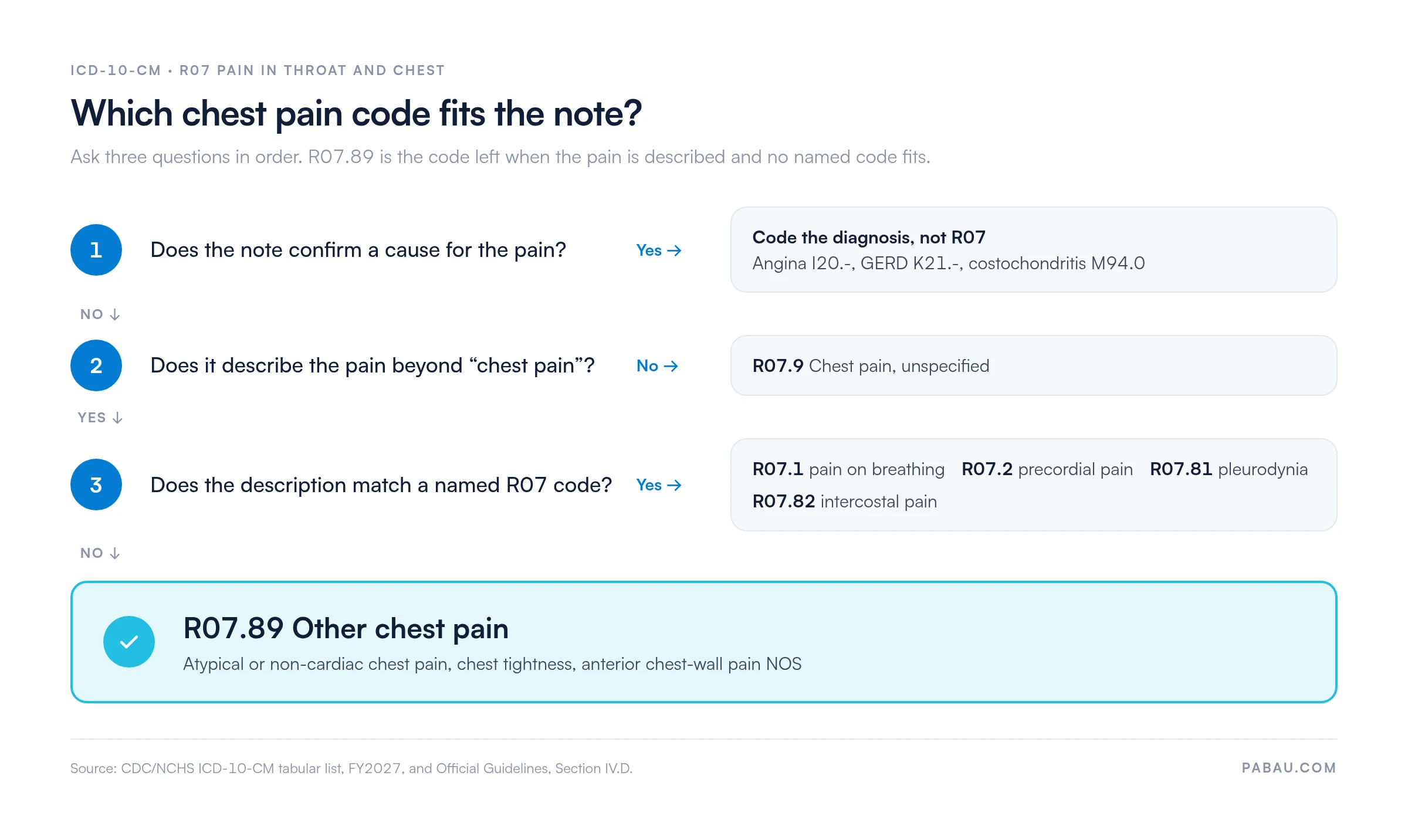
When auditing a batch of chest pain claims, sort them by the descriptor in the assessment line. Notes that say pleurodynia or intercostal pain but carry R07.89 should move to R07.81 or R07.82 before submission.
Supporting documentation is the most common point of failure on R07.89 claims. Payers do not require a confirmed diagnosis, but they do require evidence that the provider actively characterized and worked up the chest pain.
The physician’s note should include all of the following to support R07.89 and satisfy clean claim submission standards:
Outpatient coding treats “probable” and “suspected” diagnoses differently from inpatient coding. In an outpatient setting, a coder may not code a diagnosis documented as probable or suspected, so R07.89 stays until the confirmed diagnosis is documented.
R07.89 can be the first-listed outpatient diagnosis when chest pain is the documented reason for the visit and no cause has been confirmed. ICD-10-CM Official Guidelines Section IV, which governs outpatient coding and reporting, accepts symptom codes when the provider has not established a diagnosis.
Inpatient sequencing is stricter. If the workup for an admitted patient confirms a cause before discharge, that diagnosis becomes principal. R07.89 is then dropped, or moved to a secondary position when the chest pain is a distinct clinical problem. Read these scenarios against the payer’s inpatient rules and the medical billing basics they build on.
As a secondary code, R07.89 can appear when chest pain is an additional complaint managed during an encounter coded first for another condition. In that case, it is sequenced after the first-listed diagnosis.
When the note also documents shortness of breath with no confirmed cause, R06.02 can be reported alongside R07.89 as a second symptom code. Plain “dyspnea” with no type goes to R06.00 under the same rule.
Medicare accepts R07.89 as a valid diagnosis code on outpatient E&M claims, in most cases without prior authorization. No blanket local coverage determination (LCD) restricts the code. Payer policies do vary when R07.89 supports diagnostic procedures such as ECGs, stress tests and chest imaging.
Key payer-facing considerations for R07.89 include:
Denials on R07.89 claims tend to cluster into three patterns. Recognizing them lets a practice fix the cause before resubmitting, instead of sending the same documentation back. The remittance for each denial carries a reason code, and our guide to denial codes for billers explains each one.
Tracking denials by reason shows whether R07.89 rejections start in the note, in sequencing, or in the procedure pairing. A structured denial management process tags and trends each rejection, so a recurring pattern surfaces after a handful of claims.
The table below maps the CPT codes most frequently submitted alongside R07.89, with notes on the medical necessity documentation each pairing typically requires.
For Medicare, the accepted CPT-to-ICD-10 pairings sit in each contractor’s LCD and its billing article, which list the diagnosis codes that support each procedure. Commercial payers publish their own medical policies, so check both before a high-cost test goes out on R07.89.
Yes. R07.89 is valid for FY2027, which runs from October 1, 2026 through September 30, 2027. The code and its descriptor were unchanged in both the FY2026 and FY2027 ICD-10-CM updates published in the CDC/NCHS update files.
New code sets take effect each October 1. Check the official tabular list at the start of each fiscal year, because third-party databases can lag the release.
Most R07.89 denials trace back to the note or the pairing, yet many practices only find them when a remittance arrives weeks later. By then the visit is old, and the billing team has to chase the provider for an addendum.
Pabau, the practice management platform we build, keeps the chart and the claim in one system. Its claims software for practices sends CMS-1500 claims through the Claim.MD clearinghouse and checks eligibility before the visit. ERA remittances post back to the same patient record.
A denied chest pain claim then shows up beside the note that produced it. The biller can see whether the HPI described the pain and whether the test was linked to the assessment, then correct and resubmit the claim.
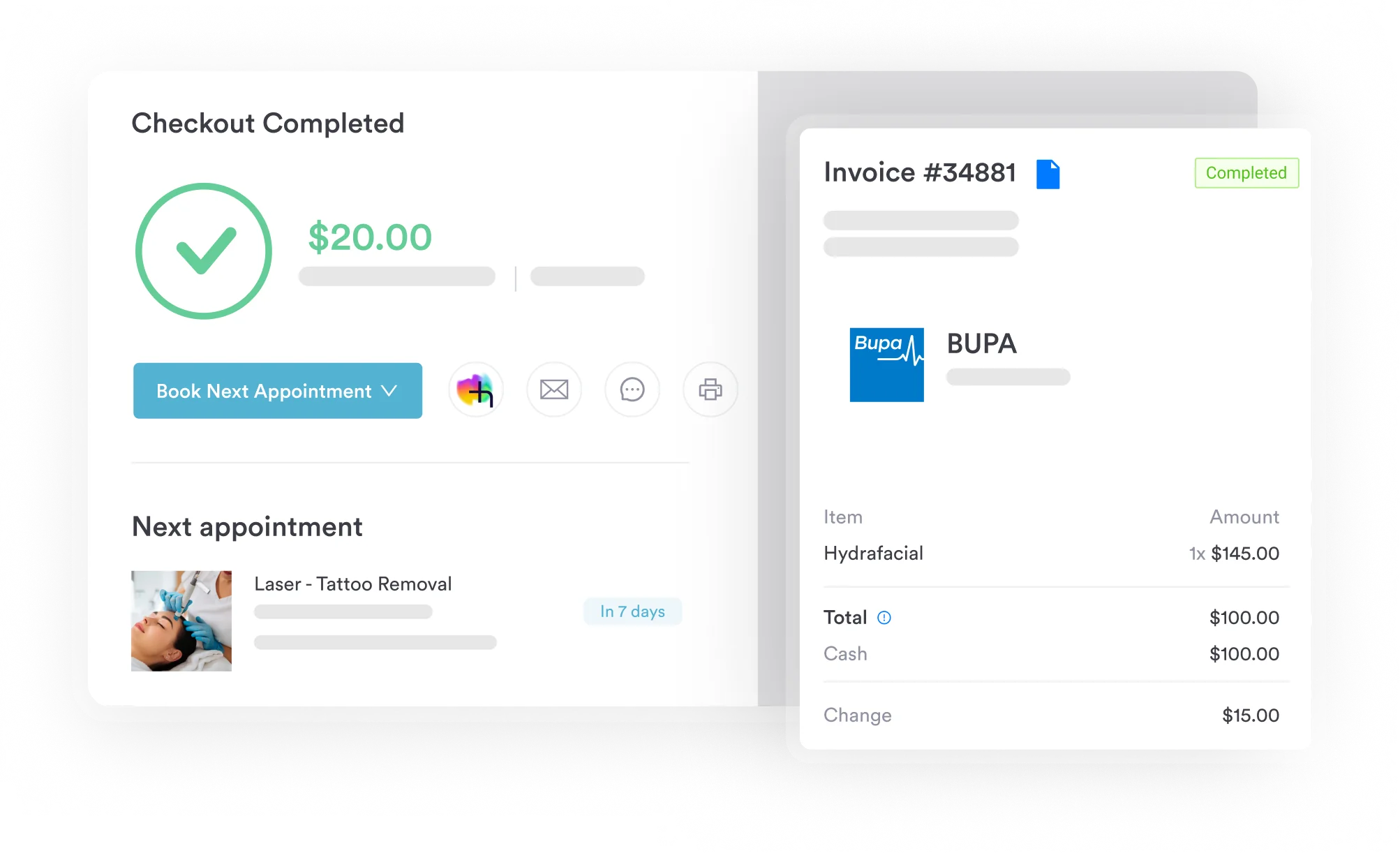

Pabau sends claims through the Claim.MD clearinghouse, checks eligibility before the visit, and posts ERA remittances to the patient record. See how it handles high-volume chest pain billing.

R07.89 is earned by the note, not chosen by the coder. Before assigning it, confirm two things in the documentation: the provider described the pain, and no named code or confirmed cause fits that description. If either check fails, the claim belongs on another code.
The cost of skipping that check lands later, on the tests billed with the visit. An ECG or stress test tied to a vague assessment is where R07.89 claims get denied. Book a demo to see how Pabau puts each denial next to the note that caused it.

Need a broader overview of ICD-10 coding for revenue cycle? Revenue cycle management guide covers how ICD-10 diagnosis coding connects to claim submission and payer reimbursement.
Billing a troponin draw with a chest pain visit? CPT code 84484 covers the quantitative troponin test and the documentation that supports it.
Ordering a stress test for atypical chest pain? CPT code 93015 explains the cardiovascular stress test code and its coverage rules.
ICD-10 Code R07.89 is the billable ICD-10-CM diagnosis code for “Other chest pain”. It covers described chest pain that no more specific R07 code fits, such as atypical, non-cardiac or anterior chest-wall pain. It is valid for FY2027 and accepted by Medicare and commercial payers.
No. R07.89 applies when the provider has described the chest pain but the description does not fit a specific code. R07.9 (Chest pain, unspecified) applies only when the documentation gives no characterization beyond “chest pain”. Using R07.9 when the note carries a descriptor is a coding error.
Yes. R07.89 is a valid, billable ICD-10-CM code, confirmed in the CMS and CDC tabular lists for FY2027. It can be submitted as a primary or secondary diagnosis on outpatient claims. Re-verify it each October 1, when the annual ICD-10-CM update files take effect.
The note should include at least one pain descriptor beyond “chest pain”. It should also record the cardiac workup status, such as an ECG ordered or troponin pending. The assessment should describe atypical or non-specific chest pain with no confirmed cause. A note containing only “c/o chest pain” supports R07.9, not R07.89.
Yes, in an outpatient encounter when chest pain is the reason for the visit and no cause has been confirmed. Section IV of the ICD-10-CM Official Guidelines accepts symptom codes for outpatient reporting when no diagnosis has been established. For an inpatient admission, a diagnosis confirmed before discharge becomes principal.
Three patterns cause most denials. The first is pairing R07.89 with a high-cost test, such as a stress test, without documented medical necessity. The second is coding R07.89 when the note confirms a diagnosis like costochondritis or GERD. The third is sequencing it as principal on an inpatient claim after a cardiac cause was confirmed.